A car crash can change your life in seconds — but you don’t have to face recovery alone. An auto accident settlement is a formal agreement to resolve your injury claim without going to court. You and the at-fault driver's insurance company agree on a final amount of financial compensation. In exchange for that payment, you agree not to pursue the case any further. This compensation is designed to cover everything you've been through—medical bills, lost paychecks, vehicle repairs, and the personal suffering that doesn't come with a price tag.
Securing a fair settlement isn’t just about money; it’s a crucial step toward rebuilding your life and protecting your family's future. It's your legal right.
Understanding Your Auto Accident Settlement
A car crash can flip your world upside down in a heartbeat. One moment you're driving to work in Houston, and the next, you're dealing with confusion, pain, and a mountain of worry about what comes next. How will you pay these medical bills? What about the time you're missing from your job? Who is going to deal with the insurance adjusters calling you?
An auto accident settlement is designed to lift those burdens. It provides the financial resources you need to heal and move forward without the constant stress.

The whole process can feel overwhelming, but at its core, it's about making you whole again. It’s a negotiation to figure out the true, fair value of everything you've lost because of someone else's carelessness. At The Law Office of Bryan Fagan, PLLC, our job is to provide clear, compassionate guidance every step of the way, empowering you with the information you need.
What Does a Settlement Actually Cover?
It's a common myth that a settlement only covers your immediate medical bills. In reality, a proper auto insurance claim must account for all the ways this accident has impacted your life, both now and in the future.
The table below breaks down the key parts of a settlement. Knowing what you're entitled to is the first step in making sure you get a fair offer.
What a Texas Auto Accident Settlement Covers
A quick summary of the key components of a typical auto accident settlement in Texas, helping you understand what compensation you can pursue.
| Type of Damage | What It Covers (Plain-English Definition) | Common Examples |
|---|---|---|
| Economic Damages | Tangible, out-of-pocket financial losses with clear dollar values. These are the costs you can prove with receipts and bills. | Medical bills (ER, surgery, therapy), lost wages, future lost earning potential, vehicle repair/replacement. |
| Non-Economic Damages | Intangible losses that don't have a fixed price but significantly impact your quality of life. This is compensation for the human cost of the accident. | Physical pain and suffering, emotional distress (anxiety, PTSD), disfigurement, loss of enjoyment of life. |
| Property Damage | The cost to fix or replace your vehicle and any personal items damaged in the wreck. | Car repairs, diminished value of your vehicle, cost of a rental car, a broken laptop or phone. |
As you can see, a comprehensive settlement goes far beyond the initial hospital visit. It's built to address the complete picture of your recovery.
A fair auto accident settlement isn’t just a number; it is a vital tool for your recovery. It provides the stability you need to focus on what matters most—healing and getting your life back on track.
Understanding your rights is the first step toward getting the compensation you deserve. To an insurance company, you might just be a claim number. To us, you're a person who has been wronged, and a dedicated Houston car accident lawyer will fight to make sure the insurance company sees that, too. If you're going through this difficult time, please remember that compassionate, experienced legal help is just a phone call away.
Calculating the True Value of Your Car Accident Claim
How do you even begin to put a number on everything you’ve lost after a car crash? The pain, the stress, the stacks of bills—it can all feel completely overwhelming. In the legal world, we call this process calculating damages, which are the losses you suffered. It’s one of the most important steps toward getting a fair auto accident settlement.
An insurance adjuster will try to reduce your experience to a few medical bills and a car repair estimate. But a comprehensive claim reflects the total impact the accident has had on your life.

Economic Damages: The Foundation of Your Claim
The first layer of your claim is built on what we call economic damages. These are the straightforward, black-and-white financial losses you can prove with receipts, invoices, and pay stubs. They are the concrete costs of the accident.
Your economic damages will almost always include:
- Medical Expenses: This covers everything—the ambulance ride, the ER visit, surgeries, physical therapy, medications, and any future medical care your doctors expect you to need.
- Lost Wages: If your injuries forced you to miss work, this is the income you lost while you were recovering.
- Future Lost Earning Capacity: This applies to devastating injuries that permanently change your ability to work or advance in your career. We calculate the income you’ll lose over the rest of your working life.
- Property Damage: This is the cost to get your vehicle repaired or, if it was totaled, replaced. It also includes personal items destroyed in the wreck, like a phone, laptop, or car seat.
When tallying up the real value of a claim, medical costs are a huge piece of the puzzle. The necessary treatments can be incredibly varied, sometimes including advanced therapies like exploring the health benefits of Hyperbaric Oxygen Therapy.
Non-Economic Damages: The Human Cost
While economic damages lay the foundation, non-economic damages account for the very real human suffering that doesn’t come with a price tag. These losses are just as legitimate—and often make up the largest part of a settlement.
These damages recognize that an accident's true cost goes far beyond the bills. It’s the pain that keeps you awake at night, the anxiety that hits every time you get behind the wheel, and the hobbies and activities you can no longer enjoy.
Common examples of non-economic damages include:
- Pain and Suffering: Compensation for the physical pain and daily discomfort your injuries have caused.
- Emotional Distress: This can include anxiety, depression, fear, and even post-traumatic stress disorder (PTSD) that stems directly from the trauma of the accident.
- Disfigurement or Impairment: This provides compensation for permanent scarring, the loss of a limb, or other physical limitations that will last a lifetime.
- Loss of Enjoyment of Life: This addresses how the accident has impacted your ability to engage in hobbies, relationships, and the simple joys you once took for granted.
For a real-world example, imagine a Houston driver rear-ended on I-45. Her economic damages might be $40,000 in medical bills and $10,000 in lost pay. But she also lives with chronic back pain and PTSD, which stops her from playing with her kids or even driving to the store without a panic attack. Those non-economic damages are a critical part of her claim's true value. To learn more, read our guide on how to calculate pain and suffering damages.
A Note on Punitive Damages
In very rare and extreme cases, Texas law allows for a third category: punitive damages. These aren't meant to compensate you for a loss. Instead, their purpose is to punish the at-fault party for truly awful behavior—think gross negligence, like driving drunk and causing a crash. As laid out in the Texas Civil Practice & Remedies Code, Chapter 41, these damages are reserved for only the most outrageous cases to send a strong message and deter others from similar conduct.
Who Is Liable in a Texas Car Accident? Key Laws That Impact Your Settlement
Figuring out your case's value is just the start. In Texas, a few specific laws can drastically change the amount of money you actually receive. Insurance companies know these rules inside and out and use them to pay you less. An experienced Texas injury attorney understands these statutes and uses them to ensure you are treated fairly.
Texas Comparative Fault Law
One of the most critical rules in Texas is comparative fault, also known as proportionate responsibility. Found in the Texas Civil Practice & Remedies Code, Chapter 33, this law is about assigning a percentage of blame to everyone involved in the crash. Liability simply means legal responsibility for the accident.
Here’s how it works: if a jury decides you were partially at fault, your final settlement is reduced by your percentage of fault. So, if they find you were 20% to blame, your settlement is cut by 20%.
But here’s the most important part: Texas has a 51% bar rule. If you are found to be 51% or more responsible for causing the accident, you are legally barred from recovering any compensation at all.
For example, say you're driving a few miles over the speed limit on the Westpark Tollway here in Houston. Another driver runs a red light and T-bones your car. While the other driver is clearly the main cause, the insurance company will argue your speed made the crash worse. If they convince a jury you were 51% at fault for speeding, your claim goes to zero. This is why having an attorney to fight these arguments is so crucial.
The Two-Year Statute of Limitations
In Texas, the clock starts ticking the moment an accident happens. You have a limited time to take legal action, a deadline known as the statute of limitations. For almost all personal injury claims, you have just two years from the date of the crash to either settle your case or file a lawsuit.
If you miss that two-year deadline, your right to pursue compensation is gone forever. The courthouse doors will be closed to you, and the insurance company will have no reason to offer you anything. Two years may sound like a long time, but building a strong case takes time, and waiting too long can jeopardize your entire claim.
Uninsured and Underinsured Motorist Coverage
What happens when the driver who hit you has no insurance, or only a minimum policy that won't cover your hospital bills? This is where your own insurance policy can help, thanks to Uninsured/Underinsured Motorist (UM/UIM) coverage. This optional coverage steps in to act as the insurance the at-fault driver should have had, protecting you and your family. A Houston car accident lawyer can help you navigate this complex process, even when it means dealing with your own insurance company.
Steps to File an Insurance Claim and Navigate the Settlement Process
The legal journey after a car accident can feel like being dropped in an unfamiliar city without a map. To give you a clear path forward, here is a practical, step-by-step guide to the auto accident settlement process. The entire process is designed to build a strong, undeniable case for the compensation you need to get your life back on track.
Step 1: The Investigation and Evidence Gathering
The first thing your legal team does is a deep dive into the facts, moving quickly to preserve critical evidence before it disappears. This is the foundation of your entire claim.
During this phase, we get to work:
- Collecting official documents: This starts with the Texas Peace Officer's Crash Report (CR-3), which gives the officer’s initial assessment of what happened.
- Gathering visual evidence: We track down photos and videos from the accident scene, nearby traffic cameras, and dashcams.
- Interviewing eyewitnesses: A good witness statement can confirm who was at fault and completely change the direction of a case.
- Consulting with experts: In complex cases, we may bring in accident reconstruction specialists to provide a scientific breakdown of how the crash occurred.
It's vital that you hold on to every piece of paper related to the accident—medical bills, receipts, and emails from the insurance company.
A critical piece of advice: Never give a recorded statement to the other driver's insurance adjuster without your lawyer present. Their questions are designed to get you to say something that could hurt your claim.
Step 2: The Demand Letter and Negotiations
Once we have a full understanding of your injuries and the total financial toll of the accident, your attorney will draft a comprehensive demand letter and send it to the insurance company. This is not a simple note; it's a detailed legal document that proves the other driver’s liability and calculates the full value of your losses. It’s the official start of settlement negotiations.
The infographic below shows how key Texas laws frame this entire process, from establishing fault to meeting critical deadlines.
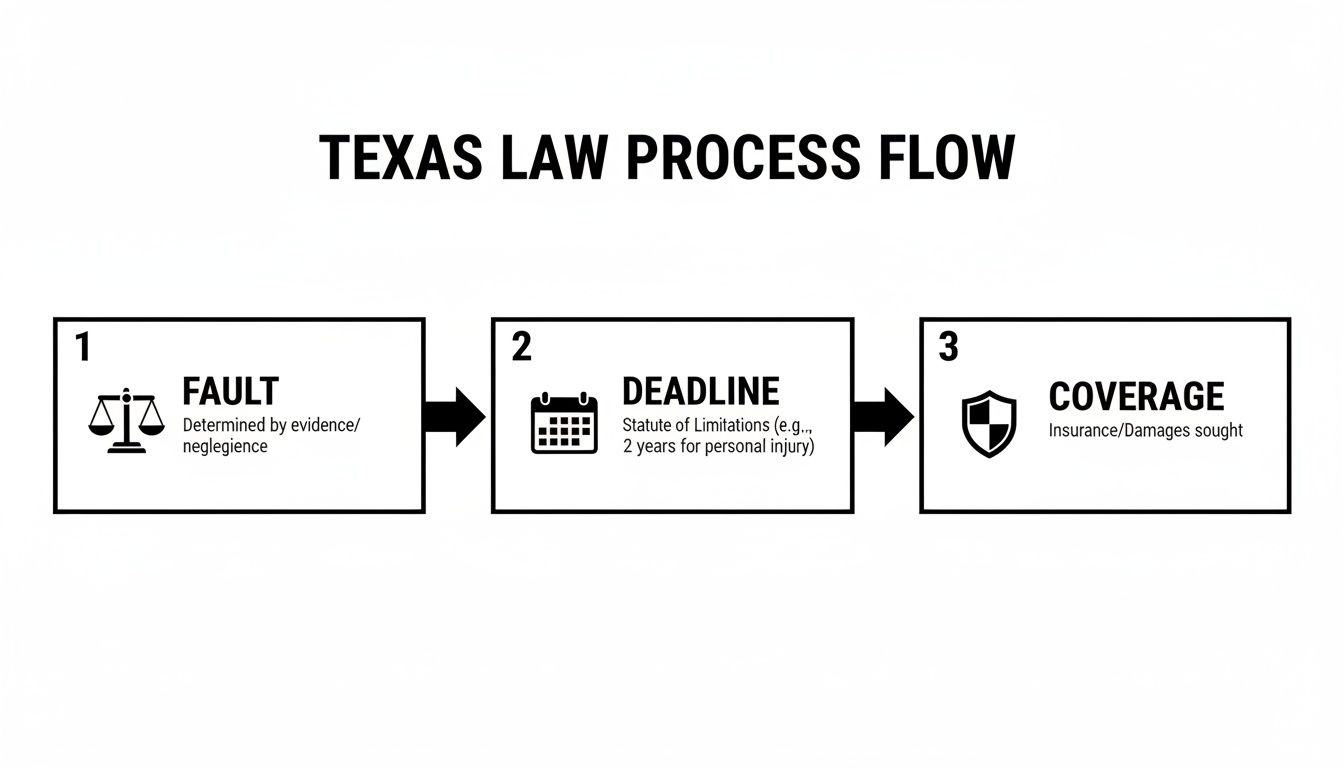
This visual guide helps you see how Texas's rules on fault, deadlines, and insurance coverage directly influence our negotiation strategy. After the insurance company receives our demand, the adjuster will almost always respond with a lowball offer. This is normal and kicks off a strategic back-and-forth where your lawyer argues your case and fights every attempt to downplay what you've been through.
Step 3: Mediation and Final Agreement
If negotiations stall, the next step is often mediation. This is a formal meeting where everyone sits down with a neutral third-party mediator. The mediator’s job is to help both sides find common ground and reach a settlement, avoiding the time and stress of a trial. If mediation is successful, we draft a final settlement agreement. Once you sign it, your case is officially closed, you receive your compensation, and you can finally focus on your recovery. For a deeper look, check out our article on the car accident settlement timeline.
Why the First Settlement Offer Is Rarely the Best
A few days after the crash, you might get a call from the other driver's insurance adjuster. They'll sound friendly and may even offer you a settlement right away. While it can feel like a relief, you need to understand what this offer truly is.
That first offer is almost always a lowball. It's a business move designed to make your claim go away as quickly and cheaply as possible. Insurance adjusters are professional negotiators, and their primary job is to protect their company's profits, not to make you whole. Accepting that first offer means you’re likely leaving thousands of dollars on the table that you will desperately need for your recovery.
The Problem with a Quick Settlement
Why is an early offer so dangerous? Because right after a wreck, nobody—not even your doctors—knows the full extent of your injuries and what they'll ultimately cost.
A fast settlement almost never accounts for:
- Future Medical Needs: Some injuries, like whiplash or concussions, have delayed symptoms. A quick check won’t cover the physical therapy or specialist visits you might need months from now.
- Total Lost Wages: How can anyone know your total lost income when you don't even have a clear timeline for returning to work?
- Long-Term Pain and Suffering: The real emotional and physical toll of an accident unfolds over time.
Once you accept a check, you sign away your rights to ever seek more money for this accident. Period. If your "sore back" turns out to be a herniated disc needing surgery in six months, that cost will come out of your own pocket.
"Insurance companies profit by collecting premiums and minimizing payouts. A quick, low offer is their most effective tool for achieving this. They are counting on you being overwhelmed and wanting to put the accident behind you."
How a Lawyer Provides Critical Leverage
This is where having a dedicated Houston car accident lawyer becomes your single greatest advantage. The moment an attorney from The Law Office of Bryan Fagan, PLLC, gets involved, the entire dynamic shifts. We take over all communication, shielding you from the adjuster's pressure tactics.
The insurance company knows they can't push you into a bad deal anymore. They know we will launch our own investigation, bring in experts to calculate the true lifetime value of your claim, and build a case that can win in court. That willingness to go to court is the ultimate leverage. It forces the insurance company to negotiate in good faith and is often what it takes to secure a fair auto accident settlement. Your job is to focus on healing; let us handle the fight for the compensation you deserve.
How a Texas Injury Attorney Maximizes Your Settlement
Trying to handle an auto accident settlement by yourself means you’re up against a massive insurance corporation with a nearly endless supply of money and lawyers. It's an unfair fight from the start. Hiring an experienced Texas injury attorney doesn't just help—it completely levels the playing field, making sure your rights are protected from day one.
At The Law Office of Bryan Fagan, PLLC, we step in and take over everything so you can focus all your energy on what truly matters: your physical and emotional recovery. We handle the stressful calls, the mountains of paperwork, and the tough negotiations. Think of us as your shield and your advocate.
Your Advocate and Investigator
The moment you hire us, we launch our own independent investigation into the crash. While the insurance company is looking for reasons to pay you less, we’re digging for evidence to make your claim stronger.
Our process includes:
- Gathering Critical Evidence: We immediately work to secure police reports, track down and interview witnesses, and find any available traffic camera or dashcam footage before it disappears.
- Calculating Your True Damages: We sit down with you and consult your doctors to get a full picture of your losses. This goes beyond current medical bills to include future treatments, long-term physical therapy, and the income you’ve lost and may continue to lose.
- Bringing in the Experts: When needed, we bring in accident reconstruction specialists, medical experts, and economists who can build an undeniable case for the full compensation you deserve, which may include wrongful death compensation for families who have lost a loved one.
Fighting for You with No Upfront Costs
We firmly believe that every accident victim deserves powerful legal representation, no matter their financial situation. It’s important to understand how law firms are paid, and many explore whether attorneys accept payment plans.
At The Law Office of Bryan Fagan, PLLC, we take that commitment a step further. We work on a contingency fee basis. This is our promise to you: you pay absolutely no attorney’s fees unless we win your case.
This isn't just a payment model; it's a partnership. It removes all financial risk from your shoulders and puts our goals directly in line with yours. We only succeed when you do. You can find out more in our guide on what a car accident lawyer does.
When you're dealing with the aftermath of a serious wreck, you need more than just a lawyer. You need a compassionate ally with the legal muscle to make things right. That's exactly what our team is here to provide.
Answering Your Questions About Texas Auto Settlements
When you're recovering from a serious car wreck, it’s completely normal for your mind to be racing with questions. We've put together answers to the most common questions we hear, hoping to bring you clarity and confidence.
Will I Have to Go to Court for My Settlement?
The short answer is: probably not. The vast majority of personal injury cases—often more than 95%—are settled through negotiation long before a trial is necessary. However, the surest way to get a fair settlement offer is to show the insurance company you’re ready and willing to go to trial if they refuse to be reasonable. At The Law Office of Bryan Fagan, PLLC, we prepare every case as if it's headed to court. That preparation gives us the leverage we need to negotiate from a position of strength and secure the best possible auto accident settlement for you.
How Is Pain and Suffering Calculated in Texas?
There isn't a simple, one-size-fits-all formula for calculating pain and suffering. However, one common approach is the "multiplier method."
- First, we add up all your economic damages—medical bills, lost wages, and other out-of-pocket costs.
- Then, we multiply that total by a number, usually between 1.5 and 5.
The multiplier depends on the severity of your injuries, their long-term impact on your life, and the degree of pain you’ve had to endure. A skilled Texas injury attorney is critical here; our job is to build a powerful story that justifies a higher multiplier, ensuring this part of your settlement truly reflects what you've been through.
What Should I Bring to a Free Consultation?
To get the most out of our free consultation, it helps to bring any documents you have related to the accident.
But don’t stress if you don't have everything. The most important thing is for you to come in and tell us your story. We're here to help you sort out the rest.
If you can, try to bring the following:
- The police report from the accident
- Any photos or videos of the crash scene, your car, or your injuries
- Names and contact information for any witnesses
- Medical bills, hospital discharge papers, or notes from your doctor
- Any letters or emails you've received from insurance companies
Your story is where we start. We’ll guide you from there.
You don't have to navigate the complex world of an auto accident settlement on your own. A car crash can change your life in seconds—but you don’t have to face recovery alone. The compassionate legal team at The Law Office of Bryan Fagan, PLLC is here to answer your questions, protect your rights, and fight for the full compensation you and your family deserve. Contact us today for a free, no-obligation consultation to learn how we can help.