A car crash can change your life in seconds — but you don’t have to face recovery alone. Most personal injury cases in Texas settle without ever seeing a courtroom, typically wrapping up within 9 to 24 months.
While every situation is different, understanding the general timeline can give you a much-needed sense of control during a very uncertain time.
Your Texas Personal Injury Case Timeline at a Glance
After a serious accident in Houston, the unknowns can be overwhelming. As medical bills start piling up and you’re focused on healing, the biggest question on your mind is probably, “How long is this going to take?” You deserve clarity, and knowing what to expect is the first step.
The journey from the moment of the crash to getting your final settlement check involves several critical stages. Each step is about carefully building the strongest case possible to account for every medical bill, lost paycheck, and the pain you've been forced to endure.
While some straightforward cases might resolve fairly quickly, many require a deliberate, methodical approach to secure the full compensation you are owed.
Visualizing the Path to Resolution
To help you see the road ahead, this timeline highlights the key milestones in a typical personal injury case.
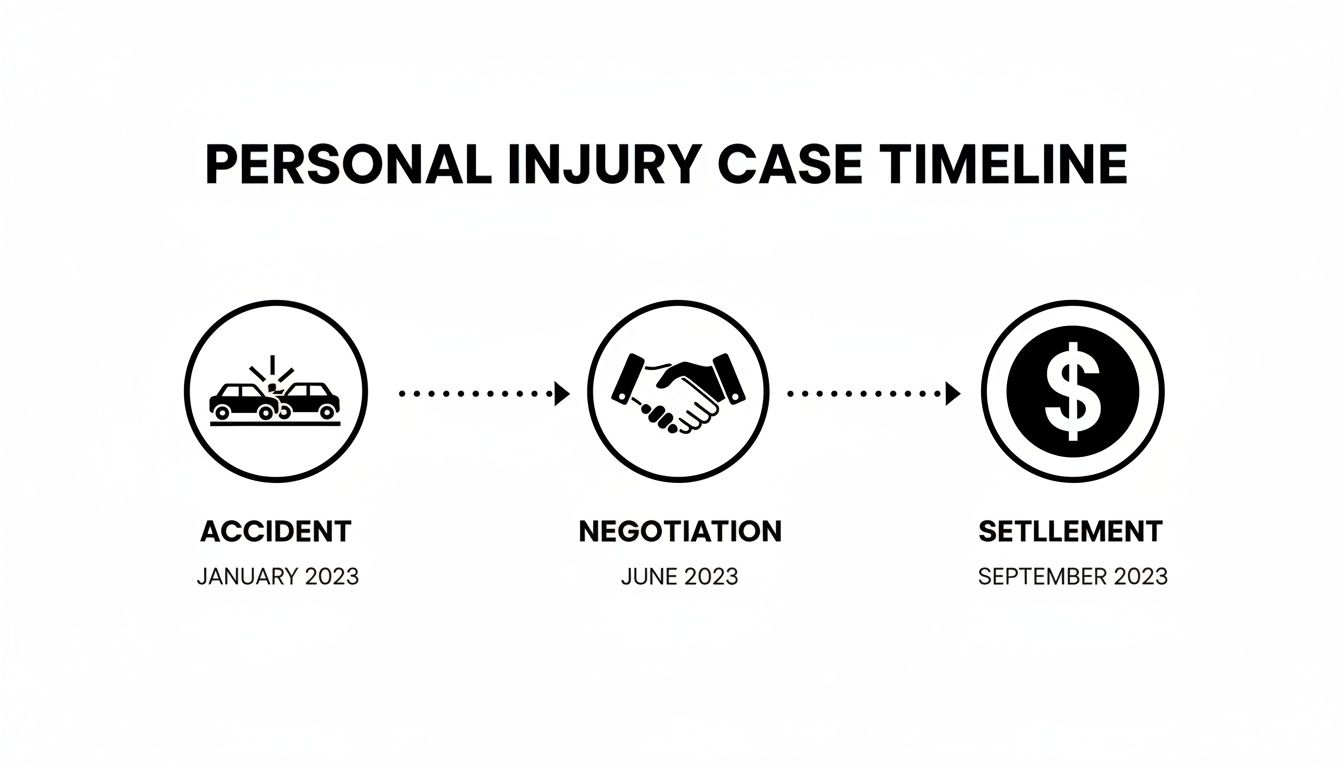
This visual shows how a case moves from the day of the accident, through the negotiation phase, and ultimately to a final settlement.
Understanding Each Stage
This timeline isn’t just about waiting; it’s about taking strategic action at every turn. The table below breaks down each major phase, how long it usually lasts, and what we’re working to accomplish. This will give you a better sense of why each step is so vital.
Typical Timeline for a Texas Personal Injury Case
This table outlines the major stages of a personal injury claim and provides an estimated duration for each, helping you understand the overall journey from accident to resolution.
| Case Stage | Typical Duration | Key Activities and Goals |
|---|---|---|
| Medical Treatment | Weeks to Months | Your top priority is healing. We must wait until you reach Maximum Medical Improvement (MMI) to fully grasp the long-term costs of your injuries. |
| Investigation | 2 to 6 Weeks | We gather police reports, medical records, witness statements, and evidence from the crash scene to establish liability (who was at fault). |
| Demand & Negotiation | 1 to 3 Months | Your attorney drafts and sends a detailed demand letter to the insurance company. This kicks off the back-and-forth process of negotiating a fair settlement for your damages. |
| Filing a Lawsuit | Optional; if needed | If the insurance company refuses to make a fair offer, we file a lawsuit. This officially moves your case into the litigation process. |
| Discovery | 6 to 12 Months | This is often the longest phase. Both sides formally exchange all evidence through depositions and written requests. It's a crucial step for strengthening your claim. |
| Mediation & Resolution | 1 to 2 Months | Many cases settle here. A neutral mediator helps both sides find common ground. If an agreement can't be reached, the case proceeds toward trial. |
| Settlement Payout | 2 to 6 Weeks | After a settlement agreement is signed, the insurer sends the check. We then pay any outstanding medical liens and you receive your funds. |
This structured process is designed from the ground up to protect your rights and maximize your recovery. For an even closer look at how insurance claims work, you can learn more about how long it generally takes to settle a car accident claim in our detailed guide.
The Four Main Phases of Your Injury Claim
Navigating a personal injury claim after a car crash can feel like you're lost in a maze. But the journey can be broken down into four distinct phases. When you understand these stages, you know what’s coming next and can feel more in control of the process.
The answer to the common question, "how long will my case take?" really comes down to how these four phases play out. Let's walk through each one so you have a clear map of the road ahead.
Phase 1: Medical Treatment and Investigation
After any accident, your health comes first. Your top priority is getting the medical care you need and following your doctor's treatment plan. This time is not just critical for your physical recovery—it's also the foundation of your legal claim.
While you focus on healing, our team gets to work. We launch a thorough investigation into the accident to gather every piece of evidence we need to prove liability—the legal term for establishing who was at fault.
This investigation is a deep dive that typically includes:
- Collecting the official police report from the responding officers.
- Obtaining your complete medical records and bills to document the full scope of your injuries.
- Interviewing witnesses who saw what happened.
- Finding photos and videos from the scene, like dashcam footage or recordings from nearby security cameras.
This phase sets the stage for everything that follows. The stronger the evidence we build here, the more leverage we have down the road.
Phase 2: Demand and Negotiation
Once you’ve reached what doctors call Maximum Medical Improvement (MMI), we finally have a full picture of your losses. MMI doesn't necessarily mean you're fully healed, but it means your condition has stabilized enough for us to understand the long-term impact on your life and your future medical needs.
At this point, your lawyer drafts a formal demand letter. This is a detailed legal package sent to the at-fault driver's insurance company. It lays out the facts, proves their driver's liability, and details all of your damages—every financial, physical, and emotional loss you've suffered.
This letter officially kicks off the negotiation process. The insurance adjuster will review our demand and almost always come back with a lowball counteroffer. This is a frustrating but predictable part of the process. This is where our experience becomes your biggest asset, as we fight back and negotiate aggressively for a settlement that truly covers what you're owed. Many cases get resolved right here.
Phase 3: Filing a Lawsuit and Litigation
What happens if the insurance company digs in its heels and refuses to make a fair offer? We don’t back down. We move to the next phase: filing a lawsuit.
It’s crucial to understand that filing a lawsuit doesn't mean your case is automatically headed for a trial. In fact, the vast majority of cases that reach this stage still settle before ever seeing a judge or jury.
Filing a lawsuit simply moves your claim into the formal legal process known as litigation. This phase has its own set of steps:
- Discovery: This is often the longest part of litigation. Both sides are required to exchange information through written questions (interrogatories) and requests for documents.
- Depositions: You, the other driver, and key witnesses will likely give sworn testimony under oath, but outside of court. It’s a critical step where we lock in stories and uncover crucial facts.
For example, imagine a Houston driver rear-ended on I-45. During a deposition, the at-fault driver admits they were looking down at a text message right before impact. That admission is now on the record, becoming powerful evidence that puts immense pressure on the insurer to settle fairly.
Phase 4: Resolution Through Settlement or Trial
This is the final stretch where everything comes together. As we uncover more evidence during discovery, the true strengths and weaknesses of each side's case become clear. This reality check often pushes the insurance company back to the negotiating table with a much more reasonable attitude.
Many Texas courts will require mediation, a process where a neutral third-party mediator helps both sides find common ground. Mediation is incredibly successful and is where a huge number of lawsuits are ultimately settled without the stress and expense of a trial.
If a fair settlement still can't be reached, the final step is trial. While only a tiny fraction of personal injury cases ever go to trial, we prepare every single case from day one as if it will. This sends a clear message to the insurance company: we are ready and willing to go all the way, a fact that often produces a much better settlement offer.
Whether through a hard-fought settlement or a jury verdict, this final resolution marks the end of your legal journey.
Factors That Influence Your Case Timeline
Why do some personal injury cases wrap up in a few months, while others drag on for a year or longer? There’s no simple answer, because every accident and every recovery path is unique. Several key factors directly dictate how long a personal injury case takes to resolve.
Understanding these variables helps set realistic expectations for the road ahead. This isn’t about rushing the process; it’s about making sure every step is handled correctly to protect the full and fair value of your claim. Rushing often means leaving money on the table—money you need for your future.

The Severity of Your Injuries and Medical Treatment
The single biggest factor driving your case’s timeline is the seriousness of your injuries and how long your medical treatment lasts. Before we can negotiate a fair settlement, we have to wait until you reach what’s known as Maximum Medical Improvement (MMI).
MMI is the point when your doctors agree that your condition has stabilized and isn't likely to improve significantly with further treatment. This doesn't always mean you're 100% healed, but it gives us a clear picture of your long-term medical needs, potential disabilities, and what your future costs will look like.
Settling your case before you reach MMI is a massive gamble. If you accept an offer and later find out you need another surgery, you can’t go back and ask for more money. That's why patience during this phase is absolutely critical to getting the compensation you truly deserve.
Disputes Over Liability
Another major factor is liability—the legal term for figuring out who was at fault for the accident. The more clear-cut the fault, the faster a case tends to move.
- Clear Liability: A rear-end collision on I-10 in Houston often involves clear liability and might settle in 6-12 months.
- Disputed Liability: A multi-car pileup on I-45 where every driver points fingers at someone else creates disputed liability. The insurance company will fight, forcing a deeper investigation that takes more time.
According to recent data, cases involving moderate injuries like broken bones have an average settlement time of 12 to 16 months. If fault is disputed or you need ongoing therapy, that timeline can easily stretch to 24-36 months. The good news? Statistics show 95-96% of all personal injury cases settle before trial. This helps avoid the 24-60+ month process that only a tiny fraction of cases endure. You can review more data about settlement timelines and statistics from this 2025 report.
Insurance Company Behavior
Unfortunately, not all insurance companies play fair. Their goal is to protect their bottom line, which often means paying out as little as possible on claims. An insurer can deliberately drag out the process by:
- Requesting excessive paperwork.
- Delaying responses to your attorney.
- Making insultingly low settlement offers to force endless negotiations.
- Falsely claiming you share blame under Texas’s comparative fault rules to reduce their payout.
A skilled Houston car accident lawyer knows these tactics and can push back effectively, but this back-and-forth inevitably adds time to your case.
The Total Value of Your Damages
The amount of money at stake also plays a huge role. A claim for minor injuries with a few thousand dollars in medical bills is likely to resolve much faster than a catastrophic injury claim worth hundreds of thousands of dollars.
High-value claims, like those from a serious truck accident or a wrongful death case, get far more scrutiny from insurance carriers. They assign their top adjusters and defense attorneys to fight the claim at every turn, which naturally extends the timeline. We are prepared for this fight and will not be intimidated into accepting a penny less than what you are owed.
How Texas Laws Affect Your Claim's Duration
The timeline for your personal injury case isn’t just about the facts of the accident. It’s also deeply connected to specific Texas laws. Insurance companies have mastered using these rules to drag things out and pay you less.
Knowing your rights under Texas law is the first step in protecting your claim's value and getting a realistic idea of how long a personal injury case takes. Let's unpack the two biggest legal roadblocks you're likely to face.

The Two-Year Countdown: The Texas Statute of Limitations
In Texas, you don't have forever to take legal action. The law puts a strict deadline on your right to file a lawsuit, known as the statute of limitations. For most personal injury claims, that deadline is two years from the date of the injury.
This is a hard cutoff. If you try to file a lawsuit even one day after that two-year window closes, the court will likely dismiss your case. You lose your right to seek compensation forever, no matter how clear the other person's fault was.
Think of it this way: if a distracted driver hits you on I-45 in Houston on June 1, 2024, you have until June 1, 2026, to file suit. If you wait until June 2nd, the courthouse doors are legally barred to you for that claim.
Insurance adjusters know this deadline is coming. It’s a classic tactic for them to drag out negotiations, hoping you'll miss your window. That’s why you must speak with a lawyer long before the two-year mark.
To dive deeper, check out our guide on the statute of limitations for a car accident in Texas.
The Blame Game: Texas Proportionate Responsibility Rules
Another Texas law that can slow things down is called proportionate responsibility, or comparative fault. This rule comes from Chapter 33 of the Texas Civil Practice & Remedies Code and comes into play when the insurance company argues that you were also partially to blame for the accident.
Under Texas law, you can still recover money even if you were partly at fault, but only if your share of the blame is 50% or less.
Here’s how it works:
- Your payout is reduced by your percentage of fault. If a jury finds you were 20% to blame and awards you $100,000, that award will be cut by 20%. You'd receive $80,000.
- If you're more than 50% at fault, you get nothing. If that same jury decides you were 51% responsible, Texas law bars you from recovering any compensation.
Insurance companies love this rule. An adjuster will jump at any chance to shift even a tiny bit of blame onto you—claiming you braked too hard or didn't signal—just to drive down their payout. These arguments create disputes that force your lawyer to gather more evidence to prove you weren't at fault, which adds more time to the process.
A sharp Houston car accident lawyer sees these tactics coming. We build a rock-solid case from day one to shut down these arguments, clearly establish the other party's liability, and protect your right to the full compensation you deserve.
How a Skilled Attorney Can Shorten Your Case Timeline
Trying to take on a massive insurance company by yourself after an accident isn't just overwhelming—it can seriously drag out your claim. A dedicated Texas personal injury attorney doesn't just level the playing field; they actively work to move the process forward.
From the moment you hire us, we take over all communications. This immediately stops the endless calls from adjusters trying to get you to give a recorded statement that could be used against you. You finally get the breathing room you need to focus on your recovery while we handle the legal legwork.
Building a Stronger Claim, Faster
A good attorney is proactive. We don't just sit back and wait for the insurance company to make a move. From day one, we launch our own independent investigation into the accident.
We move quickly to gather the critical evidence needed to build an ironclad case. This includes:
- Tracking down and interviewing witnesses while their memories are still fresh.
- Finding and preserving crucial evidence like traffic camera or dashcam video.
- Bringing in accident reconstruction experts to analyze the crash if necessary.
When we present a thoroughly prepared case, it sends a powerful signal to the insurer: we're ready for trial. This pressure is often what’s needed to bring them to the negotiating table with a fair offer much sooner.
Securing Full Compensation Without the Endless Back-and-Forth
Calculating the true value of your damages is one of the most complicated parts of a personal injury claim. It’s about much more than just your current medical bills. A Houston car accident lawyer will often collaborate with medical and financial experts to accurately project your future needs, making sure your settlement accounts for:
- Future surgeries or long-term care.
- Lost earning capacity if you can no longer do the same work.
- The real cost of chronic pain and emotional distress.
By putting together a detailed and meticulously documented demand package, we cut down on the pointless arguments that cause so many delays. We show the insurance company exactly what your claim is worth and make it clear we have the evidence to prove it in court.
For example, imagine you're a delivery driver in Dallas-Fort Worth who gets sideswiped, leaving you with a fractured arm and unable to work. Cases involving fractures often take 12-16 months to resolve. However, by clearly proving liability and calculating your total lost wages and medical needs upfront, an attorney can push for a fair resolution closer to the 6-12 month mark.
Most personal injury claims in Texas settle within 6-18 months. And while it’s true that around 95% of car accident claims are resolved before they ever see a courtroom, our willingness to go to trial is what forces a faster, fairer settlement. You can find more insights into personal injury case statistics to see how these timelines play out.
In the end, our goal is to get you the best possible result in the most efficient timeframe. Having the right legal advocate in your corner is the first step. Our guide on how to choose a personal injury lawyer can offer more advice on finding the right fit for your case.
Common Questions About Personal Injury Timelines
After a life-altering accident, it's natural to have a flood of questions and feel completely overwhelmed. The legal process can seem confusing, but you don't have to go through it alone. Here are clear, straightforward answers to the most common concerns we hear from clients across Texas.

Why Is My Case Taking So Long if the Other Driver Was Clearly at Fault?
This is one of the most frustrating parts of the process for injury victims. Even when a case seems open-and-shut—like a rear-end collision on a Houston freeway where liability is obvious—the delays often have nothing to do with who caused the crash. The real holdup is almost always the insurance company disputing the extent or cost of your injuries.
They’ll argue that a pre-existing condition is the real source of your pain or claim the medical treatment you received was excessive. These are classic tactics designed to wear you down and pressure you into taking a lowball settlement offer.
A huge reason for the timeline is the need to wait until you've reached Maximum Medical Improvement (MMI). We can't finalize your claim until we know the full, long-term cost of your injuries. Settling too early is a massive risk—it could leave you paying for future medical bills out of your own pocket. Our job is to fight these delay tactics while making sure your final demand reflects the complete value of your recovery.
What Are the Chances My Personal Injury Case Will Go to Trial?
The odds of your case actually ending up in a courtroom are incredibly low. The vast majority of personal injury cases in Texas—somewhere around 95%—settle out of court. Trials are expensive, time-consuming, and unpredictable for both sides, so there’s a powerful incentive to find a resolution through negotiation.
Our primary goal is always to secure a full and fair settlement for you through aggressive negotiation, helping you avoid the stress of a courtroom battle.
But that doesn’t mean we are unprepared. We prepare every single case from day one as if it’s headed straight for trial. This sends a powerful message to the insurance company: we are ready to fight in court if you don't make a fair offer. That readiness is often the exact motivation they need to offer the settlement you deserve. A Texas injury attorney knows exactly how to use this leverage.
How Long After a Settlement Do I Receive My Money?
Once you’ve formally agreed to a settlement and signed the release documents, the final steps to get your money begin. The process is straightforward but it does take a few weeks to complete.
First, the insurance company processes the agreement and sends the settlement check to our law firm. This usually takes anywhere from two to six weeks.
Once we receive the check, we follow a strict procedure:
- Deposit into Trust Account: We deposit the funds into a secure client trust account, as required by law.
- Satisfy Liens and Expenses: From that account, we pay off any outstanding medical liens (money owed to hospitals or your health insurer) and cover case-related expenses.
- Finalize Fees: We then deduct our agreed-upon attorney's fees.
- Disburse Your Funds: The rest is yours.
We work quickly to get these details finalized and get your net settlement funds to you as fast as possible. In most situations, you can expect to receive your money within a month or so after the settlement check has been received. This final step closes out your auto insurance claim and provides the financial resources you need to move forward.
When you’re facing a long recovery, you need a legal team that will fight for you every step of the way. The Houston car accident lawyers at The Law Office of Bryan Fagan, PLLC are here to protect your rights and pursue the justice you deserve. Don’t face the insurance companies alone. Contact us today for a free, no-obligation consultation to discuss your case by visiting https://houstonaccidentlawyers.net.