A car crash can change your life in seconds—but you don’t have to face recovery alone. When you’re dealing with medical bills, lost paychecks, and a mountain of stress, it’s natural to wonder how you could possibly afford a good lawyer to fight for you.
The answer is simpler than you think. Most Texas personal injury attorneys work on a contingency fee basis, which means we only get paid if you do. The typical fee ranges from 33.3% to 40% of the final settlement amount. This "no-win, no-fee" promise means you pay absolutely nothing unless we successfully recover money for you.
Understanding Lawyer Fees in a Texas Personal Injury Settlement

When you’re trying to heal from an injury, the last thing you need is another bill. That’s exactly why the contingency fee system is so critical for accident victims. It levels the playing field, giving you access to top-tier legal help without any upfront costs or financial risk.
Our interests become your interests. We’re both motivated to secure the absolute maximum compensation possible for what you’ve been through.
The Power of a Contingency Fee Agreement
A contingency fee is an arrangement where our payment is literally "contingent" on winning your case. If we don’t recover money for you—whether through a settlement with the insurance company or a jury verdict at trial—you owe us zero for our time.
This structure is designed to give you peace of mind. It allows you to focus on your physical and emotional recovery while we handle the entire legal battle.
The specific percentage we agree on often reflects the complexity of your case and how far it has to go. Across the U.S., the standard contingency fee for personal injury claims falls between 33% and 40% of the total recovery. A case that settles quickly, before a lawsuit even needs to be filed, will usually have a lower fee than one that requires months of litigation or a full-blown trial. You can find more details on this by reviewing these common legal practices.
How Case Stage Affects the Fee Percentage
As a case moves forward, it demands more of our time, resources, and legal expertise. To account for this increased effort, the contingency fee percentage often adjusts at key milestones.
The table below shows a typical breakdown you might see in a fee agreement. It’s a clear and simple way to see how the numbers work at each phase of the legal process.
Typical Contingency Fee Percentages by Case Stage
| Case Stage | Common Fee Percentage | Example Fee on a $100,000 Settlement |
|---|---|---|
| Settled Before Filing a Lawsuit | 33.3% | $33,300 |
| Settled After Lawsuit is Filed | 40% | $40,000 |
| Case Goes to Trial | 40% or Higher | $40,000+ |
This transparent structure ensures you understand exactly how your Houston car accident lawyer is compensated right from the start. By handling your case this way, we take on all the financial risk of pursuing your claim, so you don't have to.
How a Contingency Fee Agreement Actually Works
Think of a contingency fee agreement less like a typical contract and more like a partnership. It’s a formal promise that links your attorney’s success directly to your own. In the same way a contractor only gets paid after successfully building a house, your personal injury lawyer only earns their fee after winning your case and recovering money for you.
This powerful arrangement is designed to protect you, the accident victim. It gives you immediate access to skilled legal representation without any upfront costs or financial risk. You can focus on what matters most—your physical and emotional recovery—while a dedicated team handles the complex legal fight.
The Core of the Agreement: Your Financial Protection
The central promise of a contingency fee agreement is simple: you pay nothing unless we win your case. This "no-win, no-fee" model is the bedrock of personal injury law in Texas. It ensures that everyone, regardless of their financial situation, can stand up to massive insurance companies and fight for the compensation they deserve.
This structure also perfectly aligns our goals. Since our payment is a percentage of the total amount recovered, our team is highly motivated to fight for the maximum settlement possible. A bigger settlement for you means a bigger fee for us—it’s a true partnership where we only succeed if you do.
This shared-risk model empowers accident victims. It allows you to pursue justice without worrying about hourly legal bills, leveling the playing field against well-funded insurance carriers whose goal is to pay you as little as possible.
Understanding Key Terms in Your Agreement
To really understand how the numbers break down, you need to know two key terms you’ll see in any agreement: Gross Settlement and Net Recovery.
- Gross Settlement: This is the total, top-line dollar amount the insurance company agrees to pay to resolve your claim before a single deduction is made. For example, if we negotiate a settlement for a Houston car accident for $100,000, that is the gross settlement.
- Net Recovery: This is the final amount of money you personally receive. It’s what’s left after all the fees and costs have been deducted from the gross settlement. This is the check that goes into your pocket.
A contingency fee agreement is, of course, a legally binding document. To fully grasp how it functions, it's helpful to understand the key elements that constitute a valid contract that make it enforceable. This ensures the terms are clear, fair, and protect your rights from the very start. Our firm believes in total transparency, and we will walk you through every single line of the agreement to make sure you’re confident and comfortable before we move forward together.
Breaking Down Deductions From Your Settlement Check
When you see that first settlement offer from the insurance company, it's easy to get excited. But that big number is just the starting point. Before you see a dime, several deductions need to be accounted for, and understanding them is key to knowing what you’ll actually take home.
Think of it like a paycheck. Your gross pay is the total amount the company agrees to pay you, but your net pay—the money that hits your bank account—is what’s left after taxes and other deductions. A settlement works much the same way.
The whole process is designed to be risk-free for you. After the accident, you sign a clear agreement with our team, and we only get paid after we've recovered money for you.
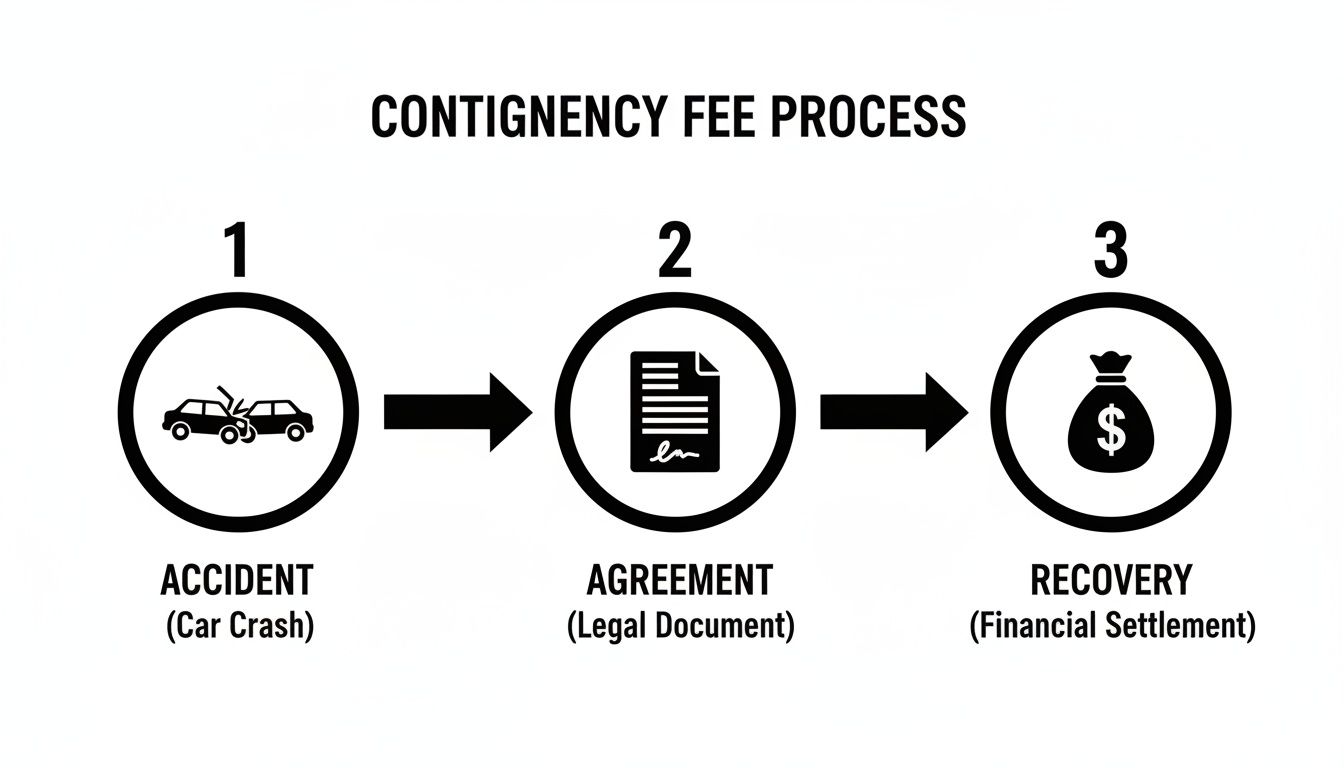
This simple path—from crash to cash—ensures you can focus on healing while we handle the fight. Let's peel back the layers and look at what comes out of that gross settlement amount.
Attorney Fees vs. Case Costs
Right off the bat, it's important to know the difference between attorney's fees and case costs. People often use these terms interchangeably, but they are two very different things.
- Attorney's Fees: This is what you pay your lawyer for their work—their time, knowledge, and skill in fighting the insurance company. As we covered, this is typically a percentage of the total settlement, often between 33.3% and 40%.
- Case Costs: These are the out-of-pocket expenses our firm pays upfront to build your case. Think of them as the operating budget for your claim. We front these costs so you don't have to worry about them.
We cover all these expenses during the legal process. They are only reimbursed from the settlement funds once we win your case.
Common case costs can include:
- Court Filing Fees: The official cost to file a lawsuit in the Texas court system.
- Expert Witness Fees: Payments to specialists like accident reconstructionists or medical doctors who provide testimony to prove liability (who was at fault) and your damages (your losses).
- Deposition Costs: Money paid to court reporters and videographers for recording sworn testimony from witnesses and experts before trial.
- Medical Record Fees: The administrative charges from hospitals and clinics to gather every piece of paper documenting your injuries and treatment.
These costs aren't optional fluff; they are the building blocks of a strong claim that can stand up to insurance company tactics.
Medical Liens and Subrogation Claims
After fees and costs, the next big deductions are usually medical liens and subrogation claims. The names sound technical, but the idea behind them is pretty simple.
A medical lien is a legal right a hospital or doctor has to get paid directly from your settlement for the care they gave you. Subrogation is a similar right, but it belongs to your health insurance company, allowing them to get reimbursed for the medical bills they covered for you.
Let’s say you were in a wreck on I-45, and your health insurance paid $20,000 for your surgery and hospital stay. That insurance company has a right to get that $20,000 back from the at-fault driver's insurance settlement. This is where an experienced Houston personal injury attorney adds tremendous value. We routinely negotiate with medical providers and insurers to reduce these liens, which means more of the settlement money goes directly into your pocket.
A Sample Settlement Breakdown
Let's put it all together with a real-world example. Imagine a Houston driver gets rear-ended and suffers serious injuries. After a tough negotiation, their lawyer secures a $150,000 gross settlement. Here’s a look at how that money might be distributed.
Sample Settlement Breakdown for a Texas Car Accident
This table illustrates how deductions work on a $150,000 settlement.
| Item | Description | Amount |
|---|---|---|
| Gross Settlement | Total amount recovered from the insurance company. | $150,000 |
| Attorney's Fee | 33.3% of the gross settlement. | -$50,000 |
| Case Costs | Reimbursed costs for experts, records, and filing fees. | -$7,500 |
| Medical Liens | Negotiated repayment to hospitals and health insurer. | -$25,000 |
| Net to Client | Final amount the client receives. | $67,500 |
As you can see, the gross settlement is just the beginning of the story. The net recovery is what truly matters for your future.
If you're interested in the behind-the-scenes mechanics, you can learn more about the intricacies of claims processing. And while most personal injury settlements aren't taxable, there are exceptions. You can find out more in our detailed guide on whether you have to pay taxes on a settlement.
How Case Complexity and Texas Law Impact Your Lawyer's Fee
Not every car accident case is built the same, so the answer to "how much do lawyers take from a settlement?" is never one-size-fits-all. The contingency fee percentage your attorney proposes will almost always reflect the amount of work, risk, and resources they anticipate needing to win your case.
Think about it: a straightforward rear-end collision on a quiet Houston street with clear video evidence is worlds apart from a multi-vehicle pileup on I-45 involving a commercial truck. The more complex the case, the more legal muscle is needed to get the compensation you deserve.
Texas Comparative Fault Rules
One of the biggest factors that can complicate your claim is something called comparative fault. Here in Texas, under Chapter 33 of the Civil Practice & Remedies Code, you can still recover money even if you were partially to blame for the accident. But there's a catch: your total compensation gets reduced by your percentage of fault.
For example, if a jury decides you were 10% responsible for a crash on I-45, your $100,000 award would be cut down to $90,000. And if they find you 51% or more at fault? You get nothing. Zero.
This is why proving the other driver holds the vast majority of the liability—or legal responsibility—is absolutely critical. Insurance companies love to shift blame onto you to slash their payout, which means your attorney has to invest serious time and resources gathering evidence to protect your claim.
This legal tug-of-war over fault percentages directly impacts the work required and can easily influence the fee agreement.
How Severe Injuries and Multiple Defendants Affect Your Case
As a rule of thumb, the complexity of a personal injury claim scales with the severity of the harm you suffered. A case involving catastrophic injuries or a tragic wrongful death demands a much more intensive legal strategy than one with minor bumps and bruises.
Here are a few other things that ramp up a case's complexity:
- Multiple Defendants: Was your accident caused by a drunk driver in a company vehicle? You might have claims against both the driver and their employer. Cases involving truck accidents, for instance, can pull in the driver, the trucking company, the cargo loader, and even the vehicle manufacturer—all of whom will have their own legal teams fighting back.
- Need for Expert Witnesses: To prove the full extent of your damages, we often have to hire medical experts, economists to calculate future lost wages, and accident reconstructionists to show exactly how the crash happened. These experts are expensive, but they are often essential for getting you the maximum recovery possible.
- Contested Liability: If the other driver flat-out denies they were at fault, your legal team has to launch a full investigation. This can mean taking depositions, subpoenaing records, and meticulously preparing for a potential trial from day one.
While Texas law doesn’t put a cap on contingency fees, ethical rules require them to be reasonable and justified by the work performed. An experienced Texas injury attorney knows how to navigate these complex situations to build the strongest case possible. Research shows that personal injury attorneys typically take 25-33% for motor vehicle accidents, with that number climbing based on the complexities we've just discussed. You can discover more insights about how average legal fees are determined based on these very factors.
Key Questions to Ask Before You Sign Any Fee Agreement
Choosing a personal injury attorney is one of the most important decisions you'll make after an accident. That fee agreement you're about to sign isn't just a formality—it's a legally binding contract that will define your partnership for months or even years. Before you put pen to paper, you need to have total clarity on how everything works.
A good, trustworthy Houston car accident lawyer will not only expect your questions but will welcome them with clear, direct answers. Your peace of mind is what matters, and open communication is the bedrock of a solid attorney-client relationship. Asking the right questions now ensures there are no painful surprises waiting for you down the road.
We believe in complete transparency. That's why we’ve put together a practical checklist of questions to bring to your free consultation. Use these to guide the conversation and help you pick the right legal partner for your recovery.
Clarifying Fees and Costs
Let's be honest: the most important conversation you'll have is about the money. You need to know exactly how your attorney's fee is calculated and what other costs you can expect. The answers to these questions will directly impact how much money actually ends up in your pocket.
A great place to start is making sure you understand the difference between the gross settlement (the total amount) and your net recovery (what you take home). Here are the key questions to ask:
- Is your fee calculated before or after case costs are deducted? This is, without a doubt, one of the most critical questions you can ask. If the fee comes off the top of the gross settlement, your net recovery will be smaller. The most client-friendly way to do it is to deduct the case costs first and then calculate the attorney's fee from that lower number.
- What specific expenses are considered "case costs"? Ask for a list of common expenses. Think expert witness fees, court filing fees, and the cost of depositions. Understanding exactly where the money is going gives you a much clearer picture.
- Who pays the case costs if we don't win? A true contingency fee agreement means you owe absolutely nothing if your case isn't successful. Get confirmation that the firm will absorb all the case costs they've advanced if you don't receive a settlement or a favorable verdict.
Understanding the Process and Your Role
Beyond the dollars and cents, you need to feel confident in the attorney’s process and know what’s expected of you. This is a partnership, and like any good partnership, it needs clear communication and shared expectations.
An experienced attorney should be able to walk you through their strategy in plain English. You should feel empowered and informed every step of the way—not like you need a law degree to understand what’s happening. Your job is to heal, not to decipher legal jargon.
Ask these questions to get a feel for the bigger picture:
- Who will be my main point of contact at the firm? Will you be talking directly with the lawyer handling your case, a paralegal, or a case manager? Knowing who to call when you have a question makes the whole process smoother and less stressful.
- How often can I expect to get updates on my case? Consistent communication is key. Find out if the firm provides updates on a set schedule, like once a month, or only when there are major developments in your claim.
- What will you need from me to build the strongest case possible? You're an active participant in your own success. Understanding your responsibilities—like making it to every doctor's appointment or keeping a journal of your pain and limitations—helps your legal team do their best work for you.
Asking these questions is a crucial step in the process. For more guidance, check out our comprehensive article on how to choose a personal injury lawyer that best fits your needs.
How a Skilled Attorney Increases Your Total Payout

It’s natural to focus on the contingency fee percentage when you're thinking, "How much do lawyers take from a settlement?" But here's what most people miss: the real story isn’t about what a lawyer costs—it’s about the incredible value they bring to the table.
An experienced personal injury lawyer doesn't just take a piece of the pie. They make the entire pie bigger. A lot bigger.
People who try to handle their own injury claims almost always walk away with far less money than those who have a lawyer. Insurance companies are for-profit businesses, and their number one goal is to protect their bottom line by paying out as little as humanly possible. They love to make quick, lowball offers to victims without lawyers, hoping they’ll take the cash before they realize what their claim is actually worth.
Maximizing Your Recovery Beyond That First Offer
A skilled Texas injury attorney completely levels the playing field. We force insurance adjusters to take you and your claim seriously by building a case they simply can't ignore or dismiss.
Our value is built on a methodical, aggressive approach:
- Deep Investigation: We go way beyond the initial police report. We dig for evidence, track down and interview witnesses, and often work with accident reconstruction experts to build an ironclad case for liability.
- Hiring Credible Experts: Proving the full scope of your damages requires more than just showing medical bills. We bring in respected medical specialists and economists who can provide powerful, convincing testimony about your future medical needs and how your injuries have impacted your ability to earn a living.
- Calculating Future Damages: An insurer's first offer almost never accounts for your long-term needs. We meticulously calculate all future medical treatments, ongoing rehabilitation, and lost wages to ensure your settlement covers you for life, not just for today.
An experienced attorney knows every trick in the insurance company's playbook and, more importantly, how to counter them. We build a fortress of evidence around your claim, making it crystal clear that a lowball offer isn't going to make us go away.
The Power of Aggressive Negotiation
Once we've built a powerful case, we negotiate from a position of strength. Insurance companies know we are fully prepared to take the fight to court if necessary, and that gives them a very strong incentive to offer a fair settlement.
This is a critical stage, and you can learn more about it in our guide on how to negotiate an insurance settlement.
This tough, strategic advocacy is the key to maximizing your financial recovery. While no lawyer can ever guarantee a specific dollar amount, having a proven legal team in your corner dramatically increases your chances of getting the compensation you truly need to rebuild your life.
Let Us Fight to Maximize Your Settlement
After a serious accident, your only job should be healing. You shouldn't have to spend your energy fighting with an insurance company. The team at The Law Office of Bryan Fagan, PLLC, is here to take that entire burden off your shoulders. We handle every single detail so you can focus on what matters most—your recovery.
Don’t let an insurance adjuster decide your future. Contact us today for a free, no-obligation consultation. Let us show you how we fight to get our clients the maximum compensation possible.
Answering Your Questions About Settlement Fees
Even with a clear breakdown, it’s completely normal to have questions swirling around how attorney fees and costs actually work. You deserve to feel confident and fully informed before you sign anything. To help with that, here are the straight answers to some of the most common questions we hear from clients.
Are Contingency Fees Negotiable in Texas?
While the standard 33.3% fee is pretty common across Texas for personal injury cases, there can be some room for discussion. For instance, a case with extremely high damages where the other party’s fault is crystal clear might open the door to a conversation about the fee structure.
But here’s the thing: the main focus should always be on the lawyer’s experience and the value they bring to the table. A lower percentage from a less experienced attorney can easily lead to a much smaller final settlement. In the end, that means less money in your pocket. We’re always upfront about our fee structure because it reflects the immense resources and expertise we pour into getting you the best possible result.
What Happens if We Lose? Do I Still Owe for Case Expenses?
This is a critical question, and the answer should always be a firm "no." Our firm operates on a true contingency basis, which is our promise to you. If we don’t win a settlement or a verdict for you, you owe us absolutely nothing. Not a dime.
That promise covers both our attorney's fees and every single case cost we paid for upfront to build your claim. We take on all the financial risk of the fight so you can put your energy where it belongs: on your recovery.
Why Does the Fee Go Up if My Case Goes to Trial?
Taking a case all the way to a jury trial is a whole different ballgame. It requires a massive investment of time, resources, and legal firepower. The prep work is incredibly intensive, covering everything from getting expert witnesses ready for the stand to creating trial exhibits and spending days—sometimes weeks—in a courtroom.
That higher percentage compensates for the dramatically increased workload and the risks that come with a trial. Unlike a negotiated settlement, a trial's outcome is never a sure thing; it's ultimately in the hands of a judge or jury.
Will I Get a Final Breakdown of All the Deductions?
Absolutely. You are legally entitled to receive a detailed settlement statement, sometimes called a disbursement sheet. This document lays out a complete, itemized breakdown of your recovery in plain English.
It will clearly show the gross settlement amount, subtract the attorney's fee, list out and deduct every single case cost, detail any payments made to satisfy medical liens, and state the final, net amount you will receive. We personally review this document with every client to ensure 100% transparency before any money changes hands.
When you've been hurt because someone else was careless, you need a team that will fight for your rights, your recovery, and your future. The The Law Office of Bryan Fagan, PLLC is here to provide the compassionate and aggressive representation you deserve. Don't try to face the insurance companies by yourself.
Contact us today for a free, no-obligation consultation to understand your legal options and learn how we can help you rebuild. Visit us at https://houstonaccidentlawyers.net to get started.