Skip to content
Losing a loved one because of someone else's negligence is an unimaginable tragedy that can change your life in seconds—but you don’t have to face recovery alone. In Texas, the law provides a specific path for certain family members to seek justice and hold the responsible party accountable. This is known as a wrongful death lawsuit, and it’s reserved for the surviving spouse, children, and parents of the person who passed away.
This legal action gives these specific family members a way to demand compensation for the profound losses they've suffered. Understanding your rights is the first step toward securing your family's future and finding a sense of justice.
Navigating Your Rights After an Unimaginable Loss
Losing someone is devastating enough. Having to navigate the legal system while you're grieving can feel completely overwhelming. One moment, life is normal; the next, a preventable car crash or another tragic incident flips your family's world upside down. You're not just dealing with the emotional pain—you're suddenly facing financial instability from lost income, unexpected medical bills, and funeral expenses.
This guide is here to offer some clarity and compassionate answers about your family's rights during this incredibly difficult time. The immediate aftermath of a loss is often a blur of grief and overwhelming practical tasks; this practical guide on what to do when someone dies can also provide comprehensive help for those initial steps.
Understanding the Purpose of a Wrongful Death Claim
First, it’s important to know that a wrongful death claim is a civil action, not a criminal case. Its purpose isn't to put someone in jail, but to hold a negligent person or company financially accountable for causing a death. It's about securing your family's future and achieving a measure of justice for the immense void your loved one left behind.
Under the Texas Civil Practice & Remedies Code, this type of lawsuit is designed to address the specific damages your family has suffered. This goes far beyond just covering bills. It includes compensation for:
- Loss of Companionship: The profound, immeasurable loss of love, comfort, and society.
- Mental Anguish: The emotional pain, sorrow, and grief your family is experiencing.
- Lost Financial Support: The income and benefits your loved one would have provided for the family.
- Loss of Inheritance: The assets the deceased would have likely built and passed on to their family.
You don't have to face this journey alone. A Houston car accident lawyer can help you understand your rights and handle the legal complexities, freeing you and your family to focus on healing. The Law Office of Bryan Fagan is here to provide the support and guidance you need.
Who Is Eligible to File a Wrongful Death Claim in Texas?
Texas law is very specific about who has the legal standing to bring a wrongful death claim. It’s not open to just any relative. The law prioritizes the closest family members who are most directly impacted by the loss.
Here's a clear breakdown of who is eligible to file a claim.
| Eligible Filer | Eligibility Details | Can They File on Behalf of Others? |
|---|---|---|
| Surviving Spouse | The legal husband or wife of the deceased at the time of their death. This includes common-law spouses recognized in Texas. | Yes, the spouse can file on their own behalf and on behalf of minor children. |
| Children | Biological and legally adopted children of the deceased, regardless of their age. | Yes, adult children can file for themselves. A legal guardian can file for minor children. |
| Parents | Biological or adoptive parents of the deceased. | Yes, parents can file for their own loss. |
It's important to remember that siblings, grandparents (unless they have legally adopted the deceased), and other relatives are generally not permitted to file a wrongful death claim in Texas. The right belongs exclusively to the spouse, children, and parents.
Defining Who Has the Legal Right to Sue for Wrongful Death
When your family is reeling from an unimaginable loss, the last thing you want to do is navigate a maze of legal rules. But one of the first and most critical questions you'll face is: who can actually file a wrongful death lawsuit? In Texas, the law is very specific, limiting this right to the people most directly impacted by the death.
According to Chapter 71 of the Texas Civil Practice & Remedies Code, a wrongful death claim can be filed by, or on behalf of, the deceased person’s surviving:
- Spouse: The person who was legally married to the deceased at the time of their death.
- Children: This includes all biological and legally adopted children, no matter their age.
- Parents: The deceased's biological or adoptive parents can file a claim to recover damages for their own profound loss.
These family members can decide to file the lawsuit on their own or join together as a group. The law is structured this way to make sure any compensation goes directly to the people who have suffered the most significant personal and financial blows.
Who Is Not Eligible to File
This is often a point of confusion and heartache for grieving families. Texas law does not allow siblings, grandparents (unless they legally adopted the deceased), unmarried partners, or other relatives to file a wrongful death claim. While their grief is just as real and their loss is immense, the legal standing is strictly limited.
For example, think of a Houston family mourning a father killed in a preventable pileup on I-10. His wife, two children, and his elderly parents would all have the legal right to seek justice. His brother, who was also his best friend and business partner, would not be able to file a claim under Texas law, despite how deeply the loss has affected him.
This legal framework in Texas isn't happening in a vacuum. Wrongful death claims have been on the rise nationwide. The National Safety Council reported nearly 150,000 such claims back in 2018—a staggering 45% increase from 2009. You can explore more statistics about these national trends to get a better sense of the bigger picture.
The flowchart below gives you a clear visual of which family members have the right to file in Texas.
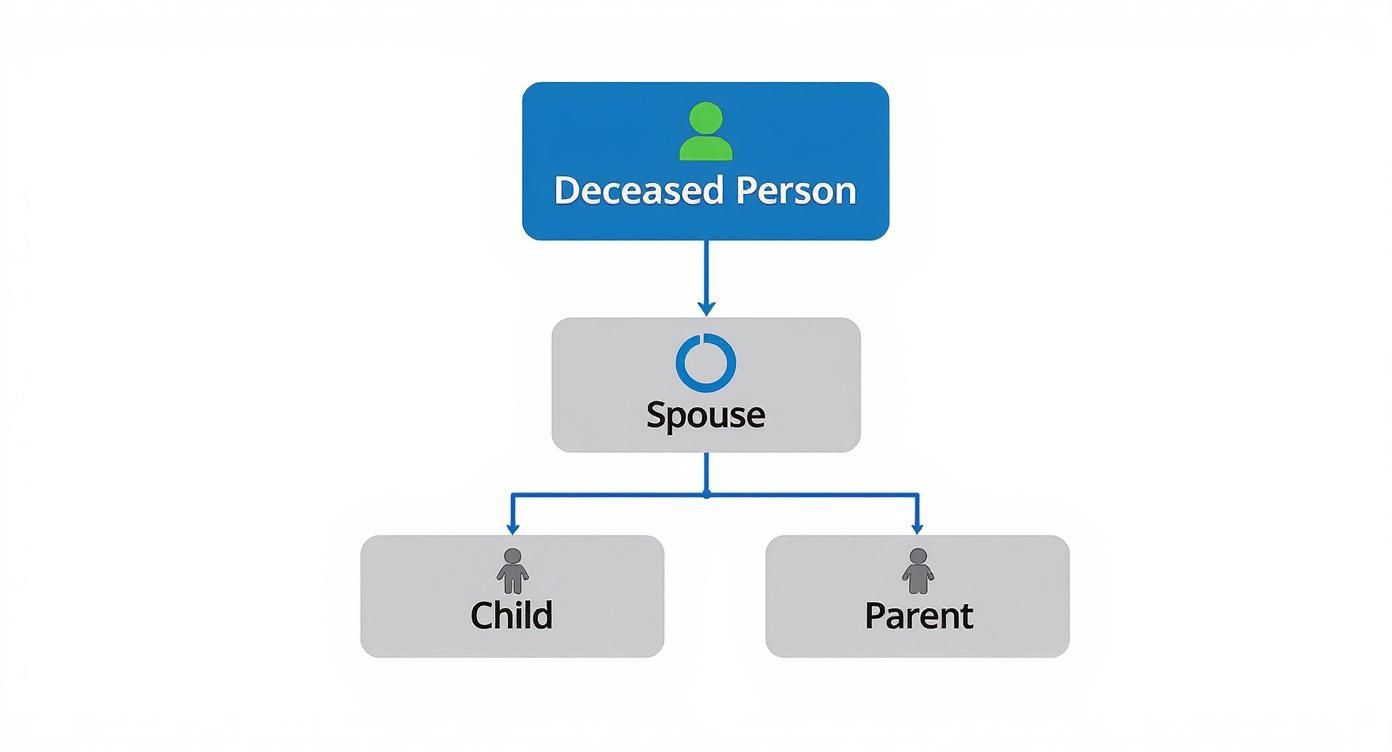
As you can see, the path to filing a claim begins and ends with the spouse, children, and parents. If you fall into one of these categories, Texas law gives you the power to hold the responsible party accountable. An experienced Texas injury attorney can help you understand these specific rules and protect your family’s rights from the very start.
Wrongful Death Claims Versus Survival Actions
When a family is reeling from a sudden, tragic loss, the legal system can feel incredibly confusing. In Texas, the law provides two different ways to seek justice against a negligent party: a wrongful death claim and a survival action. They often come up in the same conversation, but they are not the same thing.
Understanding the distinction is crucial. Knowing how each type of claim works ensures your family can pursue the full and fair compensation you are owed for such a devastating loss.
Think of it like this: a wrongful death claim is filed by the surviving family members for the losses they have personally suffered. This lawsuit is about the profound hole left in their lives—the lost companionship, the financial support that's gone, and the emotional guidance they can no longer turn to. It compensates the family for the future that was stolen from them.
A survival action, on the other hand, is filed on behalf of the deceased person’s estate. It's designed to recover damages for the pain and suffering they personally experienced from the moment of injury until their death. This action essentially allows a personal injury claim to "survive" even though the person who was harmed has passed away.
What Is the Difference Between a Wrongful Death Claim and a Survival Action?
Let’s try a real-world example. Imagine a Houston driver is rear-ended on I-45 and tragically passes away from their injuries a week later in the hospital.
- The wrongful death claim would be filed by their spouse and children to recover damages for their own grief, the loss of companionship, and the lost income the driver would have provided for the family.
- The survival action would be filed by the driver’s estate to recover damages for the physical pain and mental anguish the driver suffered during that week in the hospital, as well as the medical bills incurred.
One claim addresses the family's immense loss, while the other addresses the victim's own conscious suffering. When the circumstances allow, pursuing both is often the only way to achieve complete justice. A compassionate Texas injury attorney can sit down with you and figure out if your family has the grounds to file one or both of these claims.
"A wrongful death lawsuit focuses on compensating the survivors for their loss of companionship, financial support, and emotional guidance. A survival action seeks damages for the deceased's own conscious pain and suffering, medical expenses, and funeral costs, which are paid to their estate."
This difference is critical because each type of claim allows you to recover different kinds of damages. Together, they paint a full picture of the total harm that was caused by the responsible party's negligence.
What Damages Do These Claims Cover?
Looking at what each claim covers really helps clarify their separate but equally important purposes.
Wrongful death claim damages are intended to compensate the surviving family for their losses, which can include:
- Lost earning capacity your loved one would have provided for the family.
- Loss of companionship, comfort, and emotional support.
- Mental and emotional anguish suffered by the surviving family members.
- Loss of inheritance, including what the deceased would have likely saved and passed on.
Survival action damages are paid to the deceased’s estate and may include:
- The deceased’s conscious pain and suffering before death.
- Medical bills that piled up from the time of the injury until their death.
- Funeral and burial expenses.
In many cases, filing both claims is the most effective way to hold a negligent party fully accountable for the devastation they caused. An experienced Houston wrongful death lawyer can take on the burden of managing these complex legal actions, giving your family the space you need to focus on grieving and healing.
Understanding the Damages Your Family Can Recover
Of course, no amount of money can ever truly make up for the loss of a loved one. But a wrongful death lawsuit isn't about replacing a person—it's about providing your family with the financial stability and sense of justice needed to move forward.
In Texas, the law allows families to seek damages, which is the legal term for the compensation a negligent party must pay. This isn't a windfall; it's a measure of accountability designed to ease the very real economic burdens that a sudden, unexpected loss creates.

These damages fall into two main categories: the tangible financial losses and the profound human cost of your grief.
Economic Damages: The Tangible Financial Losses
Economic damages are the straightforward, calculable costs your family is now facing because your loved one is gone. Think of these as the losses you can see on paper—the bills piling up and the income that's no longer there. The goal is to restore the financial support your loved one would have provided for years to come.
Common examples include:
- Lost Earning Capacity: This covers the salary, benefits, and other financial contributions your loved one would have earned over their lifetime.
- Loss of Inheritance: We look at the assets your loved one would have likely built and passed on to the family if they had lived a full life.
- Medical Expenses: This includes the cost of any emergency care or medical treatment your loved one received for their injuries before passing away.
- Funeral and Burial Costs: These are the reasonable expenses for giving your loved one a proper farewell.
Imagine a Dallas construction worker was the main provider for his family. An experienced attorney would bring in financial experts to project his lifetime earnings, accounting for expected pay raises and retirement benefits, to make sure his spouse and children are taken care of financially.
Non-Economic Damages: The Human Cost of Your Loss
Non-economic damages are much harder to quantify because they compensate for the deep, personal losses that don't come with a receipt. This is where the law acknowledges the emotional and personal void left behind by your loved one's death.
While cases can vary widely, these claims often result in substantial settlements to reflect the gravity of the loss. The average medical malpractice settlement was around $420,000 in 2023, showing how the legal system attempts to quantify these immense damages.
These damages often form the most significant part of a wrongful death claim and can include compensation for:
- Mental Anguish: The profound grief, sorrow, and emotional trauma the surviving family members are forced to endure.
- Loss of Companionship and Society: This addresses the loss of your loved one's unique presence—their love, comfort, support, and guidance.
- Loss of Consortium: A specific claim for a surviving spouse, this recognizes the loss of intimacy, affection, and emotional support within the marriage.
Putting a number on these kinds of losses is an incredibly complex and sensitive process. It requires a compassionate legal team that knows how to tell your family's story and demonstrate the true, full impact of your loss. Our guide on how to calculate pain and suffering damages offers more insight into this delicate but crucial part of a claim.
Meeting the Texas Statute of Limitations for Wrongful Death
When your family is grieving, the last thing on your mind is a legal deadline. It’s completely understandable. But in a wrongful death case, time is a critical factor that you simply cannot ignore. Texas law sets a strict time limit, known as the statute of limitations, for filing a lawsuit to seek justice for your loved one.
In plain English, the statute of limitations is a legal deadline. Generally, your family has two years from the date of your loved one's death to file a wrongful death claim. This deadline isn’t a suggestion; it’s a hard and fast rule. If you miss this window, the court will almost certainly refuse to hear your case, permanently closing the door on your family’s right to pursue compensation. This is one of the most important reasons to speak with a Houston wrongful death attorney as soon as you feel able.
The Discovery Rule: An Important Exception
While that two-year clock is strict, Texas law acknowledges that some situations are more complicated. There are rare instances where the true cause of a loved one's death isn't immediately clear. This is where a legal exception called the discovery rule can come into play.
The discovery rule can effectively pause the two-year clock, starting it on the date when the surviving family members knew—or reasonably should have known—that the death was caused by someone else's wrongful act.
For example, imagine a family only learns that a loved one’s death was caused by a defective medical device or a case of hidden medical malpractice a full year after they passed. The statute of limitations might begin from the date of that discovery, not the original date of death.
However, relying on this exception is legally complex and never a guarantee. It’s far, far safer to act promptly to protect your rights. The legal clock is always ticking, and understanding how these timelines work is essential for any personal injury claim. You can learn more by reading about the general statute of limitations for a car accident in Texas, which shares a similar two-year deadline.
The best way to protect your family's right to seek justice is to take action well before the deadline approaches. Contacting a compassionate attorney allows them to start a thorough investigation right away, preserving all your legal options before it’s too late.
How a Compassionate Wrongful Death Attorney Can Help
In the midst of such profound grief, the last thing you should have to worry about is navigating a complex legal system. While you and your family need space to heal, a dedicated wrongful death attorney can step in to manage every detail of the legal process. Our role is to be your advocate, your guide, and your fighter, making sure your family’s rights are protected from start to finish.
A compassionate Texas injury attorney takes on all the essential tasks needed to build a strong case. This is about much more than paperwork—it's a meticulous process designed to hold the responsible parties accountable and secure your family's financial stability for the future.

Taking the Legal Burden Off Your Shoulders
From the moment you partner with our firm, we get straight to work. Our team handles everything, including:
- Investigating the Incident: We launch an immediate and thorough investigation to gather critical evidence, track down and interview witnesses, and collaborate with experts to build an undeniable case for negligence.
- Calculating Full Damages: We meticulously document every single economic and non-economic loss your family has suffered. This ensures we are pursuing the maximum wrongful death compensation you deserve.
- Handling All Communications: We take over all calls and negotiations with aggressive insurance companies. This protects you from their pressure tactics and frustratingly low settlement offers.
- Navigating the Legal System: We manage every deadline, court filing, and legal requirement, freeing you to focus on what truly matters—your family.
Fighting for the Justice Your Loved One Deserves
While sorting out who can file a wrongful death lawsuit is a critical first step, securing justice is the ultimate goal. The legal landscape has seen significant awards for families who can prove negligence was the cause of their loss. In fact, 2024 saw a record 135 lawsuits result in "nuclear verdicts"—awards over $10 million—totaling more than $31 billion. This trend underscores just how important skilled legal representation is when it comes to establishing fault and proving the full extent of damages. You can read the full research about these landmark cases to understand how these outcomes are achieved.
Your family deserves an advocate who will treat your case with the dignity and determination it deserves. We are committed to telling your loved one's story and fighting for a result that honors their memory and secures your family's future.
Our team at The Law Office of Bryan Fagan, PLLC, is here to provide that exact support. From Houston to San Antonio, we help families navigate these devastating circumstances with compassion and strength. If you are looking for more localized information, a dedicated San Antonio wrongful death attorney from our firm can provide the guidance you need.
You are not alone in this fight. Contact The Law Office of Bryan Fagan, PLLC, today for a free, no-pressure consultation. Let us listen to your story, answer your questions, and explain how we can help you pursue the justice your loved one deserves.
Common Questions About Texas Wrongful Death Claims
When your family is reeling from an unimaginable loss, the last thing you need is a confusing legal process. It's completely normal to have questions, and getting clear answers is the first step toward understanding your rights. Here are some straightforward responses to the concerns we hear most often from families navigating wrongful death lawsuits in Texas.
What if the Person at Fault Also Died in the Accident?
This is a scenario that comes up more often than you might think. Even if the person responsible for the accident also passed away, your family can absolutely still file a wrongful death lawsuit.
Instead of filing the claim against the individual directly, it is brought against their estate. Any compensation you recover is typically paid out by their insurance—like an auto insurance claim against their liability policy or a homeowner's insurance policy. Our attorneys have experience handling these sensitive and legally complex situations with the compassion they require.
Can an Estate Representative File a Claim if the Family Doesn't?
Yes, Texas law has a kind of safety net built in to ensure a path to justice remains open. If the eligible family members (the surviving spouse, children, or parents) do not file a lawsuit within three calendar months of their loved one's death, the personal representative or executor of the deceased's estate can step in and file the claim.
There is one important exception, however. The representative cannot move forward with the lawsuit if all the eligible family members formally request that no claim be filed.
Think of this as a safeguard. It ensures that the opportunity for accountability isn't lost while a family is overwhelmed with grief and unable to take immediate legal action.
How Much Does It Cost to Hire a Wrongful Death Lawyer?
We know your family is already under immense emotional and financial pressure. Adding legal fees to that burden is the last thing you should have to worry about. That's why The Law Office of Bryan Fagan, PLLC, handles all wrongful death cases on a contingency fee basis.
What does that mean for you? It means you pay absolutely nothing upfront. We cover all the costs of building and pursuing your case. We only get paid if we successfully recover compensation for you, either through a negotiated settlement or a court verdict. This approach lets your family seek justice without any financial risk or added stress during an already impossibly difficult time.
Your family deserves a legal partner who will fight for justice with both compassion and determination. At The Law Office of Bryan Fagan, PLLC, our goal is to lift the legal burden from your shoulders so you can focus on what truly matters: healing.
Contact us today for a free, no-obligation consultation to discuss your case and learn how we can help you and your family.