A car crash can change your life in seconds—but you don’t have to face recovery alone. For motorcyclists navigating the busy highways of Houston, knowing the rules of the road isn't just about avoiding a ticket; it's about protecting your rights after a collision. One of the most urgent questions we hear from riders is: is lane splitting legal in Texas?
The direct answer is no, lane splitting is illegal in Texas. A recent change in state law has removed all ambiguity.
If you have been injured in a motorcycle accident, understanding this law is a critical first step toward seeking the compensation you deserve. Even if you received a ticket, you have rights. Our goal is to provide clear, practical advice to help you navigate your recovery and empower you to make the best decisions for your future.
The Definitive Answer on Lane Splitting in Texas
For years, the legality of lane splitting in Texas was a gray area, leading to confusion among riders and inconsistent enforcement by police. That uncertainty has ended.
Understanding the Ban: House Bill 4122
In 2023, the Texas Legislature passed House Bill 4122, which explicitly banned lane splitting across the state. This law amended the Texas Transportation Code, requiring all motorcyclists to operate their vehicle entirely within a single marked lane. This makes riding between lanes of traffic illegal under all circumstances.
A rider who violates this law now faces a minimum fine of $175, plus court costs and other local fees.
Lane Splitting vs. Lane Filtering
It is also important to understand the difference between two related terms, as both are now illegal in Texas:
- Lane Splitting: This involves riding a motorcycle between two lanes of moving traffic, often to bypass congestion on highways like I-45 in Houston.
- Lane Filtering: This is when a motorcyclist moves between lanes of stopped or slow-moving cars, typically to advance to the front of an intersection at a red light.
While some states have different rules for these actions, Texas House Bill 4122 makes no distinction. Both are now illegal because they involve operating a motorcycle outside of a single, clearly marked lane. Whether traffic is moving at highway speeds or at a complete standstill, riding between cars is a citable offense.
Texas Lane Splitting Law At a Glance
| Topic | Status in Texas | Key Details |
|---|---|---|
| Lane Splitting | Illegal | Prohibited between lanes of moving traffic under HB 4122. |
| Lane Filtering | Illegal | Prohibited between stopped or slow-moving traffic. The law makes no exception. |
| Governing Statute | Texas Transportation Code | Amended in 2023 by House Bill 4122. |
| Penalties | Minimum $175 fine | This amount does not include court costs or additional local fees. |
This clear ban means that if you are in an accident while lane splitting, the other driver's insurance company will use it against you. They will argue that your actions contributed to the crash to reduce or deny your claim.
If you were injured in a motorcycle accident—even if you received a ticket—it is critical to speak with an experienced Houston motorcycle accident lawyer. You still have legal rights, and we are here to help you protect them.
From Gray Area to Clear Ban: Why the Law Changed
For years, lane splitting existed in a legal limbo in Texas. The Texas Transportation Code did not specifically mention the term, leading many riders to believe it was permissible. However, law enforcement often used other statutes to issue tickets, creating confusion and inconsistent enforcement across cities like Houston and Austin.
This ambiguity meant a rider could be ignored by one officer and ticketed by another for the same action.
The Old, Ambiguous Rules
Before 2023, police often cited Texas Transportation Code, Section 545.060, which requires a vehicle to be operated "as nearly as practical entirely within a single lane." They argued that a motorcycle moving between two lanes was, by definition, violating this rule.
This allowed officers to ticket riders for various offenses, including:
- Improper Lane Change
- Following Too Closely
- Reckless Driving
This lack of a clear statewide standard created an unpredictable and risky environment for motorcyclists.
Past Attempts to Legalize Lane Splitting
There have been several efforts to clarify the law. In 2015, a bill was introduced to legalize a form of lane filtering, which would have permitted motorcyclists to move between lanes of traffic moving at 20 mph or less.
Despite support from rider advocacy groups, the bill failed to pass due to concerns about safety from other lawmakers and public safety officials. You can read more about the history of lane splitting legislation to see how other states have approached this complex issue.
The failure of past legalization efforts and the ongoing confusion set the stage for a definitive decision. Lawmakers chose to eliminate the gray area by implementing a clear, statewide ban with House Bill 4122.
This new law establishes a single, unambiguous standard for all riders and law enforcement officers in Texas. The years of uncertainty are over.
How a Lane Splitting Ticket Can Wreck Your Accident Claim
A motorcycle crash is a devastating experience. The physical pain and emotional trauma are overwhelming. But if you are also handed a ticket for lane splitting at the scene, your path to financial recovery becomes much more difficult.
Insurance companies are businesses focused on minimizing payouts. They will use any available reason to shift blame onto you, the injured rider, and a traffic ticket is a powerful tool for them to do just that.
How Insurance Companies Use a Ticket Against You
Imagine this real-world example: you're riding on I-10 in Houston when a distracted driver swerves into your lane without signaling, causing a serious crash. You are injured, but because you were filtering between slow-moving cars just before the impact, the police officer gives you a citation for lane splitting.
The at-fault driver’s insurance company will immediately seize on this ticket. They will argue that even though their client was negligent, your "illegal" action contributed to the collision. This is where a key Texas law, known as comparative fault, comes into play.
The flowchart below shows how the law evolved, turning what was once a gray area into a clear-cut violation that insurers can easily exploit.
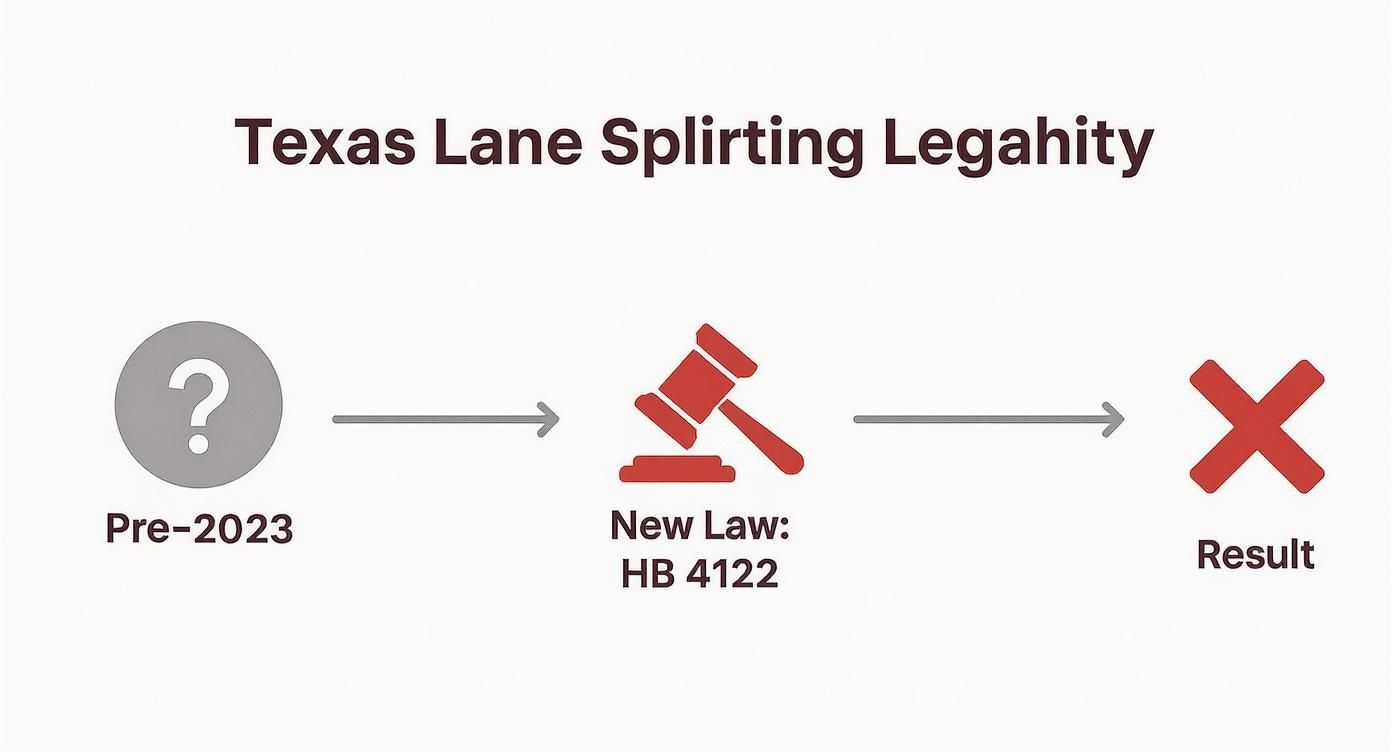
This change gives insurance adjusters a simple way to assign you partial blame for the accident.
Understanding Comparative Fault in Texas (Texas Civil Practice & Remedies Code, Chapter 33)
Texas follows a legal rule called modified comparative fault, also known as proportionate responsibility. This system is used to determine who pays for damages when more than one person is at fault for an accident. It is essential for you to understand how comparative negligence in Texas can affect your claim.
Here are some key terms explained in plain English:
- Liability: This is the legal term for responsibility. The person who is liable for an accident is financially responsible for the harm they caused.
- Damages: This refers to the money you can recover for your losses. It includes medical bills, lost wages, vehicle repairs, and compensation for your physical pain and emotional suffering.
- Comparative Fault: A judge or jury assesses the evidence and assigns a percentage of fault to each person involved. For example, they might decide the other driver was 80% at fault for texting and driving, while you were 20% at fault for lane splitting.
Under this system, your total compensation is reduced by your percentage of fault. If your damages are $100,000 but you are found 20% responsible, you can only collect $80,000.
The 51% Bar Rule: A Critical Threshold
Texas law includes a strict cut-off. If you are found to be 51% or more responsible for the accident, you are barred from recovering any money from the other driver. This is why an insurance company will fight so hard to push your percentage of fault over that 50% mark.
A lane splitting ticket makes their job much easier. They can present it as evidence that you violated the law and acted negligently, even if the other driver's actions were the true cause of the collision.
This is why you should never assume a ticket means your case is lost. The complexities involved in motorcycle accidents in Texas often require a thorough investigation to prove the other driver bears the majority of the blame. An experienced Texas injury attorney can fight an unfair fault assignment and protect your right to a financial recovery.
The Safety Debate Behind the Ban
The issue of lane splitting is highly controversial, with passionate arguments on both sides. Understanding these perspectives helps explain why Texas lawmakers ultimately decided on a complete ban. While the debate continues among riders, it is the law that matters in a personal injury claim.
The Argument for Lane Splitting
Proponents argue that lane splitting, when done responsibly, is a defensive riding technique. The primary danger for a motorcyclist stopped in heavy traffic is being rear-ended by a distracted driver—an impact that is often catastrophic or fatal for a rider.
Advocates see lane filtering as a way to move out of this vulnerable position. They point to research, such as a prominent study from the University of California, Berkeley, which found that lane-splitting riders in certain conditions were significantly less likely to be struck from behind. Proponents believe the practice can improve rider safety and even help reduce overall traffic congestion. You can read more about the history of lane splitting legislation to see how other states have approached the issue.
The Argument Against Lane Splitting
Opponents, including many lawmakers and driver safety organizations, argue that the practice introduces unacceptable risks on Texas roads. Their main concerns include:
- Driver Unpredictability: Most Texas drivers are not accustomed to checking for motorcycles between lanes. A sudden lane change can lead to a devastating sideswipe accident.
- Lack of Escape Routes: The tight space between vehicles leaves no room for error. A slight misjudgment by the rider or another driver can result in a collision with no time to react.
- The Startle Effect: A motorcycle appearing unexpectedly beside a car can startle a driver, causing them to swerve or brake suddenly, endangering the rider and others on the road.
Ultimately, Texas lawmakers sided with the arguments against the practice. For an injured rider, the key issue is not whether the law is right or wrong, but how its violation will be used by an insurance company to deny a rightful claim.
This is the reality for every motorcyclist in Texas. A lane splitting ticket provides an insurance adjuster with the evidence they need to argue you were at fault. A Houston car accident lawyer can build a strong case to counter these arguments and fight for the compensation you need to recover.
Your First Steps After a Motorcycle Accident

The moments following a motorcycle crash are often chaotic and overwhelming. You may be in pain and disoriented. However, the steps you take immediately after the accident can protect both your health and your legal rights. Following a clear plan can make a significant difference in the outcome of your insurance claim.
Practical Steps to Take at the Scene
- Prioritize Your Safety: If you are able, move yourself and your motorcycle out of the path of traffic to prevent further injury. If you are seriously hurt, do not move and wait for emergency responders.
- Call 911: Report the accident and request an ambulance, even if you feel you are not seriously injured. Adrenaline can mask pain, and some serious injuries, like concussions or internal bleeding, may not have immediate symptoms.
- Seek a Medical Evaluation: Allow paramedics to examine you at the scene and be sure to see a doctor as soon as possible. This creates an official medical record linking your injuries to the crash, which is vital evidence for your claim.
- Document Everything: If you are physically able, use your phone to take photos and videos of the accident scene. Capture the damage to all vehicles, your injuries, skid marks, road conditions, and traffic signs.
- Exchange Information: Get the other driver's name, contact information, driver's license number, and insurance details. Also, get the names and contact information of any witnesses. Their testimony can be invaluable.
- Get a Police Report: Always request that a police officer come to the scene and file an official report. This report is a crucial piece of evidence that helps establish the facts of the accident.
By thoroughly documenting the scene, you create a factual record that makes it harder for the other driver's insurance company to dispute liability or unfairly blame you for the crash.
Knowing what to do is critical. Our detailed guide on what to do after a car accident provides additional practical steps that are just as important for motorcycle riders.
Protecting Your Legal Rights After a Crash
After ensuring your immediate safety, your next actions should focus on protecting your legal and financial future. Be very careful what you say to the other driver's insurance adjuster. Their job is to protect their company's profits by paying you as little as possible. They may try to get you to admit partial fault or pressure you into accepting a low settlement offer before the full extent of your damages is known.
It is also critical to be aware of the statute of limitations in Texas. This is a strict legal deadline for filing a personal injury lawsuit. For most motorcycle accidents, you have only two years from the date of the crash to file a lawsuit. If you miss this deadline, you will lose your right to seek compensation forever. A Houston injury attorney can ensure all deadlines are met while you focus on your recovery.
How a Houston Motorcycle Accident Lawyer Can Help
Facing an insurance company alone after a serious motorcycle accident can be an isolating and overwhelming experience, especially when they are using a lane splitting ticket to deny your claim.
A citation does not automatically disqualify you from receiving compensation, but you can be sure the insurer will use it to try to avoid paying what you are owed. This is where an experienced Houston car accident lawyer from The Law Office of Bryan Fagan, PLLC can make all the difference. We level the playing field by taking over all communication with insurance adjusters, shielding you from their tactics so you can focus on healing.
Building Your Strongest Case
We begin by conducting our own independent investigation into the crash to establish the other driver's full liability. Our team will:
- Gather Critical Evidence: We secure scene photos, obtain traffic camera footage, and interview witnesses to build a comprehensive picture of what truly happened.
- Challenge Comparative Fault: We will aggressively fight back against any attempt by the insurance company to use a lane splitting ticket to assign you an unfair percentage of blame under Texas's comparative fault laws.
- Consult with Experts: If necessary, we work with accident reconstruction specialists to scientifically demonstrate how the other driver's negligence was the primary cause of your injuries.
This detailed approach is crucial to protecting your right to compensation and ensuring the responsible party is held accountable.
Fighting for Your Full Financial Recovery
The true cost of a serious motorcycle crash extends far beyond initial medical bills. We meticulously calculate the full value of your damages to ensure your settlement or verdict covers all of your losses, including:
- Current and future medical expenses
- Lost wages and diminished future earning capacity
- Compensation for physical pain and emotional suffering (Texas Civil Practice & Remedies Code, Chapter 41)
- Rehabilitation, physical therapy, and any necessary long-term care
We handle these complex personal injury claims on a contingency fee basis. This means you pay us nothing unless we win your case. There are no upfront costs or hidden fees. Our payment is a percentage of the financial recovery we secure for you.
A motorcycle accident can change your life in an instant, but you do not have to navigate the aftermath alone. Contact The Law Office of Bryan Fagan, PLLC today for a free, no-obligation consultation. Let a dedicated Texas injury attorney stand up for your rights and fight for the justice and compensation you deserve.
Common Questions About Texas Motorcycle Laws
When traffic laws change, it’s natural to have questions. Here are clear, straightforward answers to some of the most common questions we hear from Texas motorcyclists.
What’s the Fine for Lane Splitting in Texas?
Under House Bill 4122, the minimum fine for lane splitting in Texas is $175. However, this amount does not include court costs or other local fees, which can increase the total penalty. The more significant cost is the impact a ticket can have on your personal injury claim, as insurance companies will use it as evidence to assign you fault.
Is Lane Filtering Legal in Texas?
No, lane filtering is also illegal in Texas. The new law requires a motorcycle to remain entirely within a single marked lane. It makes no distinction between moving between cars at high speed (splitting) and moving between stopped cars at an intersection (filtering). Both are citable offenses.
Can I Still File a Claim If a Car Hit Me While I Was Lane Splitting?
Yes, you still have the right to file an auto insurance claim and pursue compensation for your injuries. However, you must be prepared for the insurance company to argue that you share fault for the accident. Texas law uses a "modified comparative fault" system to handle these situations.
Your recoverable damages will be reduced by your percentage of fault. The most important rule to remember is:
If you are found to be 51% or more responsible for the crash, you are legally barred from recovering any compensation. An experienced Texas injury attorney is your best ally in fighting an unfair allocation of fault and working to prove that the other driver's negligence was the primary cause of your injuries.
A motorcycle accident can be a life-altering event, but you do not have to face the legal and financial challenges alone. The dedicated personal injury attorneys at The Law Office of Bryan Fagan, PLLC are here to protect your rights and fight for the full compensation you deserve.
Contact us today for a free, no-obligation consultation to discuss your case. Let us provide the compassionate guidance and strong advocacy you need to move forward. You can reach us by visiting https://houstonaccidentlawyers.net.