A car crash can change your life in seconds—but you don’t have to face recovery alone. Many people want to know the "average" settlement number, and while some data shows the average car accident settlement for bodily injuries in Texas is about $22,734, that figure doesn't tell your story. In reality, your rightful compensation is built around the unique facts of your crash, not an average of thousands of others.
What Is a Typical Car Accident Settlement in Texas?
After a serious wreck, one of the first questions on your mind is likely, "What is my case worth?" It’s a fair question, but the answer isn't a single number. That statewide "average" is just a starting point. Minor injury claims might settle for much less, while a crash causing severe or life-altering harm can easily push a settlement into the six or even seven figures.
The truth is, your settlement isn't based on what someone else received. It's calculated by adding up your specific losses. In simple terms, a fair settlement is one that covers everything from the ambulance ride and hospital bills to the wages you couldn't earn while you were out of work. It’s about making you financially whole again after someone else’s negligence caused you harm.
Building Your Compensation Claim: What Are Damages?
Think of your settlement as a detailed accounting of every loss you suffered. The foundation is made up of your economic damages—these are the tangible, financial losses you can prove with receipts, bills, and pay stubs.
- Medical Bills: This covers everything—the ER visit, surgeries, doctor's appointments, physical therapy, and even the estimated cost of future medical care you may need.
- Lost Wages: This is straightforward compensation for the paychecks you missed while you were physically unable to work and recover.
- Future Lost Earning Capacity: If your injuries are serious enough to prevent you from returning to your old job or working at the same level, your settlement must account for that long-term financial impact on your life.
The other crucial part of your claim is non-economic damages. These are the losses that don't come with a price tag but are just as real and devastating. This is compensation for your physical pain, the emotional trauma of the crash, and the way the accident has completely disrupted your daily life. Proving these damages is where a skilled Houston car accident lawyer makes all the difference.
Estimated Texas Car Accident Settlement Ranges by Injury Severity
To give you a clearer picture, this table breaks down potential settlement ranges by the severity of the injuries. Remember, these are just general estimates. The final amount in any case will depend on the unique details of your situation.
| Injury Severity | Common Injuries | Typical Settlement Range |
|---|---|---|
| Minor | Whiplash, soft tissue strains, bruises, minor cuts | $10,000 – $25,000 |
| Moderate | Herniated discs, simple bone fractures, concussions | $25,000 – $100,000 |
| Severe | Traumatic brain injuries (TBI), spinal cord damage, amputations, multiple complex fractures | $100,000 – $250,000+ |
| Catastrophic | Paralysis, severe TBI with permanent impairment, wrongful death | $500,000 – Millions |
As you can see, the value of a claim rises dramatically with the seriousness of the injury. The more an injury impacts your health, finances, and quality of life, the higher your potential compensation.
The infographic below helps visualize how these settlement values can climb as injuries get worse.
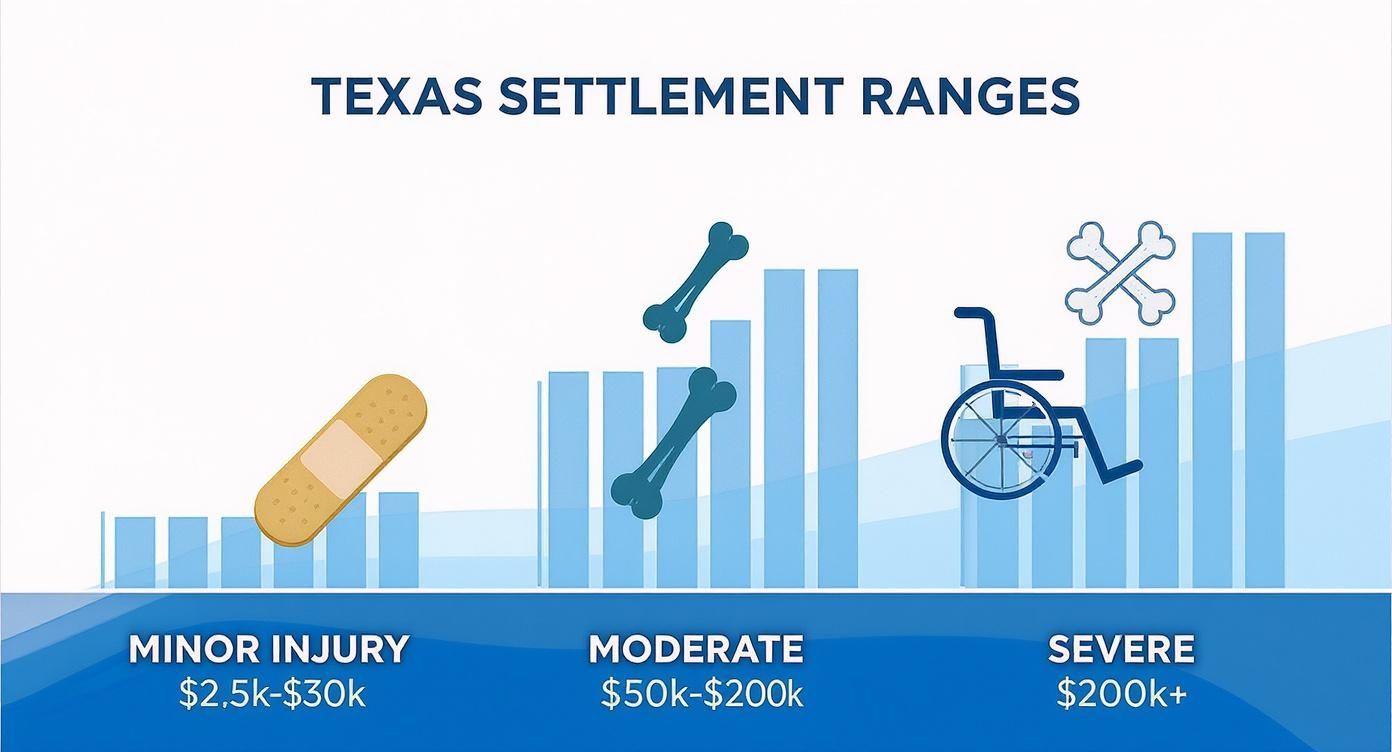
This shows why a single "average" figure isn't very helpful. So much depends on the at-fault driver's insurance, which is a critical piece of the puzzle. You can learn more by understanding insurance policy limits after a car accident in Texas.
The Key Factors That Drive Your Settlement Value
Why does one car accident claim settle for a few thousand dollars while another results in a seven-figure payout? It’s never a random number. The final figure is a direct reflection of everything you lost in the crash, and understanding how that number gets calculated is the first step toward demanding the compensation you are rightfully owed.
Your claim is a detailed accounting of every single loss the accident forced upon you—physically, financially, and emotionally. The job of a good attorney is to assemble that ledger, piece by piece, and present it to the insurance company in a way they cannot ignore.
Tallying Up the Economic Damages
The most straightforward part of any settlement calculation is adding up your economic damages. These are the tangible, out-of-pocket financial losses you can prove with a receipt, a bill, or a pay stub. The goal here is to create an undeniable paper trail of your expenses.
Your economic damages will almost always include:
- All Medical Expenses: This isn’t just the big stuff. It’s everything from the ambulance ride and ER visit to surgery, hospital stays, prescriptions, and physical therapy. Crucially, it also includes the estimated cost of future medical care, like a second surgery or long-term pain management.
- Lost Wages: This is simple math—it’s the income you lost because you were physically unable to work while recovering.
- Loss of Future Earning Capacity: This is a major factor. If your injuries mean you can’t go back to your old job or have to take a lower-paying position, your settlement must account for that lifetime of lost income.
- Property Damage: This covers the cost to repair or replace your vehicle and anything else of value that was damaged in the crash, like a laptop or phone.
Documenting every penny is critical. Start a folder and keep everything. Every single bill helps build the foundation of your claim.
Putting a Price on the Human Cost: Non-Economic Damages
While bills are easy to add up, the deepest losses from a car accident don’t come with a price tag. These are called non-economic damages, and they are meant to compensate you for the human cost of the crash.
These damages acknowledge the immense personal toll—the physical pain, the emotional trauma, and the complete disruption of your life. Proving their value takes an experienced Texas injury attorney who knows how to tell your story in a powerful way.
Non-economic damages cover intangible but very real losses, such as:
- Pain and Suffering: This is compensation for the physical pain you've had to endure and may continue to live with for years to come.
- Mental Anguish: This addresses the emotional fallout—the anxiety, depression, fear, or even PTSD that so often follows a traumatic crash.
- Physical Impairment or Disfigurement: Compensation for permanent scars, the loss of a limb, or any physical limitation that changes your life forever.
- Loss of Enjoyment of Life: If you can no longer play golf, pick up your kids, or enjoy the hobbies that once brought you joy, you deserve to be compensated for that loss.
Insurance companies often try to downplay these damages because they are subjective. But in any serious injury case, they are frequently the largest and most important part of a fair settlement.
A Real-World Houston Example
Let’s put it all together. Imagine a Houston driver is rear-ended on I-45. The wreck leaves them with a herniated disc that requires surgery and months of grueling physical therapy.
-
Their economic damages would include the surgeon's bill, hospital fees, all the physical therapy co-pays, and the three months of paychecks they missed while out of work. That could easily total $85,000.
-
Their non-economic damages would account for the constant, nagging back pain, the stress of a long recovery, not being able to play with their kids, and the new anxiety they feel every time they get behind the wheel. A skilled attorney would argue these damages are worth at least two or three times the economic losses.
By combining both types of damages, a Houston car accident lawyer builds a comprehensive demand that shows the true impact of the crash on your life. This is how you secure the full compensation you need to start putting the pieces back together.
How Texas Laws Shape Your Car Accident Claim

Navigating a car accident claim in Texas isn't just about adding up your bills. State laws play a crucial role in everything, from whether you can recover money to how much you might actually receive. Knowing how these rules work is your best defense against the pitfalls that could weaken your claim.
Who Is Liable in a Texas Car Accident? Proving Fault and Negligence
Before you can recover a single dollar, you have to prove the other driver was negligent. In plain English, negligence means showing the other driver failed to act with reasonable care, and that failure directly caused your injuries and losses. The person or party at fault is considered legally responsible, or liable.
An experienced Texas injury attorney knows exactly how to build a rock-solid case to establish liability. It starts by gathering the right evidence, which often includes:
- Official Police Reports: This is the officer's initial assessment of how the crash happened and who might be at fault.
- Witness Statements: An unbiased eyewitness account can cut through conflicting stories from the drivers involved.
- Crash Scene Evidence: Photos of vehicle damage, skid marks, and traffic signals help experts reconstruct the accident.
Understanding Texas Comparative Fault Rules
What happens if the insurance company tries to blame you for part of the accident? Texas uses a rule called modified comparative fault, also known as proportionate responsibility. This rule is found in Chapter 33 of the Texas Civil Practice & Remedies Code.
Here’s what it means for you:
Your final compensation is reduced by your percentage of fault. However, if you are found to be 51% or more responsible for the crash, you are legally barred from recovering any money at all.
For example, if a jury decides your total damages are $100,000 but finds you were 20% at fault, your award would be cut by $20,000, leaving you with $80,000. But if that same jury says you were 51% to blame? You get nothing. Insurance adjusters often use this rule to shift blame and reduce payouts, which is why having an attorney in your corner is so critical.
To learn more, you can learn more about comparative negligence in Texas and how it could impact your case.
The Two-Year Clock Is Ticking: The Statute of Limitations
Texas law puts a strict deadline on your right to file a personal injury lawsuit. This is called the statute of limitations, and for most car accident cases, you have just two years from the date of the crash.
If you miss that two-year window, you lose your right to seek compensation forever, no matter how strong your case is. Evidence can disappear, witnesses' memories fade, and legal deadlines arrive faster than you think. Contacting a Houston car accident lawyer right away is the best way to protect your rights.
It's also important to remember that Texas laws cover all types of vehicles on the road, and it's helpful to be aware of the specific laws governing mobility scooters in case one is involved in an incident.
Why "Average" Settlement Numbers Can Be Misleading
Don't be fooled by the multi-million dollar verdicts you see on the news. It’s easy to get the wrong idea and think that's a typical outcome for a car accident claim. The truth is, those sensational stories are outliers and don't reflect the reality for most people. To set realistic expectations for your own claim, you have to understand the huge difference between an "average" and a "median" settlement.
A few massive awards from catastrophic injury or wrongful death compensation cases can completely throw off the "average," making it seem much higher than what most accident victims actually receive. It's a simple math problem that paints a very misleading picture.
Average vs. Median: What's the Real Story?
Think of it like this: imagine ten people are in a room. Nine of them make $50,000 a year, but the tenth person is a CEO who earns $10 million.
- The average income in that room is almost $1 million.
- The median income—the number right in the middle—is just $50,000.
Which number gives you a clearer picture of what most people in that room are earning? The median. It's the exact same story with car accident settlements in Texas. A handful of extremely high-value cases drag the average way up, making it an unreliable benchmark for your own situation.
The Numbers in Texas Don't Lie
This isn't just a theory; you can see it in the Texas data. There’s a massive gap between the median and average personal injury settlements, which shows how much those outlier verdicts skew the numbers.
The median personal injury settlement in Texas is about $12,281, but the average skyrockets to $826,892. For crashes involving motor vehicles specifically, the median is closer to $16,000. You can dig into Texas settlement statistics to see the full picture.
This huge difference proves why focusing on the "average" is a mistake. Your case is unique. Its real value depends on your specific injuries, your financial losses, and the skill of your Texas injury attorney—not some distorted statewide number.
Instead of getting distracted by averages, the only thing that matters is building your specific claim. Your medical bills, your lost paychecks, and the real-world severity of your pain and suffering are what actually determine what your settlement is worth.
Valuing Specific Injuries Like Neck and Back Trauma

When it comes to a Texas car accident settlement, a hard truth is that not all injuries are valued the same. A broken arm, while painful, usually has a fairly clear-cut recovery path. Neck and back injuries, however, are a whole different ballgame. They're often complex, unpredictable, and can lead to a lifetime of challenges.
Injuries like whiplash from a rear-end collision or a herniated disc can trigger chronic pain that affects every part of your life. Because they’re often “invisible” injuries—with no cast or crutches—insurance adjusters love to challenge them. Their goal is simple: get you to accept a quick, lowball offer before you realize just how serious and long-lasting the consequences really are.
Proving the True Impact of Spinal Injuries
To get a fair settlement for a neck or back injury, you must prove its full extent. Your word isn't enough; you need hard medical evidence. An experienced Texas injury attorney knows exactly what it takes to gather the proof needed to build an undeniable claim.
This evidence is your foundation and typically includes:
- Diagnostic Imaging: MRIs, CT scans, and X-rays provide a clear, visual picture of the damage to your spine, discs, and surrounding tissues.
- Expert Medical Testimony: Statements from your doctors or spinal specialists are crucial. They can explain the severity of your condition and detail the future treatments you will likely need.
- Treatment Records: A complete history of your physical therapy sessions, pain management injections, and specialist visits paints a powerful picture of the injury's ongoing impact on your life.
This documentation is critical because the need for future care—like a potential surgery years down the road or ongoing physical therapy—can dramatically increase your settlement value. While building your case is key, don't forget that managing lower back pain at home is an important part of your personal recovery journey, too.
From Fender-Bender to Significant Settlement
Let’s look at a practical example. A driver in Houston gets into what seems like a minor fender-bender on the Katy Freeway. He walks away feeling sore but figures it will pass. A few days later, he’s dealing with crippling neck pain and numbness shooting down his arms. An MRI reveals a herniated disc pressing on a nerve.
Suddenly, that "minor" accident involves appointments with neurosurgeons, a series of painful epidural injections, and the terrifying possibility of spinal fusion surgery in his future. His ability to work his construction job is now completely uncertain.
This is exactly how a small case can become a significant one. The fight is no longer about a dented bumper; it's about securing compensation for a lifetime of medical bills, lost earning capacity, and chronic pain.
Recent data shows just how substantial these claims can become. The average car accident settlement in Texas for neck and back injuries is around $503,648, with the median hovering near $350,000. These aren't just numbers; they reflect the devastating, long-term nature of spinal trauma.
Properly documenting your medical journey is everything. For instance, you have to attend your prescribed treatments, and it's important to understand if physical therapy can increase your settlement. A skilled attorney ensures every single consequence of your injury is documented and presented to the insurance company in a way they can't ignore.
Steps to Protect Your Claim After an Accident

The minutes and days after a car crash are a blur of chaos and stress. But the choices you make in that critical window can make or break your final settlement. Protecting your rights starts the moment the accident happens. Follow these practical, step-by-step tips to avoid common mistakes and start building a strong claim from day one.
Your first priority is your health and safety. If you can, move to a safe spot away from traffic. Call 911 immediately to report the crash and request medical assistance. Check on everyone else involved. Even if you feel okay, remember that adrenaline can mask serious injuries like whiplash or internal damage. Getting a professional medical evaluation is non-negotiable.
What to Do After a Crash: A Checklist
Once you're out of immediate danger, your next job is to gather evidence. Every detail helps establish liability—who was legally responsible for the crash—and gives your auto insurance claim the strength it needs.
- Take Photos and Videos: Use your phone to document everything. Get shots of the vehicle damage from every angle, skid marks, nearby traffic signs, and the overall scene.
- Exchange Information: Get the other driver’s name, contact information, driver’s license number, and insurance details. Remain calm and polite, but do not apologize or say anything that could be interpreted as admitting fault.
- Talk to Witnesses: If anyone saw what happened, get their names and phone numbers. An independent witness statement can be a powerful tool for proving your side of the story.
This initial evidence is what your Texas injury attorney will use to piece together what happened and prove the other driver’s negligence.
Seek Immediate Medical Attention
After you leave the scene, the single most important thing you can do is see a doctor—even if your injuries seem minor. Insurance companies view delays in medical treatment as a major red flag. They will argue that if you were truly hurt, you would have sought care right away.
Going to an ER, urgent care clinic, or your family doctor creates an official medical record that directly links your injuries to the accident. This record is the cornerstone of your claim for damages, proving the extent of your harm and justifying the cost of your treatment.
Following your doctor's orders, attending every follow-up appointment, and keeping a file of every medical bill is crucial. This creates a clear paper trail that supports your claim for medical expenses and shows the insurance adjuster you are taking your recovery seriously.
How to Deal with Insurance Companies
You'll need to report the crash to your own insurance company. When you call, stick to the basic facts. Don't downplay your injuries with phrases like, "I'm fine." These calls are often recorded and can be used against you later to devalue your claim for pain and suffering.
When the other driver's insurance adjuster calls, you have no legal obligation to give them a recorded statement. Their job is to find reasons to deny your claim or pay you as little as possible. It is always in your best interest to speak with a lawyer before talking to the at-fault party's insurer. An experienced Houston car accident lawyer can handle these communications for you, protecting your rights every step of the way.
How a Texas Car Accident Lawyer Can Help
After a car crash, the thought of dealing with insurance companies can be overwhelming. You might be tempted to handle the claim yourself just to get it over with. But going it alone is often a costly mistake that can leave you with a settlement that doesn't even begin to cover your losses.
Hiring an experienced lawyer is one of the most important steps you can take to secure a fair average car accident settlement in Texas. Insurance companies are businesses focused on one thing—protecting their profits. Their adjusters are skilled negotiators trained to minimize payouts and pressure you into accepting a lowball offer before you even know the full extent of your injuries.
Leveling the Playing Field
A skilled Texas injury attorney levels that playing field. From the moment you hire us, we take over. All communication with the insurance company goes through our office, shielding you from their tactics so you can focus on what matters most: your recovery.
We immediately launch a thorough investigation to build the strongest case possible. This process includes:
- Gathering Critical Evidence: We track down police reports, witness statements, medical records, and expert opinions to prove who was at fault and document the true impact of your injuries.
- Calculating Your True Damages: We look far beyond your current medical bills. We work with medical and financial experts to project the full, long-term costs of your accident, including future treatments, lost earning capacity, and the personal toll of your pain and suffering.
- Negotiating Aggressively: Armed with a powerful, evidence-backed demand, we enter negotiations from a position of strength. We anticipate the insurance company's arguments and counter every low offer with hard facts.
No Upfront Costs, No Financial Risk
Many people hesitate to call a lawyer because they worry about the cost. At our firm, that's never an issue. We handle personal injury cases on a contingency fee basis.
What does that mean for you? You pay us absolutely nothing unless we win your case. Our fee is a percentage of the settlement we secure for you. There is zero out-of-pocket cost and zero financial risk to you. Our goals are perfectly aligned with yours—to get you the maximum compensation possible.
You don't have to navigate the aftermath of a serious accident by yourself. A Houston car accident lawyer can be your advocate, your guide, and your fighter, ensuring your rights are protected every step of the way.
You are not alone in this fight. The dedicated team at The Law Office of Bryan Fagan, PLLC is ready to stand by your side and demand the justice and compensation you deserve. We are here to listen to your story, answer your questions, and provide the support you need to move forward. Contact us today for a free, no-obligation consultation to discuss your rights and explore your legal options. https://houstonaccidentlawyers.net