A car crash can change your life in seconds — but you don’t have to face recovery alone. The moments that follow are confusing, chaotic, and often painful. What you do right then and there is absolutely critical for protecting your health and your legal rights to compensation down the road.
The most important question is always, "what do I do now?" It all starts with a few deliberate steps: check for injuries, move to a safe place if you can, and call 911.
Your First Moves at a Texas Accident Scene
In the minutes after a wreck, adrenaline floods your system. It's nature's way of coping, but it can make it incredibly difficult to think straight. Taking a deep breath and focusing on a few key actions can make all the difference for your well-being and any future personal injury claim.
Safety is your number one job. Before you even think about the damage to your car, check on yourself and your passengers. Are you hurt? Is anyone else? Even if you feel okay, remember that serious injuries like concussions or internal bleeding don't always show immediate symptoms.
If the cars are still drivable, and it’s safe to do so, move them out of the flow of traffic. Pull over to the shoulder or into a nearby parking lot. This simple move can prevent a secondary collision and keeps everyone out of harm's way. If the vehicles can't be moved or someone is seriously hurt, leave everything as is, turn on your hazard lights, and wait for help to arrive.
Always Call 911
This is non-negotiable, even for what seems like a minor fender-bender on a quiet Houston street. When you call 911, a police officer will come to the scene and create an official accident report. This document is one of the most powerful pieces of evidence you can have for your insurance claim. It provides a neutral, third-party account of the time, location, drivers involved, and the officer’s initial findings. Trying to prove what happened without one is an uphill battle.
Properly reporting an accident also does more than just help your case—it contributes to public safety. Diligent documentation from law enforcement helps identify dangerous roads and driving trends. In fact, the National Highway Traffic Safety Administration recently reported an 8.2% drop in traffic fatalities in the first half of 2025 compared to 2024. That’s the lowest mid-year rate we’ve seen since 2014, and it's thanks in part to the data gathered from reports just like the one you’ll be filing.
This flowchart gives you a quick visual of the essential first steps after a collision.
Stick to this sequence: safety first, then the official report, then gathering information. Following these steps builds a strong foundation for your physical and financial recovery.
When you're reeling from a crash, it's easy to forget the essentials. Here’s a quick-reference checklist to keep you focused on what truly matters at the scene.
Immediate Post-Accident Checklist
| Action | Why It's Important |
|---|---|
| Check for Injuries | Your health is the top priority. Adrenaline can mask pain, so a thorough check of yourself and passengers is crucial. |
| Move to a Safe Location | If possible, moving out of traffic prevents secondary accidents and protects everyone from further harm. |
| Call 911 Immediately | An official police report is vital evidence for your insurance claim and legally documents the incident. |
| Exchange Information | Get the other driver's name, contact info, and insurance details. Avoid discussing fault. |
| Document the Scene | Take photos of vehicle damage, road conditions, and any visible injuries from multiple angles. |
| Don't Admit Fault | Avoid saying "I'm sorry" or accepting blame. Let the investigation determine fault. |
Following these steps at the scene can significantly impact the outcome of your case. They ensure you are safe, documented, and legally protected from the very beginning.
Crucial Tip: Never say "I'm sorry" or admit fault at the scene. Statements like these can be misinterpreted and used against you by an insurance company, even if you were not the one responsible for the crash. Stick to the facts when speaking with the other driver and the police.
How to Document Everything at the Crash Site
The evidence you collect in those first few chaotic minutes is the foundation of your entire insurance claim. If you need to file a personal injury case later, this proof is what it will be built on. Your smartphone is your most important tool right now—it lets you become your own investigator. Your goal is to capture the complete story before anything gets moved or cleared away.
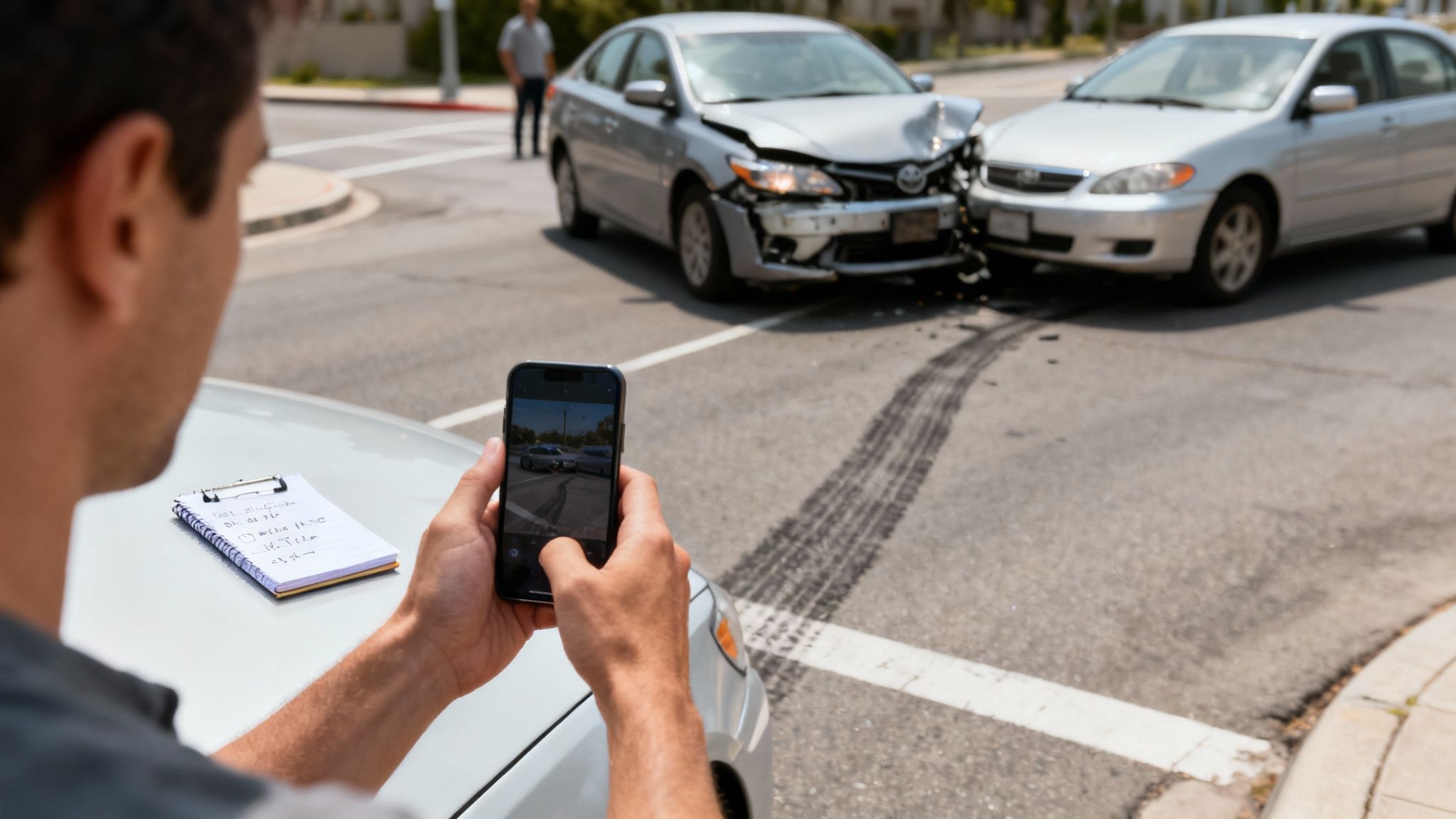
Put on your detective hat. Start by taking wide photos that show the entire intersection or stretch of road. Then, get closer. Document the specific damage to all vehicles involved, making sure to get pictures from several different angles.
Don't stop there. The small details matter. Get photos of any skid marks on the pavement, debris scattered from the impact, and nearby traffic signs or signals. Even things like the weather conditions can become important pieces of the puzzle.
Gathering Information and Finding Witnesses
Once you've taken plenty of photos, you need to exchange information with the other driver. This is a moment where you absolutely must stay calm and stick to the facts. Do not get into an argument about who was at fault. That's for the insurance companies and lawyers to figure out later.
Politely but firmly ask for the following:
- The driver's full name and phone number.
- Their insurance company and policy number.
- The make, model, color, and license plate number of their vehicle.
- Take a clear photo of their driver's license and insurance card. This is the best way to avoid typos or getting incorrect information.
This is not a negotiation. It's a critical step in protecting yourself when you file an auto insurance claim.
Pro Tip: Whatever you do, never apologize or say anything that sounds like you’re admitting fault. Simple phrases like "I'm so sorry" or "I didn't even see you" can be twisted and used against you by the other driver's insurance adjuster to deny or reduce your claim.
Finally, take a moment to look around for anyone who saw what happened. An independent witness is gold because their story is unbiased. For example, a Houston driver rear-ended on I-45 may find their claim is strengthened by a witness who saw the other driver texting. Their testimony can completely change the outcome of your case.
Just ask for their name and phone number. Most people are happy to help if you explain that their account could be really important. A neutral perspective cuts right through the "he said, she said" arguments that insurance companies love to use as an excuse to delay or deny payment. This is the kind of evidence a Houston car accident lawyer uses to establish exactly who was at fault and build a powerful case for the compensation you deserve.
Why You Should Always Seek Medical Care
After a car crash, your first instinct might be to brush yourself off and say, "I'm fine." But one of the most critical things you can do for your health and any future legal claim is to see a doctor right away.
The shock and adrenaline of an accident are powerful pain-maskers. They can easily hide serious injuries for hours or even days.

This delay in symptoms is more common than you might think. A driver who feels just a little sore after a fender-bender on I-45 could wake up a week later with debilitating back pain, only to discover a herniated disc.
Without a prompt medical visit, an insurance adjuster might argue that the injury happened sometime after the crash, not because of it. Seeking immediate medical care creates an official, time-stamped record that directly connects your injuries to the accident. This documentation is essential evidence.
Building Your Case for Compensation
In Texas, the person responsible for the accident is liable for the harm they cause. The compensation you can recover for your injuries is legally known as "damages." To claim these damages, you must prove the accident caused your injuries.
A medical record from an emergency room, urgent care clinic, or your primary care physician serves as powerful proof. It details the extent of your injuries and the necessary treatments, forming the basis for recovering costs related to:
- Medical bills (hospital stays, surgeries, physical therapy)
- Future medical needs
- Lost wages from time off work
- Your physical pain and emotional suffering
This isn't just a local issue; it's a global public health crisis. The World Health Organization reports that road traffic crashes are the leading cause of death for people aged 5-29, with 1.19 million fatalities annually worldwide. This staggering statistic highlights why prioritizing a medical evaluation after any collision is so important. You can find more information about these global road traffic injury statistics on who.int.
By seeing a doctor, you are not only taking care of your health but also laying the groundwork to hold the negligent party accountable. It's the first step toward securing the resources you need for a full recovery.
Understanding your options is key, especially when medical bills start arriving. To learn more, read our detailed guide on who pays medical bills after a Texas car accident. A Texas injury attorney can use these medical records to build a strong case and fight for the full compensation you deserve.
Who Is Liable in a Texas Car Accident?
Dealing with an insurance company after a crash often feels like a game where you don't know the rules and the other side wrote them. The truth is, knowing your rights—and what not to do—can give you a massive advantage.
Your first step is always to notify your own insurance company, even if the other driver was clearly at fault. This is a requirement of your policy, and it gets the process started on your end. The real challenge, though, comes when you have to deal with the at-fault driver's insurance adjuster. Their job isn't to help you. It's to protect their company's profits by paying you as little as possible.
Understanding Key Legal Terms
To protect your rights, you need to understand the language of Texas personal injury law. Here’s a plain-English breakdown of terms you’ll encounter:
- Liability: This is a legal term for "responsibility." In Texas, the person whose negligence (carelessness) caused the accident is liable for the harm that results.
- Damages: This is the money you are owed for your losses. It includes economic damages (like medical bills and lost wages) and non-economic damages (for your physical pain, emotional distress, and suffering).
- Comparative Fault: Texas follows a "modified comparative fault" rule, also known as proportionate responsibility (Texas Civil Practice & Remedies Code § 33.001). This means if you are found partially at fault for the crash, your compensation is reduced by your percentage of fault. For example, if you have $100,000 in damages but are found 20% at fault, your recovery is reduced to $80,000. Critically, if you are found 51% or more at fault, you cannot recover any compensation at all.
- Statute of Limitations: This is a legal deadline. In Texas, you generally have only two years from the date of the accident to file a personal injury lawsuit (Texas Civil Practice & Remedies Code § 16.003). If you miss this deadline, you lose your right to sue forever.
This comparative fault rule is precisely why adjusters will try to get you to admit even a small amount of fault. It saves their company a fortune.
Crucial Warning: Never give a recorded statement to the other driver's insurance company without talking to a Houston car accident lawyer first. Adjusters are trained to ask tricky questions designed to get you to say something that hurts your claim.
What to Do When the Adjuster Calls
When the at-fault driver's adjuster calls, be polite but firm. You are only required to provide basic information—your name, address, and phone number. That's it.
Do not discuss the details of the crash. Do not discuss your injuries or your medical treatment. When they ask for a recorded statement, politely decline and tell them your attorney will be in touch.
Accepting a quick, lowball settlement is another huge mistake. Those initial offers almost never account for future medical bills, long-term pain, or lost earning capacity. Once you take their check, you sign away your right to ask for more money, even if your injuries get worse.
To really protect your financial future, you need to understand the entire claims journey. Our firm provides a detailed guide on how to file a car accident claim in Texas that walks you through every step. A skilled Texas injury attorney will look at every angle of your case to make sure you're pursuing every single dollar you deserve.
Protecting Your Legal Rights and Deadlines
After a car crash, your world can feel like it's been turned upside down. Your immediate concern is, of course, your health and recovery. But in the background, a legal clock has started ticking, and understanding its deadlines is absolutely critical to protecting your future.

Here in Texas, the single most important deadline you need to know is the statute of limitations. For most personal injury claims, including those from car accidents, you have just two years from the date of the wreck to file a lawsuit.
Miss that deadline, and your ability to seek compensation is almost certainly gone forever, no matter how strong your case might be. The court simply won't hear it.
This legal countdown begins the very moment the accident happens, which is why taking prompt action is so important. To get a deeper understanding of this crucial timeline, take a look at our detailed guide on the Texas statute of limitations for car accidents.
Understanding Negligence and Damages in Texas
To build a successful claim, your Houston car accident lawyer needs to prove the other driver was negligent. It sounds like a complex legal term, but it’s actually pretty straightforward. Negligence just means someone failed to act with reasonable care, and that failure is what caused your injuries.
A classic example? A Houston driver rear-ended on I-45 because they were texting. Their distraction was a clear failure to drive safely and constitutes negligence.
When negligence is established, you have the right to seek damages—the legal term for the money you can recover. Texas law is designed to help make you whole again by allowing you to claim a few different types of damages.
- Economic Damages: These are the straightforward, tangible financial losses. Think medical bills, paychecks you lost because you couldn't work, and the cost of any future medical care you'll need.
- Non-Economic Damages: These are just as real but harder to put a price tag on. This category covers your physical pain, emotional trauma, and the loss of enjoyment of life you've suffered since the crash. In cases of extreme negligence, you may also seek punitive damages, which are meant to punish the wrongdoer (Texas Civil Practice & Remedies Code, Chapter 41).
It’s a sobering thought, but how well a local area responds to an accident can drastically change the outcome for victims. Global data shows this clearly. While Europe, for instance, managed a 36% drop in road fatalities, the Americas region saw no change at all. This highlights why consistent and effective legal and safety protocols are so vital everywhere. You can learn more about these global road safety statistics on developmentaid.org.
A Key Takeaway: The legal system is there to help you recover what was taken from you, but it won't wait. Understanding your rights to damages and the firm deadline to act is the very first step toward protecting yourself and your family.
Common Questions After a Texas Car Accident
After a crash, your head is spinning. The shock, the adrenaline, and the sudden disruption to your life leave you with a million questions. It’s completely normal to feel overwhelmed and uncertain about what to do next. We hear these same concerns from clients every day, so let’s clear up some of the most common ones.
Should I Call the Police for a Minor Accident?
Absolutely, yes. Even if it’s just a fender-bender in a Houston parking lot and the other driver seems friendly, you need to call the police. Think of the official police report as your most powerful piece of evidence. It's an objective, third-party account of what happened, which is gold when you're dealing with insurance companies.
Without that report, you’re walking into a "he said, she said" trap. The other driver could easily change their story later, or worse, deny the accident ever happened. Don’t take that risk.
What If the Other Driver Is Uninsured?
It’s a frustrating situation, but it happens more often than you’d think. If the driver who hit you doesn't have insurance, your own policy is your first line of defense. This is precisely why you have Uninsured/Underinsured Motorist (UM/UIM) coverage.
This part of your policy lets you file a claim with your own insurance company to cover your medical bills, lost income, and other losses. A Texas injury attorney can be invaluable here, making sure your own insurer plays fair and doesn't try to undervalue your claim.
How Long Does a Car Accident Case Take?
There's no single answer to this one—it really depends on the specifics of your case. A straightforward claim where the fault is obvious and the injuries are minor might wrap up in just a few months.
However, if you're dealing with serious injuries, a dispute over who was at fault, or an insurance company that’s dragging its feet, it could easily take a year or more. If the case has to go to a lawsuit, the timeline extends even further.
Several things can affect how long it takes:
- The severity of your injuries and how long your medical treatment lasts.
- Whether the insurance company is fighting you on who caused the crash.
- How willing the adjuster is to offer a fair settlement without a fight.
The biggest mistake we see is people rushing to settle before they know the full extent of their injuries. Being patient and strategic almost always leads to a better outcome, one that covers all your future needs, not just the immediate ones.
Of course, beyond your physical recovery and the legal process, getting your vehicle repaired is a top priority, which often includes critical auto glass replacement. Less common coverages like car key replacement insurance might also be relevant.
When Should I Contact a Lawyer?
The sooner, the better. You should definitely talk to an attorney before you give a recorded statement to the other driver’s insurance company and before you even think about accepting a settlement offer.
An experienced Houston car accident lawyer can step in immediately and handle all communications with the insurers. We know their tactics and can shield you from them while we start building your case. This lets you turn off the noise and focus 100% on what matters most: your recovery.
A car accident can make you feel lost and alone, but you don’t have to find your way forward by yourself. At The Law Office of Bryan Fagan, PLLC, we are here to be your guide, offering the compassionate support and strong legal representation you need right now. We will answer your questions, protect your rights, and fight for the full and fair compensation you deserve, including for tragic outcomes resulting in a claim for wrongful death compensation.
Contact us today for a free, no-obligation consultation. Let us take on the fight, so you can focus on healing.