Skip to content
A serious truck accident can change your life in seconds—but you don’t have to face recovery alone. One moment you're driving, the next you're dealing with injuries, trauma, and a mountain of unexpected bills. Tackling the aftermath of a commercial truck crash isn't like a typical fender bender; understanding your rights is the first and most important step toward getting the compensation you need to heal.
What you do in the moments and days after the collision is absolutely critical for protecting your family's future.
What To Do Immediately After a Texas Truck Accident
The scene of a big rig crash on a major Texas highway like I-10 or I-45 in Houston is pure chaos. It's terrifying. Your top priority must always be safety, but the actions you take next will lay the groundwork for your physical, financial, and legal recovery. It’s an overwhelming situation, but having a clear, step-by-step plan helps you take back control.
The scale of these wrecks is staggering. In 2023 alone, commercial truck accidents in the U.S. were responsible for over 5,100 deaths and around 125,000 injuries. What’s truly shocking is that nearly 76% of those killed were people in passenger cars—not the truckers themselves. This grim statistic is a reminder of the danger these massive vehicles pose to everyone on the road.
Your Immediate Post-Accident Checklist
After a crash, your mind will be racing, but focusing on a few key actions can protect both your health and your legal rights. While some steps are similar to any wreck, the stakes are much higher with a truck accident because the injuries are often more severe and the corporate insurance policies are far more complex.
- Prioritize Safety First: If possible, move your vehicle out of traffic. Turn on your hazard lights and check on yourself and your passengers. If anyone is hurt, call 911 right away.
- Report the Accident: You must call the police. A formal police report is a vital piece of evidence for your auto insurance claim and any potential lawsuit.
- Gather Essential Information: Without putting yourself in danger, get the truck driver’s name, contact information, driver's license number, and insurance details. You'll also want the trucking company's name, the truck's license plate, and its USDOT number (usually on the side of the cab or trailer).
- Document the Scene: Use your phone to take pictures and videos of everything—the final positions of the vehicles, the damage to your car and the truck, skid marks, road conditions, and any visible injuries you have.
Knowing what to do at the scene is your first move in building a strong case. These types of claims fall under Texas personal injury law, where proving who was at fault is everything.
Your Post-Accident Action Plan
This is your practical roadmap for the minutes and hours right after the crash. Following these steps helps secure your well-being and strengthens your ability to file a successful claim.
| Action Step | Why It Protects You | Real-World Example |
|---|---|---|
| Call 911 Immediately | Establishes an official record and gets medical help to the scene. | An officer creates a report detailing the accident, which becomes key evidence. |
| Seek Medical Attention | Documents injuries and links them directly to the crash. | A doctor diagnoses a concussion that you didn't feel at first due to adrenaline. |
| Document Everything | Preserves evidence that disappears quickly. | You take a photo of the truck's bald tires before the vehicle is towed away. |
| Gather Driver & Company Info | Identifies all potentially responsible parties for your claim. | You get the USDOT number, linking the driver to a multi-state trucking corporation. |
| Avoid Admitting Fault | Protects you from having your words used against you by insurers. | Instead of saying "I'm sorry," you stick to the facts when speaking to the driver or police. |
Think of this checklist as your first line of defense. Each step you take helps build a wall of evidence around your claim, making it harder for the trucking company's legal team to deny responsibility.
Why Medical Attention is Non-Negotiable
Even if you think you feel fine, you absolutely must get checked out by a doctor as soon as possible. The adrenaline surging through your body after a crash can easily mask serious injuries like internal bleeding, whiplash, or a concussion. Symptoms might not appear for hours or even days.
Waiting to see a doctor is a major mistake. It not only puts your health at risk, but it also gives the trucking company’s insurance adjuster a reason to argue your injuries aren't that serious or weren't even caused by the accident. A doctor's report creates a direct, undeniable link between the crash and your physical harm—and that link is essential for your claim. Our guide on the crucial steps to take after a car accident offers more practical advice that is just as relevant here.
Who Is Liable in a Texas Truck Accident?
When a commercial truck is involved in a wreck, figuring out who is responsible is rarely as simple as pointing a finger at the driver. A single crash can have multiple causes, and under Texas law, several different parties could share the blame. This complex web of responsibility is why liability—a plain-English term for legal fault—is so much more complicated in truck accident claims than in a typical car wreck.
Imagine a devastating tire blowout on I-10 causes a semi-truck to lose control and smash into your car. Your first instinct is to blame the truck driver. But what if the real cause is buried deeper? This "chain of liability" can stretch far beyond the person behind the wheel. Understanding this chain is critical because it tells you who you can legally seek compensation from. An experienced Houston truck accident lawyer knows exactly where to look to uncover every party whose carelessness contributed to your injuries.
More Than Just the Driver
While the truck driver’s actions are always examined, they are often just one link in a much longer chain of negligence.
Here are some of the other parties who could be held legally responsible for the crash:
- The Trucking Company: This is usually the primary target in a claim. Employers are generally responsible for the negligent acts of their employees. If the company hired an unqualified driver, failed to enforce safety rules, or pushed drivers to break hours-of-service regulations to meet impossible deadlines, they share direct liability.
- The Maintenance Shop: What if that tire blowout was caused by a shoddy repair? In that case, the third-party maintenance company that serviced the rig could be held liable for its negligence.
- The Truck or Parts Manufacturer: Sometimes the problem isn't with the maintenance but the part itself. If the tire was defective from the factory, the manufacturer could be at fault under product liability laws for putting a dangerous product on the road.
- The Cargo Loaders: An improperly loaded or secured trailer is an accident waiting to happen. If the truck’s cargo shifted and caused the driver to lose control, the company responsible for loading that trailer could be held liable.
The infographic below shows the first critical steps you should take at the scene. These actions help protect your rights and start the process of gathering crucial information.
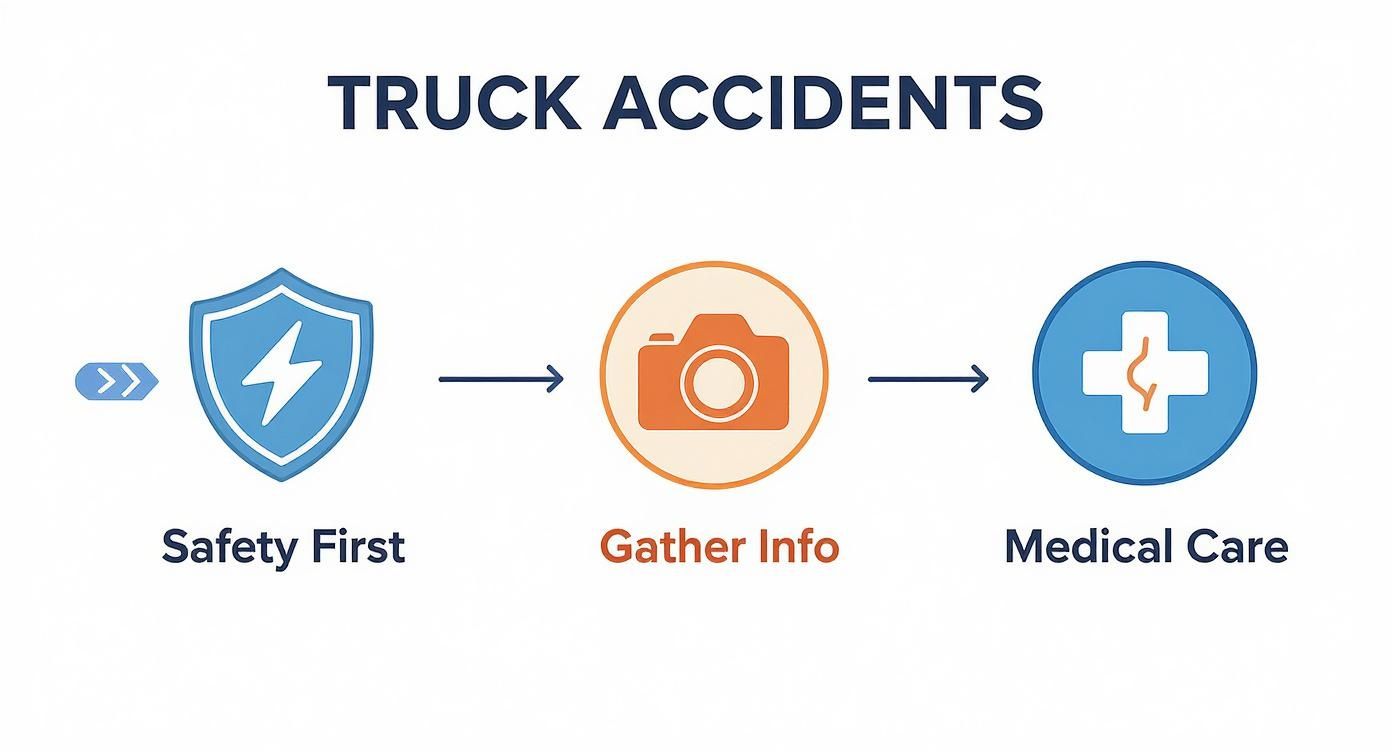
This guide highlights the basics: prioritizing safety, gathering information, and seeking immediate medical care. These are the foundational building blocks of any strong truck accident claim.
Proving Negligence Under Texas Law
To hold any of these parties accountable, your Texas injury attorney must prove they were negligent. In plain English, negligence means someone had a duty to act with reasonable care, they failed to do it, and that failure directly caused your injuries and losses.
For example, a trucking company has a legal duty to keep its fleet in safe, working condition. If they knew a truck’s brakes were failing but ordered the driver to take a load anyway, they have breached that duty. If those brakes then fail and cause a crash, their negligence is a direct cause of the harm.
A thorough investigation is all about finding where that duty of care was broken. These complex cases often involve large commercial insurance policies with high coverage amounts. It's helpful to learn more about understanding insurance policy limits after a car accident in Texas to see how these policies work. Because multiple parties can be held liable, you may have access to several sources of compensation, which is crucial when facing the catastrophic costs of a serious truck accident injury.
Gathering Evidence for Your Truck Accident Claim
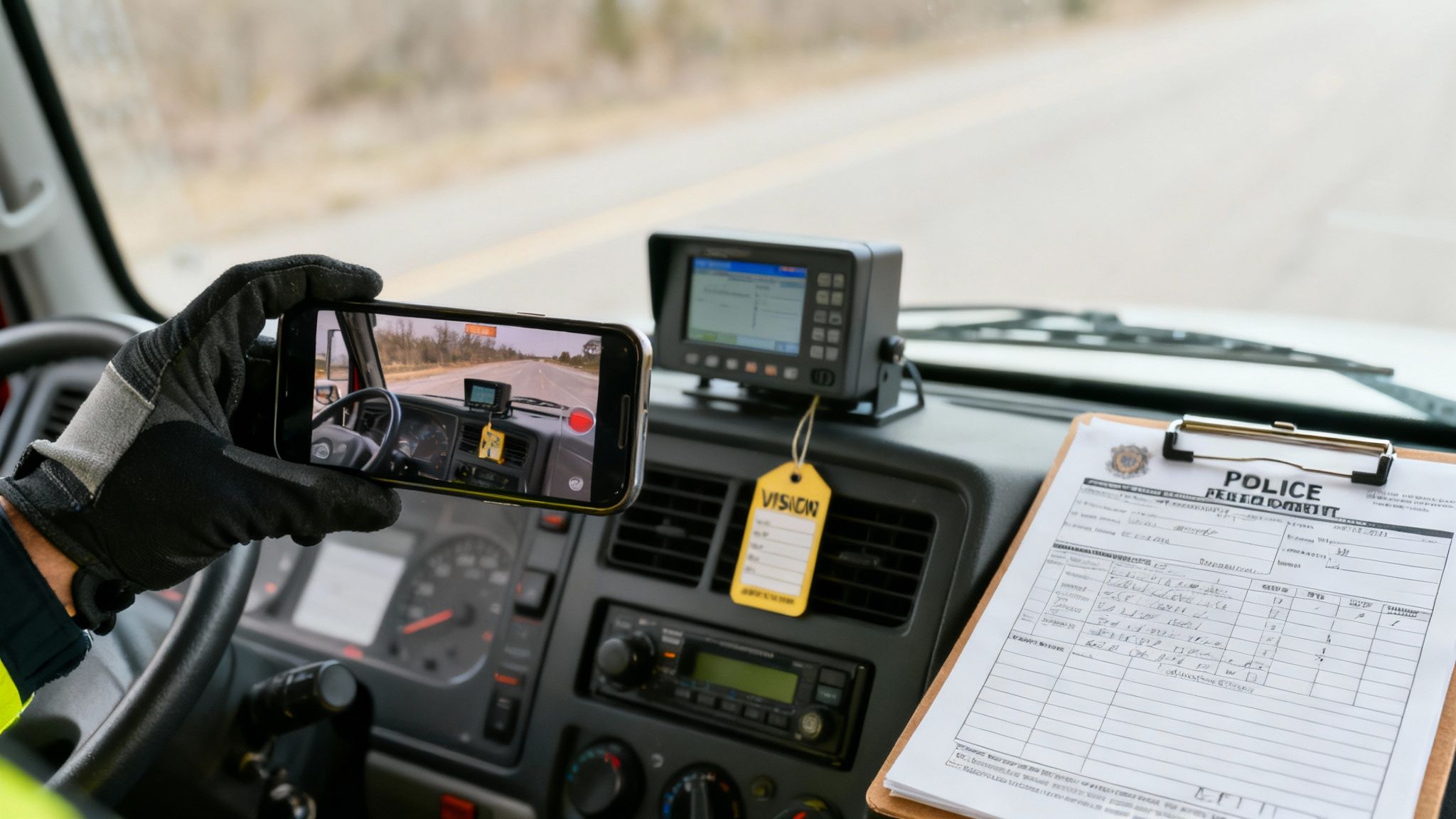
A successful truck accident claim is built on solid evidence. This isn't like a typical car wreck where a police report and a few photos might be enough. The moment a commercial truck crash happens, the trucking company and its insurance carrier launch their own investigation—one designed to protect their profits, not you.
This is why acting fast to preserve evidence is one of the most important things you can do. In a commercial truck crash, some of the most critical proof can be legally destroyed in a surprisingly short time. Building a powerful case means knowing what to look for and how to secure it before it vanishes. The importance of evidence in any legal fight can't be overstated.
The Spoliation Letter: Your First Line of Defense
One of the first tools a Houston car accident lawyer will use is a spoliation letter. This is a formal legal notice sent to the trucking company, ordering them to preserve every piece of potential evidence related to the crash.
This letter legally stops the company from destroying, altering, or "losing" crucial records as part of its normal policies. If they ignore this notice, they can face serious penalties from the court.
A spoliation letter acts as your legal shield. It ensures the proof you need to win your case—from black box data to driver logs—is protected and ready for your legal team to analyze.
The Key Evidence in a Trucking Claim
The proof needed to establish negligence in a truck accident goes beyond what you see at the scene. Your attorney will immediately move to get a wide range of documents and data from the trucking company.
Here are some of the most critical pieces of the puzzle:
- The Truck's "Black Box" Data: This device, an Event Data Recorder (EDR), is a goldmine. It captures the truck's speed, whether the brakes were applied, steering angles, and other hard data that can prove what the driver did in those final seconds.
- Driver's Logs: Federal law requires truckers to keep detailed logs of their driving and rest hours. These logs can instantly show if the driver was breaking hours-of-service rules, often pointing to driver fatigue as a key factor in the crash.
- Maintenance and Inspection Records: Trucking companies must keep their rigs safe through regular inspections and maintenance. These records can reveal if the company cut corners on necessary repairs, like fixing worn-out brakes or replacing bald tires, which could have directly caused the accident.
Building Your Case, Piece by Piece
Beyond the trucking company's files, a thorough investigation involves gathering proof from every possible source to paint a clear picture of what happened and who is to blame.
Your legal team will collect and analyze:
- The Official Police Report: This gives the officer's initial assessment of the accident, including diagrams, witness information, and any tickets issued.
- Witness Statements: Independent witnesses can provide unbiased accounts that are incredibly persuasive. A skilled investigator knows how to find these people and get their testimony on the record.
- Scene Photos and Videos: Any pictures you took at the scene are priceless. Your legal team may also bring in accident reconstruction experts to create detailed diagrams showing exactly how the collision unfolded.
- Driver Qualification File: Trucking companies must keep a detailed file on every driver containing their employment history, driving record, drug and alcohol test results, and training records. It can expose a pattern of unsafe driving or a lack of proper qualifications.
Pulling together this mountain of evidence is a massive undertaking. It takes legal know-how and resources to hold negligent trucking companies accountable and win the full compensation you and your family deserve.
How To Calculate Your Claim's True Value
After a truck accident, the scale of your losses—financial, physical, and emotional—can feel overwhelming. While no amount of money can erase the trauma, understanding how your claim is valued is a critical step in rebuilding your life. The legal term for what you can recover is damages, and it goes far beyond your initial medical bills.
In Texas, the goal of a truck accident claim is to make you "whole" again. This means calculating and recovering compensation for every single way the crash has impacted your world.

Economic Damages: The Tangible Costs
The most straightforward part of any claim is adding up the economic damages. These are the specific, provable financial losses you’ve incurred because of the accident. Think of them as the bills and receipts that start piling up from day one.
These costs form the foundation of your claim’s value and typically include:
- Medical Expenses: This covers everything from the ambulance ride and ER visit to surgery, physical therapy, medications, and any future care you'll need.
- Lost Wages: If you couldn't work while recovering, you can claim that lost income. This also includes "loss of future earning capacity" if your injuries prevent you from returning to your old job.
- Property Damage: This is the cost to repair or replace your vehicle and any other personal items destroyed in the crash.
Real-World Example: A Houston driver rear-ended on I-45 by a semi-truck suffers a severe back injury requiring surgery and months of rehab. His economic damages would include all his medical bills plus the six months of wages he lost because he couldn't perform his physically demanding job.
Non-Economic Damages: The Human Cost
But what about the losses you can't put a price tag on? Non-economic damages are designed to compensate you for the immense personal and emotional toll the accident has taken. These invisible injuries are just as real and devastating. They include compensation for:
- Pain and Suffering: The physical pain and discomfort from your injuries.
- Mental Anguish: The emotional trauma, anxiety, depression, or PTSD that often follows a violent crash.
- Physical Impairment: Compensation for no longer being able to do daily activities or hobbies you once took for granted.
- Disfigurement: Compensation for scars or other permanent changes to your appearance.
For families who have lost a loved one, a wrongful death claim also seeks wrongful death compensation for the loss of companionship and the profound void left behind.
To make these terms clearer, here’s a simple breakdown of the different types of compensation you can pursue.
Understanding Compensation in a Texas Truck Accident
| Type of Damage | What It Covers | Example |
|---|---|---|
| Economic | Tangible, out-of-pocket financial losses with a clear dollar value. | Hospital bills, lost paychecks, car repair invoices. |
| Non-Economic | The intangible, personal impact on your quality of life. | Chronic pain, emotional distress, loss of enjoyment of life. |
| Exemplary (Punitive) | A penalty for the defendant's extreme negligence or malice. | A trucking company knowingly using a truck with faulty brakes. |
This table shows how the law accounts for every aspect of your suffering, ensuring you're compensated for both the financial and human costs.
Exemplary Damages: Punishing Extreme Negligence
Under Chapter 41 of the Texas Civil Practice & Remedies Code, there’s a third, rarer category: exemplary damages (also known as punitive damages). These are not about compensating you for a loss. Instead, they are meant to punish the at-fault party for truly outrageous behavior and deter others from doing the same.
Exemplary damages are only awarded in cases where the defendant’s conduct was especially reckless or malicious. For instance, if a trucking company was caught intentionally falsifying maintenance logs, a jury might award exemplary damages to make an example out of them. Proving this level of gross negligence requires digging for hard evidence of systemic failures, which is why driver errors are a factor in about 87% of all truck collisions. You can find more details in these truck accident claim statistics.
Navigating Critical Texas Laws and Deadlines
When you're dealing with the aftermath of a serious truck wreck, the legal system can feel like a maze. But it’s a maze with strict rules and deadlines that can either protect your rights or completely shut down your chance at recovery. You simply can't afford to ignore them. Two Texas laws, in particular, play a huge role in your ability to get the compensation you deserve.
The Two-Year Statute of Limitations
In Texas, you only have a limited window of time to file a lawsuit after being injured. This deadline is called the statute of limitations. For most personal injury cases, including truck accidents, it is two years from the date of the crash.
That might sound like a lot of time, but it disappears quickly when you’re focused on healing. If you miss this two-year deadline, you will almost certainly lose your right to ever seek compensation for your injuries. The court will dismiss your case, no matter how strong it is.
Why the Deadline Matters: This isn't a suggestion; it's a hard legal cutoff. Insurance companies know this rule and will often drag out settlement talks, hoping you’ll run out of time and lose all your leverage.
Waiting also puts your case at a disadvantage. Evidence disappears, witnesses’ memories fade, and conducting a proper investigation becomes nearly impossible. To learn more about this critical deadline, see our guide on the statute of limitations for a car accident in Texas.
Understanding Texas Comparative Fault
The second critical rule is Texas’s law on shared fault, known as comparative fault or proportionate responsibility, found in Chapter 33 of the Texas Civil Practice & Remedies Code. This legal concept determines how compensation is divided when more than one person is blamed for an accident.
Under this law, you can still recover damages even if you are found partially at fault. However, your total compensation will be reduced by your percentage of fault. For instance, if a jury awards you $100,000 but finds you were 20% responsible, your final recovery is cut to $80,000.
But there's a strict 51% bar.
- The 51% Bar Rule: If you are found to be 51% or more at fault for the accident, you are completely barred from recovering any compensation. You get nothing.
The trucking company’s insurance adjuster will try to exploit this rule. They will dig for any reason—no matter how small—to shift blame onto you. Their goal is simple: push your percentage of fault over that 50% line so they can deny your claim. In 2023, Texas reported 20,537 large truck crashes, the highest number of any state. This is why having a skilled Texas injury attorney is so critical. A good lawyer fights back against these unfair blame-shifting tactics, using hard evidence to protect your right to a fair recovery.
Truck Accident Claims: Your Questions Answered
When you're trying to heal after a serious truck accident, the legal side of things can be overwhelming. You probably have many questions. We've put together straightforward, compassionate answers to the questions we hear most often from victims and their families in Texas. Our goal is to give you clear, practical information so you can feel more in control.
What Should I Do If the Trucking Company’s Insurer Calls Me?
Be extremely careful. The insurance adjuster's job is to protect their company by paying as little as possible on your claim. They might sound friendly, but they are trained to ask questions designed to get you to say something that weakens your case.
Never agree to give a recorded statement without talking to a Texas injury attorney first. You can be polite—just take the adjuster's name and number and tell them your lawyer will be in touch. Saying too much can seriously hurt your chances of getting fair compensation.
How Much Does It Cost to Hire a Truck Accident Lawyer?
Most reputable personal injury law firms, including ours, work on a contingency fee basis. This means you pay no upfront costs to hire an experienced Houston car accident lawyer. Your attorney’s fee is simply a percentage of the money they win for you, whether through a settlement or a jury verdict.
If you don’t win your case, you owe nothing in attorney fees. This system ensures that anyone, regardless of their financial situation, can get expert legal help.
Just make sure you ask for a clear, written explanation of the fee agreement during your free case evaluation.
Should I Still File a Claim If My Injuries Seem Minor?
Absolutely. It’s always a good idea to get a full medical check-up and talk to an attorney, even if you feel okay. Some of the most serious injuries, like traumatic brain injuries or internal damage, don't show obvious symptoms for days.
If you accept a quick, lowball settlement before you know the true extent of your injuries, you'll lose the right to seek more money if your condition gets worse. Filing a claim protects your ability to cover all your medical care—both now and in the future. A free consultation can help you understand your options without any pressure.
How Long Will It Take to Resolve My Truck Accident Claim?
There’s no one-size-fits-all answer. The timeline for a truck accident claim depends entirely on the specifics of what happened.
- A straightforward claim where liability is clear and injuries are moderate might settle within a few months.
- A complex case involving catastrophic injuries, multiple at-fault parties, or a dispute over fault could easily take a year or more, especially if it goes to court.
It’s tempting to take a fast payout when bills are piling up, but your legal team’s main goal is to make sure you get full and fair damages for everything you've lost. A good lawyer will give you a realistic timeline and fight to get you the best possible outcome, not just a quick settlement. Your long-term well-being is what matters most.
The aftermath of a commercial truck accident is incredibly challenging, but you don’t have to go through it alone. The dedicated legal team at The Law Office of Bryan Fagan, PLLC is here to answer your questions, protect your rights, and fight for the full compensation you need to rebuild your life. We handle every detail of your claim so you can focus on the most important thing: your recovery. Contact us today for a free, no-obligation consultation to learn how we can help.