Losing a family member in a preventable accident can change your life in seconds—but you don’t have to face recovery alone. The sudden loss is an unimaginable tragedy, leaving you grappling with profound grief and terrifying financial uncertainty. While no amount of money can ever replace your loved one, a wrongful death claim offers a legal path forward—a way to find stability and hold the responsible party accountable. This guide is here to provide clear, compassionate answers about wrongful death settlement amounts in Texas, walking you through how compensation is determined.
Finding Financial Stability After a Tragic Loss

When you're grieving, the last thing you should have to worry about is money. Yet, the financial fallout from losing a family member—especially a primary provider—can be immediate and overwhelming. A wrongful death claim is a legal tool designed to address this very burden.
This legal action allows surviving family members, like a spouse, children, or parents, to seek compensation for the staggering losses they've been forced to endure. The goal isn’t just to cover immediate expenses but to lay a foundation for your family’s future, providing a measure of security in a world that’s been turned upside down.
What Does a Settlement Aim to Cover?
A settlement is meant to provide financial relief for both the tangible, calculable losses and the deeply personal, intangible ones your family now faces. It's about trying to restore the financial position you would have been in if the tragedy had never happened.
Key areas of wrongful death compensation typically include:
- Lost Earning Capacity: This covers the income your loved one would have earned over their lifetime. It’s the money that would have paid the mortgage, covered daily living expenses, and funded future plans.
- Loss of Companionship and Support: This acknowledges the profound, personal void left behind—the loss of guidance, love, and emotional support that your family member provided. You can't put a number on it, but the law recognizes its immense value.
- Mental and Emotional Anguish: This is compensation for the grief, sorrow, and deep emotional pain that you and your family are forced to endure.
- Funeral and Burial Expenses: A settlement helps cover the immediate and often significant costs of laying your loved one to rest with dignity.
Understanding these components is the first step toward recognizing the true value of your claim. This process isn’t about putting a price on a life; it’s about securing the justice and financial resources your family needs to move forward.
As you plan for the long term, learning how to choose a financial advisor who understands your family's unique situation can be incredibly helpful. You don't have to navigate this path alone.
What Is a Wrongful Death Claim in Texas?
When you lose someone you love, the last thing you want to deal with is a confusing legal system. In Texas, a wrongful death claim is a specific kind of civil lawsuit that can provide a path to justice when a person's death was caused by the carelessness or wrongful actions of someone else.
Think of it this way: if your loved one could have filed a personal injury lawsuit for their injuries had they survived, then certain family members have the right to file a wrongful death claim in their place. This isn't about revenge; it's about holding the responsible party accountable and securing financial stability for the family left behind.
Who Is Liable for a Wrongful Death?
For a claim to be successful, you have to prove that another person or company was legally responsible—or liable—for the death. In plain English, liability means being legally at fault. This all boils down to a legal concept called negligence.
Negligence simply means that someone failed to act with reasonable care, and that failure directly caused the fatal accident. It’s not about malicious intent. It’s about the devastating consequences of carelessness.
A tragic, real-world example is a fatal truck accident on a highway like I-10 in Houston. Imagine a trucking company pressures a driver to meet an impossible deadline. That fatigued driver then causes a deadly collision. In that scenario, both the driver and their employer could be found negligent and held liable for the death. Pinpointing the exact cause of death is crucial, and understanding how medical evidence establishes liability is key, especially in cases involving private autopsies due to wrongful death cases.
Who Can File a Wrongful Death Lawsuit in Texas?
The Texas Civil Practice & Remedies Code is crystal clear about who can bring a wrongful death claim. The law reserves this right for the deceased person's closest family members:
- The surviving spouse
- The children (including legally adopted children)
- The parents
These family members can file the lawsuit on their own or file it together as a group. If none of these relatives step forward to file a claim within three months of the death, the law then allows the personal representative or executor of the deceased's estate to file the claim instead.
The Critical Two-Year Deadline
It is absolutely crucial to know that the clock is ticking. Texas law puts a strict time limit on filing a wrongful death lawsuit, which is known as the statute of limitations.
In most situations, the family has exactly two years from the date of their loved one's death to file the lawsuit. If you miss this deadline, the court will almost certainly throw your case out, and you will lose your right to seek justice forever.
This two-year window is precisely why you should speak with an experienced Texas injury attorney as soon as you possibly can. A lawyer can handle the legal deadlines and complexities, allowing your family to focus on what matters most: grieving and healing.
How Wrongful Death Settlement Amounts Are Calculated
When your family is reeling from an unimaginable loss, asking "how much?" isn't about greed. It's about survival. You're trying to figure out if a settlement will cover the mortgage, secure your children's future, and provide some stability while you learn to live without your loved one.
There’s no simple formula. The process starts by taking a hard look at the specific losses your family has suffered. In Texas, these losses are called damages.
In Texas, these damages fall into two main buckets: economic damages and non-economic damages. Think of it like building a house. Economic damages are the concrete foundation—the measurable, financial losses. Non-economic damages are the walls and the roof; they give shape to the profound, personal suffering your family is going through. Both are absolutely critical to show the full picture of your claim.
The Financial Foundation: Economic Damages
Economic damages are all about the tangible financial support your loved one would have provided. These are the losses with a clear dollar amount attached, figured out using evidence like pay stubs, tax returns, and projections from financial experts.
A skilled Houston wrongful death lawyer will meticulously pull all of this documentation together to build the strongest possible case for your family's financial future.
These damages typically include:
- Lost Earning Capacity: This is usually the biggest piece of the puzzle. It’s the total income your loved one would have earned for the rest of their working life, including wages, bonuses, and benefits.
- Loss of Inheritance: This calculation estimates how much your loved one's estate would have likely grown and eventually been passed down to their heirs.
- Medical Expenses: Any medical bills that piled up between the time of the accident and your loved one's passing are included here.
- Funeral and Burial Costs: These are the immediate, out-of-pocket expenses for laying your loved one to rest.
This infographic gives a simple visual breakdown of how these different types of damages come together to form the final wrongful death compensation.
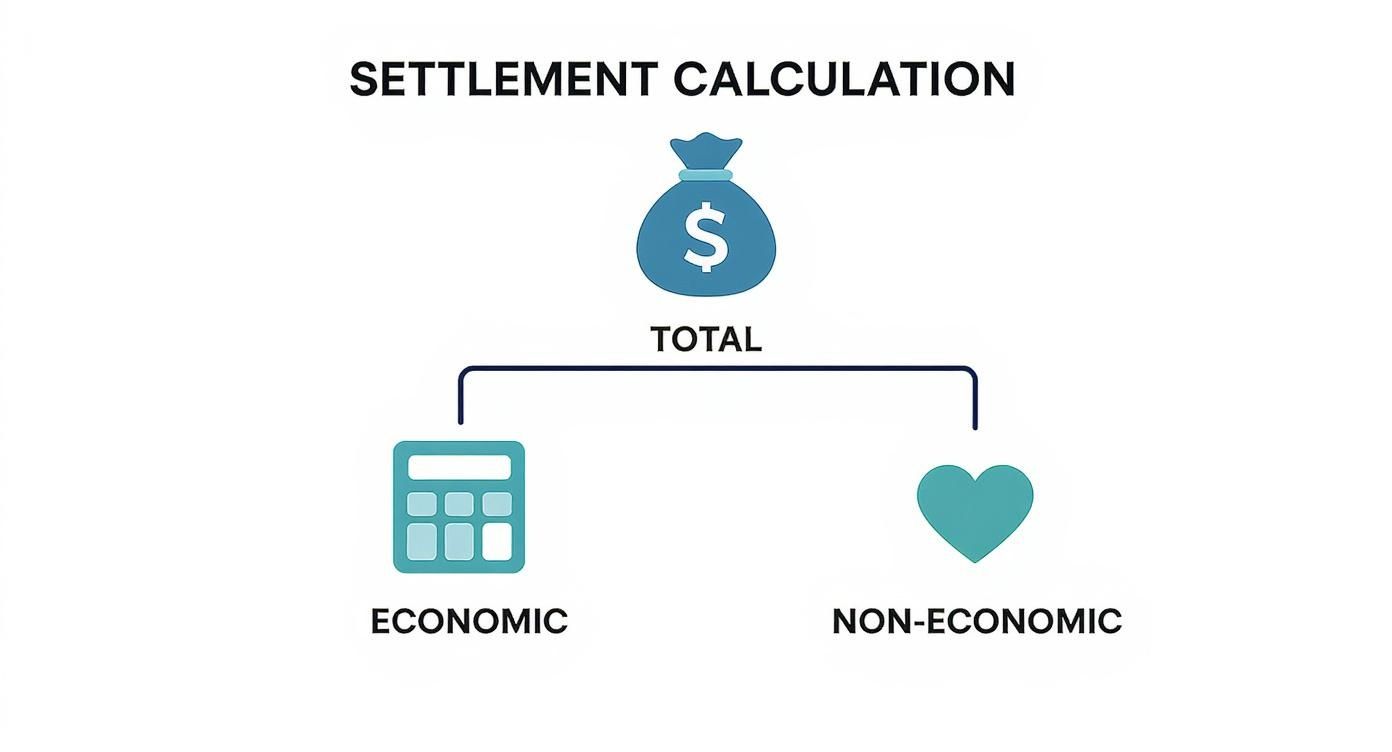
As you can see, a total settlement is a combination of these real financial losses and the equally real, but less tangible, personal losses.
To give you a clearer idea of what these damages look like in practice, here’s a breakdown of the types of compensation a family can pursue in a Texas wrongful death claim.
| Type of Damage | What It Covers | Example |
|---|---|---|
| Lost Earning Capacity | The income and benefits the deceased would have earned. | A 40-year-old Houston engineer's future salary, bonuses, and retirement contributions. |
| Loss of Services | The value of household tasks the deceased performed. | Childcare, home maintenance, cooking, and financial management. |
| Medical Expenses | Bills for treatment between the injury and death. | Ambulance ride, hospital stays, surgeries, and end-of-life care. |
| Funeral & Burial Costs | Expenses for final arrangements. | Casket, funeral service, cremation, and burial plot. |
| Mental Anguish | The emotional pain and grief of surviving family members. | A spouse's suffering from losing their life partner. |
| Loss of Companionship | The loss of the deceased's unique love and society. | A child growing up without a parent's presence and comfort. |
| Loss of Inheritance | The assets the family would have inherited. | The projected value of the deceased's estate upon natural death. |
This table covers the core components, but every family's story is unique, and other factors can come into play.
The Personal Impact: Non-Economic Damages
While the financial losses are easier to add up on a calculator, it's the personal losses that are often the most devastating. Non-economic damages are meant to compensate your family for the deep emotional and relational void left by your loved one’s death.
No amount of money can ever fix this, but the law recognizes that this suffering has immense value.
These damages are deeply personal and change dramatically from one case to the next. They require telling your family's unique story to show the true depth of your loss. A compassionate attorney helps put this suffering into words that insurance companies and juries can understand.
Common non-economic damages include:
- Loss of Companionship and Society: For the loss of the unique love, comfort, and friendship your loved one provided.
- Mental Anguish: For the grief, sorrow, and emotional trauma suffered by the surviving family.
- Loss of Consortium: A specific claim for a surviving spouse, covering the loss of the intimate marital relationship.
- Loss of Guidance and Nurture: For surviving children who have lost a parent's advice, support, and guidance through life.
Looking at the U.S. as a whole, wrongful death settlements often range from $500,000 to several million dollars. The final amount depends heavily on the specifics of the case and the financial impact on the family. When a case involves extreme negligence or criminal behavior, the payouts can be much higher due to punitive damages, which are meant to punish the wrongdoer and prevent it from happening again.
The highest settlements are often seen in medical malpractice or catastrophic accident claims where the person who died was the main breadwinner or suffered terribly before their passing.
While every case is different, the basic ideas behind calculating damages in a wrongful death claim are similar to other personal injury cases. For more context, you can check out our guide on car accident settlement amounts here in Texas.
Understanding National Settlement Averages
When you’re grappling with the grief of losing a loved one, it’s completely natural to search for some kind of frame of reference. Looking at national settlement data can give you a helpful, big-picture view of what’s possible and remind you that your family isn't alone in this fight.
While every wrongful death claim is deeply personal, these numbers help set the stage.
The goal here isn't to put a price tag on your loss. It's to understand the wide range of potential outcomes, which can go from significant six-figure amounts all the way up to multi-million dollar awards. This massive range proves just how much the specific details of a case really matter.
These figures aren't just pulled out of thin air. They’re the direct result of the core factors of any case: the strength of the evidence proving negligence, the tangible financial losses your family has suffered, and the insurance limits of the at-fault party.
What the Data Shows
Across the country, wrongful death settlements can look very different depending on state laws and the specifics of the tragedy. But the data gives us a window into what courts and insurance companies typically consider fair compensation in various situations.
California, for instance, offers a useful snapshot. Based on hundreds of cases between 2019 and 2024, the average wrongful death settlement was about $973,054. But the median amount—which often gives a more realistic picture—was closer to $294,728. This shows how a handful of massive settlements can pull the average way up. As you can discover more insights about these case findings, it becomes crystal clear that the strength of the evidence is a huge driver of value.
A settlement is more than just a number; it’s a reflection of a family's story. It represents lost income, future security, and the profound, irreplaceable loss of a loved one’s presence. An experienced attorney's job is to tell that story with clarity and conviction.
This data highlights a critical point: the stronger the case, the higher the potential settlement.
- Low-Strength Cases: These might involve shared fault or weaker evidence and often settle in the $100,000 to $500,000 range.
- Moderate-Strength Cases: With clearer liability and significant damages, these cases can range from $500,000 to $1.5 million.
- High-Strength Cases: When gross negligence and catastrophic financial loss are involved, these settlements can soar past $10 million.
It’s easy to see why a thorough investigation and a powerful legal strategy are so essential.
Why Texas Averages Can Differ
While national figures give you context, it’s crucial to remember that Texas plays by its own rules. Our state has specific laws that directly influence wrongful death compensation.
The way Texas courts calculate damages—especially for non-economic losses like mental anguish and loss of companionship—can lead to very different outcomes than you might see in other states.
On top of that, Texas juries in places like Houston or Dallas may assign different values to these intangible losses based on the unique circumstances presented at trial. This is where having a local Texas injury attorney who understands the tendencies of local courts and insurance adjusters becomes a powerful advantage for your family.
Ultimately, these averages are just a guidepost. They confirm that a substantial financial recovery is absolutely achievable when negligence is proven and a case is skillfully presented. Your family’s story is unique, and the only way to understand the true potential value of your claim is through a detailed evaluation with an attorney.
Factors That Can Push a Settlement Value Higher
While every wrongful death claim is profoundly significant, certain factors can dramatically increase the potential settlement amount. High-value cases often involve defendants with deep pockets and clear, undeniable evidence of extreme carelessness or even intentional harm.
Cases against large corporations or commercial entities, for instance, tend to yield higher settlements. This isn't just because they have more money; it's because they typically carry massive insurance policies and have significant assets, giving them the financial capacity to cover catastrophic losses.
High-Stakes Scenarios
Some types of accidents almost always carry the potential for larger wrongful death settlements simply because of the nature of the negligence involved.
- Commercial Truck Accidents: When a fatal crash involves a semi-truck or another commercial vehicle, it's not just the driver on the hook. The trucking company can be held liable for its driver's actions, cutting corners on training, or failing to maintain its fleet. For example, a Houston driver on I-45 could be killed by a tired truck driver, making the trucking company liable.
- Medical Malpractice: A surgeon's fatal error in the operating room or a hospital's negligent care is a profound betrayal of trust. The settlements in these cases reflect that breach and the immense loss it causes.
- Defective Products: If a loved one dies because a product was dangerously designed or manufactured, the corporation that put profits over people can be held accountable for the devastating consequences.
These situations often pit a grieving family against a powerful entity, making it absolutely critical to have a strong legal advocate fighting for you. While insurance is a huge piece of the puzzle, understanding the full scope of liability is key. You can learn more about insurance policy limits after a Texas car accident in our detailed guide.
Gross Negligence and the Role of Punitive Damages
Sometimes, the at-fault party's actions go far beyond a simple, tragic mistake. They show a conscious, shocking disregard for the safety and lives of others. In Texas, the law has a specific term for this: gross negligence. When this is proven, it opens the door to a powerful legal tool known as punitive damages.
Under Chapter 41 of the Texas Civil Practice & Remedies Code, punitive damages (sometimes called exemplary damages) serve a unique purpose. They aren't meant to compensate your family for your losses. Instead, they are designed to punish the defendant for their reckless behavior and send a crystal-clear message that this kind of conduct will not be tolerated in our community.
Think of a company that knew its product had a fatal defect but kept selling it anyway. Or a driver who causes a deadly crash while street racing at 100 mph. These aren't just accidents; they're choices that show an extreme degree of risk. Texas law allows juries to award punitive damages to deter anyone else from acting so recklessly.
Because their purpose is to punish and make an example, punitive damages can dramatically increase the total wrongful death compensation your family receives.
A powerful, real-world illustration of this is the litigation surrounding mesothelioma. Wrongful death settlements for this aggressive cancer, caused by corporate negligence in asbestos exposure, represent some of the largest compensation figures in the country. As of October 2025, over $5.3 billion has been awarded to families nationwide, with individual settlements frequently falling in the $1 million to $1.4 million range. These staggering numbers reflect the severe consequences when corporations are held accountable for their actions. You can discover more insights about these mesothelioma wrongful death lawsuits.
Steps to Take After a Wrongful Death

While you're grieving, the idea of launching a complex legal battle can feel impossible. This is where a compassionate and experienced Houston wrongful death lawyer steps in. Their job is to lift that heavy legal burden off your family's shoulders, giving you the space you need to focus on healing.
Think of an attorney as your advocate, your investigator, and your voice. They will manage every single part of the legal process—from filing the initial claim to fighting for a fair settlement—ensuring your family's rights are protected every step of the way.
Building Your Case From the Ground Up
The first thing a skilled attorney will do is launch a completely independent investigation into what happened. They won't just take the police report at face value. They dig much deeper to build an ironclad case proving the other party’s negligence was the direct cause of your loved one’s death.
This critical work involves practical, step-by-step actions:
- Gathering Evidence: Securing every relevant document, from official accident reports and medical records to crucial witness statements.
- Hiring Experts: Bringing in accident reconstructionists, medical professionals, and financial experts to provide powerful, credible testimony that backs up your claim.
- Calculating Full Damages: Collaborating with economists to project the complete financial impact on your family, including lost future income, benefits, and services.
This painstaking preparation is what turns a tragic event into a powerful legal case. It sends a clear message to the insurance company that your family is serious about getting justice.
An attorney’s most important job is to tell your loved one’s story. They translate your family's immense loss into a clear, persuasive legal argument that demonstrates the full value of your wrongful death compensation.
Fighting for a Fair Settlement
Once the evidence is compiled, your lawyer takes over all communications with the at-fault party’s insurance company. Insurance adjusters are trained negotiators whose main goal is to pay out as little as possible on an auto insurance claim. Having a skilled attorney in your corner completely levels the playing field.
Your lawyer will:
- File all necessary legal claims and make sure every deadline under the Texas statute of limitations is met.
- Negotiate aggressively for a settlement that truly reflects your family’s total losses—both the financial and the emotional ones.
- Protect you from lowball offers and the common tactics insurance companies use to undervalue claims.
- Prepare to go to trial if the insurance company refuses to make a fair offer, showing them you are ready to fight.
Dealing with insurance companies is incredibly stressful, which is why having an expert handle it is so important. For more guidance, you can explore our advice on how to deal with insurance adjusters and protect your rights from the start.
You don’t have to walk this path alone. A dedicated Texas injury attorney can provide the support, guidance, and aggressive representation your family needs to secure the financial stability you deserve.
Frequently Asked Questions About Wrongful Death Claims
When your family is reeling from the sudden, unimaginable loss of a loved one, the legal process can feel like the last thing you want to think about. It's completely normal to have questions and feel lost about what comes next. To help bring some clarity during this incredibly difficult time, we've answered a few of the most common questions our clients ask us about wrongful death claims in Texas.
Our goal is to give you straightforward, compassionate answers that empower you with the information you need. Understanding your rights is the first step toward seeking justice for your loved one.
How Long Do We Have to File a Wrongful Death Lawsuit in Texas?
This is one of the most critical questions because the answer involves a strict, non-negotiable legal deadline. In Texas, the statute of limitations for a wrongful death claim is generally two years from the date of your loved one's death.
If you miss this two-year window, you will almost certainly lose your right to seek compensation forever. While a few very rare exceptions exist, it's absolutely vital to act quickly to protect your family’s rights. This deadline is exactly why you should speak with a Houston car accident lawyer as soon as you feel able.
Will We Have to Go to Court for Our Claim?
The thought of a long, painful court battle can be daunting. The good news? Most wrongful death cases never actually see the inside of a courtroom. The vast majority of these claims are settled through negotiations directly with the at-fault party's insurance company.
An experienced Texas injury attorney will handle all of these negotiations for you, fighting for a fair settlement that covers your family's full range of losses. Of course, if the insurance company refuses to make a fair offer, your lawyer must be ready and willing to file a lawsuit and take your case to trial to get the justice you deserve.
What Is the Difference Between a Wrongful Death Claim and a Survival Action?
This is a common point of confusion, and for good reason—they are two distinct legal actions that often get filed together. The key is that they compensate for different types of losses.
A wrongful death claim is for the family's loss. A survival action is for the deceased's suffering. Both are vital for achieving full justice.
Let’s break it down simply:
- Wrongful Death Claim: This claim is filed by the surviving family members (spouse, children, or parents) to compensate them for their own personal losses. Think of damages like lost financial support, devastating mental anguish, and the loss of companionship, love, and guidance.
- Survival Action: This claim is brought on behalf of the deceased person's estate. It’s meant to recover damages that the deceased personally would have been entitled to had they survived. This includes their own pain and suffering before they passed, medical bills they incurred, and any wages they lost between the injury and their death.
A skilled attorney can help your family figure out if you're eligible to pursue both types of claims, making sure every single aspect of your loss is accounted for.
At The Law Office of Bryan Fagan, PLLC, we know that no amount of money can ever replace what you have lost. However, securing fair compensation can provide the financial stability your family needs to begin moving forward. If you have lost a loved one because of someone else's negligence, your rights matter. Legal help is available, and you do not have to face this alone. Please contact us for a free, no-obligation consultation to discuss your rights. We are here to listen and help you explore your legal options.