A car crash can change your life in seconds, but you don't have to face recovery alone. If you were hurt on a Houston toll road, you may be dealing with pain, vehicle damage, medical bills, missed work, and an insurance company asking for answers before you know what happened. The legal question becomes more complicated when the roadway operator may share responsibility.
An HCTRA toll road crash claim involving governmental immunity in Houston usually follows one of two paths. The other driver may have caused the collision, or a roadway condition may have contributed. Those paths involve different defendants, different evidence, and different rules.
A Crash on a Houston Toll Road Raises a Different Legal Question
You're driving along the Sam Houston Tollway near the Westpark Tollway interchange during the morning commute. Traffic slows, the vehicle behind you doesn't, and the impact pushes your car forward. Your airbags deploy. Your child, seated in the back, says their neck hurts. Within minutes, you're speaking with 911, EMS, and HCTRA police while trying to understand why the EZ TAG-only lane created confusion around the crash scene.
At first, this looks like a familiar rear-end collision. The other driver may have been following too closely, distracted, or traveling too fast for traffic. In that situation, the central issue is usually whether the other driver's negligence caused your injuries and losses. A Hardy Toll Road accident lawyer can help investigate the driver's conduct, insurance coverage, and the evidence surrounding the wreck.
But the facts may point in another direction. Perhaps reflective lane markers were missing, overhead signage malfunctioned, or a drainage grate caused your vehicle to hydroplane. Maybe another driver made the final mistake, while a dangerous roadway condition reduced visibility or control. That changes the legal analysis because HCTRA is treated as a governmental entity.
The fork that determines your claim
A claim against another driver is generally built around negligence. You'll need evidence showing that the driver owed you a duty, violated that duty, and caused injuries and provable damages. A claim involving HCTRA must also overcome governmental immunity and fit within a specific legal waiver.
That distinction matters immediately. If the other driver clearly caused the wreck, HCTRA may not be the proper defendant merely because the crash occurred on a toll road. If a roadway defect, missing warning, or malfunction contributed, the claim may require a detailed analysis of the Texas Tort Claims Act.
Practical rule: Don't decide who to sue based only on where the crash happened. Identify what caused the crash, who controlled that condition, and what evidence proves it.
Your first priorities remain safety and medical care. Call 911, accept emergency treatment when offered, document the scene if you can do so safely, and avoid making a recorded statement about fault before you understand the facts. The roadway's condition can change quickly after a crash, so photographs, witness information, toll records, and video preservation may become important.
What Governmental Immunity Means for HCTRA Crash Claims
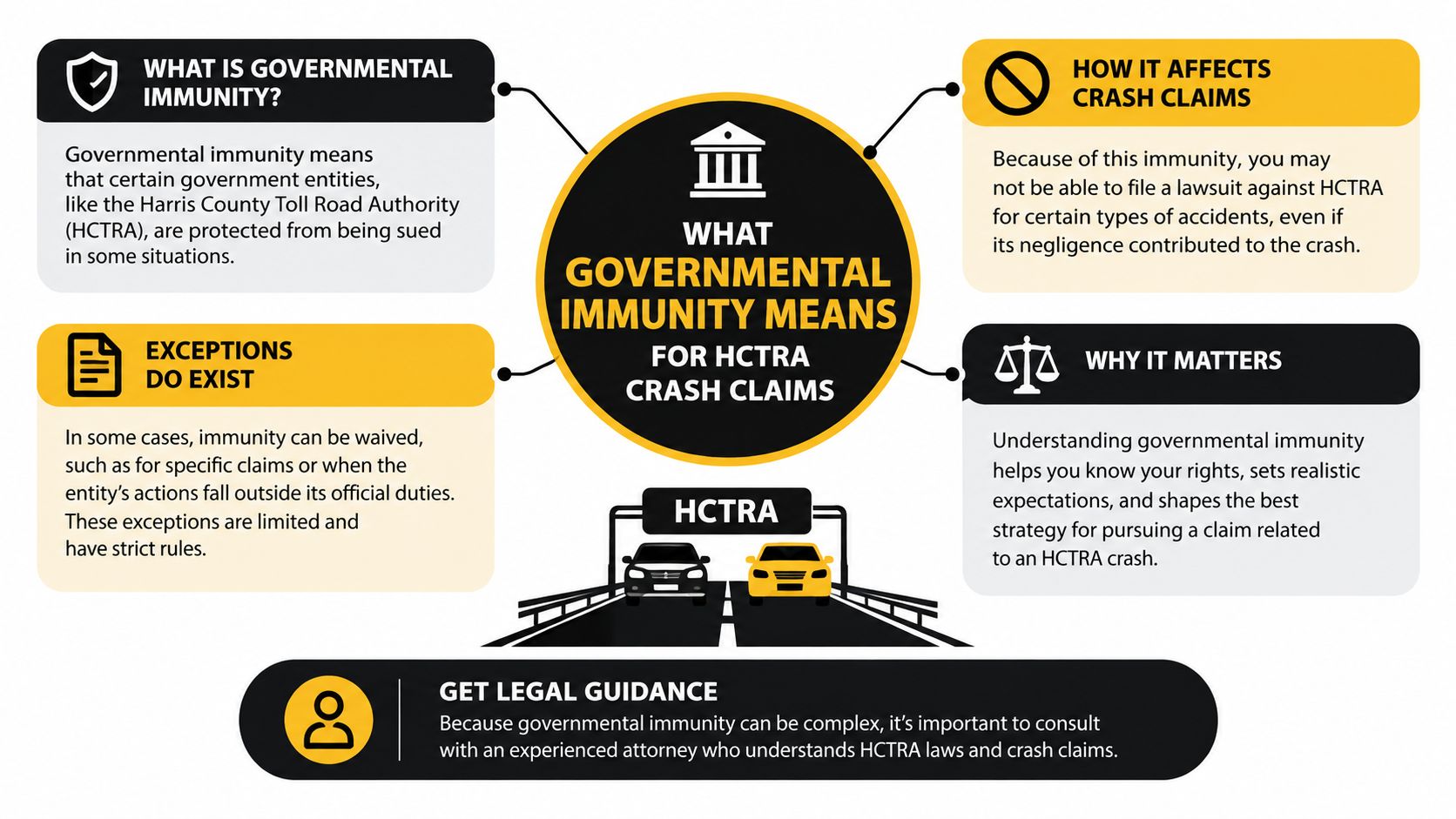
Governmental immunity is a legal protection that generally prevents a governmental entity from being sued for damages unless the Legislature has clearly waived that protection. In plain English, HCTRA isn't treated like a private toll-road company that can automatically be sued under ordinary negligence rules.
Texas courts treat HCTRA as a governmental unit. In Webber v. HCTRA, the court explained that governmental entities are “usually immune from both liability and suit,” and HCTRA asserted immunity through a plea to the jurisdiction. The Texas Court of Appeals opinion in Webber v. HCTRA illustrates why a claimant must identify a valid statutory pathway before a case can proceed.
What immunity changes
Without a waiver, a court may dismiss a claim before deciding whether HCTRA acted negligently. Liability means legal responsibility for the harm. Governmental immunity addresses a separate question, whether the government can be sued for that type of harm at all.
That's why an injured driver can have serious injuries and strong evidence of a roadway problem, yet still face a legal barrier. The claimant must connect the facts to an exception recognized by statute. Courts have rejected arguments that HCTRA waived immunity through its conduct alone, so ordinary fairness or participation in the claim process won't replace a clear legislative waiver. A Texas appellate decision addressing HCTRA's governmental immunity reinforces that point.
The rule doesn't mean an injured person has no rights. It means the claim must be placed in the correct legal category. The Texas Tort Claims Act supplies the principal route for certain motor-vehicle and roadway-condition claims, but it doesn't create a blanket right to recover for every crash or complaint about road design.
You should also distinguish HCTRA from other public entities. A Houston-area crash may involve HCTRA, Harris County, the Texas Department of Transportation, or a government employee. Each may have different notice procedures and defenses. A Houston Metro bus claim under the Texas Tort Claims Act can involve related immunity principles, but the responsible entity still must be identified precisely.
How the Texas Tort Claims Act Opens the Door to a Lawsuit
The Texas Tort Claims Act, found in Chapter 101 of the Texas Civil Practice and Remedies Code, provides limited waivers of governmental immunity. For an HCTRA crash, the two most important categories involve the operation or use of a motor vehicle and a dangerous condition of tangible real property.
A motor-vehicle claim may arise when a government employee negligently operates an HCTRA-owned or controlled vehicle and causes injury. A roadway-condition claim may involve a dangerous defect, a missing or inadequate warning, or another physical condition of the toll-road property. The facts must tie the injury to a recognized waiver, not just to a broad statement that the road was unsafe.
The two main legal pathways
The motor-vehicle pathway focuses on conduct behind the wheel. For example, if an HCTRA employee operating a vehicle negligently strikes your car, the claim may fall within the statutory waiver. The roadway-condition pathway is more technical. You may need evidence about the condition, HCTRA's knowledge, the time available to correct it, and whether a warning should have been provided.
A claim involving signs or warnings can require proof that the responsible governmental unit knew, or should have known, about the problem and failed to correct it within a reasonable time. Discretionary decisions, including many choices involving roadway design, traffic planning, funding, or repair priorities, may remain protected.
| Claim Type / Conduct | Suit Permitted? | Key Standard |
|---|---|---|
| Negligent operation of an HCTRA vehicle | Potentially | Injury must result from operation or use of a motor vehicle by a qualifying government employee |
| Dangerous physical roadway condition | Potentially | The condition must fit the statutory property waiver, with evidence concerning knowledge and failure to address the danger |
| Missing or defective warning device | Limited and fact-specific | The warning issue must satisfy the statutory requirements, including notice and reasonable time to respond where applicable |
| General roadway design or traffic-planning decision | Often protected | Discretionary decisions may remain within governmental immunity |
| A crash caused only by another private driver | Usually not an HCTRA claim | The evidence should point to the private driver's negligence and available insurance |
Why proof matters more than labels
Calling a pothole, drainage problem, or lane-marking issue “negligence” doesn't establish a waiver. You need photographs, maintenance records, prior complaints, witness accounts, inspection evidence, and reliable information about when the condition existed. HCTRA may argue it lacked notice, that the condition wasn't dangerous under the statute, or that a discretionary decision caused the situation.
Insurance issues can develop at the same time. Dealing With Insurers After a Houston Accident addresses how to protect an auto insurance claim from Houston-area insurance tactics, including requests for statements and efforts to shift blame. Keep the private-driver claim and the governmental-immunity analysis separate until the evidence shows how each party contributed.
Notice Deadlines and the Statute of Limitations You Must Meet
Timing can decide an HCTRA claim before a judge ever considers fault. Under the Texas Tort Claims Act, written notice generally must be provided within six months of the incident. Some Texas municipalities impose shorter local deadlines, and Houston-area guidance identifies notice periods as short as 90 days in some circumstances. Texas guidance on statutes of limitations explains why notice and lawsuit-filing deadlines must be treated as separate requirements.
The statute of limitations is the legal deadline for filing a lawsuit. For an ordinary Texas personal-injury claim, that period is generally two years from the date the crash injury occurs. The two-year rule doesn't replace a government-claim notice requirement. You can give notice and still miss the deadline to file suit, or file within two years and still lose the case because required notice was late or defective. Texas law on exemplary damages and related civil claims provides the statutory context for Chapter 41 claims, but deadline analysis should begin as soon as the crash occurs.
The deadline problems that cause lasting harm
A notice letter must reach the correct governmental entity or designated agent and describe the incident, location, injuries, and claimed responsibility with enough detail to permit investigation. Sending a report to the wrong office, omitting the roadway defect, or relying on a conversation with an officer may create a serious challenge.
You also shouldn't assume that settlement talks stop the clock. An insurance adjuster's promise to review records doesn't automatically extend a statutory deadline. Toll-road maintenance delays can create another trap because the physical condition may be repaired before you document it, while the notice period continues.
Take these steps within days:
- Get medical care. Tell the provider about every symptom, including delayed neck, back, or head pain.
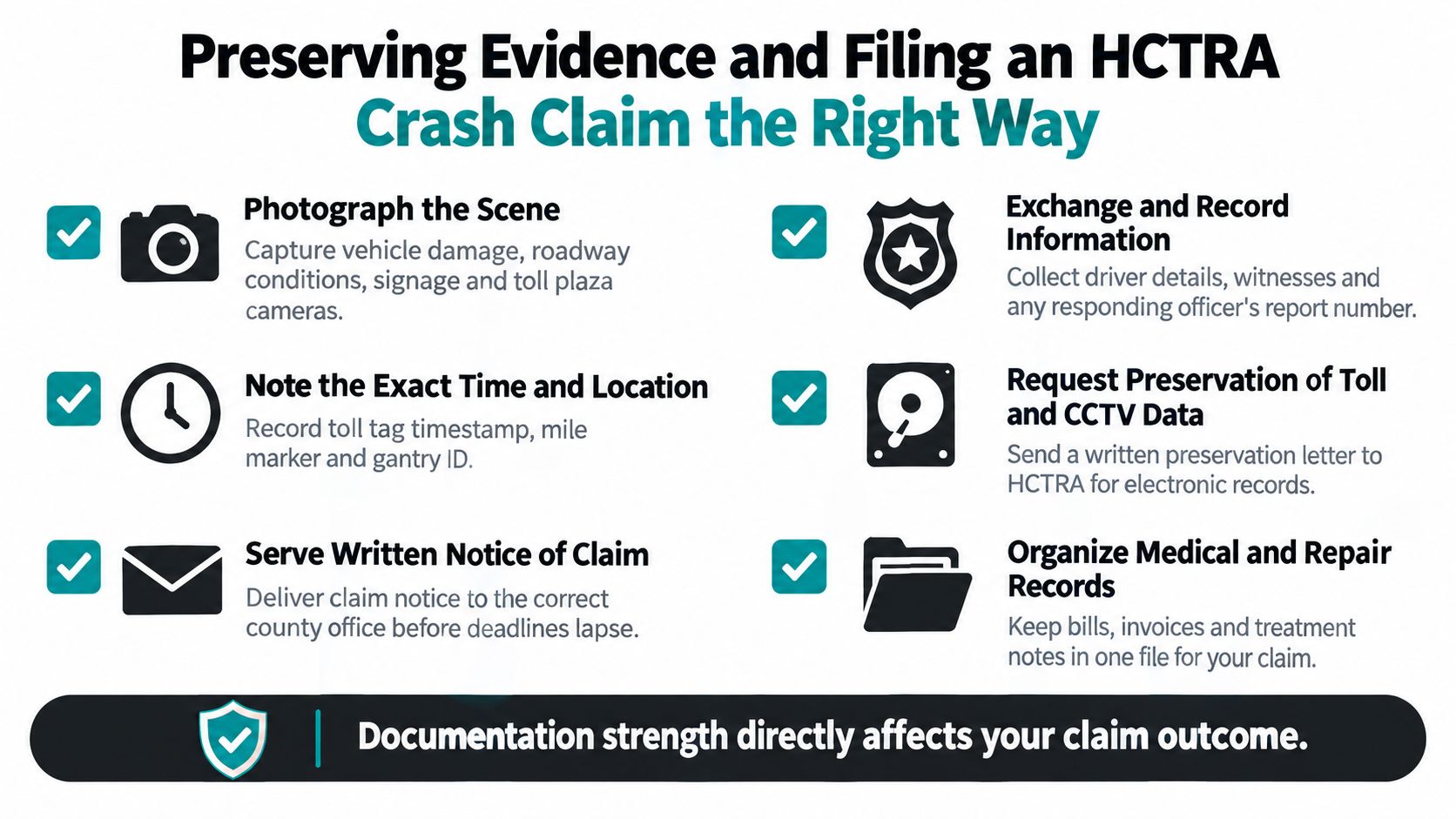
- Record the scene. Photograph vehicle damage, lane markings, signs, standing water, debris, lighting, and the precise location.
- Identify the public entity. Determine whether the road, vehicle, sign, or maintenance responsibility belongs to HCTRA, Harris County, or another agency.
- Preserve records. Keep the crash report, medical records, repair estimates, wage documentation, toll-tag information, and witness contacts.
- Seek legal advice quickly. A Texas injury attorney can assess notice requirements before an avoidable deadline expires.
If a fatal crash occurred, families may also need to examine personal-injury, survival, and wrongful death compensation issues. Filing an Injury Claim in Harris County Courts provides information about how personal-injury cases proceed in Harris County civil courts.
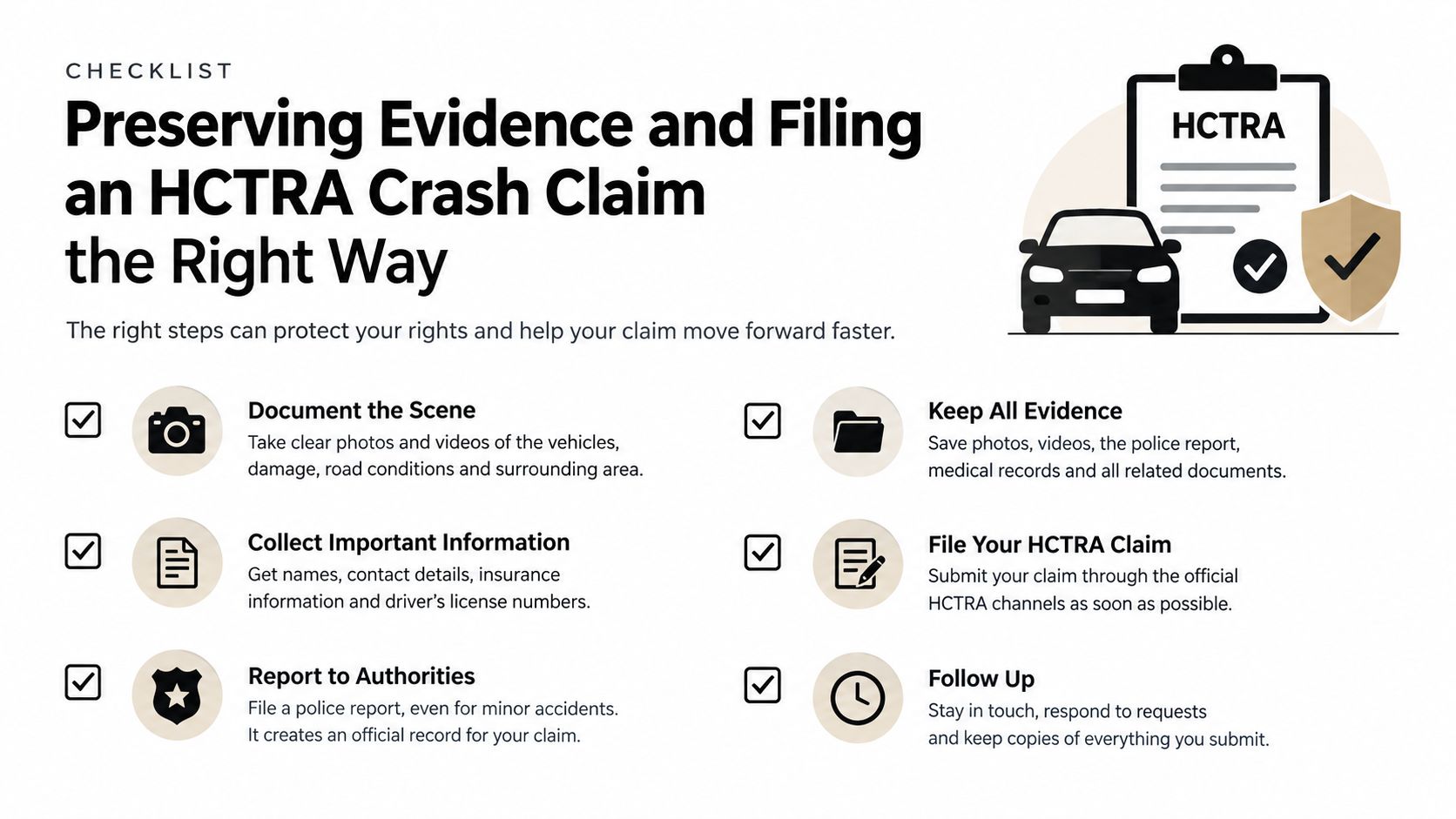
Preserving Evidence and Filing an HCTRA Crash Claim the Right Way
A strong HCTRA claim begins with a clear record of what happened. Your photographs should show more than the damaged vehicle. Capture the roadway from multiple angles, the approach to the hazard, nearby signs, lighting, lane markings, water or debris, and anything that would help another person understand the driver's view.
Build the evidence before it disappears
Request the crash report and preserve the responding officer's report number. Ask witnesses for names and contact details. Save cellphone videos, dashcam files, vehicle photographs, repair records, and medical paperwork in more than one location.
Toll-road evidence can be especially useful. EZ TAG logs, toll timestamps, gantry information, HCTRA camera footage, and other electronic records may help establish the exact location and sequence of events. Vehicle event data may also clarify speed, braking, or impact information, depending on the vehicle and the available record.
Send a written preservation request to HCTRA promptly. The request should identify the date, approximate time, road, direction, lane, location, and crash circumstances, and ask the authority to preserve relevant video, toll, maintenance, inspection, complaint, and dispatch records. A preservation letter doesn't prove the claim by itself, but it creates a clear request before electronic evidence is lost or overwritten.
Evidence matters: A repaired drainage grate doesn't erase the condition that existed during your crash. It does make timely photographs, witnesses, and maintenance records more important.
Prepare the administrative claim
A formal claim should identify the injured person, explain what happened, state the roadway location, describe the suspected dangerous condition or vehicle conduct, and outline the injuries and losses. Include supporting medical records, bills, repair documentation, wage information, photographs, witness information, and available crash reports.
HCTRA or its representatives may investigate and may deny the claim. A denial isn't the same as a court ruling that no negligence occurred. It means you must evaluate the denial, immunity defenses, notice compliance, available evidence, and the deadline for filing suit.
The legal classification matters here. Unsafe property conditions may call for a different analysis from a private premises case, such as the issues discussed in a Houston Slip and Fall / Premises Liability Lawyer resource. Don't submit an incomplete narrative that blames every possible party. State the facts accurately and let the evidence establish which legal pathway applies.
How Fault and Damages Shape What You Can Recover
Texas comparative fault rules can reduce or eliminate recovery even when another person or entity contributed to the crash. Comparative fault means the court assigns each responsible person a whole-number percentage of responsibility. Under Chapter 33 of the Texas Civil Practice and Remedies Code, a claimant who is found more than 50 percent responsible generally can't recover, as stated in the Texas proportionate-responsibility statute.
Suppose a Houston driver rear-ended on a toll road proves that another driver caused the collision, but the defense argues that the driver was speeding or failed to keep a proper lookout. The court may examine the conduct of the injured driver, the other driver, HCTRA, and any additional responsible party. If the injured driver is assigned 20 percent fault, the recoverable damages would generally be reduced to 80 percent of the provable total under Chapter 33.
Damages have different categories
Damages are the financial recovery awarded for legally recognized losses. Economic damages can include medical bills, future medical care, lost wages, and reduced earning capacity. Noneconomic damages can include physical pain, mental anguish, disfigurement, and impairment.
Punitive, or exemplary, damages are different. Chapter 41 generally limits exemplary damages in most cases to the greater of two times economic damages plus up to $750,000 in noneconomic damages, or $200,000, as described in the Texas Civil Practice and Remedies Code Chapter 41 source. Punitive damages are reserved for narrower circumstances, and they generally aren't available against a governmental unit. A private driver may face a different analysis, but you can't assume punitive damages will be awarded.
| Crash Scenario | Plaintiff Fault | Gross Damages | Applicable Cap | Estimated Net Recovery |
|---|---|---|---|---|
| Another driver causes a rear-end crash | 0% | Proven economic and noneconomic losses | Depends on the private claim and available coverage | Gross proven damages, subject to liability and insurance issues |
| Roadway defect contributes with a private driver | Assigned by the fact finder | Proven losses before reduction | Governmental limits may apply | Damages reduced by the assigned fault and affected by statutory limits |
| Claimant shares substantial responsibility | Greater than 50% | Proven losses | Recovery barred under Chapter 33 | No recovery from the claim under the statutory rule |
| Serious injury with a governmental defendant | Depends on evidence | Proven losses | Applicable governmental damages limits may restrict payment | Subject to fault allocation and the governing statutory limits |
The table uses qualitative outcomes where the available facts don't establish a specific governmental damages cap for the particular HCTRA claim. Don't confuse a large medical bill with a guaranteed recovery. Medical proof, wage records, future-care testimony, causation evidence, settlement credits, and payments from multiple defendants can all affect the final amount.
Why Early Legal Help Matters and How Bryan Fagan Can Guide You
HCTRA-related claims require more than proving that someone made a mistake. The defense may challenge the notice, argue that the roadway decision was discretionary, dispute whether HCTRA knew about the condition, assign fault to you, or invoke limits on recoverable damages.
An experienced Houston car accident lawyer should test those defenses early. That means identifying every potentially responsible party, preserving toll and camera data, examining maintenance and inspection records, reviewing the crash report, and sending legally sufficient notice to the correct entity. It also means separating a private-driver auto insurance claim from a governmental claim instead of allowing an insurer to use HCTRA's immunity as a reason to minimize all compensation.
What early representation can protect
A lawyer can help you:
- Classify the claim: Decide whether the evidence supports a private negligence claim, a Texas Tort Claims Act claim, or both.
- Protect the deadline: Track the notice period and the statute of limitations independently.
- Preserve roadway evidence: Request video, toll records, maintenance documents, and complaint histories before they become unavailable.
- Challenge blame shifting: Compare driver conduct with the roadway condition and determine how Chapter 33 may apply.
- Document damages: Organize medical treatment, lost income, repair costs, pain, and future needs.
- Evaluate settlement pressure: Review an insurer's offer before you sign away claims that may not be fully understood.
The Law Office of Bryan Fagan, PLLC handles Texas personal-injury and car-accident matters, including claims involving serious injuries, trucking collisions, uninsured or underinsured drivers, and fatal crashes. The firm's work on a toll-road case may include claim investigation, evidence preservation, notice preparation, insurance negotiations, and litigation when the legal requirements support it.
You shouldn't have to investigate governmental immunity while managing pain and caring for your family. A free consultation can help clarify who may be responsible, what deadlines apply, and what steps should happen next without promising an outcome that the evidence cannot support.
The Law Office of Bryan Fagan, PLLC offers free consultations for injured drivers and families evaluating HCTRA crash claims, private-driver negligence, insurance disputes, and wrongful death compensation. Visit The Law Office of Bryan Fagan, PLLC to discuss your crash, protect critical evidence, and understand your legal options before a notice or filing deadline passes.