Skip to content
A car crash can change your life in seconds, but you don't have to face recovery alone. If a METRORail train struck your vehicle at a Houston crossing, you may be dealing with pain, medical appointments, vehicle damage, lost income, and unanswered questions about who is responsible. The legal deadline may be moving faster than your recovery.
The phrase metro rail crossing crash claim Houston notice deadline points to the most important issue in these cases: you may have to notify the correct government entity long before the ordinary deadline for filing a lawsuit. The steps below can help you protect your rights, but contact a qualified Texas injury attorney promptly. A missed notice deadline can end a claim before a court ever considers the evidence.
Understanding the Two-Track Deadline System
You're driving through a Houston crossing when a rail vehicle hits your car. Perhaps the warning signal malfunctioned, the train operator failed to react, or another driver pushed you into danger. After emergency treatment, your attention naturally turns to surgery, rehabilitation, insurance calls, and getting your family through the next day.
That focus is understandable, but a public-transit crash creates two separate legal tracks. The first is the notice deadline, which requires written notice to the government entity within a short period. The second is the statute of limitations, meaning the legal time limit for filing a lawsuit.
Texas governmental-claim rules generally require written notice within six months of the incident, while the general Texas personal-injury limitations period is two years. Missing the notice step can defeat a claim even when the lawsuit deadline hasn't expired, as explained in this discussion of Texas statutes of limitations. For a Houston METRO case, the agency's own form sets a specific 180-day requirement, making early action essential.
Practical rule: Treat the crash date as the start of the legal process, not the date your treatment ends.
Why the longer lawsuit period can mislead you
A statute of limitations gives you time to file a lawsuit. It doesn't automatically give you the same amount of time to satisfy every earlier procedural requirement. Governmental entities receive special protections, and written notice is one of the conditions that can determine whether you may sue at all.
For example, you might believe that a two-year period gives you room to wait until doctors understand the full extent of your injuries. That approach can be dangerous. Your injury may still be developing while the shorter notice window closes.
Your first response should be immediate
Call 911, obtain medical care, preserve photos and video, and identify every potentially involved entity. Then speak with a Houston car accident lawyer who handles governmental claims. Don't assume the other driver's insurer will protect a claim against METRO, the City of Houston, a county, or another public body.
Your legal team should determine who operated the rail vehicle, who controlled the crossing, and where notice must be sent. It should also calendar both deadlines separately. That simple separation prevents a common and costly mistake: confusing the time to provide notice with the later time to file suit.
The Strict 180-Day METRO Notice Requirement
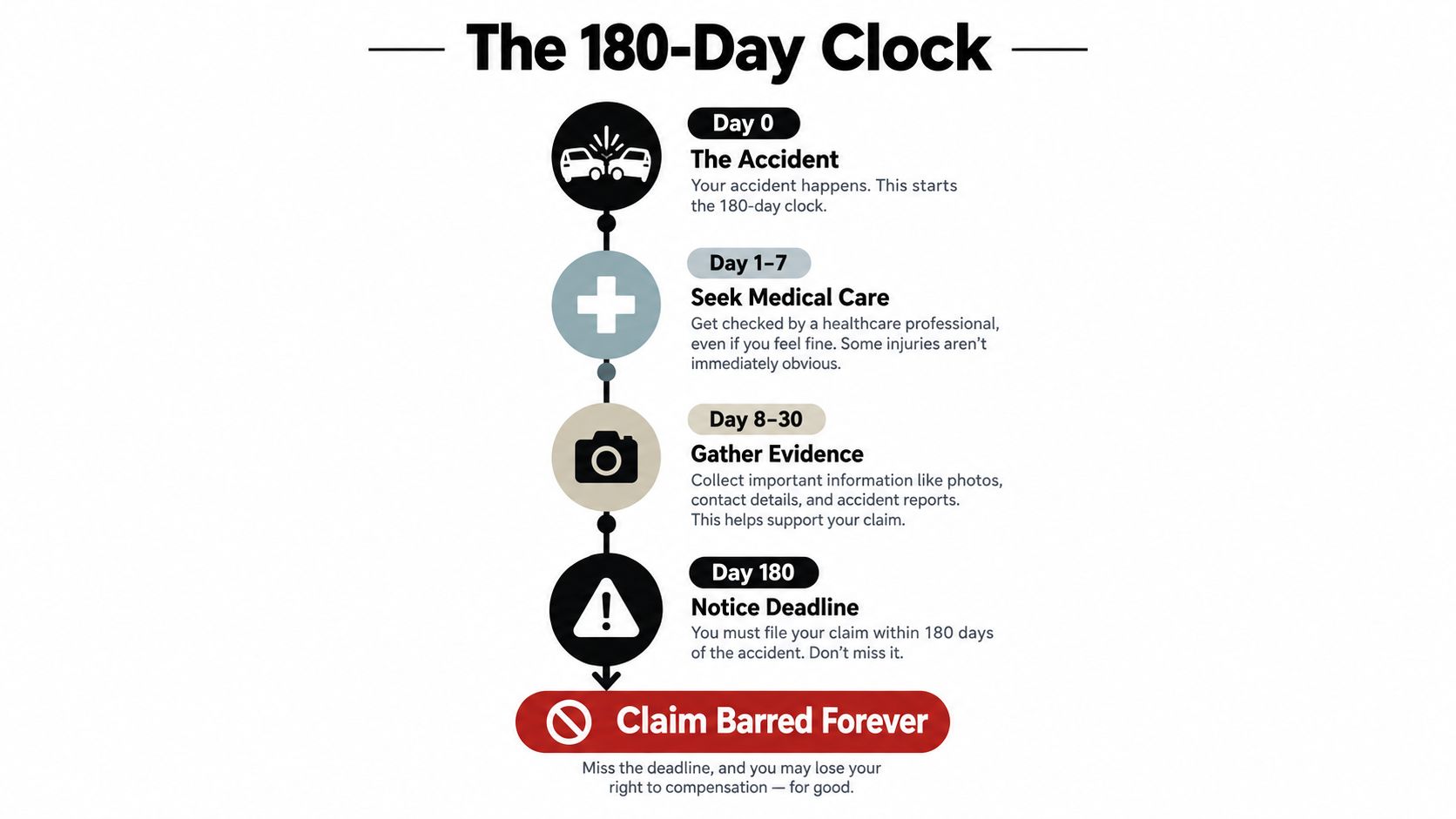
After a Houston METRO rail crossing crash, waiting for a diagnosis can cost you the claim. METRO's Notice of Claim form requires a claimant to complete, sign, and mail or deliver the form within 180 days of the incident. It identifies delivery options, including the METRO Claims Division in Houston and an email address.
The deadline begins on the crash date. It does not pause for physical therapy, a final diagnosis, or a decision about surgery. Treat day zero as the starting point unless a lawyer confirms a legally valid exception.
METRO and city deadlines aren't always identical
The Texas Tort Claims Act generally requires written notice within six months, while some local governments impose a shorter period. Houston's city charter may create a 90-day notice window for certain claims, according to this overview of Texas statute-of-limitations rules. For a deeper explanation of the notice rules, review our guide to Houston METRO bus claims under the Texas Tort Claims Act.
The difficult part is identifying every responsible entity. A single crash may involve METRO, the City of Houston, Harris County, a state agency, or a private contractor. Each may have different procedures and notice recipients. Sending notice to the wrong office may leave the correct defendant unprotected by your filing.
Missing the applicable deadline can allow governmental immunity to block the claim. Serious injuries and strong negligence evidence do not automatically excuse late notice.
This video offers general background, not case-specific advice:
Keep insurance communications separate from governmental notice. For practical guidance on protecting an insurance claim after a Houston-area crash, see Dealing With Insurers After a Houston Accident. One process does not necessarily satisfy the other.
What to Include in Your Written Notice
A valid notice isn't just a message saying you were hurt. Under the Texas Tort Claims Act, written notice generally must identify the injury, the time and place of the incident, and the nature of the damages, as summarized in the Texas Tort Claims Act materials.

Build the notice around five facts
Use a clear, accurate description. Avoid speculation about fault or injury severity when the investigation is still developing.
- Your identity: Provide your name, address, and reliable contact information.
- The incident: Describe the rail crossing crash, the vehicles involved, and what you observed.
- Time and location: State the date, approximate time, street, crossing, direction of travel, and nearby landmarks.
- Your injuries: List known injuries and explain that additional treatment may be required if that reflects your medical situation.
- Your damages: Identify medical expenses, lost income, property damage, pain, and other losses you reasonably know about.
Your notice should identify the government entity you believe may be responsible. If you aren't sure whether METRO, the City of Houston, or another public body controlled a signal, road, or vehicle, say so to your attorney immediately. Correct identification may require reviewing agency records and agreements.
Preserve evidence before it disappears
Save dashcam files in more than one location. Photograph the crossing signals, gates, roadway markings, sight lines, damage, and weather conditions if you can do so safely. Ask witnesses for their names and contact information, and write down what each person said without trying to improve their account.
Keep medical records, discharge papers, prescriptions, wage information, repair estimates, and correspondence with insurers. Don't give a recorded statement or sign a broad release before a lawyer reviews it. The insurer may ask about your injuries before doctors know their full impact.
Deliver it in a way you can prove
Follow the METRO form's instructions and retain a complete copy of everything submitted. Keep proof of mailing, delivery, email transmission, or other authorized receipt. Your lawyer should confirm the receiving office, the submission method, and the date the notice was received.
Sending notice is not the same as proving negligence. It preserves the opportunity to investigate and pursue the claim. The evidence still must show liability, the connection between the conduct and your injuries, and the damages you suffered.
How Public Transit Claims Differ from Standard Auto Cases
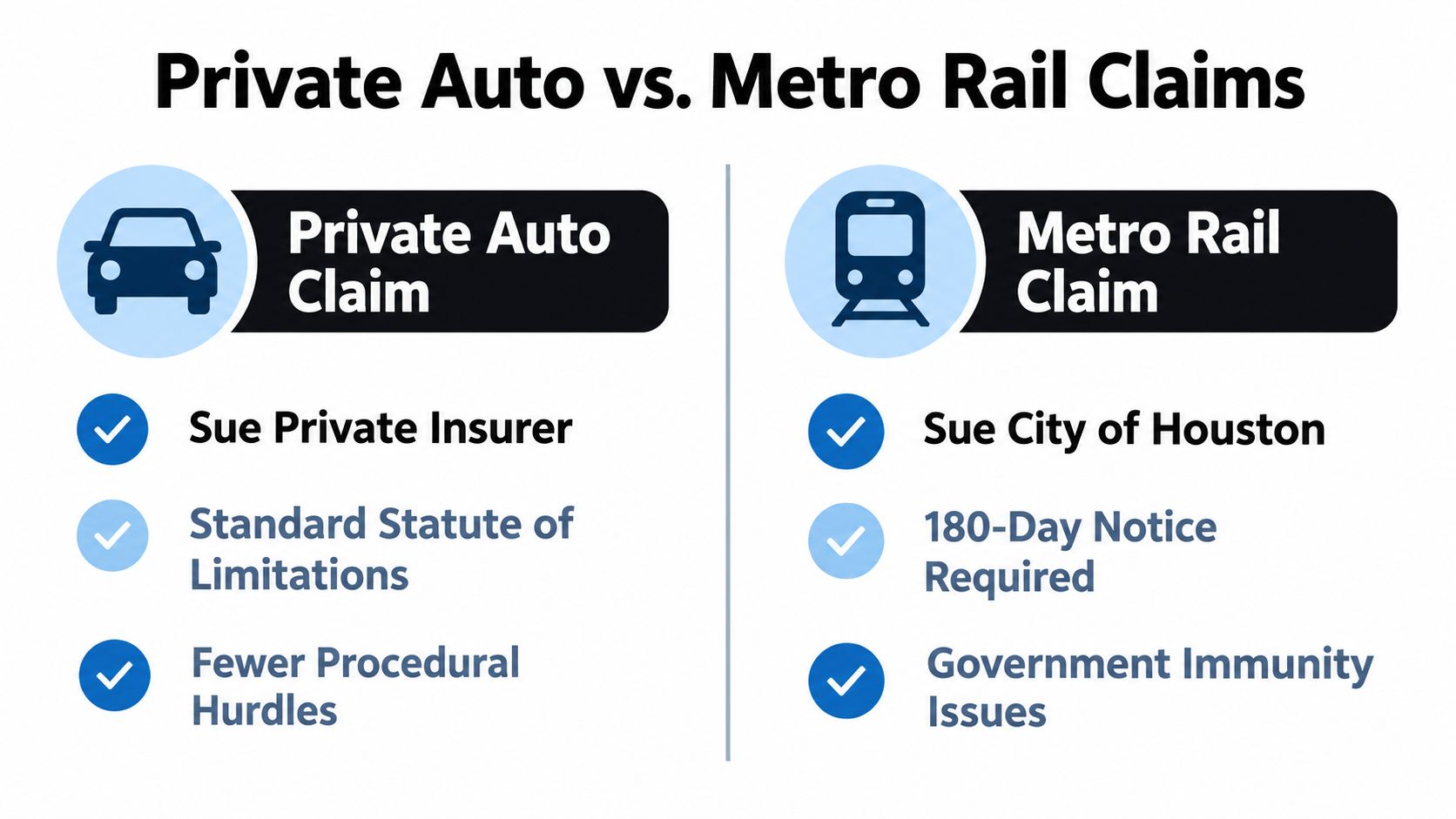
A private rear-end collision and a METRORail crossing crash may look similar from the injured person's perspective. In both cases, someone may have suffered broken bones, vehicle damage, medical bills, and lost wages. The legal route is different.
In a typical private auto insurance claim, you deal with an insurer representing a driver or company. You still need evidence of negligence, but the claim usually doesn't require compliance with a governmental notice procedure. In a METRO case, you may face governmental-immunity rules before the court reaches the merits.
The two cases require different questions
| Private collision | METRO rail crossing crash |
|---|---|
| Which driver or company caused the collision? | Which public entity operated, maintained, or controlled the relevant system? |
| What insurance coverage applies? | Did the claim satisfy governmental notice requirements? |
| What evidence proves negligent driving? | What records show operation, maintenance, warnings, or crossing conditions? |
| What damages did the crash cause? | What damages are legally recoverable from each defendant? |
Liability means legal responsibility for causing harm. In a rail case, liability might involve a train operator, a public authority, another driver, a road agency, or a contractor. The answer depends on the evidence, not on who suffered the worst injury.
Why sovereign immunity matters
Sovereign immunity is a legal protection that can limit when and how a person may sue a government entity. Texas law allows some claims under defined circumstances, but those claims come with procedural requirements and limits that don't usually apply to a private driver.
A government risk-management office may investigate the crash while protecting public funds. Its representatives aren't your advocates. Don't assume a request for information, a quick settlement proposal, or a recorded interview is harmless.
A standard Houston car accident lawyer may understand vehicle collisions but lack experience with governmental notice, public records, and municipal litigation. Choose a Texas injury attorney who can investigate both the traffic facts and the public-entity rules. That distinction becomes especially important when a crossing signal, transit vehicle, roadway, or maintenance contractor may share responsibility.
Navigating Texas Comparative Fault and Damage Caps
Filing timely notice doesn't guarantee compensation. The other side may argue that you caused the crash or failed to act safely at the crossing. Texas comparative fault means the court assigns responsibility among the parties and reduces a claimant's damages according to the claimant's share of fault.
Chapter 33 of the Texas Civil Practice and Remedies Code provides that a claimant who is more than 50% responsible may not recover damages. If the claimant is 50% or less responsible, the recovery is reduced by that percentage of fault, as stated in Texas Civil Practice and Remedies Code Chapter 33.
How fault arguments affect a rail crossing case
Suppose a Houston driver enters a crossing after traffic ahead stops. A train strikes the vehicle, but the driver says the warning system didn't work and the crossing design created a trap. Investigators may examine the driver's conduct, the signal sequence, the train's operation, roadway control, and any third-party work near the tracks.
That isn't a simple question of whether you made one mistake. Fault may be divided among several people or entities. Your lawyer should gather photographs, witness accounts, signal records, vehicle data, medical evidence, and other records before accepting the defense's version of events.
Damages are the losses the law may compensate. They can include medical treatment, lost income, property damage, physical pain, emotional harm, and other injury-related losses, depending on the facts and applicable law. Keep a running record because a claim based only on current bills may overlook future consequences.
Chapter 41 and exemplary damages
Exemplary damages, sometimes called punitive damages, are intended to punish especially wrongful conduct and deter similar behavior. Chapter 41 generally caps exemplary damages at the greater of $200,000, or two times economic damages plus an amount equal to noneconomic damages, up to $750,000, subject to statutory exceptions. The cap and exceptions are described in Texas Civil Practice and Remedies Code Chapter 41.
These damages aren't automatic, and they aren't the same as compensation for medical bills or lost wages. A family pursuing wrongful death compensation should obtain advice about the damages available to surviving family members and the estate. Don't value a catastrophic or fatal case by looking only at an early settlement offer.
Protecting Your Rights with Experienced Legal Counsel
If you are recovering from a rail crossing crash, the longer lawsuit deadline can create dangerous false confidence. METRO's notice deadline runs on a separate track and may expire first. A valid claim can be dismissed before a lawsuit is filed if the required notice is late, even while the limitations period remains open. Get legal help early, while the scene, video, vehicle condition, witness memories, and agency records may still be available.
What counsel should do first
A careful legal review should address:
- Deadline control: Calendar the METRO notice deadline, any city deadline, and the lawsuit limitations period separately.
- Entity identification: Determine who operated the train and who controlled the crossing, signals, roadway, and maintenance.
- Evidence preservation: Request photographs, video, vehicle evidence, medical records, witness information, and relevant public records.
- Liability analysis: Examine driver conduct, train operation, signal performance, roadway design, maintenance, and third-party involvement.
- Claim handling: Prepare written notice, communicate with insurers, and protect you from statements taken out of context.
The Law Office of Bryan Fagan, PLLC represents Texas injury victims in car, truck, pedestrian, motorcycle, wrongful death, and other accident claims. The firm offers free consultations and contingency-fee representation, meaning clients do not pay attorney fees unless it recovers compensation, subject to the written agreement and case expenses.
Don't wait for certainty
You do not need every detail before calling. You do need to act before the notice deadline. Bring the crash report, photos, medical records, insurance letters, vehicle information, and METRO correspondence. If you are still choosing representation, this guide on how to find a good car accident lawyer explains what to look for.
A lawyer can identify potential parties, confirm notice requirements, preserve evidence, and assess whether your claim remains viable. Timely advice can prevent a missed notice deadline from deciding the case.
The Law Office of Bryan Fagan, PLLC offers a free consultation and contingency-fee representation for victims injured in Houston rail crossing and vehicle crashes. Contact the firm promptly to review the 180-day notice issue, investigate potential liability, and protect your rights.