A car crash can change your life in seconds, but you don’t have to face recovery alone.
If you are reading your accident report right now, you are doing it for one reason. You want answers. You want to know who the officer blamed, what the insurance company will focus on, and whether one wrong box or code could hurt your case.
I’ll be direct. Your Texas crash report matters significantly, but it is not sacred. It is a starting point. If you know how to read a police accident report, you can spot the facts that help you, the codes that hurt you, and the mistakes that need to be challenged before an adjuster uses them against you.
Why Your Police Accident Report is a Critical Piece of Evidence
The first days after a wreck are a blur. You are dealing with pain, car repairs, missed work, calls from insurance, and a stack of papers you never asked for.
One of those papers becomes the backbone of the whole claim. That is your police accident report.

Why insurers care so much
Insurance adjusters want an official version of events fast. The accident report gives them names, vehicles, insurance details, witness information, roadway conditions, and the officer’s early view of what happened.
That is not minor paperwork. According to a guide discussing standardized accident reporting, those report details influence an estimated 85% of insurance claims because they help establish early liability baselines (victimslawyer.com).
The legal ideas that matter in Texas
In plain English, liability means legal responsibility. If another driver caused the crash, that driver may be liable for your losses.
Negligence means a person failed to use reasonable care. In a Texas car wreck case, negligence can mean speeding, texting, following too closely, failing to yield, or driving drunk.
Damages means the losses caused by the crash. That can include medical bills, lost pay, property damage, pain and suffering, and in fatal cases, wrongful death compensation for surviving family members.
Texas also follows comparative fault rules under Texas Civil Practice & Remedies Code Chapter 33. That means fault can be divided. If the insurance company can pin part of the blame on you, it will try. Your report is where that fight starts.
What the report can prove
A strong report can support your side in several ways:
- Basic facts: Date, time, road, lane position, weather, and which vehicles were involved.
- Driver conduct: Signs of distraction, impairment, unsafe speed, or failure to obey traffic rules.
- Injury documentation: Whether anyone reported pain, needed transport, or showed visible injury.
- Vehicle damage: The location of impact tells a clearer story than either driver does.
Take a common Houston example. A driver is rear-ended in stop-and-go traffic on I-45. The report may show front-end damage to the striking vehicle, rear damage to the lead vehicle, and a contributing factor tied to following too closely. That combination can make liability much easier to prove in an auto insurance claim.
Key point: The police report is the first version of your story the insurance company sees. If it helps you, use it. If it is wrong, challenge it early.
Why you should read it yourself
Do not assume your insurer, or the other driver’s insurer, will read the report fairly. They read it to save money.
You should read it because you need to know:
- whether the officer listed the wrong driver statement
- whether your injury was downplayed
- whether a witness was omitted
- whether the officer coded fault in a way that invites a denial
That is where a good Texas injury attorney makes a difference. We do not just “get the report.” We read it like evidence.
How to Obtain Your Official Texas Accident Report (CR-3)
The official Texas police accident report is called the CR-3, also known as the Texas Peace Officer’s Crash Report. If law enforcement responded to your wreck, this is the document you want.
What information you need
Before you request it, gather the basics:
- Crash date
- Crash location
- Name of at least one driver involved
- The investigating agency, if you know it
- Crash report number, if the officer gave you one at the scene
If you do not have all of that, do not panic. Start with the date, place, and names.
Where to request it
In Texas, the path is the TxDOT crash report system. You can also get guidance from a local resource on getting an accident report in Houston, TX.
If your crash involved a city police department, sheriff’s office, or DPS trooper, the report still ends up in the statewide system.
How to request it without wasting time
Use this order:
- Search by crash report number if you have it. That is the cleanest method.
- If not, search by names and date.
- Double-check the county and city before paying for anything.
- Save the report as a PDF immediately after download.
- Print a copy and mark it up by hand. That sounds old-fashioned, but it helps you catch errors.
What to do if it is not available yet
Sometimes the report takes time to appear. If you search too early, you may get nothing even though the officer filed it.
If that happens:
- Wait and retry: Reports post after processing.
- Call the agency: Ask whether the report has been submitted.
- Keep your case number handy: That helps the records unit find it faster.
Don’t rely on a crash exchange form
Some drivers confuse a quick exchange slip or incident card with the full CR-3. They are not the same.
The CR-3 contains the coded information, the officer narrative, and the details insurers care about. If you want to understand fault, injury coding, or how the other driver is identified in the system, you need the actual report.
Practical advice: Get the report as soon as it is available, but do not send a detailed statement to the other driver’s insurer until you have reviewed it. You should know what the official record says before you start answering questions.
Decoding the Texas CR-3 Report Section by Section
You finally get the crash report, open the PDF, and stare at a page full of boxes and codes. The insurance company is not confused by it. They know exactly which boxes help them and which ones they can use against you. You need to read the Texas CR-3 the same way.
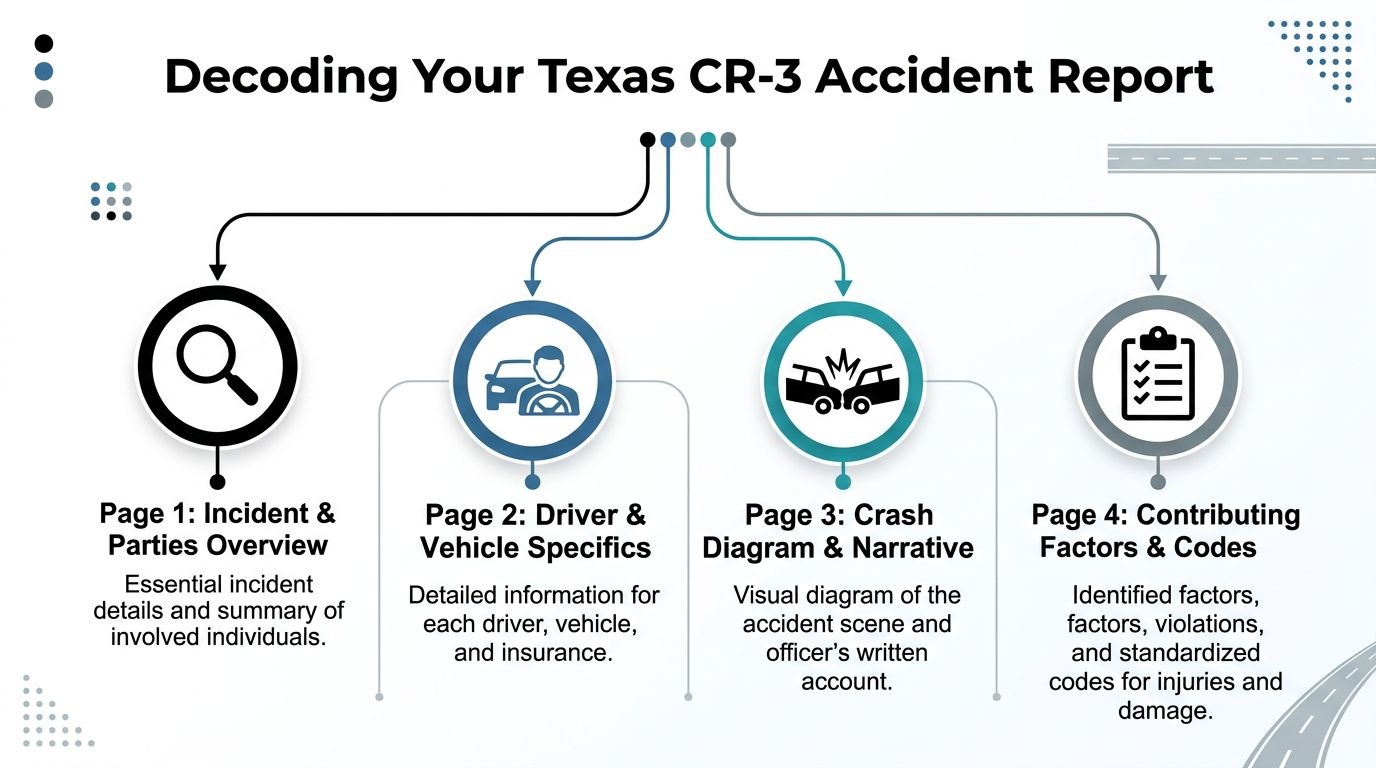
The good news is that the CR-3 follows a pattern. Once you know where fault clues hide, the report gets much easier to read. Focus on the parts that affect liability, insurance coverage, and injury value.
Start with the incident summary
The top section gives you the foundation of the case. Read it slowly.
Check the:
- date and time
- city and county
- exact location
- road name and direction of travel
- number of vehicles involved
- intersection or non-intersection designation
Small errors here cause big problems later. A wrong street, lane, or direction of travel can distort how the crash happened and give an adjuster room to argue about right of way.
In Texas claims, those details matter more than people realize. The CR-3 is not just a basic accident form. It is the state’s standardized record, and insurers treat it as the starting point for their fault analysis.
Check each unit, driver, and owner entry
On a CR-3, each vehicle is listed as a unit. Read every unit box line by line.
Look for:
- driver name
- address
- driver’s license information
- vehicle year, make, and model
- VIN
- insurance company
- policy information
- registered owner, if different from the driver
This part exposes coverage issues early. If the vehicle owner is not the driver, if the car belonged to an employer, or if the vehicle was being used for work, the case may involve additional insurance policies.
That can change the value of the claim.
It also matters in rideshare, delivery, trucking, and company vehicle cases, where the person behind the wheel is not always the only party that may be responsible.
Read the injury codes carefully
Texas officers use injury severity codes on the CR-3. Those codes are shorthand, not a medical conclusion.
Common codes include:
- A = Suspected Serious Injury
- B = Suspected Minor Injury
- C = Possible Injury
- K = Fatal Injury
- N = Not Injured
Insurers pay attention to these boxes. You should too. If the report marks you as having a possible injury, but your records later show a disc injury, concussion, fracture, or surgery, the report is not the final word.
One legal guide on reading accident reports explains that officers make quick scene-level judgments and those initial entries do not always match the full medical picture (marksalomone.com).
Here is the rule I give clients. Respect the code, but do not let it define your case. Your medical records, imaging, treatment timeline, and doctor opinions carry more weight on the true extent of your injuries.
Pay close attention to contributing factor codes
This is one of the most useful parts of the Texas CR-3.
The report includes a section for contributing factors or driver actions. Officers use numeric codes to identify conduct they believe played a role in the crash. If you know how to read those codes, you can spot the theory of fault fast.
Here is a simple Texas-focused decoder for common entries:
| Code | Meaning | Why It Matters |
|---|---|---|
| 01 | No Driver Improper Action | The officer did not assign improper driving conduct to that person |
| 02 | Failed to Control Speed | Supports a rear-end or following-too-closely theory |
| 03 | Failed to Drive in Single Lane | Points to a lane departure or unsafe movement case |
| 04 | Changed Lane When Unsafe | Supports liability in sideswipe and merge crashes |
| 20 | Failed to Yield Right of Way | Common in intersection and left-turn collisions |
| 22 | Following Too Closely | Strong indicator in rear-end crashes |
| 36 | Inattention | Supports a distraction-based negligence argument |
| 67 | Intoxicated | Can strongly affect liability and case value |
Do not stop at the number. Ask whether the code fits the physical evidence.
If the other driver is coded for failing to yield, the location of vehicle damage should make sense with that finding. If you are coded for an unsafe lane change, the diagram, impact area, and witness accounts should support it. If they do not, that is a problem worth challenging.
Review the damage areas and point of impact
Damage coding is easy to overlook. That is a mistake.
The CR-3 marks the area of damage on each vehicle and may identify the first point of impact. Those entries help test whether the story holds together. Rear damage to your car and front damage to the other vehicle support a rear-end sequence. Driver-side damage in an intersection crash may support a failure-to-yield claim.
Consistency matters. The location, damage pattern, driver statements, and coded factors should all tell the same story. When they do not, the report deserves a second look.
Check for passengers, witnesses, and the investigating officer
People focus on the drivers and miss everyone else listed on the report. Do not do that.
Review whether the CR-3 identifies:
- passengers in either vehicle
- independent witnesses
- the investigating officer
- citations issued
- statements attributed to specific people
A neutral witness can make a disputed liability case much stronger. A citation can also matter, not because it automatically proves fault, but because it shows what the officer believed happened at the scene.
Use the CR-3 like a case map
A Texas CR-3 gives you more than names and insurance information. It gives you the officer’s coded version of the crash. If you know how to read the injury entries, contributing factor codes, vehicle information, and impact areas, you can spot where the evidence helps you and where the report may be wrong.
That is the ultimate goal here. Not to memorize every box, but to find the exact entries that will affect your insurance claim and your injury case. If something in the report does not match the truth, you are not stuck with it. You just need to catch it early and respond the right way.
Finding Clues to Liability in the Narrative and Diagram
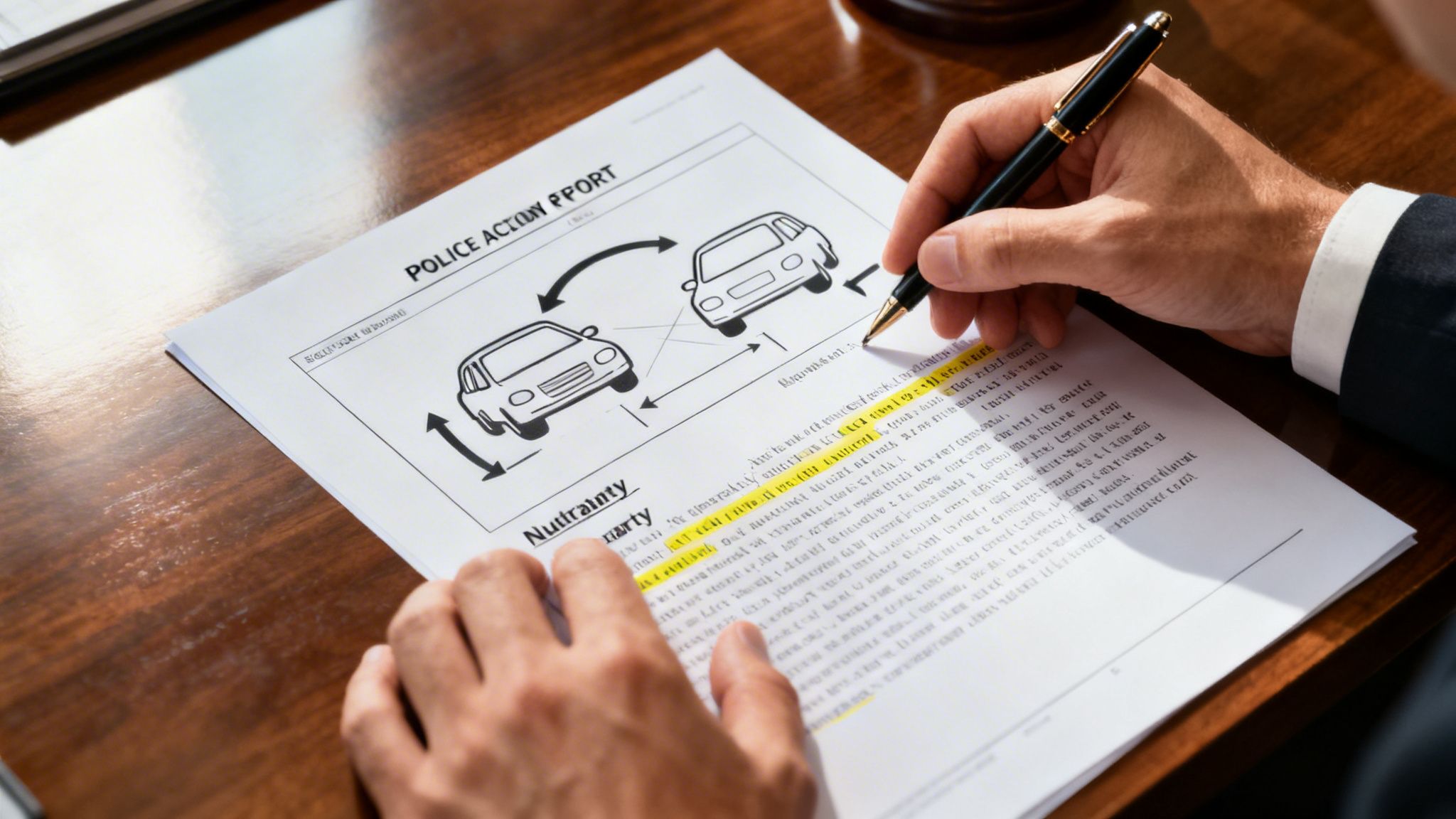
The code boxes matter. The primary fight lives in the narrative and the diagram.
That is where the officer tries to turn a chaotic event into a sequence. Who moved first. Who entered the lane. Who braked. Where the impact happened. Which driver the officer believed.
Why these two parts deserve extra attention
A guide focused on accident report analysis notes that diagrams contain unique details 35% of the time, and careful review of the written sequence, witness statements, and vehicle paths can overturn initial fault findings in up to 28% of litigated Texas cases (hankeylawoffice.com).
That should tell you something important. The narrative and drawing are not filler. They can change the case.
Read the narrative like a timeline
Do not read the officer’s words passively. Break them into moments.
Ask:
- Who was where before the crash?
- Which vehicle had the right of way?
- Did the officer describe one driver as “failed to control speed,” “turned left,” or “changed lanes”?
- Did the officer write “stated” before a fact, meaning it came from a driver and was not personally observed?
That last point matters a lot. Officers do not witness the wreck. They arrive after it happened. Some report language reflects direct observation. Some reflects what people said at the scene.
A simple example. A Houston driver rear-ended on I-45 may find the narrative says the other driver “stated traffic stopped suddenly.” That is not a defense by itself. If the damage, skid marks, and rear impact all support following too closely, the statement may not help the other driver at all.
Study the diagram for physical truth
A rough sketch can still be powerful.
Look for:
- lane markings
- arrows showing direction of travel
- point of impact
- final resting positions
- traffic controls such as stop signs or signals
If the written narrative says one thing and the diagram shows another, you may have a problem worth challenging.
For example, if the officer wrote that you merged into the other car, but the diagram shows your vehicle fully established in a lane and the other driver striking your rear quarter panel, that inconsistency matters. It may support a challenge under Texas comparative fault rules. If you want a clearer explanation of how fault-sharing works, this overview of comparative negligence in Texas is a useful companion.
Attorney’s view: The best liability arguments come from matching three things. The narrative, the diagram, and the vehicle damage. When all three line up, fault becomes harder for the insurer to dodge.
Watch for classic patterns
Some crashes leave familiar signatures:
- Rear-end collision: Rear damage to the lead car, front damage to the trailing car
- T-bone collision: Side impact at an intersection, tied to failure to yield or running a light
- Unsafe lane change: Side-swipe pattern, lane movement, and conflicting lane position statements
- Left-turn crash: Turning driver faces scrutiny unless the other driver was speeding or ran a signal
A T-bone crash at a Houston intersection can be telling. If the diagram shows one vehicle entering from a side street and the impact lands squarely on the side of the other vehicle traveling straight, that supports a failure-to-yield argument.
Use the report, but don’t worship it
The officer’s narrative is not the final truth. It is one version of the event.
Good case analysis means asking what the report left out:
- Did the officer miss a witness?
- Was one driver taken by ambulance before giving a full statement?
- Did dashcam or business surveillance video exist but never get reviewed?
- Was the first caller treated as more credible just because they spoke first?
That is how a Texas injury attorney builds beyond the report. The report starts the investigation. It should not end it.
Common Errors on Accident Reports and How to Get Them Fixed
Police reports are written by people under pressure. They work fast. They clear scenes. They make judgment calls. Mistakes happen.
And they happen enough that you should look for them on purpose.
A legal guide on reading crash reports states that discrepancies appear in an estimated 25% of all reports, and early challenges to inconsistent codes or narratives can improve settlement success by as much as 40% (slocumblaw.com).
The errors I see most often
Some are simple. Some are dangerous.
Factual mistakes
These include wrong basics:
- misspelled names
- wrong phone number
- wrong plate number
- incorrect insurance company
- wrong vehicle year or model
- wrong crash location
These errors can delay claims, trigger coverage issues, or create confusion about who was involved.
Statement mix-ups
This happens more than people realize. One driver’s explanation gets shortened, paraphrased badly, or attached to the wrong person.
If the report makes it sound like you admitted fault when you did not, fix that quickly.
Injury understatement
This is a major one. You may have told the officer you were shaken up but not yet aware of the full extent of your pain. Later, imaging shows serious injury.
The report does not update itself. You have to address the gap.
How to ask for a correction
Start with a calm, organized approach.
- Read the report line by line.
- Mark every error.
- Separate factual errors from opinion-based disputes.
- Gather proof. Insurance card, vehicle registration, medical records, photos, witness messages.
- Contact the agency that prepared the report and ask about its correction or supplement process.
- Keep your request in writing if possible.
Factual errors are easier to address than fault conclusions. An officer may correct a wrong VIN more readily than a disputed blame decision.
What helps when fault is wrong
If the problem is not a typo but a bad liability call, bring evidence:
- scene photos
- dashcam footage
- neutral witness statements
- medical records showing injury severity
- repair photos showing true impact location
This short video gives a useful overview of issues that can arise in report handling and follow-up:
Practical advice: Do not alter your story to fit the report. Correct the report so it better reflects the truth.
When you need legal help
If the report wrongly places fault on you, leaves out a witness, downplays your injuries, or creates a comparative fault argument, do not handle that casually.
A Texas injury attorney can push for a more complete record, package supporting evidence correctly, and stop the insurance company from treating one flawed report as the final word.
What to Do After You Understand Your Accident Report
Once you understand the report, act. Do not let it sit in a folder while the insurance company builds its file first.
Use the report to organize your claim
Your report should help you build a clean claim packet.
That includes:
- the CR-3 report
- photos of the vehicles and scene
- your medical records and bills
- proof of missed work
- repair estimates
- your own written summary of what happened
If you need a broader checklist, this guide on what to do after a car accident is a practical resource for keeping your next steps organized.
Know the legal terms that control your case
Comparative fault means the insurance company may argue you were partly responsible. Under Texas Civil Practice & Remedies Code Chapter 33, fault allocation affects what you can recover.
Damages are your losses. In a personal injury case, that may include medical treatment, lost income, physical pain, mental anguish, impairment, and property loss. In fatal wrecks, family members may pursue wrongful death compensation and other related claims under Texas law.
Statute of limitations means the filing deadline. In Texas, personal injury and wrongful death claims are subject to a defined statute of limitations. Waiting too long can destroy an otherwise valid case.
Texas Civil Practice & Remedies Code Chapter 41 also matters in cases involving exemplary damages, which can come up when conduct is dangerous, such as drunk driving or other extreme misconduct.
Be careful with insurance adjusters
Once you know what the report says, you can deal with adjusters more carefully.
Do this:
- stick to facts
- avoid guessing
- do not minimize your injuries
- do not accept blame to sound polite
- do not give a recorded statement without thinking through the risks
If the report favors you, the insurer may still try to downplay your damages. If the report hurts you, they will move even faster.
Decide when the case is bigger than self-help
Some claims can be handled directly. Others should not.
You should strongly consider speaking with a Texas injury attorney if:
- fault is disputed
- the report blames you unfairly
- you have serious injuries
- a commercial vehicle is involved
- the other driver is uninsured or underinsured
- the crash caused a fatality
- the insurer delays, denies, or pressures you
If you still need to make the official report or confirm your reporting obligations, this page on how to report a car accident can help.
Your report is not just a record of a bad day. It is a tool. Read it closely, challenge it when necessary, and use it to support the case you have, not the version an insurance company wants to create.
If you were hurt in a crash and you want someone to review your report with a trained eye, contact The Law Office of Bryan Fagan, PLLC for a free consultation. A Houston car accident lawyer can help you understand fault, protect your auto insurance claim, explain your rights under Texas law, and fight for the compensation your family needs to move forward.