A car crash can change your life in seconds, but you do not have to face recovery alone.
Maybe you are reading this after a wreck on I-45, sitting at your kitchen table with a pain prescription, a damaged car, and an insurance adjuster already hinting that you may share some of the blame. That is a hard place to be. You are trying to heal, keep up with work, help your family, and figure out what your rights are.
Many people first encounter the comparative fault definition here. In plain English, it means the law can divide blame between more than one person. A crash is not always treated as all one driver’s fault or all the other driver’s fault. Sometimes both sides made mistakes, and the law has rules for how that affects an injury claim.
That idea sounds simple. In real cases, it gets messy fast.
A driver may have been texting. Another may have braked suddenly. A rideshare driver may have made an unsafe lane change while a third driver was speeding. The insurance company will often focus on one question: how much blame can they place on you?
If you understand how Texas handles shared blame, you can make better decisions about your medical care, your auto insurance claim, and your next legal steps. You can also avoid common mistakes that make it easier for an insurer to reduce or deny payment.
A Crash Can Change Your Life But It Does Not Define It
A Houston driver gets rear-ended during the evening commute. At first, the case seems straightforward. Then the calls begin. The other driver’s insurer says the injured driver stopped too suddenly. They ask whether brake lights were working. They ask whether the driver was distracted. A simple claim suddenly feels like an argument over every second before impact.
That is how many comparative fault disputes begin.
When people hear the word “fault,” they often think it means shame or personal failure. In injury law, it means something more specific. It is about legal responsibility for causing a crash and the losses that follow, such as medical bills, lost income, vehicle damage, and pain and suffering.
You may still have a valid claim even if you were not perfect. That matters because few real-world crashes are perfect. Drivers react late. Roads are slick. Visibility changes. People make split-second choices.
Key takeaway: Being partly at fault does not automatically mean you lose your case. In Texas, the details matter, and the percentage of blame matters.
Families also ask about the broader picture. If a loved one died in a wreck, shared fault can affect a wrongful death compensation claim too. If your injuries are serious, comparative fault can affect not just settlement talks, but whether you recover anything at all.
The good news is that these cases are not decided by guesswork alone. Evidence matters. Timing matters. The words you use with the insurance company matter. And with the right legal guidance, many people can challenge unfair blame and protect the value of their claim.
Who Is Liable in a Texas Car Accident
Before shared fault makes sense, you need a few plain-English definitions.
Liability means legal responsibility. If someone is liable for a crash, that means the law can require that person, or that person’s insurer, to pay for the harm caused.
Negligence means failing to use reasonable care. In a car wreck case, negligence often looks like speeding, texting, following too closely, running a light, or failing to yield.
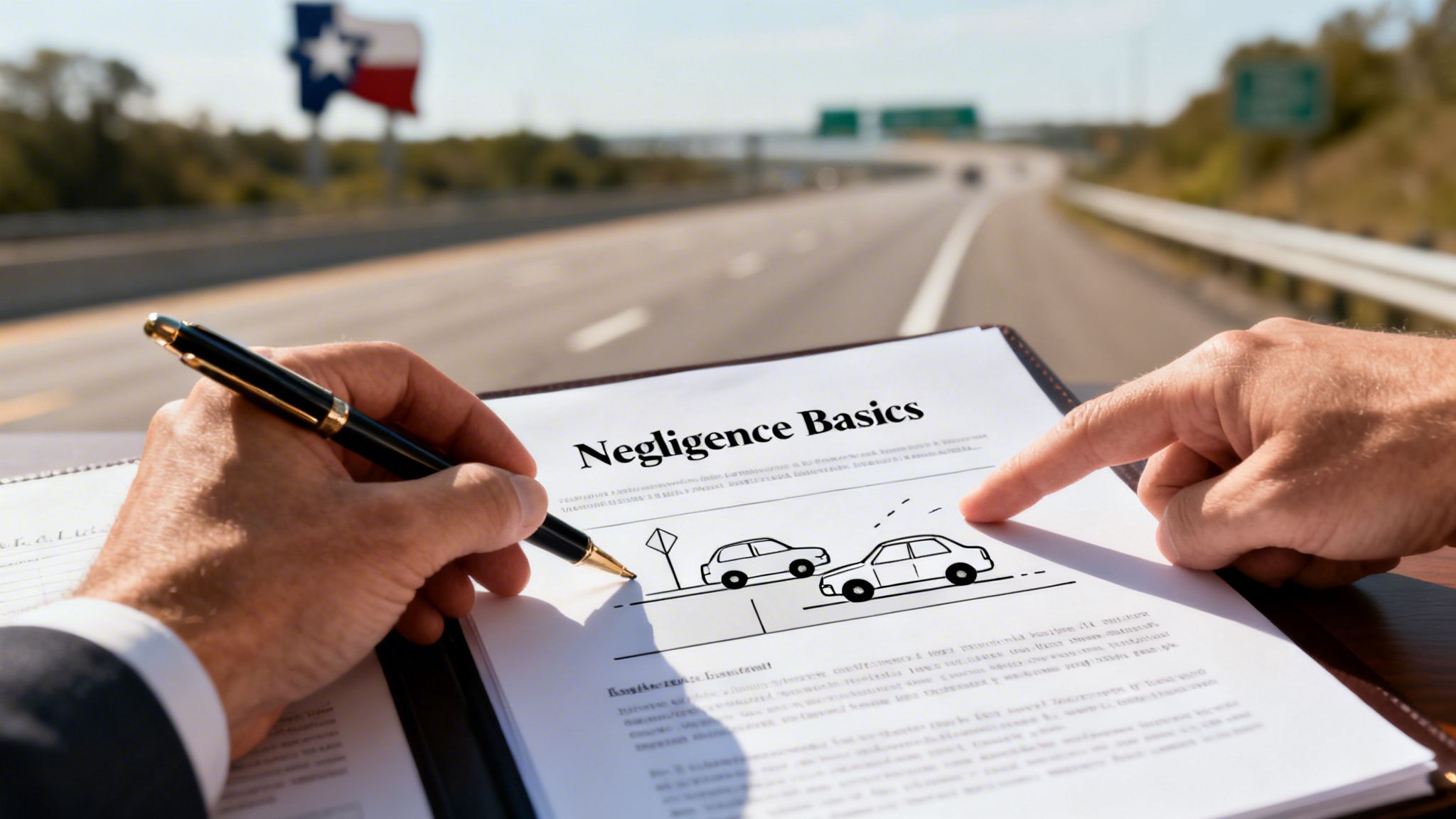
The four building blocks of negligence
Texas injury cases usually come down to four basic ideas.
Duty
Every driver has a duty to act with reasonable care. That includes watching the road, obeying traffic signals, and driving at a safe speed.Breach
A breach happens when someone breaks that duty. A driver who checks a phone instead of traffic may have breached the duty to drive safely.Causation
You must show the unsafe act helped cause the crash. If a driver looked away and drifted into your lane, that act may be linked directly to the collision.Damages
Damages are the losses caused by the crash. This can include medical expenses, lost wages, pain and suffering, and property damage. In serious cases, Texas Civil Practice & Remedies Code Chapter 41 can also matter because it addresses certain damages issues in civil injury cases.
Think of negligence like knocking over a row of dominoes. Duty is the rule that says you should not push them. Breach is the push. Causation is the chain reaction. Damages are what gets broken at the end.
What liable means in everyday terms
A simple example helps.
A Dallas driver runs a red light and hits a family crossing through an intersection on green. If the evidence shows that driver caused the wreck, that driver is likely liable for the injuries and losses.
But many crashes are not that clean.
A Houston driver rear-ended on I-10 may still hear the insurer argue that the driver changed lanes abruptly. A truck collision may involve the truck driver, a company that failed to maintain the brakes, and another motorist who created a sudden hazard. Liability can belong to one person, or it can be divided.
Other legal terms that often confuse people
Here are a few phrases clients ask about all the time:
- Comparative fault: A rule that divides blame among the people involved in a crash.
- Statute of limitations: The legal deadline to file a lawsuit. If you miss it, you can lose the right to pursue compensation.
- Auto insurance claim: A demand for payment under an insurance policy after a collision.
- Texas injury attorney: A lawyer who handles cases involving negligence, liability, and damages after someone gets hurt.
Tip: If an insurance adjuster asks for a recorded statement before you understand liability, slow down. Early statements often become part of the blame argument later.
Understanding the Different Types of Fault Systems
A lot of online articles use the phrase "comparative fault" as if every state means the same thing. They do not. That is where confusion starts for injured Texans.
A better way to look at it is to picture three different scoreboards for the same crash. The facts may stay the same, but the rulebook changes depending on the state. In one state, a small mistake can wipe out your claim. In another, you can still recover even if you carry most of the blame. Texas sits in the middle, and that middle position matters a great deal in real car wreck cases.
Three basic systems
Here is the big picture.
| Fault System | Can You Recover Damages if You Are Partially at Fault? | Example Outcome |
|---|---|---|
| Pure contributory negligence | Usually no. Even a small share of fault can block recovery. | A person with minimal blame may recover nothing. |
| Pure comparative fault | Yes. Recovery is reduced by your share of fault. | A person assigned most of the blame can still recover a reduced amount. |
| Modified comparative fault | Sometimes. Recovery depends on whether your fault stays below the state’s cutoff. | A person may recover in one state but be barred in another, depending on the percentage assigned. |
Pure contributory negligence
This is the toughest system.
Under pure contributory negligence, even slight fault by the injured person can block recovery altogether. The legal overview cited for this article explains that only a small number of states still follow that rule, including Alabama and Virginia (injury law comparative fault overview).
For a client, I often describe this rule like a locked door. If the insurer or jury can point to even a small mistake on your part, the door can shut completely.
Pure comparative fault
Pure comparative fault works differently. Fault reduces the value of the claim, but it does not automatically erase it.
Say a crash caused $200,000 in losses, and the injured driver was 20% responsible. Under this type of system, the recovery would usually be reduced by 20%, leaving $160,000. The same basic approach can allow recovery even when the injured person carries a very high share of fault.
That sounds generous, but it also creates its own problems. Insurance companies may still argue over every percentage point because each point lowers what they have to pay.
Modified comparative fault
Modified comparative fault is the middle-ground approach. An injured person can recover only if their share of fault stays under the state's cutoff.
That cutoff is the part national articles often gloss over. Some states use one threshold. Others use another. Texas follows its own rule, and if you are dealing with an adjuster after a wreck, that difference is not academic. It can decide whether the claim gets paid at all.
If you want a clearer picture of how fault arguments interact with coverage questions, this guide to liability insurance in Texas car accident claims helps connect the insurance side to the fault side.
Why Texans need the Texas version, not a generic definition
This matters even more in the cases people ask me about every week. A crash with an uninsured driver. A wreck involving an Uber or Lyft vehicle. A pileup where one insurer blames another, and both try to place part of the blame on you.
In those situations, the fault system is not just legal vocabulary. It is the measuring tool that decides how much of your losses you can still recover. If the other side can push your percentage high enough, they lower the claim or try to defeat it.
That is why broad national definitions are only a starting point. Texas drivers need to know the Texas rule, because rideshare cases, uninsured motorist claims, and multi-vehicle collisions often turn into blame-shifting contests very quickly.
Practical point: Before giving a statement or accepting an insurer's version of the crash, make sure you know which fault system applies. The label sounds simple. The rule behind it can change the result of the whole case.
Texas Law Explained Proportionate Responsibility and the 51% Bar
Texas uses proportionate responsibility, which appears in Texas Civil Practice and Remedies Code § 33.001. This is the Texas version of comparative fault.
The rule is strict. If you are 51% or more at fault, you cannot recover damages. If you are below that point, your recovery is reduced by your percentage of fault.
The verified data for this article states that Texas’s system bars plaintiffs from recovery at 51% or more at fault, and notes that Texas had over 434,000 crashes in 2024 with shared fault playing a role in up to 30% of them (Texas comparative fault glossary).
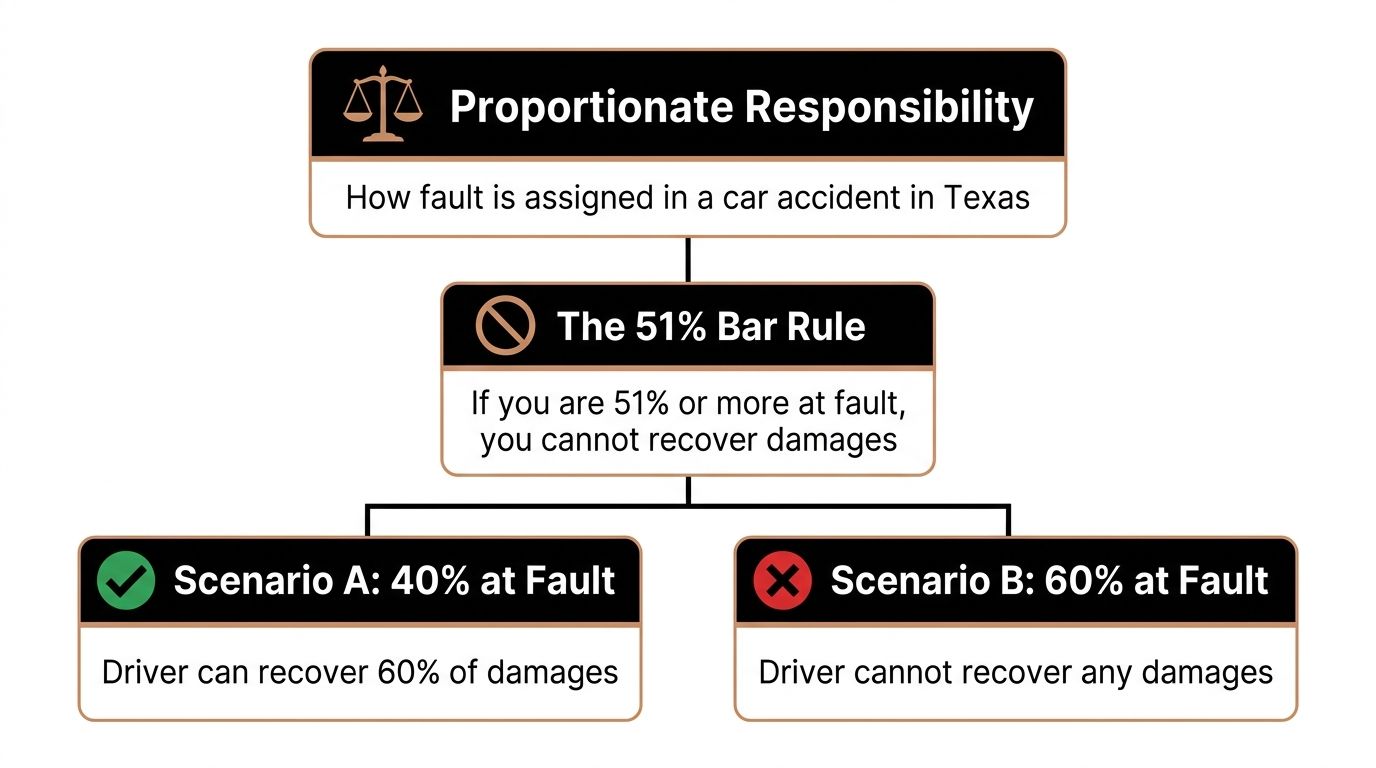
Why the 51% rule feels like a cliff
This law creates a sharp cutoff.
If a jury says you were less responsible than the other side, you may still recover something. If the blame assigned to you reaches the legal bar, your claim can fall to zero. That is why fault arguments matter so much in Texas car wreck cases.
A person can have serious injuries, high medical bills, and clear losses, but still face a denied claim if the insurer convinces the factfinder that the person bears too much responsibility.
A Houston example
Take a common situation on I-10.
A driver is hit during a lane-change crash in heavy traffic. The other driver says the injured person moved without enough warning. The injured person says the other driver was speeding and cutting through traffic. Both sides point fingers.
If the evidence shows the injured person made a mistake but stayed under the legal threshold, the claim may still have value. If the insurer pushes the blame over the threshold, the claim may be barred.
That is why these cases are often fights over details:
- Vehicle position
- Brake timing
- Turn signal use
- Phone records
- Dashcam video
- Witness accounts
Why insurance companies focus on fault percentage
Insurance adjusters do not need to prove you caused everything. Often, they only need enough facts to argue that your share of blame is high enough to reduce the payout or eliminate it.
That can happen in a rear-end collision, a left-turn crash, a trucking case, or a disputed freeway merge. It also happens in claims involving coverage questions, which is why understanding liability insurance in Texas can be important when fault and policy limits overlap.
Texas law in plain English
The easiest way to understand it is this:
- Less than 51% at fault: you may recover, but the amount is reduced.
- 51% or more at fault: you are barred from recovery.
- The fight is often about the percentage, not just the crash itself.
Texas Civil Practice & Remedies Code Chapter 33 governs this proportionate responsibility framework. Chapter 41 also matters in some injury cases because it addresses damages rules that can affect the overall case value once liability is established.
Key takeaway: In Texas, the difference between a strong claim and no claim at all can be a single shift in fault allocation.
Why legal help matters under this rule
Fault percentages are not assigned in a vacuum. They come from evidence, argument, and credibility.
A police report might help, but it is not always the final word. A witness may have seen only part of the crash. An insurer may rely on a selective reading of events. In many cases, the outcome depends on how well the injured person’s side gathers proof and responds to blame-shifting.
That is the heart of the comparative fault definition in Texas. It is not only about whether blame is shared. It is about how that shared blame changes your right to recover.
How Comparative Fault Is Calculated in Real-World Scenarios
The law becomes easier to understand when you see the math.
Example one with shared fault but recovery still allowed
A driver in Dallas tries to make a left turn at an intersection. An oncoming driver is speeding. They collide.
If the injured left-turn driver has $100,000 in damages and is found 40% at fault, the driver can still recover $60,000 under Texas proportionate responsibility. The fault reduced the recovery, but it did not erase it.
This kind of case often turns on timing, line of sight, and whether the speeding driver had enough distance to avoid impact.
Example two with a complete bar to recovery
A multi-vehicle pileup happens during bad weather. One driver follows too closely and also reacts late. The other side argues that this driver’s own choices were the main cause of the crash.
If that driver is found 60% at fault, the driver cannot recover damages in Texas. The exact dollar amount of losses does not change the legal bar. Once the fault percentage crosses the threshold, recovery is blocked.
That is why two cases with similar injuries can have very different outcomes.
Example three with a straightforward percentage reduction
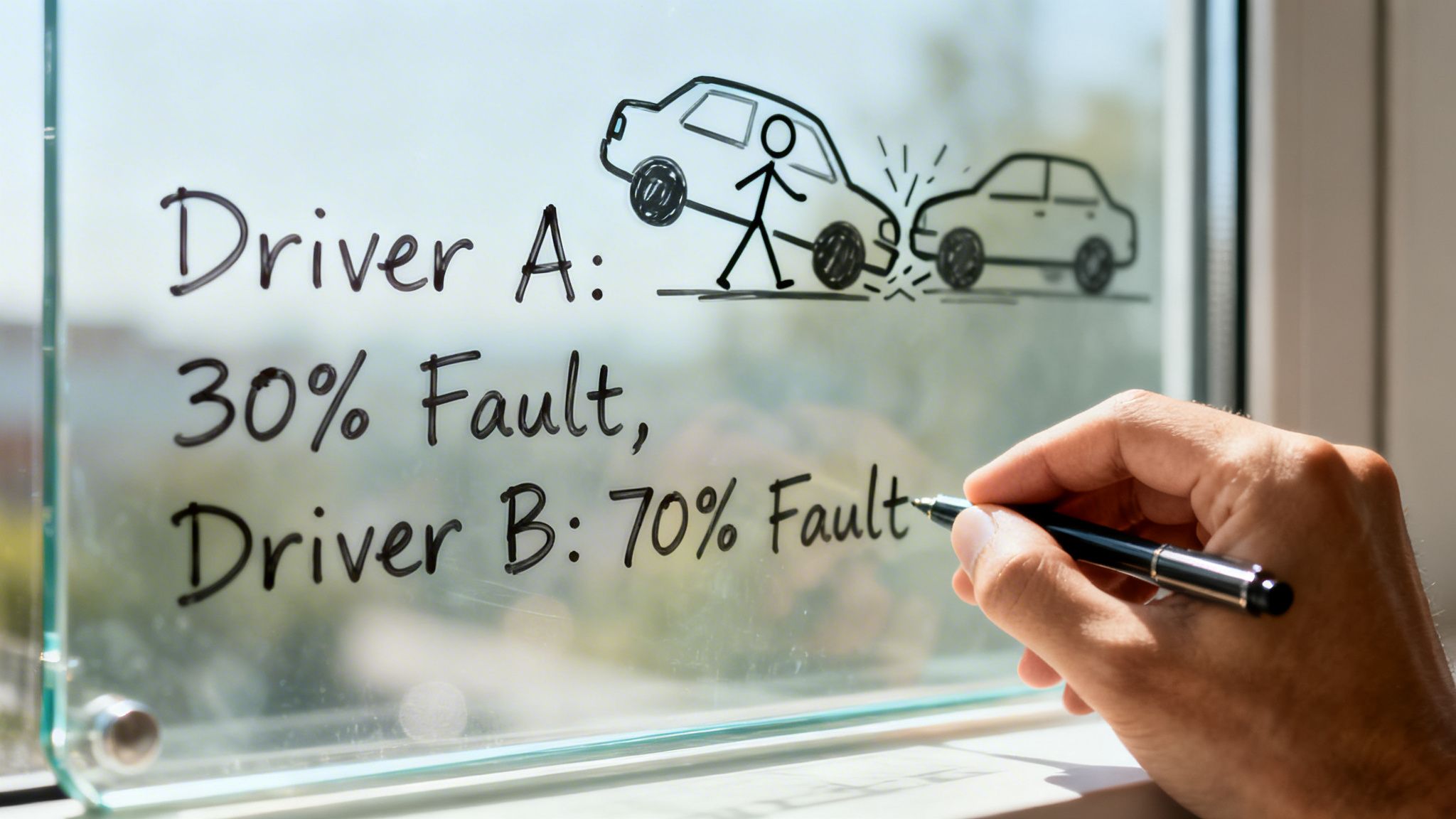
A person suffers $100,000 in damages after a crash, but evidence shows the person was only partly careful before impact. If that person is assigned 30% fault, the recovery would be reduced to $70,000. The same basic math applies whenever the injured person remains below the Texas cutoff.
The legal formula is simple:
- Start with total damages
- Subtract the injured person’s percentage of fault
- If the injured person reaches the Texas bar, recovery stops
That sounds mechanical. The hard part is not the subtraction. The hard part is who gets assigned which number.
Evidence usually drives the percentage
In real cases, parties use many kinds of proof to argue over fault. That can include scene photos, vehicle damage patterns, witness accounts, and digital records.
A short video overview can help make that process feel more concrete.
Why these examples matter
People generally do not struggle with the arithmetic. They struggle with uncertainty.
They ask questions like:
- Who decides the percentage? Insurance adjusters may make an early assessment, but a judge or jury may later view the evidence differently.
- Can the number change? Yes. As more evidence comes in, arguments over fault often shift.
- What losses count as damages? Damages can include medical bills, lost wages, pain and suffering, and in fatal cases, losses tied to wrongful death compensation.
Important: Comparative fault is not a moral scorecard. It is a legal tool for dividing financial responsibility after a crash.
Special Cases Uninsured Motorists and Rideshare Accidents
Some of the hardest comparative fault cases involve claims that do not fit the usual two-driver model.
Uninsured and underinsured motorist claims
Many drivers assume that if the other person has no insurance, their own policy will cover the loss. It is not always that simple.
The verified data for this article explains that in Texas, your comparative fault percentage reduces your Uninsured/Underinsured Motorist payout. It also states that 15% of Texas accidents involve uninsured drivers, and gives this example: if you are 40% at fault, a $50,000 UM/UIM recovery can be cut to $30,000 (comparative negligence consumer explanation).
That surprises many people.
If you pay for UM/UIM coverage, you may expect full protection. But your own insurer can still examine fault and reduce payment based on your role in the crash. In other words, fault disputes do not disappear just because the other driver lacked coverage.
Rideshare crashes add layers
Uber and Lyft collisions create another set of problems.
A rideshare crash may involve the rideshare driver, another motorist, a commercial policy, a personal policy, and disputes over what the driver was doing in the app at the time of the wreck. Was the driver waiting for a ride request, on the way to pick someone up, or transporting a passenger? Coverage may change depending on those facts.
Fault can also be split across more than two people. One driver may have been speeding. Another may have made an unsafe turn. The rideshare driver may have stopped unexpectedly in traffic.
That is why rideshare claims often need a closer look at app status, policy layers, and driver conduct. If your wreck involved Uber or Lyft, this guide to rideshare accidents in Houston can help you understand how these claims differ from ordinary crashes.
Why these cases confuse people
These claims combine two separate questions:
- Who caused the crash
- Which policy must pay
Those are not always answered the same way, and both can be affected by comparative fault.
For injured passengers, the situation can feel especially unfair. You may have done nothing wrong, yet still end up caught between multiple insurers arguing over liability and coverage. For drivers, one disputed detail can reduce what would otherwise have been available under a UM/UIM policy.
Protecting Your Claim From Unfair Blame
A Houston driver gets hit at an intersection, says “I’m sorry” while still shaken, and later learns the insurer is using those two words to argue he caused part of the wreck. That happens more often than people expect. In Texas, a blame argument is not just about pride. It can directly affect whether you recover compensation at all, especially if the insurer is trying to push you toward the 51% bar.

The first few days after a crash often shape that fight. Insurance companies start building their version of events early. If your case involves an uninsured driver or a rideshare vehicle, the risk can be even higher because insurers may argue over both fault and coverage at the same time.
What helps protect your claim
These steps give your case a stronger factual foundation:
Get medical care quickly
Treatment protects your health and creates a record tying your injuries to the collision.Photograph the scene
If you can do it safely, take pictures of vehicle positions, damage, skid marks, debris, traffic signals, road conditions, and visible injuries.Collect witness information
A neutral witness can carry weight when drivers disagree about what happened.Request the police report
The report may not end the dispute, but it often provides names, diagrams, and an initial account of the crash.Notify your insurer carefully
Report the wreck promptly. Stick to facts you know firsthand.
What can hurt your case
After a wreck, people often try to be polite or fill awkward silence. That instinct can create problems later.
Avoid guessing. Avoid apologizing for the crash. Avoid broad statements about your condition before you know how badly you are hurt.
Phrases like these can be taken out of context:
- “I didn’t see them.”
- “It might have been my fault.”
- “I’m fine.”
If an adjuster calls, keep your answers short and accurate. If the questions become detailed or you are asked for a recorded statement, read this guide on how to deal with insurance adjusters before responding.
Evidence can change the blame picture
Fault is often treated like a math problem, but it is built from evidence. Better evidence often leads to a fairer percentage.
For example, a driver may be accused of unsafe lane movement after a freeway crash. Then dashcam video shows the other vehicle cutting across two lanes. A black box download may show braking that matches your account. Phone records, ride app status, vehicle damage patterns, and scene photos can all help correct an insurer’s first version of the story.
That matters in Texas because even a small shift in fault percentage can change the value of a claim. In uninsured motorist cases, your own insurer may still try to assign you too much blame to reduce what it pays. In rideshare cases, one carrier may point at another while also trying to pin a larger share of responsibility on you.
Practical tip: Keep dashcam files, photos, repair estimates, towing invoices, medical records, and all insurer emails in one folder. Small details often become strong proof later.
A simple post-crash checklist
- Get medical attention.
- Save photos and video.
- Gather names and contact information.
- Report the collision.
- Choose your words carefully.
- Keep every bill, estimate, and record.
- Speak with a Houston car accident lawyer or Texas injury attorney before the insurer hardens its blame position.
You Are Not Alone How a Houston Car Accident Lawyer Can Help
Shared fault cases are stressful because they are rarely about one simple fact. They are about percentages, evidence, timing, and credibility.
The most important thing to remember is this. In Texas, being partly at fault does not automatically destroy your claim. But it can make your case much more vulnerable to insurance company tactics, especially when the insurer is trying to push blame high enough to reduce or deny payment.
A lawyer can help gather records, preserve digital evidence, challenge unfair fault claims, and calculate damages fully. That includes medical costs, lost income, pain and suffering, property losses, and, in fatal cases, wrongful death compensation. A lawyer can also explain how Texas Civil Practice & Remedies Code Chapters 33 and 41 may affect your case, and help you understand filing deadlines under the statute of limitations before time runs out.
If you are dealing with a confusing auto insurance claim after a crash, you do not have to sort through these issues by yourself. A skilled Houston car accident lawyer can help you understand what happened, what your rights are, and what steps protect your recovery.
If you were hurt in a crash and you are worried that the insurance company is placing too much blame on you, contact The Law Office of Bryan Fagan, PLLC for a free consultation. You can talk through your accident, your injuries, your insurance questions, and your legal options with a team that understands Texas car accident law and treats clients with compassion and respect.