Skip to content
A car crash can change your life in seconds—but you don’t have to face recovery alone. The real impact isn’t just the screech of tires or the initial shock—it’s the quiet, creeping anxiety that follows. The medical bills piling up, the calls from insurance adjusters, and the paychecks you're losing while you can't work.
When someone else’s mistake causes you harm, you have the right to be made whole again. In the legal world, we call this compensation damages. Calculating the true value of your damages isn't just about adding up receipts. It’s about creating a complete, undeniable picture of every single loss you've suffered—financial, physical, and emotional. This guide explains how damages are calculated under Texas law and how you can protect your rights.
The True Cost of Your Accident
After a serious wreck, the immediate aftermath is often a blur of flashing lights, paramedics, and overwhelming stress. Once the adrenaline fades, you're left with the harsh reality: physical pain, emotional trauma, and a mountain of unexpected bills. It’s completely normal to feel lost and wonder how you’ll ever get back on your feet.
Under Texas personal injury law, the goal is to secure compensation that covers the total impact the accident has had on your life. This goes far beyond just your emergency room visit. It’s about accounting for everything, from the cost of a prescription to the pain that keeps you from picking up your kids.
To really understand what your claim is worth, you have to know what you can claim. Texas law breaks damages down into a few key categories.
First, let's look at a quick summary of the types of compensation you can pursue.
Quick Guide to Texas Personal Injury Damages
This table breaks down the different categories of compensation available to accident victims. Think of it as a roadmap for what we can help you recover.
| Type of Damage | What It Covers | Example |
|---|---|---|
| Economic | All tangible, out-of-pocket financial losses that can be proven with receipts, bills, or pay stubs. | Hospital bills, lost wages from missed work, medication costs, future physical therapy. |
| Non-Economic | The intangible, personal suffering caused by the accident. These are very real losses, even if they don't have a price tag. | Physical pain, emotional distress, scarring or disfigurement, loss of enjoyment of life. |
| Punitive | Also called "exemplary damages," these are meant to punish the at-fault party for extreme negligence and deter others from similar behavior. | Awarded against a drunk driver with a history of DUIs or a company that knowingly sold a defective product. |
Understanding these categories is the first step toward building a strong case and ensuring you don't leave money on the table.
Breaking Down the Damage Categories
Economic Damages: These are the most straightforward. Think of them as any loss you have a receipt for. They are the black-and-white financial costs tied directly to the crash. This includes ambulance rides, hospital stays, surgery costs, prescription medications, and, critically, any lost wages from time you had to take off work.
Non-Economic Damages: This is where things get more personal. How do you put a price on chronic pain? Or the emotional trauma of a life-altering injury? These damages cover the immense human cost of an accident—the physical suffering, mental anguish, permanent scarring, and the inability to enjoy hobbies or activities you once loved. While they are harder to calculate, they are a very real and significant part of your claim.
Punitive Damages: These are different. Reserved for the most shocking cases, punitive damages aren’t meant to compensate you for a loss. They are designed to punish the wrongdoer for grossly negligent or malicious acts, as defined in Texas Civil Practice & Remedies Code, Chapter 41. For instance, a court might award punitive damages against a company that knew its product was dangerous but sold it anyway, or a driver who intentionally caused a road rage incident.
Think about a multi-car pileup on I-10 in Houston. One driver might walk away with minor whiplash and miss a week of work—their damages would be mostly economic. But another person in that same crash could suffer a permanent spinal cord injury, requiring a lifetime of medical care and making it impossible for them to ever work again. Their damages would include massive economic losses and substantial non-economic damages for their pain and altered quality of life. Each person's claim is unique because their losses are unique.
The foundation of any personal injury claim is proving liability—showing that another party was negligent and caused your injuries. Once we establish who is at fault, our focus shifts entirely to proving the full, true value of your damages.
Building a powerful claim means telling the story of your life before the accident and contrasting it with the reality you face now. This requires meticulous documentation, expert testimony, and a deep understanding of how Texas law applies to your specific situation.
The compassionate attorneys at The Law Office of Bryan Fagan are here to help. We offer a free consultation to listen to your story, answer your questions, and explain how we can fight for the maximum compensation you deserve.
Calculating Your Economic Damages: The Financial Toll
After a wreck, the bills start piling up almost immediately, and that financial pressure can be overwhelming. These concrete, out-of-pocket costs are what the law calls economic damages. They are the foundation of your personal injury claim—every single, provable dollar you've lost because someone else was negligent.
Think of it as building a case brick by brick. These are the black-and-white numbers, the receipts and invoices that show exactly what the accident has cost you. Your job—and ours—is to create an undeniable record of these financial losses, leaving no room for the insurance company to argue.
It all starts with meticulous documentation.
Tallying Your Past and Present Medical Bills
The most obvious costs are, of course, your medical bills. From the second the accident happens, the meter is running. You have to keep a detailed file of every single bill and receipt connected to your medical care.
These expenses add up fast and include things like:
- Ambulance transport from the crash scene
- Emergency room visits and any hospital stays
- Surgeries and all the follow-up appointments
- Diagnostic imaging—X-rays, CT scans, and MRIs
- Prescription medications and medical equipment like crutches or braces
- Physical therapy and other rehabilitation sessions
Every receipt, every invoice, and every Explanation of Benefits (EOB) from your insurance is a critical piece of evidence. We organize these chronologically to paint a clear picture of your medical journey and the staggering costs involved.
Accounting for Lost Income and Earning Capacity
A serious injury doesn’t just hurt your body; it can devastate your ability to provide for your family. The income you lose while recovering is a key part of your economic damages. And sometimes, the impact is permanent.
Take, for example, a Houston driver who suffers a severe back injury in a rear-end collision on I-45. Suddenly, he can't lift heavy packages for his job anymore and is forced into a lower-paying career. His claim isn't just about the weeks of work he missed right after the crash. It has to account for the income he will now lose over the rest of his working life.
To prove this, we gather hard evidence:
- Pay stubs from before the accident to establish your average earnings.
- A letter from your employer confirming your pay rate, hours missed, and any sick or vacation time you were forced to use.
- Tax returns to show a broader history of your annual income, which is crucial if you're salaried or have a variable income.
The real financial toll of a serious injury goes far beyond the initial hospital bills. Workplace injury data gives us a glimpse into this reality, and the same principles apply to Texas car accident claims. The National Safety Council reported that the average cost per medically consulted workplace injury was $43,000, while the cost per death was a staggering $1,460,000. These figures underscore why a thorough, detailed calculation is absolutely essential to getting fair compensation.
This process flow chart breaks down the key categories of damages that add up to the total value of your claim.
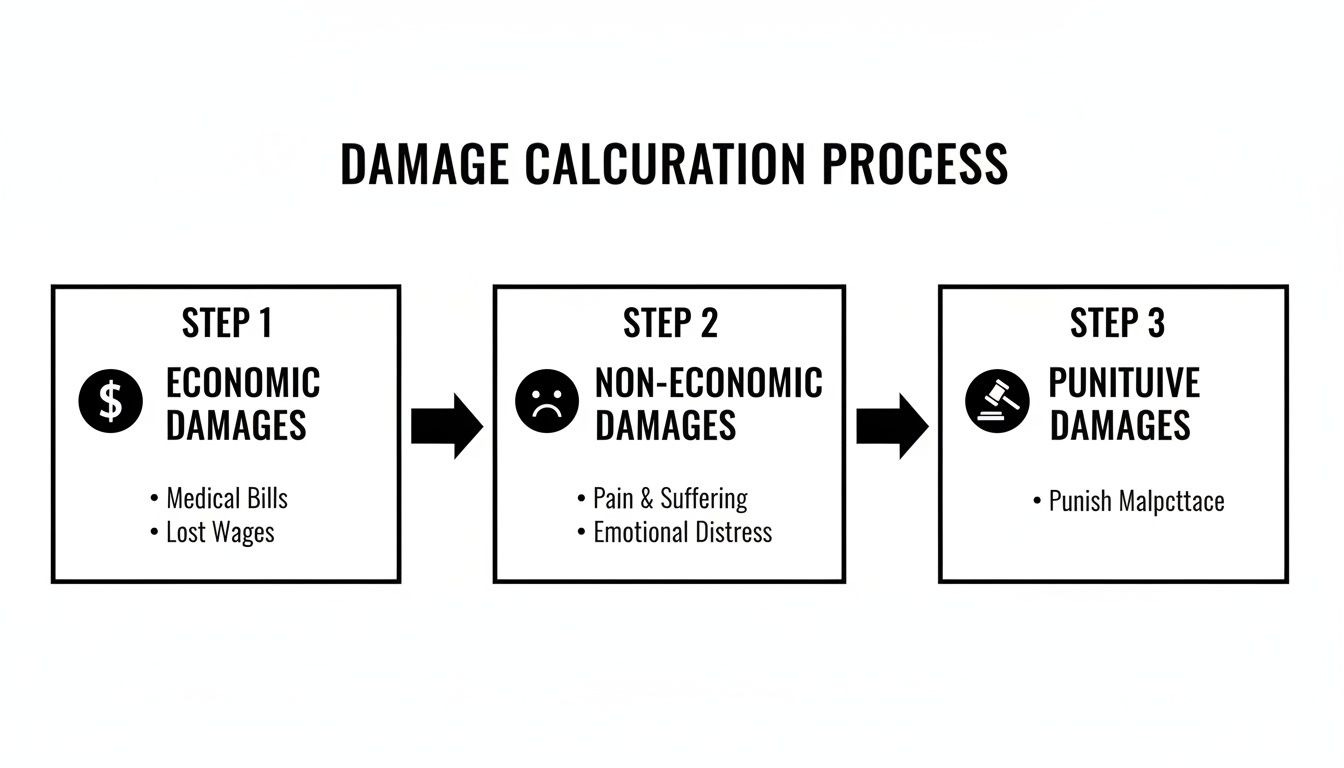
As you can see, your claim is built on the solid foundation of economic damages. From there, we add the more complex non-economic damages and, in some cases, pursue punitive damages.
Projecting Your Future Financial Needs
A severe injury doesn't stop costing you money once you leave the hospital. It often creates a lifetime of future expenses. If your injury requires long-term care, additional surgeries, or permanent modifications to your home or vehicle, those projected costs must be part of your claim.
This is where having a skilled Houston car accident lawyer truly makes a difference. Proving future losses isn't guesswork; it requires a team of experts. We frequently work with:
- Life Care Planners: These are medical professionals who create an exhaustive report detailing all your future medical needs, from ongoing physical therapy to in-home nursing care.
- Vocational Experts: They analyze how your injury impacts your ability to work and earn a living down the road, providing testimony on your diminished earning capacity.
- Economists: These financial professionals take the reports from the other experts and calculate the total lifetime cost, projecting it into one solid, defensible dollar amount.
By turning these future needs into a specific number, we can demand compensation that truly covers the lifelong consequences of your injuries. When you start adding these numbers up, it can be helpful to see what factors influence the average settlement for car accident claims.
For a closer look at what qualifies as a recoverable cost, check out our article on special damages in Texas. Building this comprehensive list of economic damages is the critical first step in making sure any settlement offer from the insurance company reflects the true financial toll of your accident.
Valuing Your Pain and Suffering
How do you put a price tag on the agony of a broken bone? Or the anxiety that grips you every time you get behind the wheel? What’s the dollar value of not being able to lift your own child?
While financial losses are tracked with receipts and pay stubs, the human cost of an accident is just as real. In Texas law, these intangible losses are known as non-economic damages, and they are a critical piece of any personal injury claim.
It might seem impossible to assign a value to your suffering, but insurance companies and attorneys do it in every single case. They rely on established methods to translate your personal experience into a number that can be negotiated. Understanding how they do it is the key to fighting for what you truly deserve.

Common Methods for Calculating Non-Economic Damages
Insurance adjusters don’t just pull a number out of thin air. They typically start with one of two common formulas to get a baseline value for your pain and suffering. It's crucial to remember that these are just starting points—not the final word.
The Multiplier Method: This is the most common approach. The adjuster totals your economic damages (medical bills and lost wages) and multiplies that figure by a number, usually between 1.5 and 5. The multiplier hinges on the severity of your injuries. A minor whiplash claim might get a 1.5x multiplier, while a catastrophic injury causing permanent disability could command a 4x or 5x.
The Per Diem Method: This method assigns a daily rate for your suffering. "Per diem" is just Latin for "per day." The calculation involves setting a dollar amount for each day from the accident until you reach what doctors call "maximum medical improvement." That daily rate is often based on what you earn in a day, based on the argument that enduring constant pain is at least as difficult as going to work.
These methods provide a rough framework, but they can't possibly capture the full story. Our job as your advocate is to build a case that proves why you deserve far more than a simple formulaic payout.
Telling Your Story to Prove Your Suffering
A number from a formula means very little on its own. The real value of your non-economic damages comes from showing how the accident has fundamentally altered your life. This is where evidence beyond the medical bills becomes absolutely essential.
Think of a young parent in Austin who suffers a spinal cord injury in a rear-end crash on I-35. They can no longer lift their toddler, coach their older child's soccer team, or even enjoy a simple family walk without debilitating pain. No amount of money can undo that, but non-economic damages are meant to provide a measure of justice and the resources needed to adapt.
To build this part of the case, we rely on powerful evidence like:
A Personal Injury Journal: Documenting your daily struggles is one of the most powerful things you can do. Make notes about your pain levels, medication side effects, sleepless nights, and moments of frustration or sadness. This creates an undeniable record of your day-to-day reality.
Statements from Family and Friends: Testimony from people who knew you before and after the accident can be incredibly compelling. They can speak to the changes in your personality, your inability to enjoy hobbies, and the overall toll the injury has taken on your relationships and happiness.
Photos and Videos: Visuals showing your life before the crash compared to your limitations now can have a profound impact on an insurance adjuster or a jury.
Your non-economic damages are deeply personal, and a generic calculation will never fully capture your experience. The strength of your claim rests on our ability to tell a compelling story, backed by evidence, that demonstrates the true human cost of the other driver's negligence.
For instance, a construction worker from Houston who suffers a severe hand injury can no longer work in his trade or enjoy his passion for playing the guitar. While the multiplier method gives us a baseline, his claim must also reflect the loss of his career identity and personal joy. We highlight these specific, personal losses to argue for a value that goes beyond the standard calculation. If you want to dive deeper into this topic, you can learn more about pain and suffering damages in our detailed guide.
Ultimately, valuing your pain and suffering is both an art and a science. It begins with formulas but ends with a human story. An experienced Texas injury attorney knows how to combine the hard numbers with compelling personal evidence to fight for the full and fair compensation you are owed.
How Texas Laws Impact Your Final Settlement
Adding up all your economic and non-economic damages is a huge first step, but it’s only one piece of the puzzle. The final check you receive isn't just based on your losses. It's also shaped by specific Texas laws—and you can bet the insurance companies are masters at using these rules to their advantage.
Knowing how these laws work is absolutely essential to protecting the true value of your claim. Two legal concepts stand out as the most important: liability and the statute of limitations. Think of them as the gatekeepers to getting paid.
Defining Liability and Comparative Fault
In simple terms, liability is just legal responsibility. Before you can recover a single dollar, you have to prove the other driver was legally at fault—or liable—for causing the wreck through their negligence. That could mean anything from texting while driving to speeding or ignoring a red light.
But Texas law knows that sometimes, an accident isn't 100% one person's fault. This is where a critical rule called modified comparative fault comes into play, straight from Chapter 33 of the Texas Civil Practice & Remedies Code. This rule can dramatically reduce your settlement.
Basically, if you're found partially to blame for the crash, your total compensation is cut by your percentage of fault. So, if your damages total $100,000 but you're found 20% at fault, your award drops by $20,000, leaving you with $80,000.
The 51% Bar Rule: This is the make-or-break part of Texas's comparative fault system. If a judge or jury decides you were 51% or more responsible for the accident, you are legally barred from recovering anything at all. This "51% bar" is exactly why insurance adjusters will fight tooth and nail to shift blame onto you, even if it seems ridiculous.
How Comparative Fault Works in the Real World
Let's say you're driving through an intersection in San Antonio, and another car blows a stop sign, T-boning you. Seems open-and-shut, right? The other driver is clearly 100% at fault.
Not so fast. Their insurance company might dig for evidence to claim you were going a few miles over the speed limit or were distracted for a split second, trying to pin 20% of the blame on you.
Here's how that plays out:
- Your Total Calculated Damages: $150,000
- Your Percentage of Fault: 20%
- Reduction Amount: $30,000 (20% of $150,000)
- Your Final Potential Recovery: $120,000
This is a classic tactic adjusters use to slash the value of legitimate claims. A good Texas injury lawyer sees these arguments coming a mile away and builds a powerful case to prove the other party shoulders most—if not all—of the liability. For anyone facing these tough arguments, you can learn more about the nuances of comparative negligence in Texas in our in-depth article.
The Statute of Limitations: An Unforgiving Deadline
Of all the legal rules, the statute of limitations might be the most unforgiving. This is a hard, non-negotiable deadline for filing a lawsuit.
In Texas, you have just two years from the date of the accident to file a personal injury lawsuit.
If you miss that two-year window, you lose your right to seek compensation forever. It doesn't matter how badly you were hurt or how obvious the other driver's fault was. The court will throw your case out, and the insurance company won't owe you a dime.
This deadline is precisely why you should talk to an attorney as soon as you can after a wreck. Building a strong case takes time, and waiting too long puts everything you're entitled to at risk. As you move toward a final resolution, it's also important to understand the details of any settlement release agreement you're asked to sign. Getting past these legal hurdles is just as crucial as adding up your bills.
When Punitive Damages Are Awarded
In most Texas personal injury cases, the money you receive is meant to cover your actual losses—things like medical bills, lost paychecks, and the pain you've been forced to endure. But in some truly shocking situations, the law recognizes that just covering a victim's costs isn't enough.
That’s where punitive damages come in. Also known as exemplary damages, they have a completely different goal. They aren’t about making you whole. They are about punishing the at-fault party for their outrageous behavior and sending a clear, powerful message that our community will not stand for it.
The High Bar for Punitive Damages in Texas
Let's be clear: punitive damages are rare. The legal standard you have to meet is incredibly high, and for good reason. Under Chapter 41 of the Texas Civil Practice & Remedies Code, you can't just show someone was careless. You must prove with “clear and convincing evidence” that the harm you suffered was the result of:
- Malice: The defendant had a specific intent to cause you substantial injury.
- Fraud: They used dishonest or deceitful tactics to cause you harm.
- Gross Negligence: This is the most common path. It involves an action (or failure to act) that carries an extreme risk, where the defendant knew about that risk but went ahead anyway, showing a conscious indifference to the safety and well-being of others.
This isn't the usual "preponderance of the evidence" standard used in most civil cases. It's a much heavier burden of proof.
Examples of Gross Negligence
So, what does this level of misconduct actually look like? We're talking about behavior that goes far beyond a simple mistake or a moment of inattention.
Think about a commercial trucking company on I-45 that deliberately falsifies its drivers' logbooks, forcing them to drive well past the legal hour limits. When a fatigue-related crash inevitably happens, that's not just negligence—it's a conscious choice to put profits over lives.
Or consider a drunk driver who causes a catastrophic wreck while having multiple prior DUI convictions and driving on a suspended license. Another clear example is a manufacturer that discovers a deadly defect in its product but decides to cover it up to avoid a recall.
These aren't just accidents. They are conscious, blatant displays of disregard for human safety.
Punitive damages are reserved for the worst-of-the-worst cases. They are designed to hold defendants accountable when their actions are so reckless or malicious that simply paying for the victim's losses isn't enough to achieve justice.
Calculating and Capping Punitive Damages
While every case is unique, looking at outcomes in other complex claims can offer some perspective. For instance, national data shows that medical malpractice cases paid out an average of $679,000, while the median payout for product liability claims was $748,000. You can read more about personal injury case statistics to see how different factors influence case values, but it's important to remember that punitive damages operate under their own set of rules.
Even if you prove your case, Texas law puts limits, or "caps," on how much can be awarded in punitive damages. Generally, the amount cannot exceed the greater of:
- $200,000, or
- Two times the amount of your economic damages, plus an amount equal to your non-economic damages (up to a maximum of $750,000 for the non-economic portion).
Because the standard is so high and the rules are so specific, pursuing a claim for punitive damages is not something you should ever attempt alone. It requires an exhaustive investigation and a deep understanding of Texas law. A skilled Texas injury attorney can dig into the facts of your accident, determine if the defendant's conduct meets the threshold for gross negligence, and build the powerful case needed to hold them fully accountable.
You Don't Have to Do This Alone

After a serious accident, the last thing you should be forced to do is spend your recovery time wrestling with complicated legal formulas and spreadsheets. As this guide shows, figuring out how to calculate damages isn't just about adding up hospital receipts. It’s a fight.
It’s a battle of evidence and persuasion.
To value your claim correctly, you have to project future medical costs, put a number on your pain and suffering, and push back against Texas laws that insurance companies will absolutely use to minimize their payout. You are not on a level playing field with them.
Why the First Offer Is Never the Best Offer
Let’s be clear: the first settlement offer an adjuster sends you is almost never a fair one. It's just a starting point, a number carefully calculated to protect their company’s profits—not to secure your future.
They know you’re in a tough spot. You’re dealing with pain, stress, and a growing pile of bills. They’re banking on you taking a lowball offer just to make the whole ordeal go away.
An insurance adjuster's job is to save their company money. Our job is to fight for every dollar you need to rebuild your life. You have the right to have a champion in your corner.
You do not have to accept their first offer, or any offer that doesn't feel right. You have the right to get experienced legal help to take this burden off your shoulders. This is your opportunity to focus completely on your physical and emotional healing while a dedicated advocate handles the fight for full compensation.
You don’t have to go up against the insurance companies by yourself. A compassionate and skilled Houston car accident lawyer can be your advocate, taking over the stressful negotiations and complex calculations.
At The Law Office of Bryan Fagan, we are here to make sure your story is heard and your rights are protected. We invite you to contact us for a free, no-obligation consultation to discuss the specifics of your case and find out how we can help.
Common Questions We Hear After an Accident
After a crash, your mind is racing with questions. Beyond the physical pain and emotional shock, the financial uncertainty can be overwhelming. Here are the answers to some of the most pressing concerns we hear from injured Texans trying to figure out what comes next.
Do I Have to Go to Court to Get Paid for My Injuries?
Probably not, but we prepare as if we will. The reality is that the vast majority of personal injury cases in Texas settle long before they ever see the inside of a courtroom.
We’ve found the best way to secure a fair settlement is to build a rock-solid case from day one. When the insurance company knows we're ready and willing to go to trial, they are far more likely to negotiate in good faith and offer the compensation you deserve without a lengthy court battle.
How Long Will It Take to Get a Settlement?
This is one of the toughest questions to answer because every case is unique. The timeline really depends on a few key factors:
- The complexity of the accident itself. A straightforward rear-end collision is very different from a multi-vehicle pileup with disputed fault.
- The severity of your injuries. Your medical treatment needs to be complete—or at least have a clear future prognosis—before we can know the full value of your claim.
- The insurance company's behavior. Some negotiate fairly, while others will do everything they can to delay, deny, and underpay.
A simple case might wrap up in a few months, but a more complicated one involving serious injuries could easily take over a year. An experienced Houston injury attorney can give you a much clearer estimate after reviewing the specifics of your situation.
What Happens If the At-Fault Driver Had No Insurance?
Getting hit by an uninsured driver feels like a worst-case scenario, but you still have options. This is exactly why Uninsured/Underinsured Motorist (UM/UIM) coverage exists.
If you have this coverage on your own auto policy, you can file a claim with your own insurance company to cover your damages. Be warned, though—even your own insurer may not make it easy. An experienced lawyer can step in to manage your UM/UIM claim and make sure you get the compensation you've been paying for.
Calculating the full and fair value of your claim is a complex process that requires legal skill and fierce advocacy. You don't have to face this challenge alone. At The Law Office of Bryan Fagan, PLLC, we handle the legal complexities so you can focus on healing. If you or a loved one has been injured, contact us today for a free, no-obligation consultation to discuss your rights and legal options. Visit us at https://houstonaccidentlawyers.net to learn how we can fight for you.