Skip to content
A car crash can change your life in seconds — but you don’t have to face recovery alone. In the confusing aftermath, you're likely dealing with injuries, a damaged vehicle, and a mountain of stress about what comes next. At the heart of every Texas car accident claim is one central question: who is legally responsible, or "liable," for the crash?
The answer isn't always simple. Texas law recognizes that sometimes, more than one person is to blame. This is where the legal concept of comparative negligence comes in, and it's the rule that determines how much money you can recover if you were partially at fault for your own injuries. Understanding this rule is the first step toward protecting your rights and securing the compensation you need to heal.
Who Is Liable in a Texas Car Accident?

After a crash, determining who is liable is rarely a black-and-white issue. Accidents are messy, often with multiple factors contributing to the collision. For example, the other driver may have run a red light, but perhaps you were driving a few miles over the speed limit. This is exactly the kind of situation where Texas's comparative negligence laws become crucial.
Understanding Key Legal Terms in Plain English
Before we dive deeper, let's define some important terms you'll encounter:
- Liability: This is the legal term for fault or responsibility. The person who is liable for the crash is the one responsible for paying for the harm they caused.
- Damages: This refers to the money you can recover for your losses. It includes compensation for medical bills, lost wages, vehicle repairs, and your physical pain and emotional suffering.
- Comparative Fault (or Comparative Negligence): This is the legal rule Texas uses to assign a percentage of blame to each person involved in an accident. This percentage directly affects the amount of damages you can receive.
- Statute of Limitations: This is a strict deadline set by law for filing a lawsuit. In Texas, you generally have two years from the date of the accident to file a personal injury claim.
Under Texas law, you can recover damages for your medical bills, lost income, pain and suffering, and property damage (like your car). You can learn more about how your car’s lost value is handled in our detailed guide on a diminished value claim.
However, the insurance company for the other driver will do everything it can to shift more of the blame onto you to reduce what they have to pay. Even if you worry you might have been a little bit at fault, you could still be entitled to significant compensation. The key is understanding how this system works and having a dedicated Texas injury attorney in your corner to protect your rights.
Understanding The Texas 51% Bar Rule
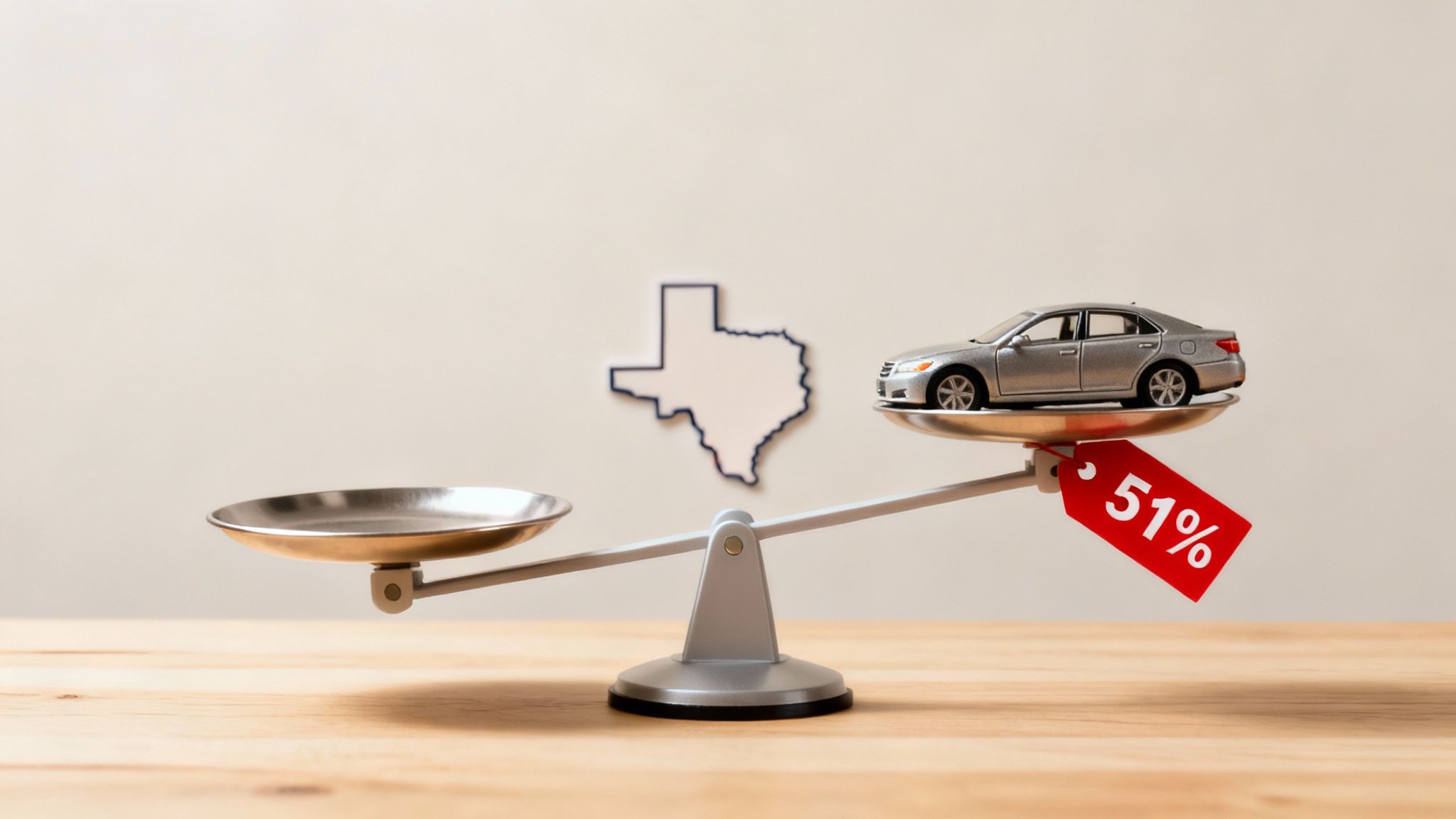
After a car wreck in Texas, determining liability isn't just about pointing fingers. It’s a formal process of assigning a specific percentage of responsibility to every driver involved. This process is governed by a state law called modified comparative negligence, found in Chapter 33 of the Texas Civil Practice & Remedies Code. The single most important part of this law is what’s known as the "51% Bar Rule," and it can make or break your entire personal injury claim.
What Is The 51% Bar Rule?
The Texas 51% Bar Rule, laid out in the Texas Civil Practice and Remedies Code Section 33.001, draws a hard line in the sand. The law states that you can recover damages from the other driver as long as your share of the blame is 50% or less.
However, the moment a jury or insurance adjuster decides you are 51% or more at fault, you are completely barred from receiving a single penny in compensation. It’s a harsh cutoff, and it’s exactly why the other driver’s insurance company will fight tooth and nail to push as much blame as possible onto your shoulders.
In Plain English: Texas law allows you to be partially at fault and still get paid for your injuries. But if you are found to be mostly at fault (51% or more), your right to compensation disappears completely. This makes fighting back against any unfair blame absolutely critical for your financial recovery.
How Your Fault Percentage Reduces Your Compensation
Even when you are safely under that 51% threshold, any fault assigned to you still reduces the amount of money you can receive. The process is straightforward: the total value of your damages is calculated first. Then, your percentage of fault is subtracted from that total.
Let’s use a real-world example. Imagine a Houston driver rear-ended on I-45, and their total damages from medical bills, lost wages, and pain and suffering add up to $100,000. Here’s how the 51% rule would affect their recovery:
- You are 10% at fault: You can recover $90,000 ($100,000 minus your 10% share).
- You are 30% at fault: You can recover $70,000 ($100,000 minus your 30% share).
- You are 50% at fault: You can recover $50,000 ($100,000 minus your 50% share).
- You are 51% at fault: You recover $0.
As you can see, every single percentage point is crucial. A small shift in the fault calculation can be the difference between getting the money you need to put your life back together and walking away with nothing.
Why Texas Law Is Stricter Than Other States
It’s important to realize that not every state handles shared fault this way. Texas uses what’s known as modified comparative negligence. It’s a middle-ground approach that sits between two other systems:
- Pure Comparative Negligence: In states like California, you can be 99% at fault for a crash and still recover 1% of your damages. Your payout is simply reduced by your share of the blame, with no cutoff point.
- Contributory Negligence: This is the harshest system, now used by only a handful of states. If you are found to be even 1% at fault, you get nothing.
Texas law is much less forgiving than "pure" systems. As you've learned, you can only recover compensation if your fault is 50 percent or less. For more insights, you can read about how Texas negligence laws affect claims on aguirrelawpllc.com. This legal framework gives insurance adjusters a massive incentive to argue that you share a big chunk of the blame, even when the evidence clearly shows otherwise.
How Fault Is Determined in a Texas Car Accident
We've established how the Texas 51% Bar Rule works, but how do insurance adjusters, lawyers, and juries actually assign those critical fault percentages? It’s not a guessing game. The process of assigning liability is all about investigating the crash, gathering evidence, and piecing together exactly what happened.
For anyone who has just been in an accident, this process can feel incredibly intimidating. You can be sure the other driver’s insurance company has a team of professionals already looking for ways to push blame onto you. That's why understanding what evidence truly matters is your best line of defense.
The Building Blocks of a Strong Claim
Building a personal injury claim is like solving a puzzle. You need every piece to create an undeniable picture of the truth. Several key types of evidence are used to prove who was at fault.
- Police Reports: This is often the first official record of the accident. It contains the officer's on-scene observations, statements from drivers and witnesses, a diagram of the crash, and sometimes, the officer's initial opinion on who violated a traffic law.
- Witness Statements: An independent witness who saw the crash can be invaluable. Their unbiased account can either support your story or challenge the other driver's, making their testimony incredibly powerful.
- Photos and Videos: Nothing tells a story like a picture. Photos of the vehicle damage, skid marks, debris on the road, and nearby traffic signs provide objective proof of how the wreck occurred. Dashcam footage or video from a nearby security camera is even better.
- Accident Reconstruction Experts: When a case is complex, a Houston car accident lawyer may bring in an expert. These specialists use physics and engineering to scientifically reconstruct the crash, showing exactly what happened with speeds, impact angles, and driver actions.
This evidence is crucial because the other insurance company is doing the exact same thing—hunting for any detail they can use to argue you were partially responsible for your own injuries.
Key Evidence Used to Determine Fault in a Texas Crash
To truly understand how a claim is built, it helps to see all the pieces laid out. Insurance companies and legal teams rely on a wide range of evidence to assign those critical fault percentages. Each piece tells a part of the story, and together, they create a full picture of the accident.
| Type of Evidence | What It Reveals | Why It's Critical for Your Claim |
|---|---|---|
| Police Accident Report | Officer's initial findings, witness info, citations issued, and a diagram of the scene. | Often the first piece of evidence an insurer reviews. A citation against the other driver is powerful proof. |
| Witness Testimony | Unbiased, third-party accounts of what happened before, during, and after the crash. | Can confirm your version of events and counter the other driver's claims, especially in "he said, she said" situations. |
| Scene Photographs & Videos | Vehicle positions, property damage, skid marks, road conditions, and traffic controls. | Provides objective, visual proof that is hard to dispute. Captures details that may be missed or cleaned up later. |
| Dashcam/Surveillance Footage | Real-time video of the collision, showing the actions of all drivers involved. | The most compelling evidence available. It can instantly end a dispute over who had the right-of-way. |
| Medical Records | Documentation of your injuries, treatment, and the link between the crash and your physical harm. | Proves the extent of your damages and helps show the severity of the impact. |
| Expert Analysis | Scientific reconstruction of the crash, analysis of vehicle data (black box), and medical opinions. | In complex cases, experts can provide definitive proof of speed, braking, and other critical factors. |
Gathering and properly presenting this evidence is the key to fighting back against unfair blame and making sure the fault is placed where it truly belongs.
Common Accident Scenarios and How Fault Gets Complicated
While every crash is unique, some scenarios come with a general assumption about who is at fault. But thanks to comparative negligence in Texas, even a seemingly straightforward accident can get messy.
Take a T-bone crash at a busy Houston intersection on the 610 Loop. Both drivers claim they had the green light. Without evidence like a traffic camera or a credible witness, this becomes a frustrating "he said, she said" standoff. An insurance adjuster might try to assign 50/50 fault, which could prevent a seriously injured victim from recovering the full compensation they need.
Rear-end collisions are another common example. There's a strong legal assumption that the rear driver is at fault. But what if the driver in front slammed on their brakes for no reason or had broken brake lights? The rear driver could argue the front driver shares some of the blame, which would reduce the final settlement.
Texas has a staggering number of motor vehicle accidents—on average, around 1,532 car crashes happen every single day across the state. With so many accidents, decisions about comparative negligence are made in thousands of cases each year. For a deeper look into these statistics, you can discover more insights about Texas accident claims at ulg.law.
At the end of the day, insurance companies will look for any opening to argue that you contributed to the accident. They know that every percentage point of fault they can successfully pin on you is money they get to keep in their pockets.
Calculating How Comparative Negligence Affects Your Payout
Understanding the 51% Bar Rule is one thing; seeing how it affects your ability to pay your bills is another. To truly grasp the financial stakes of a comparative negligence Texas claim, you have to look at the math. This all starts with the legal term for the money you're owed for your losses: damages.
In a car accident case, damages are usually split into two main categories:
- Economic Damages: These are the straightforward, calculable costs. This includes medical bills, lost wages from being unable to work, the cost to repair or replace your car, and any future medical treatments you might need.
- Non-Economic Damages: These are harder to put a price on, but they're just as real. This is compensation for your physical pain, emotional distress, mental anguish, and the loss of enjoyment of life the crash has caused.
Once the total value of all your damages is added up, the fault percentages are applied. This is where an insurance adjuster’s attempt to pin even 10% of the blame on you can cost you thousands of dollars.
This flowchart shows how critical evidence is in figuring out who's at fault after a Texas car wreck.
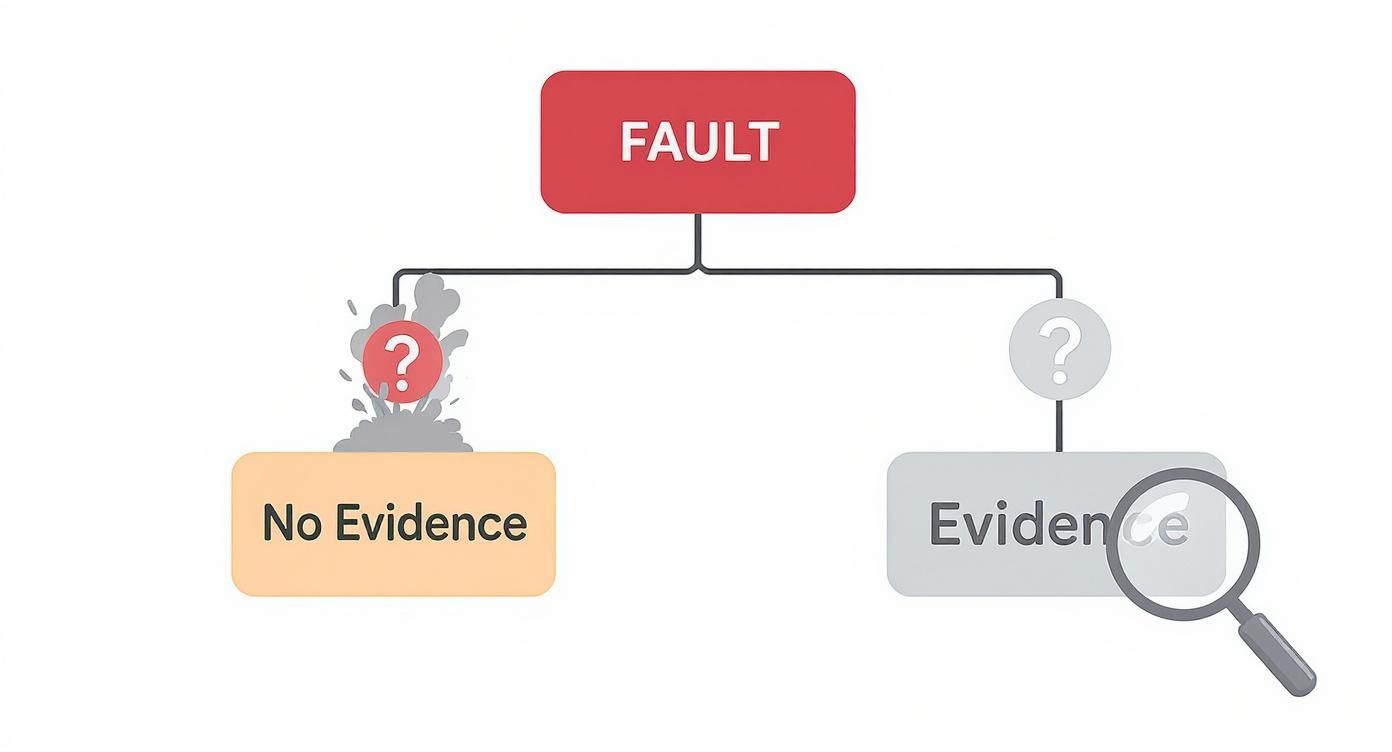
The takeaway here is simple. Without solid proof, your auto insurance claim can hit a wall. But with strong evidence, you can push for a fair fault determination and get the recovery you deserve.
Real-World Scenarios: The Financial Impact of Fault
Let's put this into practice. Imagine a Houston driver gets T-boned in an intersection on I-45. A jury decides their total damages are $100,000, covering their hospital stay, weeks of missed work, and the intense pain they’ve had to endure.
Now, let’s see how different fault percentages completely change their final payout.
Scenario 1: You are Found 10% At Fault
The other driver blew through a stop sign, but it turns out you were going a little over the speed limit. The insurance company successfully argues you share a tiny piece of the blame.
- Total Damages: $100,000
- Your Fault: -10% ($10,000)
- Your Final Recovery: $90,000
A seemingly small fault assignment has already cost you $10,000.
Scenario 2: You are Found 30% At Fault
In this version, maybe you were texting right before the crash, even though the other driver was clearly the main cause. The adjuster jumps on this, assigning you a much bigger share of the fault.
- Total Damages: $100,000
- Your Fault: -30% ($30,000)
- Your Final Recovery: $70,000
You’ve now lost nearly a third of the money you needed to get back on your feet.
Scenario 3: You are Found 51% At Fault
The insurance company argues that your distraction was the primary reason for the accident, even though their driver broke a traffic law. They convince a jury that you are mostly to blame.
- Total Damages: $100,000
- Your Fault: -51%
- Your Final Recovery: $0
Because your fault tipped just past the 50% line, you are legally barred from receiving a single penny.
These examples show exactly why insurance companies fight so hard over every single percentage point. It’s not about what’s fair; it’s about protecting their bottom line. The more blame they can shift to you, the less they have to pay.
This is why having a clear picture of what your case is truly worth is so important. To get a better handle on the factors involved, you can learn more about how to calculate what your car accident claim is worth in our detailed guide. An experienced Houston car accident lawyer recognizes these tactics and is ready to build a powerful, evidence-based case to shield you from unfair blame and maximize your financial recovery.
Steps to Protect Your Rights After an Accident
In the chaotic moments after a car crash, it’s easy to feel overwhelmed and unsure of what to do. But the actions you take at the scene and in the days that follow are absolutely critical. Each step is a strategic move to build a strong foundation for your claim and protect yourself from the insurance company, which will be looking for any reason to use Texas's comparative negligence rules against you.
What to Do After a Crash: A Step-by-Step Guide
The work of protecting your claim starts immediately. Your top priorities are ensuring everyone's safety, creating an official record of what happened, and documenting everything you can.
Here are the crucial first steps you need to take:
- Call 911 Immediately: Even if the crash seems minor, you need an official police report. This report is often the first piece of evidence an insurance company will review. It documents key details like driver statements, witness information, and any traffic tickets issued.
- Seek Medical Attention: Adrenaline can mask serious injuries. Go to the emergency room or see a doctor right away, even if you feel fine. This creates a medical record that directly links your injuries to the crash—vital for proving your damages.
- Gather Your Own Evidence: Don't rely solely on the police. Use your phone to take photos and videos of everything: damage to all vehicles, skid marks, nearby traffic signs, and the overall scene. If there are witnesses, get their names and phone numbers. Their unbiased account can be incredibly valuable.
- Exchange Information: Get the other driver's name, contact information, insurance company, and policy number.
- Be Careful What You Say: A simple "I'm sorry" at the scene can be twisted into an admission of guilt. Stick to the facts when speaking with the other driver and the police. Avoid discussing who was at fault.
How to Deal with Insurance Companies
After an accident, you must be cautious. What you say and do can have serious consequences for your claim. Insurance adjusters are trained to find any statement or action they can use to assign you a higher percentage of fault.
It is also essential to be mindful of your digital footprint. Insurance companies often look at social media profiles for any evidence they can use against you. It is wise to avoid posting about the accident or your activities until your case is resolved. For a complete checklist, review our guide on what to do after a car accident.
Finally, be extremely careful when speaking with the other driver’s insurance adjuster. They may call you quickly, acting friendly and concerned, but their goal is to get a recorded statement where you might say something that damages your claim. You are not obligated to give them a statement. It is always in your best interest to speak with a Houston car accident lawyer before talking to the other party's insurer. Your attorney can handle all communications, protecting you from their tactics and ensuring your rights are defended every step of the way.
Why You Need a Houston Lawyer to Fight for You
It's a common thought after a crash: "Maybe I can handle the insurance claim myself." But the other driver’s insurance company isn't on your side. Their adjusters are skilled professionals whose job is to protect their company's bottom line by paying out as little as possible—or denying your claim altogether.
They understand comparative negligence Texas law intimately and will use it to their advantage. Every phone call and every question is a potential trap designed to shift more fault onto you. More fault on you means less money they have to pay.
Leveling the Playing Field
This is where The Law Office of Bryan Fagan, PLLC, comes in. Hiring an experienced Houston car accident lawyer is the single best thing you can do to level the playing field. The insurance company has a team of experts working against you; we become your team, fighting exclusively for your interests.
From day one, we take over all communication with the insurance companies. This immediately shields you from their tactics and lets you focus on what really matters: your recovery.
An insurance adjuster’s job is to save their company money. Our job is to make sure you get every penny you are rightfully owed under Texas law. We fight to ensure your side of the story is told and that the blame is placed where it actually belongs, whether it's for a car, truck, or wrongful death compensation claim.
How We Build a Winning Case
Protecting your rights is about much more than just making phone calls. It takes a proactive, detailed strategy designed to dismantle the insurance company’s arguments.
Here’s a look at how our team goes to bat for you:
- We Conduct an Independent Investigation: We never just take the police report at face value. Our team launches its own deep-dive investigation to uncover the truth, hunting for evidence like surveillance footage and witness statements.
- We Preserve Critical Evidence: Evidence can disappear. We move quickly, sending legal preservation letters to secure crucial information—like a truck driver's logbooks or a company's vehicle maintenance records—before it can be lost or destroyed.
- We Bring in Experts: For complex accidents, we work with a network of top-tier accident reconstructionists and medical experts whose analysis can provide scientific proof of how the crash happened and the true scope of your injuries.
- We Construct a Powerful Legal Argument: We take all that evidence and weave it into a compelling narrative that shuts down any attempt to blame you and maximizes the value of your claim. We are always ready to negotiate aggressively for a fair settlement, but we're equally prepared to take your case to court if that's what it takes to get you justice.
After a serious accident, getting strong legal representation should be a priority. You might start by researching what goes into finding a qualified car accident law firm in your area. You don’t have to go through this fight on your own. Having a powerful advocate in your corner is the best way to ensure your rights are protected.
Common Questions About Comparative Negligence in Texas
After a car wreck, you’re left with a mountain of worries and just as many questions. Understanding comparative negligence in Texas is one of the most important things you can do to protect your rights. Here are straightforward answers to the questions we hear most often.
What Happens if Both Drivers Are Found 50% at Fault?
This is a critical question at the heart of Texas’s 51% Bar Rule. If you are found to be exactly 50% at fault for an accident, you can still recover damages. The law only bars you from compensation if your share of the blame is 51% or more.
In a 50/50 fault scenario, your total damages would be reduced by your 50% share. For instance, if you had $50,000 in medical bills and lost wages, you’d be able to receive $25,000.
How Long Do I Have to File a Car Accident Lawsuit in Texas?
In Texas, the deadline for filing a lawsuit is set by a law called the statute of limitations. For most personal injury claims from car accidents, you have two years from the date of the crash to file.
This two-year deadline is incredibly strict. If you try to file a lawsuit even one day too late, the court will almost certainly throw out your case, and you will lose your right to seek compensation forever. It's vital to contact a Texas injury attorney long before that clock runs out.
Does Comparative Negligence Apply to Other Injury Cases?
Yes. While we discuss it most often in the context of car accidents, Texas's modified comparative negligence rule applies to almost any personal injury claim where your own actions might have played a role in your injuries.
The 51% rule can come into play in other cases, including:
- Premises Liability: Such as a slip and fall at a grocery store.
- Product Liability: When you're hurt by a defective or dangerous product.
- Wrongful Death: Cases where a loved one's death was caused by someone else's carelessness, seeking wrongful death compensation.
In any situation where the blame can be split, the same rules about allocating fault will be used to decide if you can recover damages.
The insurance company understands the ins and outs of comparative negligence in Texas and will use that knowledge to reduce or deny your claim. You don't have to face them on your own. The dedicated team at The Law Office of Bryan Fagan, PLLC is here to fight for you, reassure you, and empower you. We will launch a thorough investigation, stand up to the insurance giants, and work tirelessly to make sure you receive the maximum recovery possible. Contact us today for a free, no-obligation consultation to discuss your case and learn how we can help. Visit us at https://houstonaccidentlawyers.net.