A car crash can change your life in seconds—but you don’t have to face recovery alone. The financial fallout can linger long after your vehicle is back from the shop. There's a hidden cost that repairs alone don't cover: diminished value. Under Texas law, you have the right to get that money back. It's a real, measurable loss—often thousands of dollars—that you shouldn't have to carry on your own.
Why Your Repaired Car Is Still Worth Less After an Accident
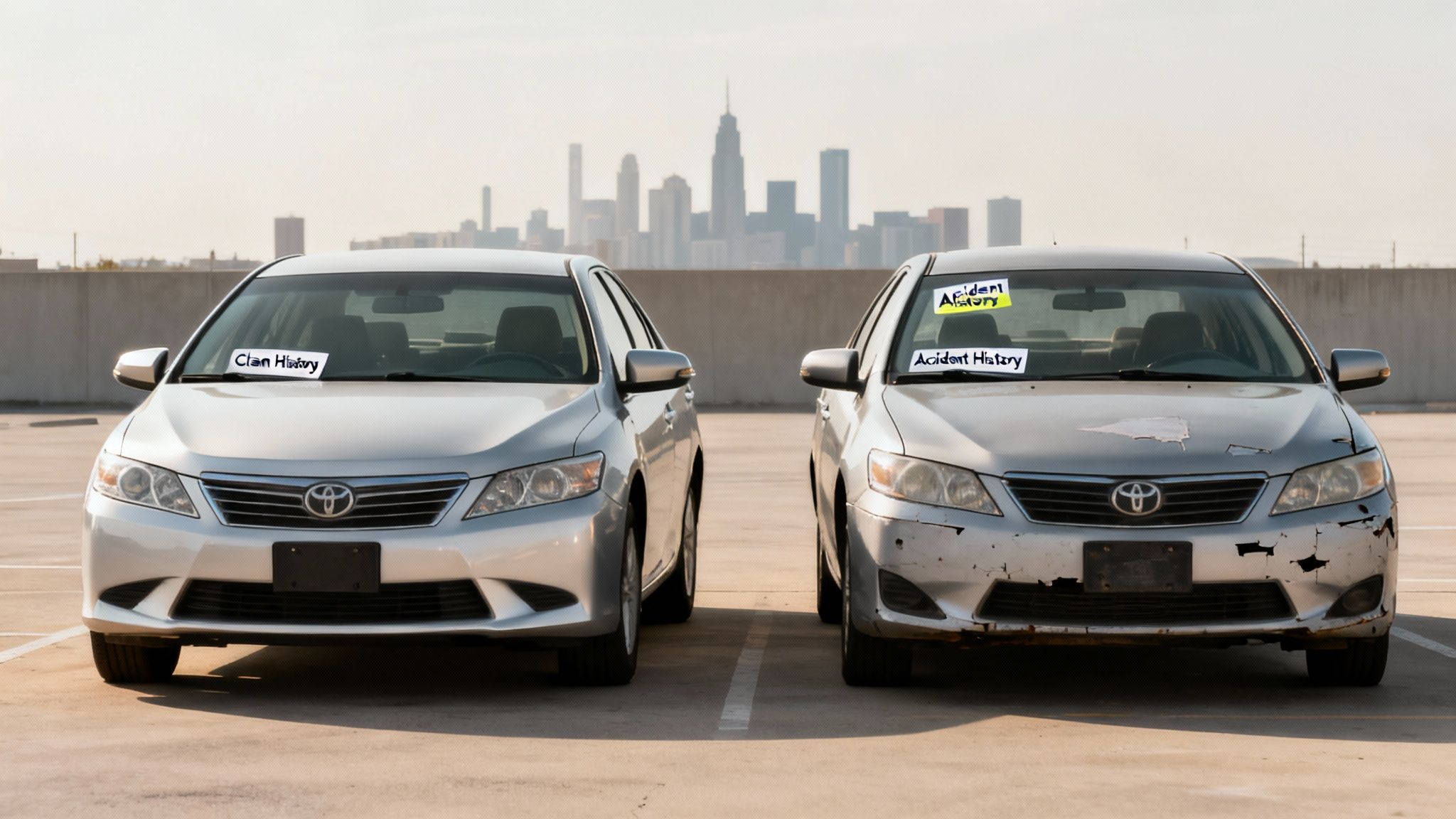
Let's walk through a simple scenario. Imagine you're at a Houston dealership looking at two identical used cars. Same make, same model, same mileage. One has a squeaky-clean vehicle history report. The other? It shows a significant collision in its past.
Even if the second car was perfectly restored by the best mechanics in Texas, which one would you choose? More importantly, which one would you expect a discount on?
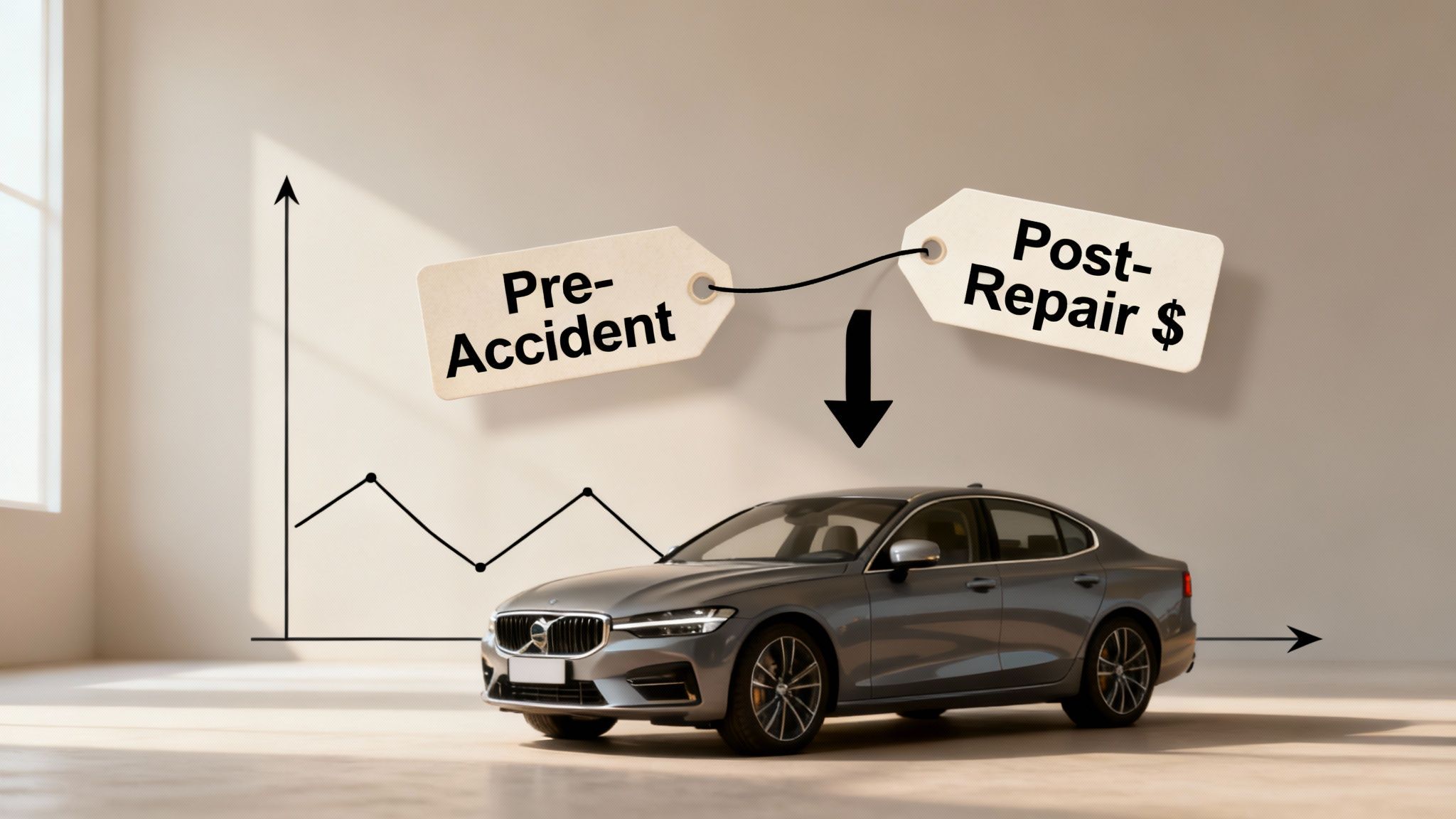
The answer is obvious. The car with an accident on its record is simply worth less. That permanent drop in resale value, a direct result of the crash, is the entire basis of a diminished value claim. It's the gap between what your car was worth moments before the accident and what it's worth the second the repairs are finished.
A Loss You Did Not Cause
Here’s the thing: this financial hit isn't your fault. When another driver's carelessness causes a wreck, they are legally on the hook for all the resulting harm. The Texas Civil Practice & Remedies Code establishes the principle of liability, meaning the at-fault driver is responsible for the harm they cause. Their insurance must compensate you not just for the repair bill but also for this invisible damage to your car's market value.
But don't expect the at-fault driver's insurance company to bring this up. They are banking on you not knowing your rights. Their goal is to pay for the repairs and close the case, leaving you to absorb the loss in value.
Texas law is on your side, though. You are entitled to be made whole, and that includes recovering your vehicle’s lost resale value. This guide will break down exactly how to file a diminished value claim and fight for the full amount you're owed. The Law Office of Bryan Fagan is here to help you understand the process and protect your rights every step of the way.
Understanding What a Diminished Value Claim Really Means
Let's ditch the confusing legal jargon and get straight to the point. A diminished value claim is all about a simple, frustrating truth: a car that’s been in an accident is worth less than one that hasn’t, even if it’s repaired perfectly. It’s the gap between what your car was worth seconds before the crash and what it’s worth the moment the repairs are done.
Think about it from a buyer's perspective. You’re looking at two identical cars, but one has a clean history and the other has a major collision on its vehicle history report. Which one are you going to pay top dollar for? The accident permanently taints your car's record, and that stigma costs you real money when it’s time to sell or trade it in.
This isn’t some made-up loss; it's a real financial hit you take because someone else was negligent on the road.
The Three Main Types of Diminished Value
While the core idea is straightforward, "diminished value" actually breaks down into a few different categories. Figuring out which type applies to your situation is the first step in building a solid case against the at-fault driver's insurance.
Knowing these distinctions helps you understand exactly what you're owed and gives you the language to discuss your losses confidently.
Here’s a quick look at the three types of diminished value.
Three Types of Diminished Value
| Type of Diminished Value | What It Means for You | When It Applies |
|---|---|---|
| Inherent Diminished Value | This is the automatic, unavoidable drop in value simply because your car now has an accident history. | This is the most common and powerful type of claim. It applies to nearly any vehicle that's been in a wreck, even if the repairs are flawless. |
| Repair-Related Diminished Value | This is an extra loss in value because the repairs themselves were shoddy or incomplete. | This comes into play if the body shop used cheap aftermarket parts, couldn't match the paint, or left other obvious signs of a bad repair job. |
| Immediate Diminished Value | This is the difference in your car's value right after the crash but before any repairs have been made. | This is more of a temporary calculation. Most final claims don't focus on this, but rather on the permanent loss after repairs are complete. |
Most successful claims in Texas focus on inherent diminished value because it’s the most undeniable loss. It’s the market’s reaction to a documented crash history—something no amount of buffing or painting can ever erase.
The Real-World Financial Impact
So, how much money are we talking about? The loss can be surprisingly large. On average, a diminished value settlement can run anywhere from 10% to 25% of your car’s pre-accident market value.
Consider a real-world example: a vehicle sustained $6,621 in repair costs after an accident. On top of getting the repairs fully paid for, the owner successfully recovered an additional $3,040 for the car's diminished value. That's a significant amount of money that would have otherwise been lost. You can learn more about how these claim payouts are calculated.
Key Takeaway: Filing for diminished value isn't about getting "extra" money. It's about being made whole again. The at-fault party is responsible for all the damages they caused—not just the dent in your bumper, but the dent in your car's resale value, too. An experienced Houston car accident lawyer can fight to make sure you don't leave that money on the table.
Who Is Liable and Who Can File a Claim in Texas?
After a car wreck, you're juggling repairs, medical bills, and a whole lot of paperwork. It’s a mess. A common question that pops up is, "Can I even file a diminished value claim?" In Texas, the answer isn't always straightforward—the rules are specific, and you need to know them to get the compensation you deserve.
Here’s the single most important thing to remember: you can only file a diminished value claim against the at-fault driver's insurance company. This is called a third-party claim. You can't turn to your own insurance policy for diminished value, even if you have full collision coverage. This detail makes one thing crystal clear: proving the other driver was at fault is step one.
Think of it this way: if a Houston driver rear-ended you on I-45, they are clearly responsible. Their liability insurance is on the hook for your losses—not just the repair costs, but also the hit to your car’s resale value.
Understanding Comparative Fault and Your Right to Claim
Texas law uses a system called comparative fault (or proportionate responsibility). It’s a legal rule tucked away in Chapter 33 of the Texas Civil Practice & Remedies Code that decides how to split the bill when more than one person is to blame for an accident.
Here's how it breaks down for you:
- You are 0% at fault: You can go after the other driver’s insurance for 100% of your damages, including the full diminished value of your vehicle.
- You are partially at fault: Your payout gets reduced by your percentage of fault. If a judge decides you were 20% responsible for the crash, you can only claim 80% of your car's diminished value.
- You are 51% or more at fault: You get nothing. Texas law bars you from recovering any damages if you're found to be mostly at fault. This is exactly why proving the other driver's negligence is so critical.
Because fault is the key to everything, don't be surprised if the other driver’s insurance adjuster tries to pin some of the blame on you. It's a common tactic to reduce or completely deny their payout.
The Clock Is Ticking: The Statute of Limitations
Another huge factor is the legal deadline for filing a claim. Texas has a strict time limit, known as the statute of limitations, for any property damage case.
For property damage, which includes a diminished value claim, you have two years from the date of the accident to either settle your claim or file a lawsuit. If you let that deadline pass, your right to compensation is gone for good.
Two years might sound like plenty of time, but it flies by. Gathering evidence, getting a professional appraisal, and wrestling with a stubborn insurance company can easily eat up months. It’s smart to get the ball rolling quickly to build a strong case. To successfully file a diminished value claim, it's also important to understand Texas's auto insurance requirements. An experienced Texas injury attorney can make sure you hit every deadline and meet all the legal requirements.
How to Prove and Calculate Your Car's Lost Value
After a crash, don't expect the at-fault driver's insurance company to just hand you a check for your car's lost value. In fact, they’ll probably act like it doesn't even exist. It's a frustrating reality, but the burden falls on you to prove your loss and fight for every dollar you're owed.
You have to be the one to build the case. Remember, the insurance adjuster’s job isn’t to make you whole; it’s to protect their company's bottom line by paying out as little as possible.
Challenging the Insurer's Lowball Formulas
Insurance companies love to use a canned calculation called the "17c formula" to come up with a diminished value offer. This formula was literally created by an insurance company, for insurance companies. It’s designed to spit out the lowest possible number by applying arbitrary caps and weird modifiers that have little to do with the real world.
You are under zero obligation to accept an offer based on a biased formula that only benefits the insurance company. The key is to counter their weak offer with strong, independent proof of what your vehicle is actually worth now.
This is where you take back control. Instead of letting the adjuster run the show, you come to the table with your own evidence—a professional, unbiased assessment they can't ignore.
The Power of an Independent Appraisal
Your single most powerful tool in this fight is a certified independent appraisal. This isn't just someone's opinion; it's a detailed, expert report from a professional who specializes in assessing how much value a car loses after an accident. Crucially, they work for you, not the insurance company. Their report gives you the objective proof you need.
A solid appraisal report will always include:
- Your Vehicle's Pre-Accident Value: The appraiser establishes the fair market value of your car right before the collision, based on its specific condition and real market data.
- A Detailed Damage Assessment: The report digs into the police report and repair shop invoices to document exactly how severe the damage was, paying close attention to any structural issues.
- Post-Repair Market Analysis: This is the core of it. The expert compares your repaired car to similar, never-wrecked cars for sale to calculate the real-world drop in what a buyer would pay.
- The Final Diminished Value Amount: The report concludes with a clear, specific dollar figure representing your car's lost value.
This professional report turns your request into a documented, evidence-based demand. It becomes much harder for an adjuster to blow you off or stick to their ridiculously low first offer when you're armed with this kind of proof. For more tips on navigating these conversations, check out our guide on how to negotiate an insurance settlement.
Factors Influencing Your Diminished Value Claim
Not all diminished value claims are created equal. Several key factors can dramatically increase—or decrease—the amount you can recover. A good Houston car accident lawyer knows exactly how to frame these elements to build the strongest possible case for you.
Here's a breakdown of what matters most when calculating your car's diminished value.
| Factor | How It Impacts Your Claim | Example |
|---|---|---|
| Vehicle Age & Mileage | Newer cars with low mileage lose a much higher percentage of their value. | A one-year-old SUV with 10,000 miles will have a much larger DV claim than a five-year-old model with 90,000 miles. |
| Pre-Accident Condition | A car in pristine condition before the crash has more value to lose. | A meticulously maintained car will have a higher claim than one with existing dings, scratches, or interior wear. |
| Severity of Damage | Frame damage or airbag deployment creates a major stigma that kills resale value. | A vehicle with structural damage repaired will always be worth less than one that just needed a new bumper. |
| Make and Model | Luxury, exotic, or specialty vehicles take a bigger hit from accident history. | Buyers for a Porsche or a Tesla are extremely sensitive to accident reports, leading to a significant drop in value. |
Ultimately, it's not about arguing with the adjuster. It’s about presenting undeniable facts that compel the insurance company to do the right thing and pay what you are rightfully owed under Texas law.
Steps to File Your Diminished Value Claim in Texas
Feeling lost about how to file a diminished value claim? You're not alone. It can feel like a maze, but we've mapped out a clear, step-by-step path to help you move forward with confidence.
Following a structured approach is the best way to build a rock-solid claim that the at-fault driver’s insurance company can't just brush aside.
Step 1: Gather Your Critical Evidence
Before you even think about picking up the phone to call an insurance adjuster, you need to build your case. Think of yourself as a detective putting together a file that proves your loss, leaving no room for doubt.
Your evidence file is your ammunition. It should include:
- The Official Police Report: This is your foundation. It’s a critical document that often points to who was at fault for the crash.
- All Repair Documentation: Gather every single invoice, estimate, and receipt from the body shop. These papers prove the physical extent of the damage your car suffered.
- Photos and Videos: A picture is worth a thousand words. You need clear photos of the damage before repairs, during the process (if possible), and after the work is done.
- Your Independent Appraisal Report: This is your ace in the hole. A certified appraisal from a diminished value expert gives you an objective, data-backed number for your car's lost value.
Step 2: Draft a Compelling Demand Letter
Once you have all your evidence organized, it's time to make your official move. You do this by sending a demand letter to the at-fault driver's insurance adjuster. This isn't just a simple note—it's a professional document that lays out the facts and demands a specific dollar amount for your loss.
After you've figured out what your car has lost in value, the demand letter is how you formally ask for that money back. For some solid examples, you can look at these effective demand letters to see how to structure your argument.
Your letter needs to clearly state:
- The key details of the accident (date, location, and the at-fault driver's name).
- The specific amount you are claiming for diminished value.
- A quick summary of the evidence you have, making sure to mention the attached police report and your professional appraisal.
This letter is what officially puts the insurer on notice and kicks off the negotiation process. The visual below boils the core steps down to the basics.
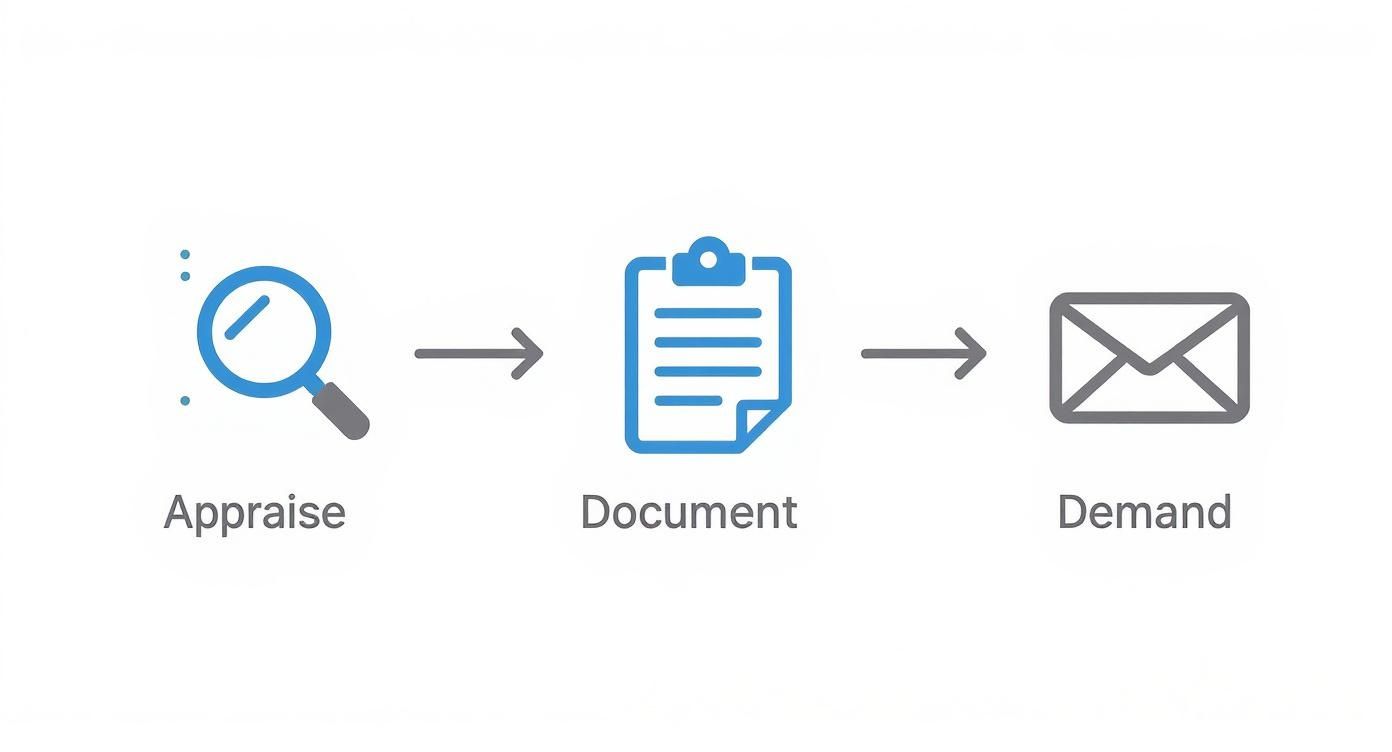
As you can see, a successful claim always moves from a professional appraisal to thorough documentation before you ever make that formal demand.
Step 3: Deal with the Insurance Company
After you send your demand letter, the insurance adjuster will get back to you. Be ready for some pushback. It’s their job to delay, devalue, or deny your claim if they can. This is just part of the game, so don't get discouraged.
Stay calm, be professional, and stand your ground. Keep pointing back to your evidence, especially that independent appraisal. Whatever you do, don't accept their first lowball offer, which is almost always based on a bogus, insurer-friendly formula like “17c.”
Remember: You are in control as long as you have the facts on your side. The goal is to show the adjuster that you have a well-documented, legitimate claim they cannot ignore.
Filing a property damage claim has a lot of moving parts, from the initial report to the final settlement negotiation. For a more detailed look, you can check out our guide on how to file a car accident claim. If the adjuster still refuses to be reasonable, it might be time to bring in the pros. A Houston car accident lawyer can take over the fight and show the insurance company you’re serious about getting back every dollar you're owed.
Why an Attorney Makes a Difference in Your Claim
While it’s certainly possible to file a diminished value claim on your own, it’s a lot like walking into a negotiation where the other side has a full team of experts, years of experience, and a powerful financial incentive to pay you as little as possible. Insurance companies aren't in the business of generously handing out fair payments. They're businesses, and their goal is to protect their bottom line.
Hiring an experienced Houston car accident lawyer completely changes the dynamic. An attorney who deals with these cases every day understands the exact tactics insurance adjusters use to downplay, delay, and flat-out deny legitimate claims. We know the biased formulas they love to use, the arguments they’ll make, and most importantly, how to build a rock-solid, evidence-based case they can't simply brush aside.
Leveling the Playing Field Against Insurers
Think about it: insurance companies process thousands of claims a day. They have a well-oiled system designed to wear you down and convince you that their first lowball offer is the best you're going to get. An attorney is the wrench in that machine.
At The Law Office of Bryan Fagan, we step in and take over the entire diminished value claim process, lifting that stress right off your shoulders. Here’s how we do it:
- Commissioning a Credible Appraisal: We connect you with trusted, independent appraisal experts whose reports carry weight and stand up under intense scrutiny.
- Handling All Communications: You can stop worrying about calls from adjusters trying to trip you up with tricky questions. We manage every single interaction to protect your rights.
- Aggressive Negotiation: We don’t just ask for fair compensation; we demand it. We present your claim with a strong, evidence-backed demand letter and negotiate aggressively to secure every penny you're owed.
Bringing in an attorney sends a clear message: you’re serious, you know your rights, and you won’t be pushed around. This is more important than ever, as the quality of the claims experience has a huge financial impact on the insurance industry. In fact, industry research shows that poor claims handling could put up to $170 billion in global insurance premiums at risk by 2027, simply because unhappy clients will take their business elsewhere. You can read the full research on how claims experiences impact insurance premiums.
We Are Not Afraid to Go to Court
Maybe the biggest advantage of having a lawyer is our willingness to take your case all the way to court. Insurance companies know that the average person doesn't have the time, resources, or legal knowledge to file a lawsuit. They are far more likely to offer a fair settlement when they see you have a trial-tested Texas injury attorney ready to fight for you in a courtroom.
We prepare every single claim as if it's going to trial. This meticulous preparation often results in better settlement offers because insurers want to avoid the time, expense, and risk of a courtroom battle they are likely to lose.
If the insurance company digs in its heels and refuses to be reasonable, we won't hesitate to file a lawsuit to demand what's fair. Deciding to get legal help is a big step, and you can learn more by reading our guide on if you should hire a car accident lawyer. Your fight becomes our fight, and we're committed to seeing it through to the end.
Your Top Questions About Texas Diminished Value Claims
After a wreck, your head is probably spinning with questions. The insurance process can be a maze, but getting clear, straight answers is the first step toward getting back what you’ve lost. Let's tackle some of the most common questions we hear from our clients about Texas diminished value claims.
What if the Driver Who Hit Me Has No Insurance?
This is a tough spot to be in, and unfortunately, it happens all the time. If the at-fault driver is uninsured, you can’t exactly file a claim with an insurance company that doesn't exist.
While your own collision coverage will pay for your vehicle's repairs, it won't touch the lost resale value. Even more frustrating, your Uninsured/Underinsured Motorist (UM/UIM) policy in Texas is strictly for bodily injuries—it does not cover property damage like diminished value. Your only real option here is to sue the driver directly, but that can be a dead end if they don’t have the personal assets to pay what you’re owed.
Is There a Deadline to File My Claim?
Yes, and you can't afford to miss it. In Texas, the statute of limitations for any property damage claim is just two years from the date of the accident. This isn’t a suggestion; it’s a hard deadline set by law.
If you don't either settle your claim or file a lawsuit within that two-year window, you permanently lose your right to recover a single dollar. While two years might sound like a long time, it's always smart to start the process as soon as your repairs are done. The longer you wait, the tougher it is to prove your case and the more excuses the insurance company has to drag its feet.
Is It Worth Hiring a Lawyer for a Smaller Claim?
We get this question a lot. If your car’s lost value is only a few thousand dollars, you might wonder if hiring an attorney is worth the cost. In most cases, the answer is a firm yes.
Insurance adjusters are professionals trained to do one thing: pay you as little as legally possible. Their first offer for diminished value is almost always a lowball number spit out by a self-serving formula. They're banking on you not knowing any better.
An experienced Texas injury attorney knows their playbook. We know how to pick apart their weak arguments, build a rock-solid case with real evidence, and force them to negotiate fairly. Even after our fee, the money our clients take home is almost always significantly more than they could have gotten on their own. We're here to make sure you don't leave money on the table.
Don’t let an insurance company tell you what your car—and your claim—is worth. The skilled attorneys at The Law Office of Bryan Fagan, PLLC are ready to fight for every penny you deserve.
Contact us today for a free, no-obligation consultation to discuss your case. We are here to inform, reassure, and empower you on the road to recovery. Just visit our Houston accident lawyers website to get started.