A car crash caused by a drunk driver can change your life in seconds—but you don’t have to face recovery alone. You're left grappling with injuries, emotional shock, and a mountain of bills. While the driver is clearly at fault, Texas law recognizes that another party might share the blame: the place that sold them the alcohol.
This is where the Texas dram shop law comes into play. It provides a way for you to hold a business accountable for selling alcohol to someone who was already obviously intoxicated and went on to cause injury or death. In other words, if a bar or restaurant over-serves a customer who then gets behind the wheel and hurts you, you can seek compensation from both the drunk driver and the establishment.
Understanding Your Rights After a Drunk Driving Accident
A collision with a drunk driver can shatter your world in a split second. Suddenly, you're facing physical pain, emotional trauma, and immense financial pressure. It's a fight you shouldn't have to face alone.
The Texas Dram Shop Act is a powerful tool for justice in these situations. It gives victims like you a legal path to hold negligent businesses accountable for their part in the tragedy. Think about it: when a bartender keeps pouring drinks for a patron who is clearly stumbling and slurring their words, they aren't just making a sale—they're contributing to a dangerous situation that's about to hit the road.
What Is Liability in a Dram Shop Case?
In legal terms, liability simply means legal responsibility for causing harm. In a typical car accident claim, the at-fault driver is liable for the damages they cause. A dram shop claim broadens this circle of responsibility to include a third party—the alcohol vendor.
To win a dram shop case, your Houston car accident lawyer has to prove the establishment served alcohol to a customer who was already “obviously intoxicated to the extent that he presented a clear danger to himself and others.”
This is a specific legal standard. It isn't enough to show the person had a few drinks. We have to show there were clear, visible signs of intoxication that a reasonably trained server should have spotted. These laws have a fascinating history, tracing back to 19th-century movements to make taverns answer for the chaos they sometimes fueled. You can learn more about the history of dram shop laws and see how they've evolved.
Pursuing a claim against a bar or restaurant can be challenging, but it's often crucial, especially if the drunk driver has little or no insurance. An experienced Texas injury attorney can navigate the complexities and explore every avenue for you. To better understand the process, you can read our guide on whether you should hire a car accident lawyer to protect your interests. Our mission is to make sure you have the resources you need to rebuild your life.
When a drunk driver causes a crash, all the focus naturally lands on them. But what if the chain of events that led to your injuries started hours before, at a bar, restaurant, or store that chose profit over safety? That's where the Texas Dram Shop Law comes in.
This law is a powerful tool for victims. It essentially says that legal responsibility—or liability—doesn't stop with the driver. It can extend to the business that sold them alcohol when they were already past their limit. This law creates a pathway to hold licensed establishments accountable when they serve someone who is already "obviously intoxicated."
What "Obviously Intoxicated" Really Means
This phrase is the absolute heart of any dram shop case. It isn't enough to simply show that the at-fault driver was drinking at a particular bar. As your attorney, we have to prove that the staff knew—or reasonably should have known—that the customer was so drunk they presented a clear danger to themselves and everyone else.
This isn't just a hunch. We have to establish that the person was showing visible, undeniable signs of intoxication that any reasonably attentive employee would have noticed. Proving this is the key to connecting the establishment's negligence to the harm you suffered.
A successful dram shop claim hinges on showing that the establishment continued serving alcohol despite clear warning signs. This negligent act directly contributes to the danger posed on our roads.
Think about it in real-world terms. Imagine a Houston driver on I-45 who just left a downtown bar. Before getting in their car, they were stumbling on their way to the restroom, slurring their words so badly you could barely understand their order, and had become loud and obnoxious with other patrons. These aren't subtle hints; they are glaring red flags signaling dangerous impairment.
Signs of Obvious Intoxication Under Texas Law
Texas law requires more than just a high blood alcohol level; it looks for concrete, observable evidence of impairment that a server should have spotted. While every person is different, the signs an establishment should be trained to recognize often fall into a few key categories.
| Physical Signs | Behavioral Signs | Speech Patterns |
|---|---|---|
| Stumbling or unsteady gait | Becoming loud, aggressive, or argumentative | Slurred or incoherent speech |
| Spilling drinks or fumbling with objects | Annoying other customers or staff | Speaking unusually slowly or quickly |
| Glassy or bloodshot eyes | Extreme changes in mood or behavior | Difficulty forming complete sentences |
| Difficulty keeping their head up | Making irrational or nonsensical statements | Repeating phrases or losing their train of thought |
A bartender who sees these signs and pours another drink isn't just making a mistake. They're actively creating a hazard for the entire community. For instance, if a server on Washington Avenue keeps pouring shots for a customer who can barely stay on their barstool, and that person later causes a multi-car pile-up on I-10, that bar shares the blame for the devastation.
Grasping this legal standard is the first step toward justice. By digging into the establishment's conduct on the day of the incident, we can work to hold every negligent party accountable for the pain they've caused you and your family.
How to Build a Successful Dram Shop Claim
Knowing the law is one thing, but actually proving a dram shop case in court is a different battle altogether. A winning claim is built on a foundation of solid, undeniable evidence that links a bar's reckless decision to serve alcohol to the crash that changed your life. Think of it like a prosecutor building a case—we have to connect all the dots for a jury, showing them precisely how one irresponsible choice led directly to your injuries.
As your Houston car accident lawyer, our investigation will zero in on three crucial points we have to prove:
- The Sale: First, we have to show that the bar or restaurant actually sold or served alcohol to the person who hit you.
- Obvious Intoxication: This is the key. We must prove the driver was already visibly drunk when the establishment kept serving them.
- Causation: Finally, we have to draw a direct line from that act of over-serving to the injuries you suffered in the accident.
This isn't a simple process, and time is absolutely critical. Evidence in these cases has a bad habit of disappearing, so we have to move fast.
Gathering the Essential Evidence
To build a case that can stand up to scrutiny, we have to dig deep and get the facts. The insurance companies representing big bars and restaurant chains have armies of lawyers ready to poke holes in every claim. That means our evidence can't just be good; it has to be rock-solid.
One of our first moves is to send the establishment a legal notice demanding they preserve all potential evidence. From there, we work to get our hands on things like:
- Bar Receipts and Credit Card Statements: These create a clear timeline, showing when the driver was there and just how much alcohol they were buying.
- Surveillance Footage: Video is often the most powerful evidence. Footage from inside or outside the bar can show the driver slurring their speech, stumbling, or acting aggressively—clear signs of intoxication.
- Eyewitness Testimony: We’ll talk to other customers, bartenders, or servers. Their statements can confirm that the driver was obviously drunk long before they were given that last drink.
- Police Reports and Toxicology Results: The official auto insurance claim report and the driver's blood alcohol concentration (BAC) from a breath or blood test are fundamental pieces of the puzzle.
Let’s put this into a real-world scenario. Imagine a driver plows into the back of your car on I-45. If we can get security footage from the bar they just left that shows them stumbling to their car, and pair it with a credit card receipt for eight drinks paid just minutes before, we've built a powerful case for the bar's liability.
Visualizing the Path to Liability
It helps to see how all these pieces fit together. This flow chart shows the chain of events that leads from a bartender's bad decision to a successful dram shop claim against the establishment.
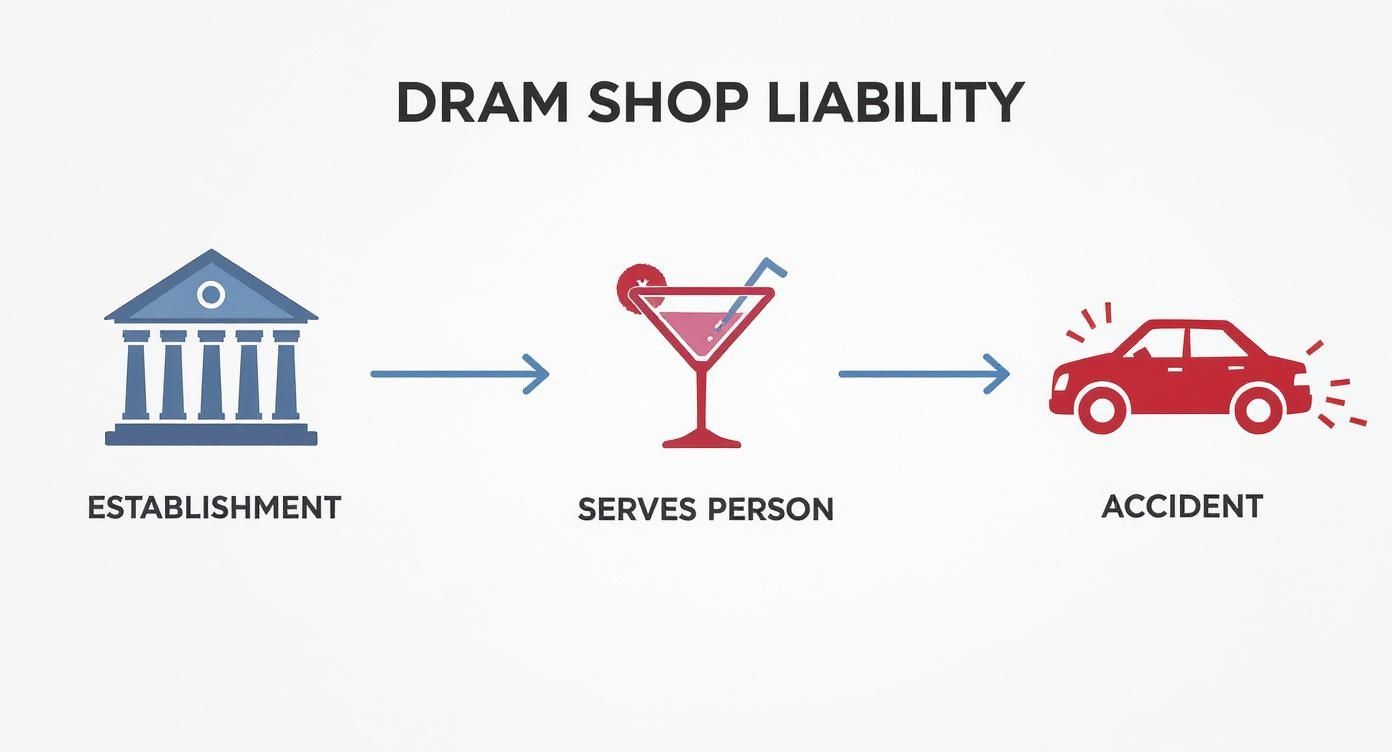
As the image shows, there's a straight line from the bar’s negligence to the devastating crash that followed.
While dram shop laws are different from state to state, they all share a common goal: preventing drunk driving accidents. It's a massive problem. In 2020 alone, the National Highway Traffic Safety Administration (NHTSA) reported that 28% of all traffic fatalities in the U.S. involved a drunk driver. Here in Texas, where our laws are fairly strict, we've seen more and more lawsuits successfully hold establishments accountable for their role in these preventable tragedies. You can read more about how dram shop liability works on williammattar.com.
Proving a dram shop case requires more than just showing a driver was drunk. It requires demonstrating that a licensed establishment made a conscious decision to ignore clear signs of intoxication, placing profits ahead of public safety.
By carefully gathering and presenting this evidence, your Texas injury attorney can show exactly how the establishment's negligence directly caused your harm. This not only holds them accountable but helps you get the damages you deserve for your medical bills, lost income, and the pain you’ve endured. If a drunk driver has hurt you, don't wait. Contact us for a free consultation and let's start protecting your rights today.
Who Is Liable and What Damages You Can Recover
After a drunk driving crash, the path to recovery often starts with a simple but critical question: who is responsible? In a Texas dram shop case, the answer isn't always just the person behind the wheel. The circle of liability can actually expand to include any business licensed to sell alcohol.
That means bars, restaurants, liquor stores, and even convenience stores can be held legally accountable for irresponsibly over-serving the person who caused your injuries. As your attorney, my job is to track down every single party whose negligence played a role in what happened. We then work to hold them responsible and secure the full financial compensation—what the law calls damages—that you and your family are entitled to.
Understanding the Types of Damages
In Texas personal injury law, damages refer to the money awarded to a victim to compensate for their losses. They're typically broken down into two main types: economic and non-economic damages.
Economic Damages
These are the clear-cut, out-of-pocket financial losses that start piling up immediately after a crash. Think of them as the tangible costs you can see on bills and receipts.
- All medical expenses, from the emergency room visit to future physical therapy and surgeries.
- Lost wages if you were unable to work while recovering.
- Loss of future earning capacity if your injuries have permanently impacted your ability to do your job.
- The cost to repair or replace your vehicle and other damaged property.
The stress of medical bills alone can be overwhelming. We put together a guide on who pays medical bills after a car accident that dives deeper into this specific challenge.
Non-Economic Damages
Some losses don't come with a price tag. Non-economic damages are intended to compensate you for the immense personal and emotional toll the accident has taken on your life.
While no check can undo the harm, these damages provide a legal acknowledgment of your suffering, which can include:
- Physical pain and suffering.
- Mental and emotional anguish, like anxiety, depression, or PTSD.
- Permanent scarring or disfigurement.
- Loss of enjoyment of life—the inability to do the things you once loved.
Seeking Justice: Wrongful Death and Punitive Damages
Tragically, some drunk driving accidents result in a fatality. In these heartbreaking situations, we can help the surviving family members file a wrongful death claim. This action seeks wrongful death compensation for the family’s profound loss, covering things like funeral costs, lost financial contributions from the deceased, and the loss of their love, guidance, and companionship.
In certain dram shop cases, we can also pursue punitive damages under Chapter 41 of the Texas Civil Practice & Remedies Code. These are different. They aren't about compensating you for a loss; they are about punishing the establishment for exceptionally reckless behavior.
Punitive damages are designed to send a crystal-clear message to the business and the community: choosing profits over public safety will come at a steep cost.
Imagine we find proof that a bar has a long history of over-serving customers and has been repeatedly warned by police but did nothing to change. A jury might award punitive damages to hold them accountable for their conscious disregard for the safety of everyone else on the road. A dedicated Houston car accident lawyer will explore every avenue to make sure you get the maximum compensation possible under the law.
Understanding Comparative Fault in Your Case
When you file a personal injury claim, don't expect the other side to simply accept responsibility. The lawyers for the bar and the drunk driver have one primary goal: to minimize how much their clients have to pay. A common tactic is to try and shift the blame away from them and, unfortunately, right onto you.
This strategy hinges on a key Texas legal doctrine called comparative fault, sometimes referred to as proportionate responsibility. You can find the specifics in Chapter 33 of the Texas Civil Practice and Remedies Code, but the core idea is what truly matters for your case.
How Comparative Fault Works in Texas
So, what is comparative fault? It’s a system that allows a jury to assign a percentage of blame to everyone involved in an accident. That includes the intoxicated driver, the establishment that over-served them, and yes, even you as the injured victim.
Texas follows what’s known as the "51% bar rule." This rule is critical. It means you can still recover damages from the other parties as long as you are found to be 50% or less at fault for what happened.
However, if a jury decides you were 51% or more to blame, you are completely barred from receiving any compensation. This is precisely why defense attorneys fight so hard to push even a small amount of fault onto you—they're trying to get you over that 51% threshold. If you are found partially at fault (but 50% or less), your final compensation award is just reduced by your percentage of responsibility.
A huge part of our job as your injury attorneys is to shut down these blame-shifting tactics. We focus on building a case so strong that the evidence points squarely at the negligent parties, leaving no room for them to unfairly blame you.
A Real-World Example of Blame-Shifting
Let's put this into a real-world scenario. A Houston driver rear-ended on I-45 files a claim. You're driving through an intersection on a green light when a drunk driver blows through their red light and T-bones your car, causing serious injuries. We file a dram shop claim against both the driver and the bar that kept serving him drinks.
In court, the defense lawyers might bring up that your car’s data recorder shows you were driving 5 miles per hour over the speed limit. They will argue that your speeding makes you partially responsible for the crash.
The jury listens to all the evidence and assigns fault like this:
- The drunk driver was 60% at fault.
- The bar that over-served him was 30% at fault.
- You were 10% at fault for speeding.
Let's say your total damages—for medical bills, lost income, and pain and suffering—come to $200,000. Because you were found 10% at fault, your award is reduced by that amount ($20,000). You would still be able to recover 90% of your damages, which comes out to $180,000.
As you can see, having a minor degree of fault doesn't have to sink your case. Our legal team knows how to anticipate these arguments, build a powerful case to minimize any fault assigned to you, and protect your right to the full and fair compensation you need to move forward.
Protecting Your Rights After the Accident
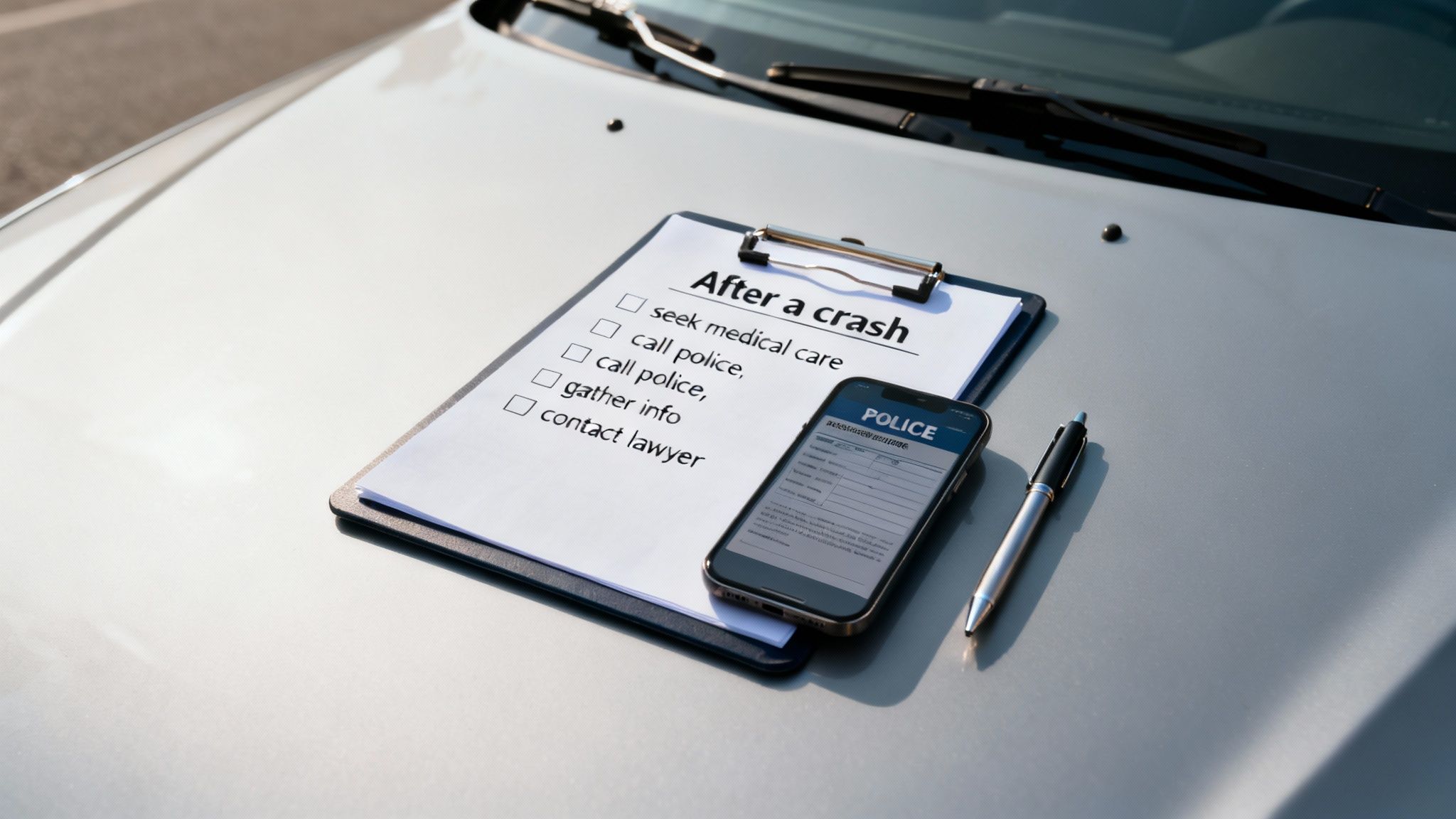
The moments after a drunk driving crash are pure chaos. You're shaken, possibly injured, and trying to make sense of what just happened. But the actions you take right then and there can make all the difference for your health and your ability to get the compensation you deserve down the road.
Your number one priority is your well-being. Get checked out by a doctor, even if you think you’re fine. The adrenaline pumping through your system can easily hide serious injuries, and a medical visit creates a clear record connecting your injuries to the crash—a cornerstone of any personal injury claim.
Practical Steps for Accident Victims
Once you've addressed any immediate medical needs, here are some practical, step-by-step actions you can take to protect your legal rights after a crash. If you're physically able, try to gather as much information as you can right at the scene.
- Call 911 Immediately: Get police on the scene. The official police report is an indispensable document, providing details about the crash, the people involved, and sometimes the officer's initial thoughts on who was at fault.
- Document Everything: Your phone is your best tool. Take photos and videos of everything—the damage to all vehicles, the road conditions, any relevant traffic signs, and of course, your injuries.
- Gather Information: Swap contact and insurance details with the other driver. Just as importantly, get the names and numbers of anyone who witnessed the crash.
- Note Key Details: Pay close attention to the other driver. Do they seem drunk? Make sure you mention your suspicions to the responding officer. Try to listen for any comments they make about where they were coming from, like a specific bar or restaurant.
Crucial Insight: Evidence in dram shop cases disappears fast. A bar’s security footage might be erased in a matter of days, and receipts get thrown away. The faster your lawyer can get to work, the better the chance of saving this critical proof.
Finally, one of the most important moves you can make is to call a seasoned Houston personal injury lawyer as soon as possible. Our detailed article explains more about what to do after a car accident. Remember, the insurance companies for both the driver and the bar have legal teams that start working to limit their liability the moment they're notified. You need an advocate on your side, fighting for you from day one.
At The Law Office of Bryan Fagan, PLLC, our first step is to send a legal notice demanding that the bar or restaurant preserve all evidence. We then kickstart our own investigation to collect the proof needed to build the strongest possible dram shop claim on your behalf. This frees you up to focus on the most important thing: healing.
Answering Your Questions About Dram Shop Laws
When you're dealing with the aftermath of a serious accident, the legal system can feel like a maze. It's completely normal to have questions, so let's walk through some of the most common ones we hear from our clients about Texas dram shop claims.
Is There a Time Limit to File a Dram Shop Lawsuit in Texas?
Yes, and this is critically important. In Texas, the statute of limitations is a strict deadline that generally gives you just two years from the date you were injured to file a lawsuit.
While two years might seem like a long time, it really isn't in legal terms. Key evidence—like security camera footage or receipts—can be lost or erased in a matter of days or weeks. The sooner you get an attorney involved, the better your chances are of preserving the proof you need to build a strong case.
Can I Sue a Friend Who Hosted a Party Where Someone Got Drunk?
This is a common question. Generally, the answer is no. Texas law is designed to hold licensed alcohol providers (think bars, restaurants, liquor stores) accountable, not private individuals hosting a party for adult friends.
The major exception involves minors. An adult social host can be held responsible if they serve or provide alcohol to a minor under 18 (who isn't their own child), and that minor goes on to cause an accident due to intoxication.
A dram shop claim can be a lifeline, especially if the drunk driver who hit you was uninsured or did not have enough insurance to cover your losses. The establishment's insurance policy provides another crucial source of potential compensation.
What if the Drunk Driver Who Hit Me Had No Insurance?
This is precisely when a dram shop claim becomes essential. If the driver who caused the crash is uninsured or underinsured, their policy (if they even have one) will likely fall far short of covering your medical bills, lost income, and other damages.
Pursuing a claim against the establishment that overserved them opens up another avenue for recovery. It allows you to seek the financial support you need to pay your bills and start putting the pieces of your life back together.
If you or someone you love has been hurt by a drunk driver, you don’t have to face this alone. The dedicated Houston car accident lawyers at The Law Office of Bryan Fagan, PLLC are here to help you fight for the justice you deserve. We understand the pain and uncertainty you are facing, and we are committed to providing the compassionate, knowledgeable guidance you need. For a free, no-pressure consultation to discuss your case and understand your rights, contact us today by visiting our website at https://houstonaccidentlawyers.net. Let us help you take the first step toward recovery.