Skip to content
A car crash can change your life in seconds — but you don’t have to face recovery alone. Following your doctor's recommendation for physical therapy (PT) can absolutely increase your final personal injury settlement amount, often significantly. Why? Consistent PT creates a clear, official record of your injury's severity, the medical care you needed, and how it impacts your day-to-day life.
Insurance companies don't just take your word for it—they need hard evidence. Physical therapy records build the exact kind of powerful paper trail that forces them to justify higher compensation for your damages—the legal term for the losses you've suffered.
How Physical Therapy Strengthens Your Texas Injury Claim

A car wreck on a busy Houston highway can flip your life upside down in an instant. While your first priority is always healing, the steps you take to get better can also be the key to protecting your financial future.
Think of it this way: your pain is real, but to an insurance adjuster, it's just a line item on a claim form. Physical therapy translates your experience into the official language they have to listen to.
Building a Foundation of Proof
Every physical therapy session adds another brick to the foundation of your claim. It turns abstract ideas like "pain and suffering" into a concrete, documented timeline that justifies a higher settlement. This official record is essential for building a case that an insurer can't easily dismiss.
Here's what the evidence from your PT treatment accomplishes:
- It validates the severity of your injuries with objective, detailed notes from a licensed medical professional.
- It documents your commitment to recovery, shutting down any potential argument from the insurance company that you aren't taking your healing seriously.
- It creates a detailed log of your medical expenses, which is the core of your claim for economic damages—the tangible, out-of-pocket losses from the accident.
The table below breaks down exactly how physical therapy provides the proof needed to strengthen different parts of your claim.
How Physical Therapy Provides Proof for Your Claim
| Component of Your Claim | Evidence Provided by Physical Therapy |
|---|---|
| Severity of Injury | Therapists' notes detail your pain levels, functional limitations, and progress over time. |
| Medical Necessity | The treatment plan itself shows a doctor deemed ongoing care essential for your recovery. |
| Pain and Suffering | A long course of therapy provides a tangible measure of the duration and intensity of your suffering. |
| Future Medical Needs | A professional’s recommendations for future therapy or equipment are officially documented. |
| Economic Damages | Each session generates a bill, creating a clear record of your mounting medical costs. |
As you can see, the connection is direct. The more documented care you require, the stronger your case becomes.
The Financial Impact of Documented Treatment
The link between consistent therapy and a higher settlement value is undeniable. Data consistently shows that settlements for car accident victims who complete their physical therapy often fall between $72,500 and $300,000, with the largest awards going to cases that required extensive, long-term rehabilitation.
We saw this firsthand when a client with a back injury was initially offered a paltry $4,200. Once we presented the insurance company with clear evidence of their ongoing need for therapy, their settlement jumped to $72,500. You can learn more about how these figures are calculated in our guide to car accident injury settlement amounts. These examples prove a simple truth: more therapy often means higher medical bills, greater pain and suffering, and a much stronger argument for the compensation you deserve.
It's also worth noting that modern rehabilitation plans go beyond traditional exercises. Many therapists now incorporate advanced tools like Pilates reformers in physical rehabilitation to help patients safely rebuild core strength and improve flexibility after a traumatic injury.
Who Is Liable in a Texas Car Accident?
After a serious crash, figuring out your legal options can feel overwhelming. The first step in any Texas injury claim is determining liability—a legal term for figuring out who was at fault.
Texas uses a rule called “modified comparative fault.” It might sound complex, but it’s actually pretty straightforward. It means you can still recover money for your injuries even if you were partially to blame for the accident, as long as a jury doesn't find you more than 50% at fault.
A Real-World Example of Comparative Fault
Let's put that into perspective. Imagine a Houston driver rear-ended you on I-45. Later, the other driver's insurance company tries to argue that you were speeding slightly right before the collision.
A jury might look at the evidence and decide you were 10% responsible. Under Texas law (specifically, Chapter 33 of the Texas Civil Practice & Remedies Code), that doesn't stop you from getting paid. Instead, your final settlement is just reduced by your percentage of fault. So, if your total damages were $100,000, you could still walk away with $90,000.
Understanding Your Economic vs. Non-Economic Damages
The money you recover in a personal injury claim is called damages. It’s meant to compensate you for everything you lost because of someone else's carelessness. In Texas, these damages fall into two main buckets:
- Economic Damages: These are the clear, out-of-pocket costs with a price tag. Think of all your medical bills—from the ER visit to your physical therapy sessions—plus lost wages from being unable to work and any future medical treatments you’ll need.
- Non-Economic Damages: This is compensation for the human cost of an accident. These damages cover intangible losses, like physical pain, mental anguish, emotional distress, and not being able to enjoy your life the way you used to.
This is exactly where your commitment to physical therapy becomes a game-changer. Your PT bills are a core part of your economic damages, creating a clear paper trail of your treatment costs. At the same time, your therapist's detailed notes on your pain levels and daily struggles provide powerful, objective evidence for calculating your non-economic damages.
An experienced Houston car accident lawyer knows how to weave all this documentation together to paint a complete picture of your losses. We use it to fight for a settlement that covers every single aspect of your recovery. Knowing how these costs are handled is crucial, which is why we created a guide explaining who pays medical bills after a car accident in Texas.
What Insurance Adjusters See in Your PT Records
Let’s pull back the curtain on how an insurance adjuster looks at your personal injury claim. Their job isn't to help you—it's to protect their company's bottom line by paying out as little as possible. That means they will dig through every page of your medical history, looking for any excuse to downplay your injuries or deny your claim outright.
When you consistently show up for your physical therapy appointments, you're sending a powerful message. It tells the adjuster your injuries are legitimate and that you're taking your recovery seriously. This documented commitment makes it much harder for them to argue you’re exaggerating the pain.
On the flip side, missed appointments or long gaps between treatments are huge red flags. Adjusters are trained to jump on these inconsistencies. They'll use your spotty attendance as "proof" that your injuries must not be that bad. "If you were really in that much pain," their argument goes, "you wouldn't miss a single chance to get better."
The Story Your Records Tell
To an adjuster, your PT records aren't just a stack of bills; they're the story of your recovery. They read this story carefully, looking for plot holes they can use against you.
Here’s what they’re zeroing in on:
- The Initial Evaluation: This sets the baseline for your condition right after the accident, detailing your pain levels, limitations, and functional problems.
- Therapist's Progress Notes: These are the weekly entries that track your journey. They document whether you're improving, hitting a plateau, or even getting worse.
- Your Subjective Complaints: Every time you tell your therapist, "My back still aches when I try to pick up my toddler," it gets written down. These personal accounts become an official part of the record that paints a picture of your daily struggles.
- The Discharge Summary: This summarizes your entire course of treatment, noting any permanent limitations or the potential need for future medical care.
Think about it this way: a detailed PT file from a Houston driver hurt on I-45, showing a long and grueling recovery from a back injury, becomes the hard evidence needed to shut down an insurer's lowball offer. It proves the real, lasting impact of the crash. You can find more strategies for success in our guide on how to deal with insurance adjusters.
This graphic breaks down exactly how physical therapy shores up both the financial and human costs of your claim.
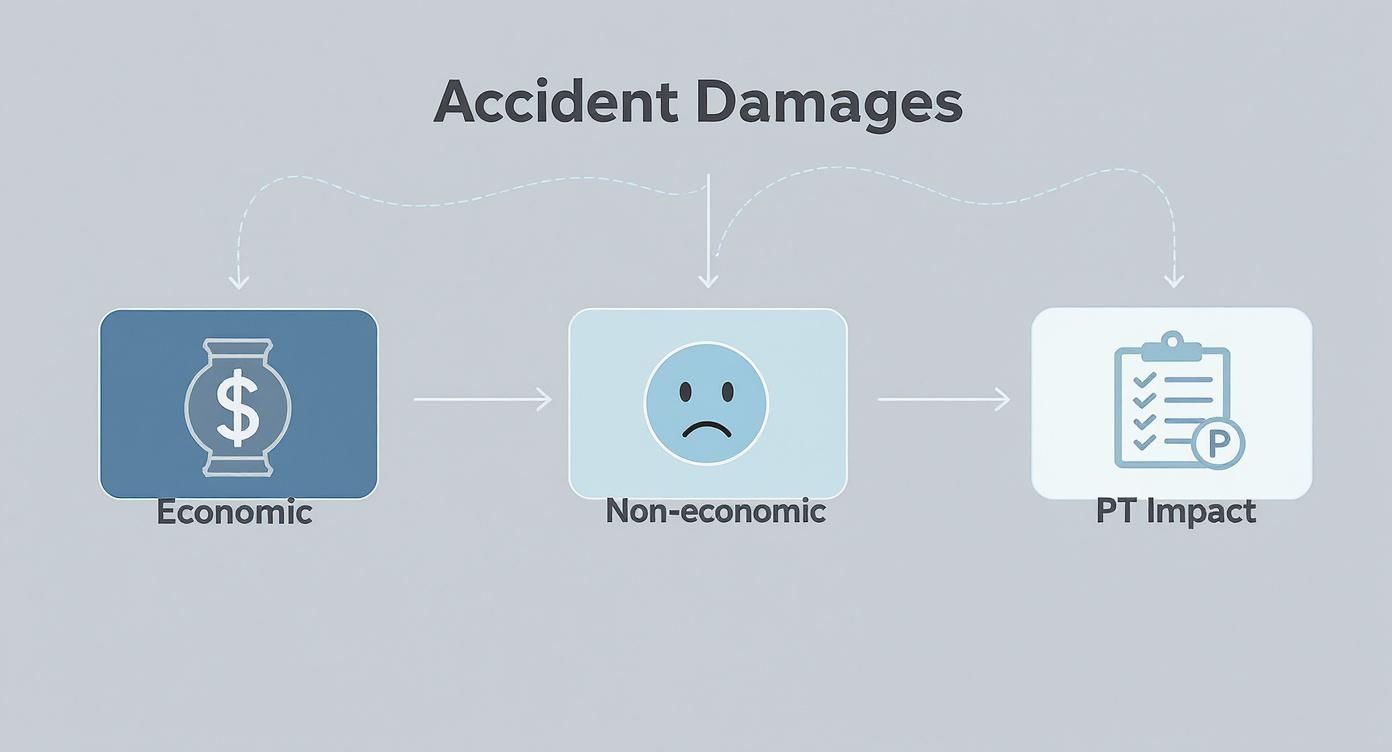
As you can see, your therapy records provide the concrete proof needed to justify both your bills and your pain and suffering.
The Financial Link Between Therapy and Settlement Value
There’s a direct financial link between the amount of physical therapy you need and the final value of your settlement. It just makes sense—more therapy means a more serious injury.
Data reflecting national trends shows that moderate injuries involving PT can lead to average settlements around $31,262. For severe injuries that demand extensive, long-term therapy, that average can jump to $256,821.
The clear, documented evidence from your treatment gives undeniable proof of how the injury has disrupted your life, which is exactly what you need to build a strong case for higher compensation. To make sure your records are telling the most persuasive story possible, it helps to understand what goes into strong medical records and how to enhance clinical documentation.
Proving Long-Term Injuries with Physical Therapy

Unfortunately, not every injury heals completely. This is where your commitment to physical therapy becomes the cornerstone for proving the real, long-term impact of an accident—and for securing a settlement that truly accounts for your future.
What happens if therapy only gets you so far? Or if you hit a plateau that doctors call "maximum medical improvement" (MMI) but are still left with daily pain and serious limitations? At that point, your PT records transform. They stop being just treatment notes and become the single most powerful piece of evidence you have for a much larger settlement.
Documenting a Permanent Change in Your Life
Let's imagine you were hurt in a Houston slip and fall. After months of physical therapy, you've learned to walk again—a massive victory. But what if your therapist’s notes carefully document that you still can’t stand for more than 30 minutes without debilitating pain? That one detail makes it impossible for you to return to your job as a cashier.
This documentation of a permanent limitation is priceless. A skilled Texas injury attorney at The Law Office of Bryan Fagan, PLLC takes these precise records and builds an undeniable case. We use them to argue for compensation that goes far beyond your initial medical bills, fighting for damages like:
- Future Medical Expenses: Covering the costs of ongoing pain management, future therapy sessions, or any medical equipment you'll need down the road.
- Lost Earning Capacity: Compensation for the income you've lost because you can no longer perform the same job—or any job at the same pay grade.
- Permanent Impairment and Disfigurement: Damages that acknowledge the permanent physical changes and limitations you now have to live with every single day.
The Financial Proof of Ongoing Care
Your dedication to physical therapy tells a clear, undeniable story about the lasting consequences of the accident. It creates a detailed roadmap for calculating your future needs—a roadmap that insurance companies find very difficult to argue with.
When your PT records clearly show that your recovery has plateaued and left you with permanent functional deficits, it validates a claim for compensation that reflects a lifetime of impact, not just a few months of treatment.
This kind of detailed evidence is what separates a lowball offer from a fair settlement. For example, legal data from other major markets shows that injury settlements involving documented physical therapy and evidence of chronic pain can often top $100,000, even when no surgery was performed. These records prove the seriousness of your injury and the real-world challenges you face.
If you want to read more about how documented therapy impacts settlement values, you’ll see just how critical this financial proof is. Your PT journey becomes the centerpiece of a compelling argument for a settlement that truly secures your future.
How Your Lawyer Turns PT Records Into a Winning Strategy
You’ve been putting in the hard work at physical therapy, and your only focus has been on getting better. That’s exactly as it should be. Now, let’s show you how an experienced personal injury attorney transforms all that effort into a powerful legal argument for the compensation you deserve.
Think of us as the translators for your recovery journey. We take the medical facts and turn them into a compelling story that an insurance adjuster simply can't ignore.
Our first move is to gather every single piece of paper related to your care. We’re talking every bill, every therapist's note, every diagnostic report, and every progress summary. We don't just file these records away; we dissect them, page by page, hunting for the key details that paint a vivid picture of your pain, your daily struggles, and the real-world impact of your injuries.
Building an Ironclad Demand Package
Once we have the full story, we start building what’s called a demand package. This isn't just a stack of documents—it's a meticulously crafted, strategic presentation designed to leave the insurance company with no doubts.
We shine a spotlight on the critical evidence, such as:
- Your therapist’s notes detailing your reported pain scores at every single session.
- The objective, clinical measurements showing your limited range of motion.
- Direct quotes and descriptions of how your injuries are keeping you from working, playing with your kids, or just living your life.
If the records feel a bit thin or need more context, we'll get on the phone with your physical therapist or other medical experts. They can provide professional opinions that hammer home the necessity of your treatment and the potential long-term consequences of what you’ve been through. You shouldn't have to decipher medical jargon or fight this battle on your own.
Your job is to focus on healing. Our job is to translate that entire recovery journey into the powerful evidence needed to win you maximum compensation for your damages.
Your dedication to showing up and doing the work becomes the bedrock of our legal strategy. As your Houston car accident lawyer, we make sure every bit of that hard work is seen, valued, and—most importantly—compensated. We turn your path to healing into your path to justice.
Practical Advice for Accident Victims
When you're recovering from an accident, you have a lot on your mind. Here are some straightforward answers to the questions we hear most often from our clients across Texas about physical therapy and their auto insurance claim.
How Long Should I Attend Physical Therapy?
There’s no magic number here. The only right answer is: follow your doctor’s orders. The length of your physical therapy depends entirely on your specific injuries and how your body is healing.
The most critical part is seeing your treatment plan all the way through until your medical team officially discharges you. If you stop therapy early, you’re not just risking your physical recovery—you're handing the insurance company a golden opportunity. They’ll argue that your injuries couldn't have been that serious if you quit treatment, and they'll use that as an excuse to slash your settlement offer.
What if I Cannot Afford My Co-Pays?
This is a completely valid worry, and it’s one of the first things people ask us. Never, ever let the cost of co-pays stop you from getting the medical care you need. Your health has to be the top priority.
This is where a Texas injury attorney at The Law Office of Bryan Fagan, PLLC can step in. We often work with your physical therapist and other medical providers using something called a "letter of protection." It’s a formal agreement that lets you get all the treatment you need right now, while the provider agrees to wait for payment until your case settles. This takes the financial pressure off so you can focus 100% on getting better.
Does the Type of Therapy Affect My Settlement?
Absolutely. The kind of physical therapy you receive is a huge factor in your claim's value. But it's not just about the type of therapy; it's about making sure the treatment is medically necessary and directly tied to the injuries from your accident. That connection needs to be crystal clear in your medical records.
Intensive, long-term rehabilitation for a spinal cord injury after a major truck wreck is going to support a much higher settlement than a few weeks of light therapy for a minor muscle strain. A key part of your attorney's job is proving that link—showing exactly how the at-fault driver’s negligence led to injuries that required the specific, necessary treatment you received. This is how we demonstrate in a real, tangible way does physical therapy increase settlement value.
A car accident can turn your world upside down in an instant, but you don’t have to go through it alone. At The Law Office of Bryan Fagan, PLLC, our compassionate team is ready to take on the legal fight for you. We’ll handle the insurance companies so you can focus on what truly matters—your recovery. We have the experience to build a powerful case that reflects the full and fair value of your claim.
If you or someone you love has been injured, reach out to us today for a free, no-obligation consultation. Let's talk about your case and how we can help you move forward with confidence.
Call us now at (713) 581-3839 or visit our website to get the support you deserve.