A collision with a commercial truck can change your life in seconds—but you don’t have to face recovery alone. When you’re sharing the road with an 80,000-pound semi-truck, a crash isn't just another car accident; it's a terrifying, violent event that can leave you feeling confused, overwhelmed, and unsure of what to do next.
If a truck crash has shattered your world, it’s important to know that help is available and you have rights.
The Reality of Truck Crashes on Texas Highways
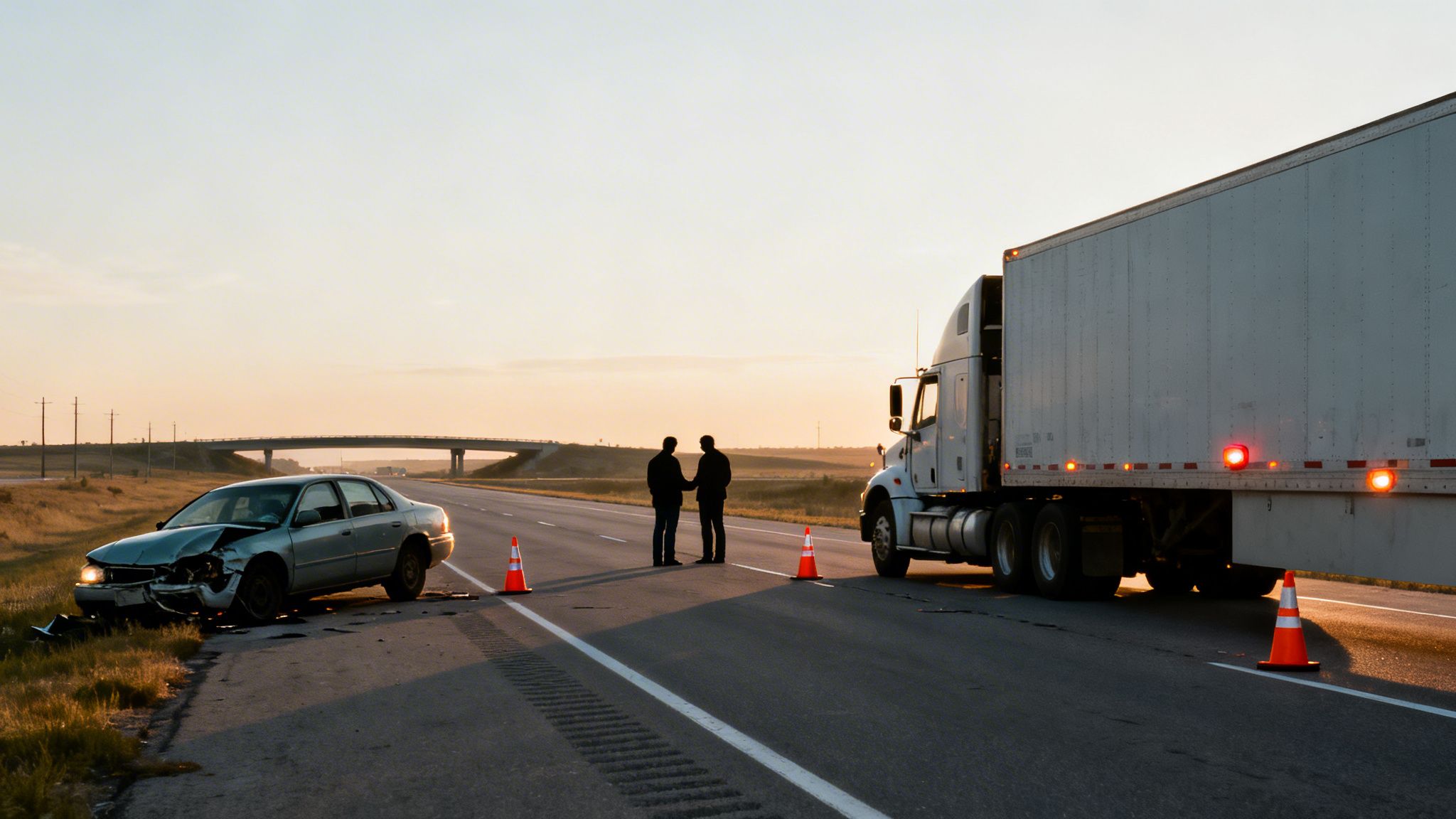
Our Texas highways are the lifeblood of the state’s economy. Major corridors like I-10 through Houston and the ever-congested I-35 corridor are constantly packed with commercial trucks hauling goods across the country. Unfortunately, this relentless flow of commerce comes at a steep price.
The sheer volume of freight traffic makes truck crashes in Texas a tragically frequent occurrence. What happened to you wasn't just a random act or bad luck. More often than not, it was the final, devastating result of a long chain of decisions where profits were prioritized over people.
A Look at the Alarming Statistics
The numbers don't lie. They paint a brutal picture of the dangers we all face on Texas roads. In one recent year, Texas led the nation with a staggering 730 deaths from large truck crashes. That figure is more than double the fatalities seen in other huge states like California and Florida, a grim reminder of the unique risks drivers face here.
In fact, Texas accounted for over 12% of all vehicles involved in fatal large truck crashes in the entire country. Data from the Texas Department of Transportation (TxDOT) drills down even further, revealing 32,562 total commercial motor vehicle crashes that year, including 513 crashes that were fatal. You can explore more about these national truck accident trends on the National Safety Council's website.
These aren't just numbers on a page. Each one represents a family torn apart and a life changed forever. For families who have lost a loved one, a Texas injury attorney can help explore options for seeking wrongful death compensation.
Texas Counties with the Most Truck Crashes
The danger isn't spread evenly. Certain counties, particularly those with major interstate intersections and industrial hubs, see a much higher concentration of these devastating wrecks.
| County | Total Commercial Vehicle Crashes |
|---|---|
| Harris | 5,607 |
| Dallas | 4,374 |
| Bexar | 2,900 |
| Tarrant | 2,752 |
| El Paso | 1,363 |
This data highlights the hotspots where the risk is most acute, from the Permian Basin's oilfield traffic to the dense urban corridors of our biggest cities.
Why Are Texas Roads So Dangerous?
So, what makes our state the epicenter for these tragedies? Several factors combine to create a perfect storm for catastrophe. Our role as a central hub for national and international trade means more trucks are on our roads, day and night.
This constant traffic, combined with the immense pressure on drivers and their companies to meet impossible deadlines, creates an environment where safety takes a backseat. Some of the most common causes we see include:
- Driver Fatigue: Truckers are often pushed to break federal hours-of-service rules just to make their next delivery on time. A tired driver is a dangerous driver.
- Improper Maintenance: To save a few dollars, some companies will cut corners on critical repairs for brakes, tires, and steering systems.
- Inadequate Training: Not every company invests in properly training or vetting their drivers before handing them the keys to a vehicle weighing tens of thousands of pounds.
- Speeding and Aggressive Driving: The pressure to meet tight schedules often leads to reckless driving behaviors on already crowded highways.
When you're involved in a collision with a semi-truck, it’s critical to remember that these systemic problems are often the real root cause—not just a simple mistake by the driver.
Who Is Liable in a Texas Truck Accident?

After a crash with a regular car, figuring out who’s at fault is usually pretty simple. But when an 18-wheeler is involved, the driver behind the wheel is often just the beginning of the story. Pinpointing liability—the legal term for responsibility—is a much deeper dive, because several different people or companies could share the blame for what happened to you.
A commercial truck accident is rarely the result of one single mistake. It's more often a chain reaction of failures. A company cutting corners on maintenance, a dispatcher pressuring a driver to stay on the road too long, or a careless cargo crew—these are the hidden factors that lead to disaster. Think of it like a line of dominoes. The crash itself is just the last one to fall. A good Houston car accident lawyer knows how to trace that line all the way back to the first domino that was pushed.
The Chain of Responsibility
It’s natural to blame the person who hit you, but in a commercial truck crash, focusing only on the driver can be a huge mistake. Texas law allows you to hold every negligent party accountable, which is absolutely vital for getting the full and fair compensation you need to rebuild your life.
Several parties might be on the hook, including:
- The Truck Driver: If they were speeding, distracted, exhausted, or under the influence, their negligence is front and center.
- The Trucking Company (Motor Carrier): The company itself is often a key target. Did they hire a driver with a bad record? Fail to provide proper training? Or create a culture where breaking safety rules was encouraged to meet deadlines?
- The Truck’s Owner: Sometimes, the person or company that owns the truck is different from the company operating it. If they skimped on essential maintenance for the brakes, tires, or steering, their negligence contributed to the crash.
- Cargo Loaders & Shippers: Was the trailer improperly loaded? If cargo shifts mid-route, it can throw the truck off balance and cause the driver to lose control. The company that loaded it can be held partly responsible.
- Maintenance Shops: If a third-party mechanic performed a shoddy repair that led to a mechanical failure on the highway, they share in the liability.
Holding the Company Accountable: Vicarious Liability
There’s a powerful legal concept in these cases called vicarious liability, or respondeat superior in legal terms. Put simply, it means an employer is responsible for the mistakes their employee makes while on the job.
For example, if a Houston driver rear-ended on I-45 was hit by a trucker for a national company, the company itself is legally responsible for the harm that driver caused. Why? Because the driver was acting in the "course and scope" of their employment.
This is critical because trucking companies carry massive commercial insurance policies—the kind needed to cover the catastrophic damages that truck crashes in Texas often cause. As a major logistics hub, Texas sees more than its fair share of these devastating wrecks. Statistics show that thousands of injuries and hundreds of deaths occur on our roads annually. Many of these tragedies are tied directly to violations of federal safety regulations, a problem you can learn more about the causes of Texas truck accidents.
Building the Case Piece by Piece
Proving that multiple parties were at fault requires an immediate and aggressive investigation. An experienced truck accident lawyer acts like a detective, working quickly to preserve key evidence before it disappears. We demand access to driver logs, maintenance records, the truck’s “black box” data, and internal company safety policies.
By identifying every single person and company whose negligence played a role, we maximize your ability to recover the money you need for medical bills, lost wages, and your pain and suffering. You don’t have to untangle this complicated web alone. A skilled legal team can investigate these complex cases and hold every single responsible party accountable for their actions.
How Texas and Federal Laws Shape Your Accident Claim
After a serious truck wreck, it’s easy to feel lost in a sea of confusing legal terms. Your case isn't just about dealing with an insurance adjuster. It’s a fight that’s fought on two fronts: one governed by Texas state law, and the other by a tough set of federal trucking regulations. Understanding how these two rulebooks interact is absolutely critical to getting the justice you deserve.
The first set of rules is right here in Texas. Our state operates under a legal standard called comparative fault, or what the law officially calls proportionate responsibility. You can find it spelled out in Chapter 33 of the Texas Civil Practice & Remedies Code.
Simply put, this rule means you can still recover money for your injuries even if you were partially at fault for the crash. But there's a huge catch.
Understanding Texas's 51% Bar Rule
Texas law makes it clear: your final compensation will be reduced by your percentage of blame. Let's walk through an example. Say you get hit by a semi-truck on a Houston highway, and a jury determines your total damages—for medical bills, lost income, and pain—add up to $100,000. But they also decide you were 10% at fault.
Because of the comparative fault rule, your $100,000 award gets reduced by that 10%. You’d walk away with $90,000.
But here’s the most important part. Texas has a strict cutoff known as the 51% Bar. If that jury decides you were 51% or more to blame for the crash, you get nothing. Zero. This is exactly why the trucking company’s defense team will fight tooth and nail to push even a tiny bit of fault onto you—it can completely erase their financial responsibility.
The Power of Federal Trucking Regulations
The second, equally powerful set of rules comes from the federal government. The Federal Motor Carrier Safety Administration (FMCSA) is the federal agency that polices the entire commercial trucking industry, and their regulations are the law of the land for any big rig on our highways.
These federal rules are incredibly detailed and set the minimum safety standards for everything. They cover things like:
- Hours of Service: Strict limits on how long a trucker can be behind the wheel before they are legally required to stop and rest. This is meant to fight driver fatigue, a top cause of catastrophic truck wrecks in Texas.
- Vehicle Inspections: Mandated, documented checks of a truck’s most critical safety systems—especially brakes, tires, and lights.
- Cargo Securement: Precise rules for how all cargo must be loaded, balanced, and tied down to keep it from shifting in transit or spilling onto the roadway.
- Driver Qualifications: Minimum standards for hiring, training, and drug and alcohol screening for every commercial driver.
When a truck driver or their employer breaks one of these federal safety rules, it’s not just a slap on the wrist. It’s powerful proof of negligence. For an experienced Texas injury attorney, showing that a company ignored these federal laws is a huge part of building a strong case. It paints a clear picture of a company that put profits ahead of people's safety, directly linking their illegal choices to the harm you suffered.
It's also important to know whether the truck was operating across state lines or only within Texas, as different rules can apply. You can learn more about interstate vs. intrastate trucking rules in our detailed guide on the topic.
Calculating the Full Cost of Your Damages
After a serious truck accident, the first bills that show up are just the tip of the iceberg. The real cost isn’t just about the totaled car or the initial ER visit—it’s about the physical, financial, and emotional ripple effects that can follow you for years.
Under Texas law, you have the right to demand compensation for every single loss you’ve suffered. In legal terms, this is called seeking damages. It can feel overwhelming to put a number on your pain, but understanding what you're owed is the first step toward getting the resources you need to rebuild your life. We can break these damages down into two main categories under the Texas Civil Practice & Remedies Code, Chapter 41.
What Are Economic Damages?
First up are economic damages. Think of these as the tangible, calculable costs—the ones you can track with receipts, invoices, and bank statements. These are the black-and-white numbers meant to make you financially whole again.
These damages typically cover:
- All past, current, and future medical bills from the crash.
- The costs of rehabilitation, physical therapy, and any long-term care you might need.
- Lost income and wages from time you couldn't work.
- Loss of future earning capacity if your injuries prevent you from returning to your old job.
- The cost to repair or replace your vehicle and any other damaged property.
Imagine a construction worker who gets caught in a horrific pile-up on I-45 in Dallas. He can demand damages not just for his hospital stay, but also for the future surgeries he'll require, the income he's losing because he can no longer handle a physically demanding job, and even the cost of vocational training to learn a new trade.
What Are Non-Economic Damages?
Then, there are non-economic damages. These are far more personal. They are meant to compensate for the very real human suffering that doesn’t come with a price tag. While no check can ever erase trauma, these damages are the legal system’s way of acknowledging the profound impact the crash has had on your life.
In Texas, non-economic damages can include compensation for physical pain, emotional distress and mental anguish, scarring and disfigurement, and loss of enjoyment of life. For families grieving an immeasurable loss, a wrongful death claim can also seek damages for the loss of companionship and financial support.
These losses are just as devastating as the financial ones. Someone left with a spinal cord injury after a truck wreck on a San Antonio freeway deserves to be compensated for the daily pain they endure and the inability to enjoy the hobbies and activities they once loved.
The scale of these wrecks is staggering. Texas sees over 38,000 commercial truck crashes every single year. Of those, 1,350 are suspected serious crashes that injure 1,687 people. As you can find more details about these serious injury statistics, it becomes clear that for many victims, the harm requires lifelong care and creates immense suffering that must be accounted for.
Adding up the full scope of your losses is a complex and deeply personal process. If you want to dive deeper, you can learn more about how to calculate damages in our comprehensive article. An experienced and compassionate Texas truck accident lawyer can help you document every loss to ensure you pursue the full and fair compensation you are owed.
What To Do After a Truck Accident: A Step-by-Step Guide
In the immediate aftermath of a collision with a commercial truck, your world can feel like it's been turned upside down. With adrenaline pumping and confusion setting in, it’s almost impossible to think clearly.
Following a clear plan can help you regain a sense of control, protect your health, and preserve your legal rights from the very start.
1. Call 911 and Secure the Scene
Your first and most important priority is safety. If you can, move your vehicle to the shoulder or another safe spot away from traffic. Then, call 911 immediately to report the crash and ask for both police and medical responders.
Even if you believe the crash was minor, a police report is essential. It creates an official, unbiased record of the event that becomes a cornerstone for your auto insurance claim. When the officers arrive, give them a clear and factual account of what happened, but never admit fault or apologize. Stick to the facts.
2. Gather Critical Information and Evidence
While you wait for help to arrive, and only if you are safe and able to do so, start documenting everything you can. This is the time for fact-gathering.
Focus on collecting these key details:
- Driver & Company Info: Get the truck driver's name, contact number, driver's license number, and the name of the trucking company they work for.
- Truck & Insurance Details: Snap clear photos of the truck's insurance card, its license plate, and the USDOT number (this is usually printed on the side of the cab). Don't forget to get pictures of any company logos or branding on the truck and trailer.
- Witness Contacts: If any other drivers or pedestrians saw what happened, politely ask for their names and phone numbers. An independent witness statement can be incredibly powerful evidence.
- Photos of the Scene: Use your phone to take pictures of everything from multiple angles. Capture the final resting positions of all vehicles, the damage to your car and the truck, any skid marks on the road, and relevant traffic signs or signals. You can't take too many photos.
3. Get Medical Attention Right Away
This step is non-negotiable, even if you feel completely fine. The shock and adrenaline of a crash are powerful and can easily mask serious injuries like internal bleeding, concussions, or whiplash. Symptoms often don't appear for hours or even days.
Going to an emergency room or an urgent care clinic creates a crucial medical record. This document officially links your injuries to the accident, which is vital for proving the full extent of the harm you've suffered when you file a claim.
4. Report the Crash and Start a File
You'll need to report the accident to your own insurance company as soon as you can. But here’s a critical piece of advice: do not give a recorded statement to the trucking company's insurance adjuster. Their job is to protect their company, and they are trained to ask questions designed to get you to downplay your injuries or accidentally accept partial blame.
Simply and politely decline their request for a statement and inform them that your attorney will be in touch.
From this point on, keep every single piece of paper related to the crash. Create a dedicated folder for the police report number, medical bills, prescription receipts, and any letters or emails from insurance companies. Each document helps build the foundation of your case.
This flowchart shows the three core financial pillars of a personal injury claim that you'll need to track.
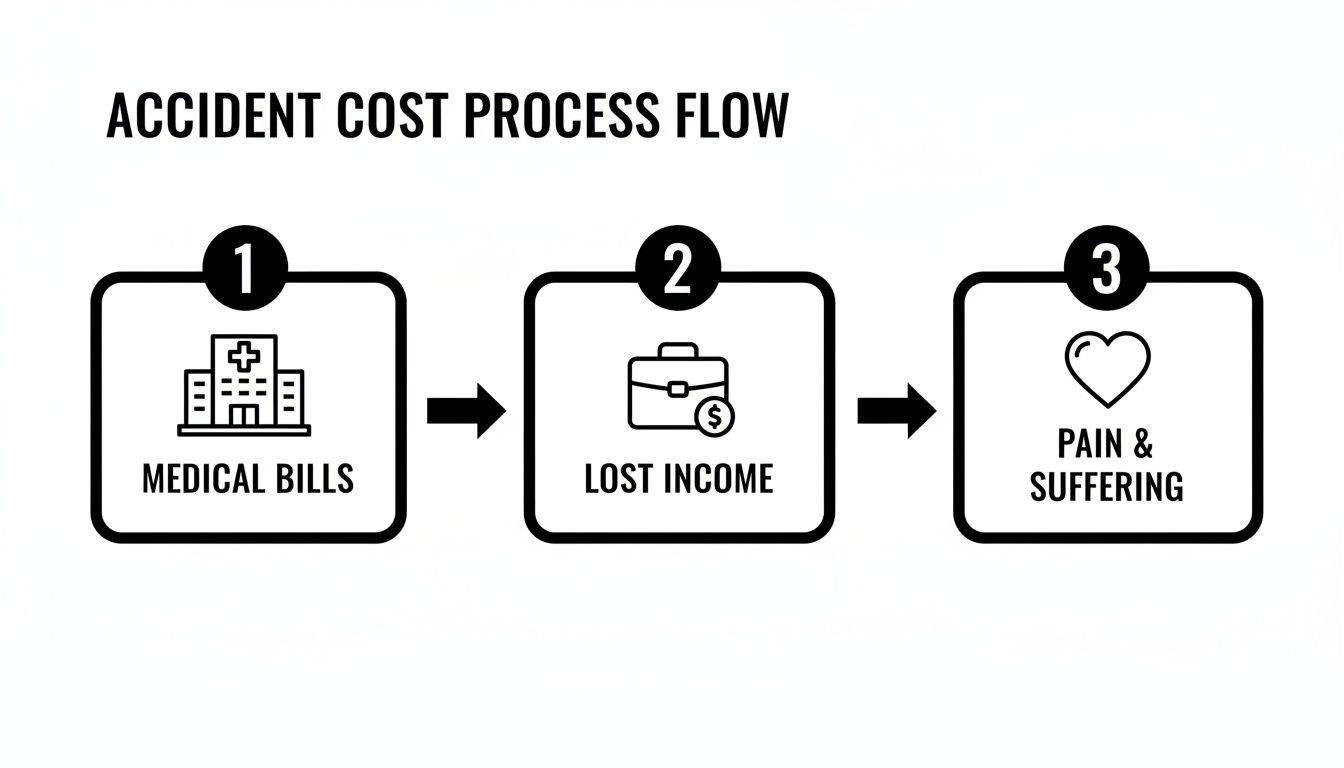
As you can see, the costs go far beyond the initial hospital visit. They include income you lose from being unable to work and compensation for the physical pain and emotional trauma of the experience. As you start this process, you may find it helpful to review our in-depth guide on what to expect with your truck accident claim.
5. Be Aware of the Deadline and Contact an Attorney
In Texas, the law gives you a strict deadline to take legal action. This is known as the statute of limitations, and for most personal injury cases, it is two years from the date of the crash. If you miss this window, you lose your right to seek compensation forever.
While the steps above are things you can do on your own, the single most important action you can take is to speak with a Texas injury attorney who focuses on commercial truck accidents. The trucking company and its insurance carrier have a team of investigators and lawyers who start building their defense the moment the crash is reported. You need a professional in your corner to level the playing field.
How a Texas Truck Accident Lawyer Fights for Your Case
Trying to handle a truck accident claim on your own is not a fair fight. You’re up against massive insurance companies and their experienced legal teams, whose only goal is to protect their bottom line. At The Law Office of Bryan Fagan, PLLC, our job is to step in, take that immense burden off your shoulders, and start fighting for you from day one.
The moment you hire us, we move quickly to level the playing field. Trucking companies often dispatch their own investigators to the crash scene within hours, working to control the story and minimize their financial responsibility. We immediately counter their tactics by launching our own thorough investigation.
Taking Control of Evidence and Communication
Our first move is to send a legal notice to the trucking company, demanding they preserve all critical evidence. This is non-negotiable. That evidence includes the truck’s “black box” or Electronic Data Recorder (EDR), which holds crucial data about the truck’s speed, braking, and other actions in the moments before the crash. This data can be erased or recorded over, so acting fast is absolutely essential.
We then work to uncover other vital documents that can expose negligence, such as:
- The driver’s logs and hours-of-service records to check for fatigue.
- The truck’s maintenance and inspection history.
- The driver’s employment file, including training and past violations.
- Information about the cargo and whether it was loaded properly.
While we gather this proof, we also take over all communication with the insurance companies. Their adjusters are trained to pressure you into a quick, lowball settlement or get you to give a recorded statement they can twist and use against you. We shield you from these tactics, making sure you are never manipulated into damaging your own claim.
Building Your Case for Maximum Compensation
A Texas truck accident lawyer does far more than just file paperwork. We build a powerful, evidence-based case designed to secure the full and fair compensation you need to truly recover. This often involves working with a network of trusted experts to prove what happened and calculate the true, long-term cost of your injuries.
For instance, we may bring in accident reconstruction specialists to create a scientific model of the collision, proving exactly how the trucker’s negligence caused the crash. We also consult with medical experts and economists to determine the total financial impact of your injuries, from future medical treatments to your lost earning potential.
Most importantly, we handle these complex cases on a contingency fee basis. This means you pay absolutely nothing upfront. We cover all the costs of the investigation and litigation ourselves. You only owe us a fee if we successfully win compensation for you.
This approach removes any financial barrier to getting the expert legal help you deserve. Let us do the fighting so you can focus on what matters most: your healing.
Answering Your Questions About Texas Truck Accidents
After a collision with a commercial truck, it's completely normal to feel overwhelmed and have a flood of questions. We’ve put together direct, straightforward answers to some of the most common concerns we hear from crash victims and their families.
What Is the Average Settlement for a Truck Accident in Texas?
There’s really no such thing as an “average” settlement, because every single case is different. The compensation you can recover is tied directly to the unique facts of your accident and your life.
It all depends on factors like the severity of your injuries, the total cost of your medical treatment, how much income you’ve lost, and the insurance policies involved. Because truck wrecks often cause catastrophic injuries, the potential damages can be substantial. A dedicated attorney will work to calculate every loss—from hospital bills to your personal pain and suffering—and fight for the full amount you deserve.
How Long Do I Have to File a Claim?
Texas has a strict legal deadline known as the statute of limitations. For most truck accident injury and wrongful death claims, you have just two years from the date of the crash to file a lawsuit.
If you miss that two-year window, the courthouse doors close forever, and you lose your right to seek any compensation. It is absolutely critical to act fast. Evidence like the truck’s “black box” data and the driver's logbooks can disappear quickly, so the sooner an attorney gets involved, the better your chances of building a strong case.
Should I Accept the Insurance Company's First Offer?
Absolutely not. You should never accept an initial offer from the trucking company’s insurer without first speaking to an experienced truck accident lawyer. Those first offers are almost always a lowball amount, nowhere near the true value of your claim.
Insurers use quick, cheap offers as a tactic. They want to get you to sign away your rights before you even know how serious your injuries are or what your future medical needs will be. Once you accept, it's over—you can't ask for more money later, even if your condition gets worse. It's a trap designed to protect their bottom line, not you.
A car crash can change your life in seconds—but you don’t have to face recovery alone. The experienced and compassionate attorneys at The Law Office of Bryan Fagan, PLLC are here to protect your rights and fight for the justice you and your family deserve.
We take on the legal complexities so you can focus on what matters most: healing. If you or a loved one was hurt in a crash, contact us for a free, no-obligation consultation to discuss your legal options. Let us be your advocate. Learn more and get the help you need by visiting us at https://houstonaccidentlawyers.net.