Skip to content
A car crash can change your life in seconds—but you don’t have to face recovery alone. The shock, the flashing lights, the gut-wrenching realization that the other driver was drunk—it’s an experience that leaves you feeling angry, violated, and completely overwhelmed.
When someone makes the selfish choice to drive intoxicated, they don’t just cause an accident; they shatter lives. You're left to deal with the aftermath, and the path forward can seem impossibly confusing. This guide is here to provide clear, step-by-step advice to help you navigate your legal rights and recovery options.
We'll cut through the legal jargon and give you a straightforward plan for what to do next. Think of this as the advice you'd get from an experienced Texas injury attorney, focused on one thing: helping you reclaim your life.
Criminal Charges vs. Your Civil Claim: The Two Paths to Justice
After a drunk driver hits you, the legal system splits into two separate paths. It's a critical distinction that many accident victims don't realize until it's too late.
The State’s Criminal Case
This is the case you see on the news. The police arrest the drunk driver, and the District Attorney’s office prosecutes them for a crime like Driving While Intoxicated (DWI).
If convicted, the driver faces penalties like jail time, fines, and a suspended license. This process is about punishing the driver for breaking the law. However, a criminal conviction does not automatically get you a single dollar for your medical bills or lost wages.
Your Personal Civil Claim
This is your fight for financial recovery. It is a completely separate legal action where you, the victim, file a claim against the drunk driver and their insurance company. The goal here isn't jail time; it's securing the money you need to cover all your losses.
This is where your power lies. The criminal case provides a sense of justice, but the civil claim is what provides for your recovery. You must actively pursue it to protect your rights.
Your Path to Financial Recovery
This guide is about empowering you to pursue that civil claim. We’ll walk through exactly how to build a powerful case against the drunk driver, from gathering evidence at the scene to calculating the full extent of your damages.
Imagine a Houston driver was rear-ended on I-45 by someone who just left a bar. The police report, their breathalyzer results, and photos of the scene all become crucial evidence—not just for the criminal case, but for proving your right to compensation.
The road ahead is challenging, but you don't have to walk it alone. With the right strategy, you can hold the responsible driver accountable and secure the financial stability you need to truly heal. You are not a statistic; you are a person who deserves justice, and an experienced Houston car accident lawyer can help you fight for it.
Your First Steps to Protect Your Health and Your Claim
In the immediate aftermath of being hit by a drunk driver, your adrenaline is surging. It's almost impossible to think straight, but what you do in these first few minutes and hours is critical—both for your physical safety and for your ability to hold the driver accountable. Building a strong drunk driving accident claim starts right there at the scene.
Prioritize Safety and Call 911 Immediately
First things first: get to safety. If you can still drive your car, try to move it to the shoulder to get out of the way of other traffic, especially on a chaotic Houston freeway like I-10 or the 610 Loop. If your car is too damaged or you're hurt, don't move. Stay put unless you're in immediate danger, like a fire.
No matter how minor the crash seems, always call 911. This is not optional. A police report is the first official, unbiased record of what happened. When you talk to the dispatcher, make sure to tell them you believe the other driver is intoxicated. That single piece of information is crucial; it alerts the responding officers to investigate a potential DWI, which provides powerful evidence for your future civil claim.
Document Everything While You Wait
While you’re waiting for police and paramedics to arrive, your next job is to become an evidence collector—but only if you are safely able to do so. Do not confront the drunk driver. Their state of mind is unpredictable, and they could become aggressive. Keep your distance and use your phone.
Your observations can be incredibly powerful later on. Make a mental or written note of specifics like:
- Slurred speech or difficulty standing and walking.
- The smell of alcohol on their breath or coming from inside their car.
- Any attempts to hide bottles or cans.
- Confused statements about where they were or what just happened.
Use your phone to take photos and videos of everything. Get shots of the damage to both cars, their positions on the road, skid marks, and any visible injuries you have. If you can see open containers of alcohol in their vehicle, get a clear picture. This kind of visual evidence is tough for an insurance company to argue with.
Key Insight: At the scene of a drunk driving accident, your smartphone is your best friend. The photos, videos, and notes you take create an undeniable record of events, preserving details your mind might forget under stress.
Seek Medical Attention Without Delay
After any drunk driving accident, you must get checked out by a doctor. Period. Even if you feel okay, some of the most serious injuries—like concussions, whiplash, or internal bleeding—don't show symptoms right away.
Going to the ER or an urgent care clinic immediately creates a solid medical record linking the crash directly to your injuries. This is absolutely essential for your auto insurance claim. If you wait days or weeks to see a doctor, the other driver’s insurance adjuster will argue that something else must have caused your injuries. Protecting your health is the first step in protecting your claim.
This journey—from the moment of impact to your eventual recovery—is a process. It requires guidance, a fight for justice, and a focus on healing.
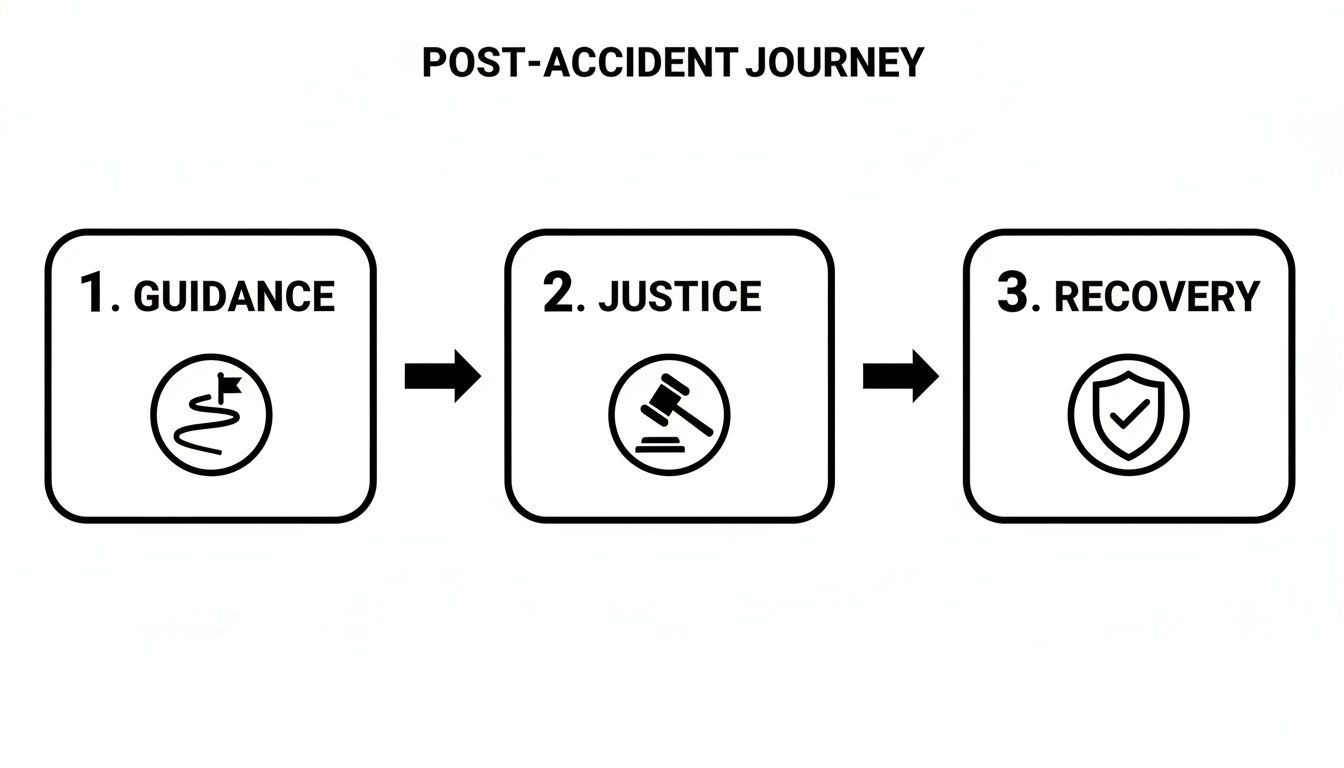
As the chart shows, taking these first steps correctly sets you on the right path. Once your immediate health is secure and you’ve preserved the initial evidence, it's time to understand the legal road ahead. To get a clearer picture of this process, you can learn more about what the path to auto accident recovery involves in our detailed guide.
Who Is Liable in a Texas Drunk Driving Accident?
When a drunk driver hits you, it feels like fault should be obvious. They broke the law, they caused the crash, case closed. But in the eyes of an insurance company, it’s never that simple. Proving liability—or legal responsibility—requires a specific strategy. Understanding how Texas law works is your first step toward getting the justice you deserve.
Thankfully, Texas law gives victims a powerful tool called negligence per se.
In plain English, this legal doctrine means that when someone breaks a safety law—like the one against driving while intoxicated—and causes the exact kind of harm the law was meant to prevent, they are automatically considered negligent. You don't have to prove they should have been more careful. Their decision to get behind the wheel while intoxicated is the proof.
The Two Parallel Legal Battles You'll Face
After a drunk driving crash, it's critical to understand that two entirely separate legal cases will begin to unfold. They run on parallel tracks and have very different goals.
It's a common point of confusion for victims, so let's break down the difference.
Criminal DWI Case vs. Civil Personal Injury Claim
| Aspect | Criminal DWI Case | Civil Personal Injury Claim |
|---|---|---|
| Who is Involved? | The State of Texas vs. the Drunk Driver | You (the Victim) vs. the Drunk Driver & their Insurer |
| Primary Goal | To punish the driver for breaking the law (DWI) | To recover financial compensation (damages) for your losses |
| Possible Outcomes | Jail time, fines, license suspension, criminal record | A monetary settlement or verdict for medical bills, lost wages, pain & suffering |
| Who Manages It? | A government prosecutor (District Attorney) | Your personal injury attorney |
| Burden of Proof | "Beyond a reasonable doubt" (very high standard) | "Preponderance of the evidence" (much lower standard) |
The criminal case is about punishment; your civil case is about your recovery. This distinction is vital.
A guilty verdict in the criminal DWI case is powerful evidence for your civil claim. However, even if the driver is found not guilty in criminal court, you can still win your civil case. The burden of proof is much lower, meaning we only have to show it was more likely than not that their intoxication caused your injuries.
Building an Unshakable Case with Evidence
To build a civil claim that the insurance company can’t deny, your attorney will gather concrete evidence that proves two things: the other driver was intoxicated, and their intoxication directly caused the crash and your injuries.
This goes far beyond just your side of the story. We assemble a file of hard proof, which often includes:
- The Official Police Report: This is the foundation. It contains the responding officer's direct observations of the driver's behavior, slurred speech, smell of alcohol, and notes on the DWI investigation.
- Breathalyzer or Blood Test Results: Chemical tests showing a Blood Alcohol Concentration (BAC) of 0.08% or higher are the gold standard for proving legal intoxication.
- Field Sobriety Test Records: We'll obtain any dashcam or bodycam footage of the driver failing tests like the walk-and-turn or one-leg stand. Visual evidence is incredibly persuasive.
- Witness Statements: Testimony from anyone who saw the crash happen or who observed the driver’s erratic behavior before or after the collision can be invaluable.
- Bar or Restaurant Receipts: If we can determine where the driver was drinking, credit card receipts can establish a timeline and show just how much alcohol they were served.
The Insurance Company's Favorite Defense: Comparative Fault
Even with a mountain of evidence against their driver, the insurance company will do everything it can to pay you less. Their most common tactic is to try and shift some of the blame onto you.
This strategy is based on a Texas law called comparative fault (or proportionate responsibility), as outlined in Chapter 33 of the Texas Civil Practice & Remedies Code.
The adjuster might argue that you were speeding slightly, or that you didn't swerve quickly enough to avoid the collision. Their goal is to convince a jury that you were partially responsible for your own injuries. If they succeed in assigning you 10% of the fault, your final compensation is automatically cut by 10%.
Worse yet, if they can convince a jury you were 51% or more at fault, you get nothing. Zero. You can learn more about the complexities of comparative negligence in Texas and how to fight back.
This is exactly why having a skilled Texas injury attorney is so critical. We’ve seen these tactics countless times. We build a wall of evidence to shut them down, keeping the focus squarely on the drunk driver’s reckless and illegal choices. Your job is to focus on healing; our job is to fight for every dollar you are owed.
The Devastating Reality of Drunk Driving in Texas

The crash that shattered your world wasn't a freak accident. It was the result of a choice—a reckless decision made by one person that now forces you to live with the consequences. You've now joined a community no one ever asks to be a part of: families across Texas torn apart by a drunk driver.
Your anger, your fear, and your pain are completely justified. Understanding just how widespread this problem is can help clarify why holding the responsible driver accountable is so critical. This is about more than just your own recovery; it's about taking a stand against a senseless pattern of negligence.
A Heartbreaking Pattern on Texas Roads
Losing a family member or suffering a life-altering injury because someone chose to get behind the wheel intoxicated is an all-too-common tragedy on Texas highways. Our state consistently, and tragically, leads the nation in alcohol-related driving fatalities.
According to the National Highway Traffic Safety Administration (NHTSA), thousands of lives are lost every year in the U.S. due to impaired driving. The data reveals a grim picture, often pointing to young drivers between the ages of 21-24 as being involved in these fatal wrecks. You can learn more about the national scope of this crisis on the NHTSA website.
These aren’t just abstract statistics. Every number represents a parent, a child, or a spouse whose life was stolen or changed in an instant. For every fatality, there are countless others left with catastrophic injuries, facing a future filled with medical treatments and overwhelming financial strain.
For example, a driver leaves a Houston bar and causes a head-on collision on I-45. A person celebrating in Dallas runs a red light and T-bones a family’s minivan. These aren't "accidents." They are the predictable, devastating outcomes of selfish choices.
Your Story Is More Than a Statistic
While your path to recovery is deeply personal, your pursuit of justice sends a powerful message that this behavior is unacceptable. It puts drunk drivers and their insurance companies on notice.
When you pursue a civil claim against the drunk driver, you accomplish two crucial goals:
- You secure your future. A fair settlement or court verdict provides the financial resources you need to cover medical bills, make up for lost wages, and compensate for the incredible pain and suffering you've been forced to endure.
- You demand accountability. Holding a drunk driver financially liable for the devastation they caused is a powerful deterrent. It forces them to confront the real-world consequences of their actions in a way a criminal case alone often can't.
The road ahead might feel overwhelming, but you are not just another number in a government report. You are a person who deserves to see justice served. By fighting for full and fair compensation, you're not only rebuilding your own life but also helping make Texas roads safer for every family.
The team at The Law Office of Bryan Fagan is ready to stand with you and help you achieve both of those goals.
Securing the Compensation You Deserve
When you’re staring at a growing stack of medical bills and can’t go back to work, the idea of "full compensation" can feel a bit abstract. After being hit by a drunk driver, however, it’s about one thing: making you financially whole again. It means forcing the driver who made that reckless choice to answer for every single loss you’ve suffered.
In Texas, this compensation is legally known as damages. This term simply refers to the money awarded to a victim for their losses. These damages are divided into a few key categories. Knowing what they are is the first step in understanding the true value of your claim and fighting for what you need to put your life back together.
What Are Economic Damages?
This is the most concrete part of any personal injury claim. Economic damages cover every tangible, out-of-pocket cost that the crash forced upon you. These are the real-world financial losses you can prove with receipts, invoices, and pay stubs.
Your claim for economic damages will almost always include:
- All past and future medical expenses, from the ambulance ride and ER visit to surgeries, ongoing physical therapy, and prescriptions.
- Lost wages for the time you were unable to work while recovering.
- Loss of future earning capacity if your injuries are so severe they prevent you from returning to your career or working at all.
- The cost to repair your vehicle or, if it was totaled, its replacement value.
Imagine a construction worker in San Antonio who suffers a permanent back injury because a drunk driver ran a red light. His economic damages aren't just his hospital bills. They include the lifetime of income he’ll lose because he can no longer handle the physical demands of his job. These are real, calculable losses.
What Are Non-Economic Damages?
While they don’t come with a price tag, non-economic damages are just as real as a hospital bill. This is compensation for the human cost of the accident—the physical pain, emotional trauma, and daily struggles you’ve been forced to endure.
These damages are meant to acknowledge the profound, personal ways the crash has shattered your life, including:
- Pain and suffering
- Mental anguish and emotional distress
- Loss of enjoyment of life
- Physical impairment or disfigurement
How can anyone put a dollar amount on the chronic pain that ruins your sleep? Or the trauma that now makes you terrified to even get in a car? An experienced Houston car accident lawyer understands how to build a case that shows an insurance company—or a jury—the true extent of these invisible wounds. To get a broader perspective on this process, this ultimate guide to personal injury settlement claims offers some great insights.
What Are Punitive Damages?
Finally, Texas law makes room for a third category of damages in particularly outrageous cases: punitive damages. Outlined in Chapter 41 of the Texas Civil Practice & Remedies Code, these aren’t designed to pay you back for a loss. Their purpose is entirely different: to punish the at-fault driver for their extreme misconduct and to send a powerful message deterring others from doing the same.
A drunk driving accident is the textbook example of a situation where punitive damages are often on the table. The driver didn't just make a simple mistake; they made a conscious decision that showed a blatant disregard for the safety of others.
To win punitive damages, we have to prove the driver acted with “gross negligence.” This is a high legal bar, meaning their actions were so reckless that they demonstrated a conscious indifference to the rights, safety, and welfare of everyone else on the road. A drunk driver getting behind the wheel fits that definition perfectly.
It’s also important to remember that others could be on the hook, too, like a bar or restaurant that knowingly over-served the driver. You can learn more by reading our article on how Texas Dram Shop law may apply to your case.
By pursuing all three types of damages, our goal is to achieve a result that accounts for the complete impact this crash has had on your life—financially, physically, and emotionally. It’s about getting you the resources needed for a secure future and making it clear that this kind of behavior will not be tolerated on Texas roads.
How a Dedicated Drunk Driving Accident Lawyer Wins Your Case

After a drunk driver turns your life upside down, trying to face off against a massive insurance company by yourself is not a fair fight. Their goal is simple: protect their bottom line by paying you as little as they possibly can. This is exactly where an experienced drunk driving accident lawyer becomes your most critical ally.
Hiring an attorney isn't about looking for a fight; it's about leveling the playing field. From the moment we take your case, we put a shield between you and the insurance adjusters who are trained to twist your words. We take over all communications, which frees you up to focus on what truly matters—your recovery.
Launching an Independent Investigation
The police are focused on the criminal side of things. But while they do their job, your lawyer launches a completely separate, civil investigation aimed at one thing: building your claim for compensation. We never just take the police report at face value. We dig much deeper.
This means taking immediate, decisive action.
- We fire off spoliation letters to preserve key evidence, like the drunk driver's "black box" vehicle data or video footage from the bar that may have over-served them.
- We track down and interview witnesses while their memories are still sharp.
- We bring in accident reconstruction experts who can show a jury exactly how the crash happened, leaving no room for the insurer to shift blame.
We essentially build a fortress of evidence to prove the other driver's gross negligence and document the full, devastating impact on your life.
The Clock Is Ticking: The Texas Statute of Limitations
It's crucial to understand that your right to demand justice in court doesn't last forever. Texas law has a strict deadline, called the statute of limitations, for filing a personal injury claim. In plain English, the statute of limitations is the time limit you have to file a lawsuit. In most car accident cases, you have just two years from the date of the wreck to file a lawsuit.
If you miss that two-year deadline, you will almost certainly lose your right to recover a single dollar, no matter how clear-cut your case is. This is why it is so critical to contact a Texas injury attorney right away. Navigating the complex world of a drunk driving claim requires specialized knowledge, which is why victims often turn to dedicated personal injury law firms.
Be warned: Insurance companies know this deadline exists. They will often drag out settlement negotiations, acting like they’re on your side, all while hoping you’ll run out of time to sue. An attorney protects you from these delay tactics.
You Don’t Pay Unless We Win Your Case
One of the first things people worry about is how they can afford a top-tier lawyer. We take that worry completely off the table. At The Law Office of Bryan Fagan, PLLC, we handle all drunk driving accident cases on a contingency-fee basis.
This means you pay zero upfront costs. We advance all the money needed to build your case, from hiring experts to paying court filing fees. Our fee is a percentage of the money we successfully recover for you.
Simply put: If we don’t win your case, you don’t owe us a dime.
Repeat offenders and young drivers contribute to a devastating cycle of destruction on our roads. Drivers between the ages of 21-34 consistently account for a high percentage of fatal alcohol-related crashes, which often result in catastrophic injuries or wrongful death compensation claims. Our contingency-fee promise means you take on no financial risk to seek justice for your medical bills, lost income, and pain and suffering. You can see more about these alarming fatality trends from YourLawyer.com.
Your free, no-obligation consultation is the first step. It’s your chance to understand your rights and get a powerful advocate on your side. Let us handle the legal battle so you can focus on healing.
Steps to File a Drunk Driving Accident Claim
When you're reeling from a drunk driving crash, your mind is flooded with questions. The path forward feels uncertain, and it’s hard to know who to trust. Based on our experience helping families across Texas, here are the answers to some of the most pressing concerns that come up.
Can I Sue the Bar That Served the Drunk Driver?
Yes, in many cases, you can. Texas has what are called Dram Shop laws, and they exist for a reason. These laws allow you to hold an establishment—like a bar, club, or restaurant—liable for the crash if they served alcohol to a person who was already “obviously intoxicated.”
To win a dram shop case, we have to prove the establishment served someone who was a clear danger to themselves and others. This requires a fast, aggressive investigation to get our hands on crucial evidence like security camera footage, credit card receipts, and statements from employees or other patrons. This evidence disappears quickly, which is why acting fast is so important.
What if the Drunk Driver Had No Insurance?
This is a terrifying and unfortunately common scenario. If the driver who hit you was uninsured (no insurance) or underinsured (not enough insurance to cover your medical bills and losses), you aren't out of luck. This is exactly why you have your own auto insurance.
Your policy should include Uninsured/Underinsured Motorist (UM/UIM) coverage. This specific protection allows you to file a claim with your own insurance company to cover the damages the at-fault driver can’t. We can help you navigate this complex process and make sure your own insurer treats you fairly and pays what you’re owed.
How Long Will My Drunk Driving Accident Case Take?
There’s no simple answer, because every case is unique. The timeline really depends on the severity of your injuries, how complex the evidence is, and whether the insurance company is willing to negotiate a fair settlement.
A straightforward case with clear proof of fault and intoxication might settle in just a few months. On the other hand, a case involving catastrophic injuries or a dispute that has to go to trial could easily take more than a year to resolve. Once we review the specifics of your accident, we can give you a much more realistic timeline based on our experience.
Will I Have to Go to Court?
It’s highly unlikely. The overwhelming majority of personal injury cases, including those involving a drunk driving accident, are settled out of court. Insurance companies know that juries have little sympathy for drunk drivers, and they are often motivated to settle to avoid the risk and expense of a public trial.
But here’s the key: the best way to get a fair settlement offer is to prepare every single case as if it’s going to trial. When the insurance company sees that we are ready and willing to fight in court, it gives your lawyer powerful leverage to demand the compensation you truly deserve.
The road to recovery after a drunk driving accident is difficult, but you don’t have to walk it alone. The dedicated attorneys at The Law Office of Bryan Fagan, PLLC are here to answer your questions, protect your rights, and fight for the full and fair compensation you are owed. We are committed to informing, reassuring, and empowering you every step of the way.
Contact us today for a free, no-obligation consultation to learn how we can help. Your recovery is our priority.