A car crash can change your life in seconds—but you don’t have to face recovery alone. The specifics of how your accident happened, whether it was a rear-end bump on a busy street or a chaotic multi-car pile-up on the highway, directly shape how you prove fault and fight for the compensation you need to recover.
Understanding the details of your crash is the first step toward protecting your legal rights and securing your family's future. This guide is designed to empower you with the knowledge you need to navigate the difficult road ahead.
Common Types of Car Accidents in Texas
The minutes and hours after a wreck are a blur of shock, confusion, and fear. Your first thoughts are rightly on your health and safety. Soon, though, the tough questions about your financial and legal recovery will start to surface.
This guide was created to bring clarity and confidence to a difficult and overwhelming time. We'll break down the most common car crash types and explain how each one comes with its own set of legal challenges for proving who was at fault under Texas law.
Whether you were hit from behind on I-10 in Houston or tangled in a complex pile-up on the 610 Loop, the evidence needed to build a powerful claim changes dramatically depending on the crash. When you understand these differences, you become a more effective advocate for your own future.
A Quick Guide to Texas Car Crash Scenarios
To help you get started, the table below provides a quick snapshot of the most common types of accidents, their typical causes, and the general rules for determining fault here in Texas.
| Crash Type | Common Cause | General Liability Rule in Texas |
|---|---|---|
| Rear-End Collision | Distracted driving, tailgating, sudden stops | The rear driver is almost always presumed to be at fault. |
| T-Bone / Side-Impact | Running a red light or stop sign, failure to yield | The driver who violated the right-of-way is typically liable. |
| Head-On Collision | Drunk driving, wrong-way driving, unsafe passing | The driver who crossed the center line is usually at fault. |
| Sideswipe Accident | Unsafe lane changes, drifting, merging errors | The driver who left their lane is generally held responsible. |
| Rollover Accident | High-speed turns, "tripping" on a curb, T-bone impacts | Liability depends on what caused the rollover (e.g., another driver, a vehicle defect). |
| Multi-Vehicle Pile-Up | A chain reaction from an initial crash, poor weather | Fault can be complex and may be shared among multiple drivers. |
While this table offers a general guide, every accident is unique. The specific facts and available evidence will ultimately determine who is held legally and financially responsible for your injuries and damages.
Who Is Liable in a Texas Car Accident?
Knowing what kind of crash you were in is one thing. Figuring out who's legally responsible for your medical bills and lost wages is another. In Texas, assigning blame isn't just about pointing fingers—it's about applying specific legal principles to the facts of your accident.
For anyone hurt in a crash, understanding these rules is the first step toward securing fair compensation.
Proving Liability Through Negligence
Every personal injury claim is built on one core concept: negligence. In plain English, negligence is a driver's failure to use the basic level of care that any reasonable person would under the same circumstances. Texting while driving, blowing through a stop sign, or weaving through traffic—that's all classic negligence.
When a driver’s carelessness causes a wreck, they become legally responsible for the outcome. We call this liability. To win your case, your Houston car accident lawyer has one job: prove that the other driver’s negligent actions directly caused your injuries and financial losses.
It’s a straightforward link. For instance, a Houston driver checking social media on I-45 who doesn't notice traffic has stopped ahead isn't just distracted; they're negligent. When they slam into the car in front of them, their negligence is the direct cause of the collision, making them liable for the damage.
Understanding Comparative Fault in Texas
But what happens when things aren't so black and white? Texas law has a specific way of handling accidents where more than one person might be partially to blame. This rule, found in Chapter 33 of the Texas Civil Practice & Remedies Code, is called comparative fault, and it can make or break your ability to recover money.
Here’s the breakdown:
- Your recovery is reduced by your share of the blame. If a jury decides you were 20% at fault for the accident, your final compensation award will be cut by 20%.
- If you are 51% or more at fault, you get nothing. This is the "51% Bar Rule." If you're found to be the primary cause of the crash (at least 51% responsible), Texas law completely bars you from recovering any damages.
Let’s put it in a real-world context. Imagine you’re making a legal left turn at a busy Houston intersection, but an oncoming car is speeding and runs a yellow light, hitting you. A jury might find the speeding driver was 80% at fault, but that you were 20% at fault for misjudging their speed. If your total damages were $100,000, you could only collect $80,000 ($100,000 minus your 20% fault). This is exactly why having a skilled Texas injury attorney who can effectively argue down your percentage of fault is so critical. To see a more detailed breakdown, you can read our guide on how comparative negligence works in Texas.
The Clock Is Ticking: The Statute of Limitations
It's absolutely vital to know that your time to take legal action is limited. In Texas, the statute of limitations for most car accident and personal injury claims is just two years from the date of the crash. This is a strict deadline.
If you fail to file a lawsuit within that two-year window, you will almost certainly lose your right to seek compensation forever.
This deadline is unforgiving, and it highlights why you must act quickly. Evidence gets lost, skid marks fade, and witness memories become unreliable. Building a strong case demands immediate action. Contacting a Texas injury attorney right away is the best way to protect your rights and ensure every legal deadline is met.
A Deeper Look at Common Collision Scenarios
Knowing legal terms like "negligence" and "liability" is one thing, but seeing how they play out on the road is what really matters. The specific way your crash happened directly shapes the kind of evidence needed to build your case and fight for the money you deserve.
Let's break down the most common car crash types we see on Texas roads and what each one means for your potential personal injury claim.
Rear-End Collisions
This is, without a doubt, the most frequent kind of wreck. In Texas, the law starts with a strong presumption that the driver who hit the car from behind is at fault.
Why? Because every driver has a legal duty to keep a safe following distance and pay attention. When they don't, it’s usually for a few common reasons:
- Distracted Driving: Texting, messing with the GPS, or anything else that takes their eyes off the road.
- Tailgating: Following too closely, leaving no room to react if traffic suddenly stops.
- Speeding: Driving too fast for conditions, making it impossible to stop in time.
If you were stopped in traffic on I-45 in Houston and a distracted driver plowed into your bumper, proving their fault is usually straightforward. The key evidence will be the police report, photos of the damage to both cars, and any witness statements that confirm you were stopped.
T-Bone or Side-Impact Crashes
A T-bone crash is exactly what it sounds like—the front of one car hits the side of another, forming a “T” shape. These are incredibly dangerous because the side of a car offers almost no protection. They almost always happen at intersections.
Liability here boils down to one simple question: who had the right-of-way? The driver who blew through a red light, ignored a stop sign, or failed to yield is the one who acted negligently.
To prove fault, we need specific evidence:
- Traffic Camera Footage: Many city intersections have cameras that can end the "he said, she said" argument instantly.
- Witness Testimony: Other drivers or pedestrians who saw what happened can confirm who had the green light.
- Vehicle Damage: The location and severity of the impact can help accident reconstruction experts piece together how the crash occurred.
This visual guide shows how a driver's simple act of negligence can lead directly to legal liability and financial damages under Texas law.
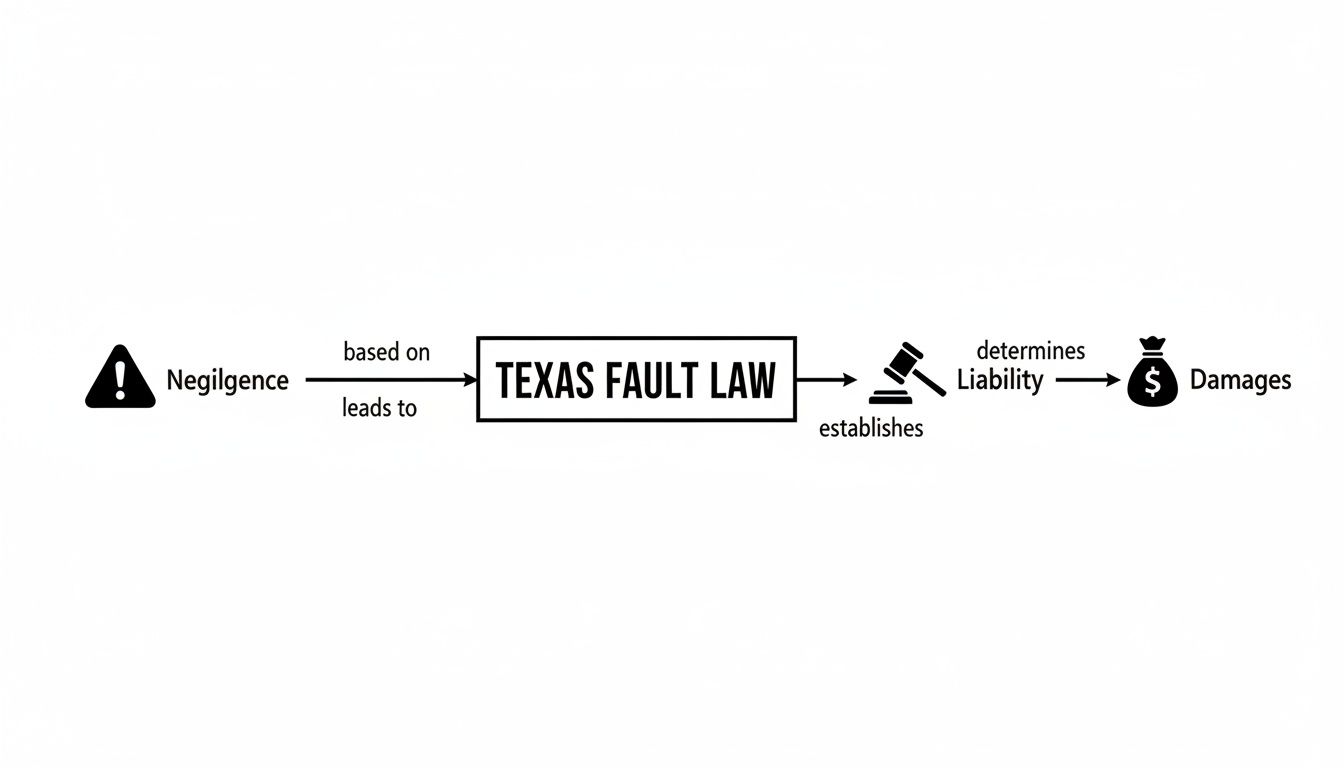
The image clearly illustrates the legal path from a careless mistake to financial responsibility—the very foundation of every personal injury case we handle.
Head-On Collisions
While they happen less often, head-on collisions are by far the deadliest. The combined force of two vehicles colliding front-to-front creates a catastrophic impact, frequently causing life-altering injuries or death.
These crashes are almost always the result of one driver’s extreme negligence, including:
- Driving while intoxicated (DWI).
- Falling asleep at the wheel.
- Driving the wrong way down a one-way street or highway on-ramp.
- Trying to pass another car illegally in a no-passing zone.
The driver who crossed the center line is presumed to be at fault. Evidence like police reports, toxicology results from the at-fault driver, and physical clues from the scene are vital for establishing liability and pursuing wrongful death compensation if you've lost a loved one.
Rollover and Sideswipe Accidents
Rollover accidents occur when a vehicle flips onto its side or roof. They are especially common in vehicles with a high center of gravity, like SUVs and trucks, and can be caused by "tripping" on a curb, getting hit in a T-bone crash, or swerving too hard at high speeds.
Sideswipe accidents happen when two cars driving next to each other make contact, often during an unsafe lane change. When looking at what causes these crashes, a vehicle's mechanical fitness can't be overlooked; knowing the signs your vehicle needs new brakes can be crucial in preventing a wreck where a driver swerves because they couldn't stop in time.
For both rollover and sideswipe crashes, liability hinges on proving which driver made the unsafe move that initiated the collision. Evidence might include dashcam video, witness statements, and an expert’s analysis of the vehicle dynamics.
Multi-Vehicle Pile-Ups
These chain-reaction crashes are some of the most complicated cases to sort out. What starts as a simple two-car wreck can trigger a domino effect involving dozens of vehicles, especially in bad weather or gridlocked traffic on a major Texas highway.
Figuring out who is at fault is a massive undertaking. Was it the first driver who caused the initial impact? Was it a driver further back who was tailgating and couldn't stop? In these scenarios, multiple drivers can share the blame.
This is where an experienced Texas injury attorney becomes essential. It takes a painstaking investigation, often with the help of accident reconstruction specialists, to examine all the evidence, interview everyone involved, and correctly assign percentages of fault under Texas's comparative fault rules.
Complex Car Accident Claims
Not all car accidents are straightforward. When your crash involves a pedestrian, an Uber driver, or a massive 18-wheeler, the path to getting fair compensation suddenly gets a lot more complicated.These aren't your typical two-car collisions. They come with unique laws, powerful corporate opponents, and aggressive insurance tactics. If you've been hurt in one of these complex accidents, you need to know exactly what you're up against and why having an experienced Texas injury attorney is non-negotiable.
Pedestrian and Bicyclist Accidents
A collision between a two-ton vehicle and a person on foot or on a bike is never a fair fight. The injuries are almost always devastating. Worse, insurance adjusters often try to shift the blame, unfairly suggesting the pedestrian "darted into traffic" or the cyclist was "hard to see."
In Texas, the law is clear: drivers must be vigilant and yield to vulnerable road users like pedestrians and cyclists, especially at crosswalks. To win these cases, we have to prove the driver was negligent by showing they were speeding, distracted, or simply failed to yield the right-of-way. Imagine a Houston driver turning right on red who plows into a cyclist in the designated bike lane. The insurance company might try to reduce the settlement by arguing the cyclist wasn't wearing bright clothing. This is where an attorney steps in to protect your rights.
Rideshare Accidents with Uber and Lyft
Figuring out who pays after a crash with an Uber or Lyft driver can feel like a shell game. The answer depends entirely on the driver's app status at the exact moment of the crash.
The insurance coverage is a moving target:
- App Off: If the driver wasn't logged into the app, you're dealing with their personal auto insurance claim.
- App On, Waiting for a Ride: A smaller Uber/Lyft policy may kick in if the driver's personal insurance denies the claim.
- App On, During a Ride: This is when Uber and Lyft’s big $1 million liability policy is active.
This tangled web of policies gives insurance companies plenty of room to point fingers and deny responsibility. A Houston car accident lawyer who knows the ins and outs of rideshare law can cut through the confusion, pinpoint the right policy, and fight to get your claim paid.
Commercial Trucking Accidents
Crashes with 18-wheelers, semi-trucks, and other big rigs are among the most destructive events on Texas roads. The catastrophic force often leads to life-altering injuries or fatalities, resulting in wrongful death compensation claims.
These cases go far beyond the driver's actions. Trucking companies and their drivers have to follow strict federal and state safety rules. A thorough investigation often reveals that the company itself is just as liable as the person behind the wheel.
Liability can fall on the trucking company for:
- Negligent Hiring: Putting a driver on the road with a known history of DUIs or crashes.
- Poor Maintenance: Cutting corners on essential upkeep for brakes and tires.
- Hours-of-Service Violations: Forcing drivers to stay on the road past legal limits, leading to deadly fatigue.
Investigating a truck wreck is a race against the clock. Key evidence, like the truck's "black box" data recorder, can be legally destroyed by the trucking company after a short time. An attorney must act immediately to legally force the company to preserve that evidence. It's a critical first step in building a powerful case.
Steps to Take After a Car Accident
The moments after a car crash are a blur of adrenaline and confusion. It’s natural to feel overwhelmed, but the steps you take right at the scene are absolutely critical. They don’t just protect your health—they lay the groundwork for your legal right to fair compensation.

1. Secure Your Health and the Scene
First, check yourself and your passengers for injuries. If anyone is hurt or the crash looks serious, call 911 immediately. Even if you think you feel fine, get a medical evaluation as soon as possible. Adrenaline can mask serious injuries like whiplash or concussions. Seeing a doctor creates a vital medical record that directly ties your injuries to the accident.
2. Gather Critical Evidence
While you're waiting for help, if you're physically able, start documenting everything.
- Take Photos and Videos: Use your smartphone to capture vehicle damage, skid marks, traffic signs, and any visible injuries.
- Exchange Information: Get the other driver’s name, phone number, address, license number, and insurance policy information. Be polite, but do not apologize or admit fault.
- Talk to Witnesses: If anyone saw what happened, get their name and phone number. An independent witness is invaluable.
- Get the Police Report Number: Ask the responding officer for the police report number. This official document is a cornerstone of your case.
3. Report the Accident and Protect Your Rights
You must report the crash to your own insurance company. Give them the basic facts, but do not speculate or offer too many details. The other driver’s insurance adjuster will call you. They will be friendly and ask for a recorded statement.
We strongly advise you not to give a recorded statement to the other driver's insurance company without talking to a lawyer first. Their job is not to help you; their job is to find reasons to pay you as little as possible. Anything you say can be used to hurt your claim. The smartest thing you can do is contact a Houston car accident lawyer before you speak to the at-fault party's insurer.
What Kind of Compensation Can I Recover?
After a serious car crash, you may hear about “full and fair compensation.” In Texas, this means recovering every dollar the accident took from you, while also demanding justice for the human toll it’s had on your life.

To get there, your claim is broken down into two types of damages—the legal term for your losses.
Economic Damages: The Tangible Costs
This category covers every measurable financial loss you’ve suffered. These are the bills, receipts, and income statements with a clear dollar amount attached.
Your economic damages include:
- All Medical Expenses: Every ER visit, future surgery, physical therapy session, and prescription.
- Lost Wages: Every paycheck you missed because you were unable to work.
- Reduced Earning Capacity: If your injuries prevent you from returning to your old job, we fight for compensation to cover that future lost income.
- Property Damage: This covers the cost to repair or replace your vehicle. If your car is totaled, understanding salvage titles is key to making sure you aren't short-changed.
Non-Economic Damages: The Human Cost
This category is about putting a value on the immense suffering the accident forced on you and your family—losses that don’t come with a receipt. While harder to quantify, Texas law allows you to demand justice for them.
These damages cover:
- Pain and Suffering: The physical pain and emotional trauma you endure because of your injuries.
- Mental Anguish: This compensates for the anxiety, fear, depression, or PTSD that many victims experience.
- Physical Impairment: This addresses the loss of your ability to enjoy life as you once did—whether it’s playing with your kids or simply getting through a day without pain.
Proving these "human" costs takes experience and a deep understanding of how to tell your story. It’s a complex process, which is why we created a guide on how to prove pain and suffering in a Texas injury claim. Chapter 41 of the Texas Civil Practice & Remedies Code also provides guidance on when punitive damages, meant to punish the wrongdoer for extreme negligence (like in a drunk driving crash), may be available.
Answering Your Urgent Car Accident Questions
After a crash, your mind is racing. Your health, your car, your job—it all feels uncertain. We get it. Here are some straight answers to the most immediate questions we hear from accident victims.
How Much Does It Cost to Hire a Houston Car Accident Lawyer?
This is often the first question on everyone’s mind. At The Law Office of Bryan Fagan, PLLC, we handle car accident cases on a contingency fee basis.
Put simply, this means you pay us nothing upfront. We only get paid if you get paid. Our fee is a percentage of the compensation we recover for you. If we don’t win your case, you owe us absolutely nothing. Your initial case review is also 100% free, so there is zero financial risk in getting the expert legal answers you need right now.
Should I Talk to the Other Driver's Insurance Company?
Our advice is simple: No. We strongly recommend you do not give a recorded statement or even have a detailed conversation with the at-fault driver's insurance adjuster before speaking with a lawyer.
Make no mistake, their job is to protect their company’s profits by finding any reason to pay you as little as possible. They are professionals trained to turn your words against you. Let your attorney handle all communications. We know their tactics and will protect you from saying something that could damage your case.
What If an Uninsured or Hit-and-Run Driver Hit Me?
You're not out of options. This is exactly why Texas law requires insurance companies to offer Uninsured/Underinsured Motorist (UM/UIM) coverage. You likely have this as part of your own policy.
This coverage is designed to step in and pay for your medical bills, lost income, and other damages when the at-fault driver has no insurance or flees the scene. But even when dealing with your own insurer, it’s not always a smooth process. A lawyer on your side ensures they treat you fairly and honor the policy you’ve paid for.
Navigating the aftermath of any of the car crash types we’ve discussed can feel like an impossible fight, but you don’t have to do it alone. The insurance company has a team of experts working against you; it's only fair that you have an expert fighting for you. If you have questions or you’re ready to explore your legal options, the dedicated team at The Law Office of Bryan Fagan, PLLC is here for you. We are ready to listen to your story, answer your questions, and explain how we can help protect your rights and your recovery. Contact us today for a free, no-obligation consultation to discuss your case. Visit us at https://houstonaccidentlawyers.net.