A car crash can change your life in seconds—but you don’t have to face recovery alone. You’re not just dealing with the physical pain and shock; suddenly, you’re buried under a mountain of unexpected bills. In a Texas personal injury claim, we have a specific term for these concrete, calculable financial losses: special damages.
Think of them as every single receipt, bill, and lost paycheck that adds up to the real-world monetary cost of your accident.
Your Financial Recovery After a Texas Car Accident
When someone else’s negligence leaves you injured, the damage goes far beyond a crumpled fender. The wreck attacks your financial stability. All at once, you’re staring at hospital bills, missing time from work, and scrambling to figure out how to keep your family afloat while you heal. This is precisely why understanding your rights under Texas law is so critical.

The legal term for the compensation you are owed is damages. These are broken down into different categories, but the most tangible and straightforward are what we call special damages.
The Foundation of Your Claim
Picture special damages as the solid, concrete foundation of your entire insurance claim. They represent every penny you were forced to spend or lost out on because of the crash. These aren't abstract concepts or fuzzy estimates; they are real, documented costs you can prove with paperwork.
Common examples include things like:
- Medical Expenses: Every single bill, from the ambulance ride and the ER visit to your follow-up appointments with doctors and physical therapists.
- Lost Wages: The income you couldn't earn because your injuries kept you from going to work.
- Property Damage: The cost to get your vehicle repaired or, if it’s a total loss, what it costs to replace it.
- Out-of-Pocket Costs: All the little things that add up, like prescription medications, crutches, or even the gas money for driving to and from your appointments.
These special damages, also known as economic damages, are the measurable financial losses that form the bedrock for calculating the total compensation you deserve. Because they are backed by hard evidence—receipts, pay stubs, and billing statements—they are the starting point for any serious settlement negotiation.
A Houston car accident lawyer can help you meticulously track down and calculate every single one of these costs. It's our job to make sure nothing gets overlooked, ensuring you have the strongest possible foundation for your claim.
Special Damages vs. General Damages Explained
When you’re reeling from a serious car accident, the costs start piling up from every direction. Medical bills, lost paychecks, car repairs—it's overwhelming. In a Texas personal injury claim, the law sorts these losses into two main buckets to make sure you're compensated for everything you've been through.
Getting a handle on this difference is the first step toward protecting your rights.
Think of your entire injury claim as a detailed expense report you're submitting for reimbursement. The first part of that report is for special damages. These are the concrete, black-and-white financial losses you can prove with a paper trail. If you have a receipt, an invoice, or a pay stub for it, it’s a special damage.
The other part of the report is for general damages. These are just as real and often more devastating, but they don't come with a neat price tag. This category covers the human cost of the accident—things like physical pain, emotional trauma, and the simple loss of being able to enjoy your life like you used to.
The Key Differences at a Glance
Special damages are objective. You can add them up with a calculator. An insurance adjuster can look at your hospital bills and see exactly what you owe.
General damages are more subjective. How do you put a dollar value on the constant fear of getting behind the wheel after a crash on I-45? It’s not easy, but an experienced Houston injury attorney knows exactly how to build a case that proves their value. You can learn more about how to calculate pain and suffering damages in our detailed guide.
Here's the most important takeaway: Special damages are calculated, while general damages are assessed. Meticulous record-keeping is your best weapon. Every single receipt and bill helps build an undeniable foundation for your claim.
To make this crystal clear, let's break down the two side-by-side.
A Clear Comparison of Special and General Damages
This table contrasts the two main types of compensation you can pursue in a Texas personal injury claim, showing what each one covers and how it's proven.
| Category | Special Damages (Economic) | General Damages (Non-Economic) |
|---|---|---|
| What It Covers | Measurable financial losses. This includes all your medical bills, lost wages, and property repair costs. | Intangible, personal losses. This covers physical pain, mental anguish, and diminished quality of life. |
| How It's Proven | With concrete evidence. You will use receipts, invoices, pay stubs, and official repair estimates. | Through testimony and documentation. This involves medical records, personal journals, and expert opinions. |
| Example in an I-45 Crash | The $15,000 bill from Memorial Hermann for your emergency room visit after a Houston driver rear-ended you on I-45. | The ongoing anxiety and fear of driving that you now experience every time you get behind the wheel. |
Both types of damages are absolutely critical to your recovery. One restores the money that was taken out of your pocket, while the other acknowledges the profound human cost of someone else's negligence.
A successful claim fights for both, ensuring you get the resources you need to truly heal and move forward.
Pinpointing Your Special Damages After a Houston Car Wreck
After a serious car wreck, it feels like the financial hits just keep coming from every direction. The chaos of the moment often masks the true, long-term costs of an accident. Tracking every single expense isn't just about getting bills paid—it’s about getting the resources you need to actually recover and put your life back together.
Those specific, documented costs are what the law calls special damages. Let’s break down the real-world financial burdens that Texas accident victims face every day.
Medical Expenses: Past, Present, and Future
Medical bills are almost always the biggest and most immediate stressor. But this category goes way beyond the initial ambulance ride or the ER visit. It has to include every single medical cost tied to that crash.
Think of it in three stages:
- Immediate Care: This is everything from the first hospital stay, X-rays, CT scans, and any surgeries you needed right after the wreck.
- Ongoing Treatment: Recovery is a marathon, not a sprint. This bucket includes all your follow-up appointments with specialists, physical therapy to get your mobility back, and prescription medications to manage the pain.
- Future Needs: For severe injuries, the costs don't stop. You might need future surgeries, long-term pain management, or even assistive devices like a wheelchair. A seasoned Houston car accident lawyer works with medical experts to forecast these future costs so they become part of your claim today.
If you're wondering how these bills get paid while your case is ongoing, check out our guide on who pays medical bills after a car accident. It’s a messy process, and you shouldn’t have to figure it out alone.
Lost Wages and Diminished Earning Capacity
Being unable to work is one of the most frightening parts of being injured. Special damages are designed to cover not just the income you've already lost, but also the money you won't be able to earn in the future.
This breaks down into two key parts:
- Lost Wages: These are the paychecks you missed while you were stuck at home recovering. We prove this with your pay stubs or a formal letter from your employer. It’s simple math.
- Loss of Earning Capacity: This is absolutely critical for anyone with a life-altering injury. Imagine a delivery driver who gets hit on I-10 and suffers a permanent back injury. If they can no longer lift heavy packages or sit for hours, their ability to do their job is gone. We fight to get compensation for that lost future.
Every day you can't work is a real, measurable loss. It’s not just a missed paycheck; it’s a direct financial blow caused by someone else's negligence, and you have every right to be compensated for it.
Property Damage and Out-of-Pocket Costs
Finally, special damages cover all the other expenses that pile up. The most obvious one is the cost to repair or replace your vehicle if it was damaged or declared a total loss in the crash.
But it also includes all the smaller, easily overlooked costs that add up fast:
- Rental car fees while your car is in the shop.
- Towing and storage bills for your wrecked vehicle.
- Gas mileage and parking fees for all those trips to the doctor.
- The cost of crutches, braces, or other medical equipment you had to buy.
Keeping meticulous records of every single one of these expenses is vital. Each receipt is a piece of evidence that makes your claim stronger and helps us fight for the full and fair compensation you’re owed under Texas law.
How to Calculate and Prove Your Special Damages
When you've been hurt in a Houston car wreck, getting fair compensation isn't about pulling a number out of thin air—it’s about proof. The at-fault driver's insurance company is going to demand a receipt for every single dollar you claim. Winning your case hinges on your ability to present cold, hard evidence of every financial loss you've suffered.
Think of it as building a case brick by brick. Every piece of paper tells part of your financial story after the crash, and your claim's strength depends on a solid foundation of organized records. In a way, knowing what receipts to keep for taxes is a good starting point, as that same level of detailed documentation is exactly what an insurance adjuster wants to see.
The infographic below breaks down the main categories of losses you’ll need to track.
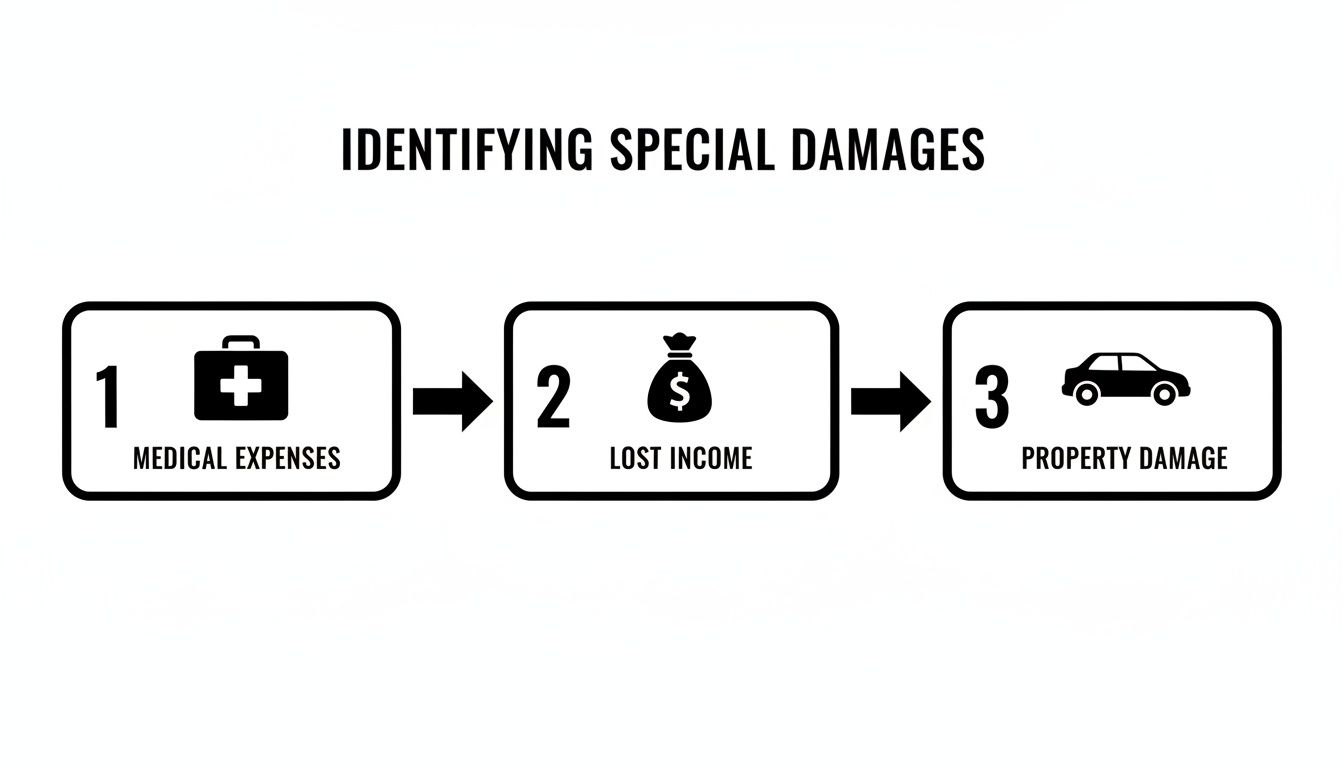
This visual shows the core financial hits you take after a wreck—medical bills, lost paychecks, and property damage. Your recovery depends on addressing every single one.
Building Your Case with Documentation
To make the insurance company pay what they owe, you need a paper trail. Adjusters are trained to poke holes in any undocumented cost, so your best defense is meticulous organization. Get a folder—digital or physical—and save absolutely everything related to the accident.
Your most critical documents will be:
- Medical Invoices: Every bill you get from the hospital, your doctor, specialists, and even the ambulance ride.
- Pharmacy Receipts: Proof of payment for every prescription, brace, or crutch you needed.
- Official Wage Statements: Pay stubs or a formal letter from your employer showing your hourly rate and the exact shifts you missed.
- Vehicle Repair Estimates: Official quotes from body shops or the insurance company’s own total loss valuation.
These documents are the facts of your case. Each receipt is another piece of evidence a Texas injury attorney uses to fight for the full and fair amount you deserve.
The Role of Expert Testimony
Sometimes, bills and receipts don't tell the whole story. This is especially true when your injuries are going to affect you for years to come. In these situations, Texas law allows us to bring in experts to establish the true, long-term value of your special damages.
For instance, your doctor might need to testify about a future surgery you’ll require and what it’s projected to cost. We could also bring in a vocational expert to explain how your injuries will limit your ability to work, calculating your loss of future earning capacity in real-world dollars.
This kind of expert testimony is critical for making sure your settlement covers not just the bills you have now, but the ones you'll be facing down the road. The total of all your proven special damages then becomes the foundation for calculating the rest of your compensation.
A strong claim is built on more than just numbers—it’s built on the story those numbers tell. Each document helps prove the true impact the accident had on your life and financial well-being.
Your special damages also directly influence the value of your pain and suffering. Attorneys often use the multiplier method, where your total documented economic losses are multiplied by a factor (usually between 1.5 and 5) based on the severity of your injuries. So, if you have $20,000 in special damages and a moderate severity multiplier of 3, your general damages could be valued at $60,000, bringing your total potential claim to $80,000.
Once we've gathered all this evidence, we package it into a formal request for payment. To see how all these pieces come together, take a look at our guide on preparing a car accident demand letter sample.
How a Houston Injury Attorney Maximizes Your Claim
While you’re focused on healing, who is fighting to make sure every dollar of your loss is counted? After a serious wreck, going up against a massive insurance corporation on your own is an uphill battle. Their goal is simple: protect their profits by paying you as little as possible. This is where an experienced Houston car accident lawyer becomes your most powerful advocate.

Insurance adjusters are trained to minimize the special damages they have to cover. They’ll question whether your medical treatments were truly necessary, challenge the hours you missed from work, and dangle lowball settlement offers, hoping you’ll take the bait out of desperation.
An attorney knows exactly how to shut down these tactics. We handle all communications, gather every piece of evidence, and build a claim so solid that the insurer has no choice but to take it seriously.
Protecting Your Claim from Unfair Reductions
One of the most critical roles an attorney plays is defending your claim from being unfairly slashed. Texas operates under a legal rule known as comparative fault, sometimes called proportionate responsibility. In plain English, this means if you're found partially responsible for the accident, your total compensation gets cut by your percentage of fault. For example, if you’re found 10% to blame, your award is reduced by 10%.
But here’s the real kicker: under Texas Civil Practice & Remedies Code § 33.001, if you are found to be 51% or more at fault for the crash, you get absolutely nothing. Insurance companies know this rule inside and out and will do everything they can to shift blame onto you.
A skilled Texas injury attorney fights back against these unfair blame games. We dig deep into the crash, gathering police reports and witness statements, and even bring in accident reconstruction experts to prove the other driver was the one primarily responsible.
Building a Case for Maximum Compensation
Getting you the maximum compensation isn't just about adding up receipts. It's about telling a compelling story backed by undeniable proof.
Your legal team will:
- Consult with Experts: We work closely with medical professionals to document the full scope of your injuries and map out the costs of any future care you’ll need.
- Hire Financial Analysts: For severe injuries that sideline your career, we bring in vocational and economic experts to calculate your total lost earning capacity over a lifetime.
- Negotiate Aggressively: Armed with powerful evidence, we negotiate from a position of strength, demanding a settlement that truly covers all of your special and general damages.
Don't let an insurance company decide what your recovery is worth. The Law Office of Bryan Fagan, PLLC, is here to ensure every single loss is accounted for so you can get the resources you need to rebuild your life.
Don't Let the Clock Run Out on Your Claim
After a serious car wreck in Houston, your first and only priority should be healing. The last thing on your mind is hiring a lawyer, but you need to know that your right to demand compensation has a strict expiration date. Texas law is crystal clear on this.
You have a very specific window of time to protect your financial future. If you wait too long, you could lose your right to recover a single dollar—no matter how obvious the other driver's fault was.
The Texas Statute of Limitations
In Texas, the law that sets this deadline is called the statute of limitations. For most personal injury claims, it gives you just two years from the date of the accident to file a lawsuit. This isn't a suggestion; it's a hard legal cutoff.
If you miss that two-year mark, the courts will almost certainly throw your case out for good.
Insurance companies know this deadline inside and out. It's not uncommon for them to drag out negotiations or dangle lowball settlement offers, hoping you'll get frustrated and run out of time. Once the clock expires, so does all your leverage. This is exactly why a sense of urgency is so critical.
Waiting to get legal advice is one of the biggest mistakes an accident victim can make. Over time, evidence disappears. Witness memories fade. The physical proof from the scene gets cleaned up. The longer you wait, the harder it becomes to build a winning case.
Your job is to focus on your physical and emotional recovery. Let a dedicated Texas injury attorney worry about the legal deadlines and the fight with the insurance company.
At The Law Office of Bryan Fagan, PLLC, we offer a free, no-obligation consultation to help you understand your rights and what your options are. Don’t risk your family's financial future by waiting. Contact our Houston team today and let us start fighting for you.
Your Questions About Special Damages, Answered
When you're dealing with a personal injury claim, the questions can pile up fast. Here are some clear, straightforward answers to the concerns we hear most often from accident victims right here in Texas.
Can I Claim Lost Wages If I’m Self-Employed?
Yes, absolutely. It’s a common misconception that it's harder to prove lost income when you work for yourself, but it just requires a different type of proof.
Instead of pulling out pay stubs, we’ll build your case using documents like tax returns, 1099 forms, client invoices, and even records of contracts or business opportunities you were forced to turn down because of your injuries. A skilled Houston personal injury attorney knows exactly what financial documents are needed to paint a clear picture of your lost earning capacity for the insurance company.
What If the Insurance Offer Doesn’t Even Cover My Medical Bills?
This happens all the time, and frankly, it’s a classic insurance company tactic. Adjusters will often throw out a lowball offer right away, hoping you’re desperate enough to take it and walk away.
It is critical not to accept any offer until you have a complete understanding of your special damages. That includes not just the bills you have now, but the estimated cost of any future medical care you'll need. An experienced lawyer can calculate the true value of your claim and go to bat for you, negotiating for a settlement that’s actually fair. If the insurer still refuses to do the right thing, we’re not afraid to file a lawsuit to demand the compensation you are owed.
Is My Property Damage Claim Handled Separately From My Injury Claim?
In most cases, yes. The claim for your vehicle damage usually gets resolved much faster than the personal injury part of your case. Why? Because it’s pretty straightforward to get a repair estimate or a value for a totaled car.
But don’t forget, both the damage to your car and the injuries to your body were caused by the same at-fault driver. It’s important to handle both claims correctly. Even if you settle the property damage portion of your claim, you can—and should—still pursue your injury claim for medical bills, lost wages, and your pain and suffering.
How Long Will It Take to Get a Settlement?
There’s no single answer to this one. The timeline can vary dramatically based on the specifics of your case, how serious your injuries are, and whether the insurance company is willing to negotiate in good faith.
A simple car wreck case with clear fault and minor injuries might settle in a few months. But a complex case involving life-altering injuries and significant future medical needs could easily take a year or longer, especially if it becomes necessary to go to court. The goal should never be to settle quickly—it should be to get the full and fair compensation you need to cover all of your losses.
The aftermath of an accident is overwhelming, but you don't have to face it alone. The dedicated attorneys at The Law Office of Bryan Fagan, PLLC are here to protect your rights and fight for the full compensation you deserve. Contact us today for a free, no-obligation consultation to discuss your case. Let us handle the legal battle so you can focus on healing.