A car crash can change your life in seconds—but you don’t have to face recovery alone. Securing fair compensation for whiplash is about understanding your rights under Texas law and ensuring a just settlement covers your medical bills, lost income, and the real physical and emotional toll caused by someone else's negligence.
Who Is Liable for a Whiplash Injury in a Texas Car Accident?
After a car wreck in Texas, you have the legal right to seek compensation from the at-fault driver. This process is built on the legal concept of liability, which is simply the formal way of determining who is legally responsible for the crash and the injuries it caused. For most car accidents, this means proving the other driver was negligent.
In plain English, negligence means the other driver failed to act with reasonable care. For example, a Houston driver rear-ended on I-45 because the other car was texting is a clear case of negligence. Their careless action directly led to your whiplash injury. Under Texas law, you have the right to be made “whole” again by recovering financial compensation for your losses, which are legally referred to as damages.
How Texas Law Defines Your Claim
Texas follows a “modified comparative fault” rule, found in Chapter 33 of the Texas Civil Practice & Remedies Code. This rule is a critical factor in your personal injury claim.
What Comparative Fault Means for You: In simple terms, you can still recover damages even if you were partly to blame for the accident, as long as your share of the fault is 50% or less. Your final settlement is then reduced by your percentage of fault. For example, if you are found to be 10% at fault in a collision, your total compensation award would be reduced by 10%.
This law protects accident victims from being denied compensation entirely just because an insurance company tries to assign them a small amount of blame. An experienced Houston car accident lawyer is your best defense against these unfair tactics.
A Look at Whiplash Claims Around the World
Whiplash claims are a significant part of personal injury cases not just in Texas, but globally. Imagine you're driving home in Houston traffic, and a distracted driver rear-ends you at a stoplight. That sudden jolt is all it takes to cause a whiplash injury that can lead to months of neck pain and medical treatment.
Interestingly, other countries have taken steps to reform how these claims are handled. In England and Wales, for instance, reforms introduced in May 2021 led to a 50% drop in road traffic injury claims. The goal was to reduce fraudulent claims while still protecting those who were genuinely hurt.
This global perspective highlights why having skilled legal guidance here in Texas is so vital. The rules are specific, and one of the first questions you'll have is who is responsible for your initial medical costs. Our detailed guide explains who pays for medical bills after a Texas car accident.
What a Fair Whiplash Settlement Actually Covers
When you are injured because of another driver’s carelessness, you deserve compensation for every single loss you have suffered. A fair settlement isn't just about covering the emergency room bill; it’s about making you whole again.
In Texas, these losses are legally called damages. They are the foundation of your whiplash compensation claim. Understanding what qualifies as a damage is key to demanding a settlement that addresses not only your financial recovery but your overall well-being.
Economic Damages: The Tangible Costs
The first category, economic damages, includes all the financial losses that have a clear price tag. You can prove these costs with receipts, invoices, and pay stubs. These are the black-and-white numbers that add up after your whiplash injury.
Non-Economic Damages: The Human Cost
The second category is non-economic damages. These losses are just as real as your medical bills but don’t come with a simple receipt. They compensate you for the human cost of the injury—the physical pain and emotional suffering you have endured.
Here is a simple breakdown of what these two types of damages cover for a whiplash victim.
Types of Compensation Available for a Texas Whiplash Injury
| Type of Damage | What It Covers | Example for a Whiplash Victim |
|---|---|---|
| Economic | All direct financial losses and out-of-pocket costs with a clear monetary value. | Medical Bills (ER, chiropractor, MRI), Lost Wages from missed work, future therapy costs, and prescription medications. |
| Non-Economic | The intangible, human impact of the injury on your quality of life. | Pain and Suffering from chronic neck pain, Mental Anguish like anxiety when driving, or Loss of Enjoyment from being unable to play sports. |
While economic damages are straightforward, calculating non-economic damages is far more complex. It requires placing a monetary value on human suffering, something insurance companies are known for downplaying.
This diagram shows how understanding your rights is the bridge between fighting unfair insurance tactics and getting the compensation you deserve.
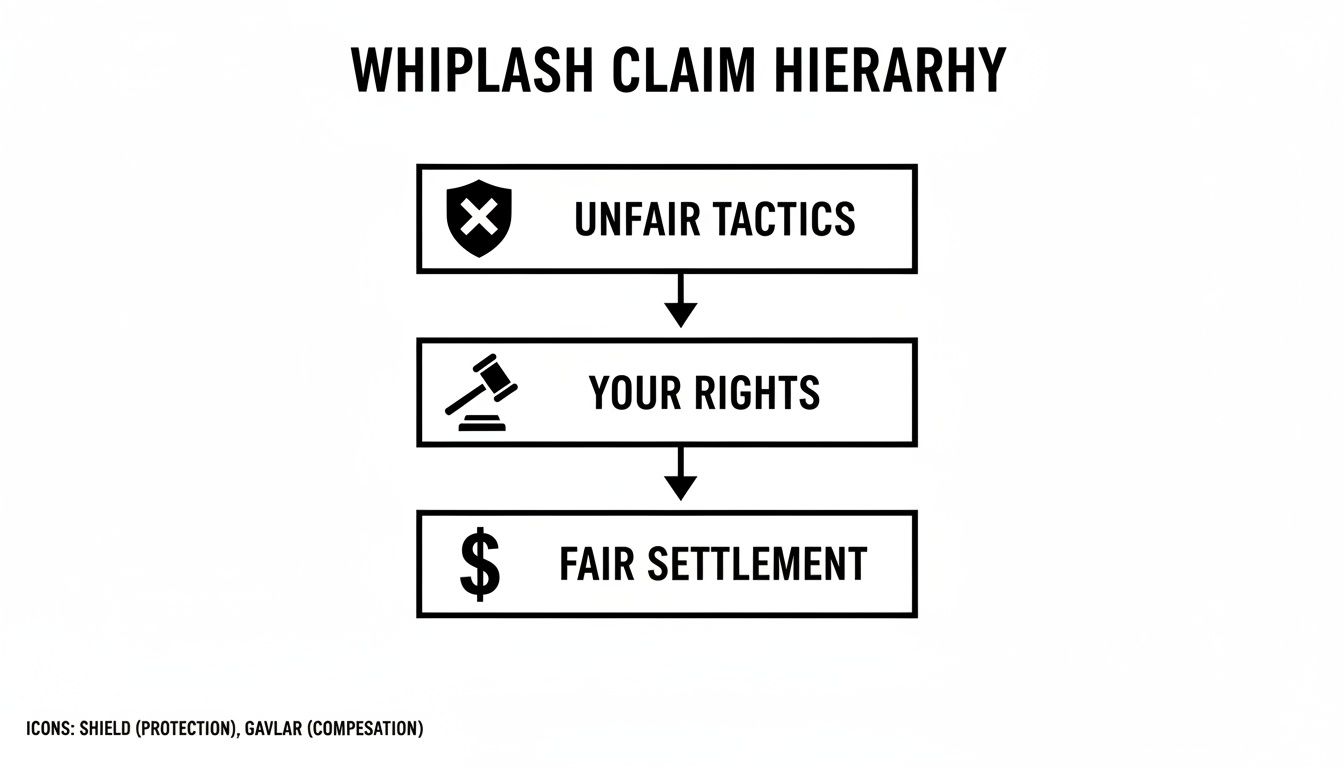
As you can see, a fair outcome isn't just about adding up bills; it's about pushing back against adjusters trained to minimize your auto insurance claim.
Real-World Example: Imagine a construction worker from Pasadena who is rear-ended on I-45. His whiplash prevents him from lifting heavy materials, forcing him out of work. Beyond his lost wages (economic damages), he also suffers from chronic headaches, anxiety about his family's finances, and the frustration of not being able to play catch with his kids. These intangible losses are exactly what non-economic damages are designed to cover.
Calculating these damages correctly is a critical part of any personal injury claim. You can learn more about how to calculate pain and suffering damages in our detailed guide. An experienced Texas injury attorney can help you identify and value every loss to ensure no part of your suffering is overlooked.
How Insurance Companies Calculate Your Settlement Offer
When an insurance company receives your whiplash claim, they don't just pick a number at random. Their adjusters use specific formulas and internal strategies to calculate a settlement figure. Their primary goal is always to protect their bottom line by paying you as little as possible.
To get the fair compensation for whiplash you deserve, you must first understand their playbook. Insurance adjusters are trained negotiators who handle thousands of claims. They know which questions to ask and which tactics to use to downplay your injuries and pressure you into a quick, lowball settlement.
The Multiplier Method Explained
One of the most common tools adjusters use is the "multiplier method." It’s a straightforward formula they use to assign a value to your non-economic damages, like pain and suffering.
Here’s a breakdown of how it works:
- They Tally Your Economic Damages: First, the adjuster adds up all your concrete, provable financial losses. This includes every medical bill, physical therapy receipt, prescription co-pay, and dollar of lost wages.
- They Apply a Multiplier: Next, they multiply that total by a number, typically between 1.5 and 5.
- The Result is Their Offer: That final number becomes their starting point for your pain and suffering. They add it to your economic damages to create their initial settlement offer.
Let's say your medical bills and lost wages total $10,000. The adjuster might use a multiplier of 2 to offer you $20,000 for your pain and suffering, making their total offer $30,000. The multiplier they choose is subjective and depends on factors like the severity and permanence of your injury. A lower multiplier is used for injuries that heal quickly, while a higher one may be considered for injuries with long-term complications.
Common Tactics Used to Devalue Your Claim
Knowing their formula is only half the battle. Insurance companies use various strategies to justify a low multiplier or dispute your economic damages entirely. Your best defense is to know what to expect.
They Will Question Everything: The adjuster’s job is to be skeptical. They may argue that your pain is from a pre-existing condition, challenge your doctor's recommended treatment, or suggest you're exaggerating your symptoms for a bigger payout.
Here are some of their most frequent tactics:
- The Quick, Lowball Offer: They may call you just days after the crash with a fast settlement offer. This tactic is designed to close your case before you understand the full extent of your whiplash injury or realize you might need future medical care.
- Requesting a Recorded Statement: Adjusters will almost always ask for a recorded statement, hoping you’ll say something they can use against you later, like downplaying your pain ("I'm doing okay") or unintentionally admitting partial fault. Our guide on how to deal with insurance adjusters can help you navigate these tricky conversations.
- Disputing Medical Treatment: They might claim your physical therapy was "excessive" or that an MRI your doctor ordered wasn't "necessary." Their goal is to reduce the value of your economic damages, which in turn shrinks the entire settlement calculation.
Putting Your Compensation in a Global Context
Picture this: a San Antonio commuter gets rear-ended by an uninsured driver, suffering a whiplash injury that disrupts their life for the next 12 to 15 months. Getting fair compensation isn't just a local issue; it's a global benchmark for what's right.
In England and Wales, for example, the "whiplash tariff"—a fixed payment scale for injuries—is set for a 14-15% increase to keep up with inflation. For a whiplash injury lasting 12 to 15 months, the payout is rising to £2,335. This matters for Texas families, where a single crash can sideline the main breadwinner.
While the U.S. doesn't have these exact schedules, these international standards help benchmark what's considered 'fair' and shine a light on how insurers often undervalue the pain and suffering of Texans by 50% or more.
Steps to Build a Strong Whiplash Claim

To win a whiplash claim, you must do more than just tell the insurance company you’re in pain—you have to prove it. A successful claim is built with solid evidence that creates a foundation the other side cannot ignore. Think of it as building a case piece by piece, where every document, photo, and receipt tells the story of what happened.
This practical, step-by-step approach transforms your claim from a simple request into a powerful, documented demand for what you are owed. As you begin, it’s also helpful to understand the basic steps to file a personal injury claim in Texas to ensure you are on the right track from day one.
Your Evidence Checklist: What You Need to Gather
Every piece of paper, photo, and note helps paint a clear picture of how this accident has impacted your life. Start collecting these items immediately to protect your right to fair compensation.
1. The Official Police Report
This is your starting point. The police report is an official account of the accident and often includes crucial details like the officer's opinion on who was at fault, road conditions, and witness contact information.
2. Photos and Videos
A picture can be worth thousands of dollars in a personal injury case. Use your phone to document everything.
- The Accident Scene: Take photos of the cars before they are moved, skid marks, traffic signs, and weather conditions.
- Vehicle Damage: Get close-up shots of the damage to all vehicles, especially the points of impact. This helps demonstrate the force of the collision.
- Your Injuries: While whiplash may not be visible, document any bruising or swelling immediately.
3. Complete Medical Records
Your health is the priority, and your medical records are the backbone of your claim. Keep a dedicated folder for every medical document.
This includes everything—the emergency room visit, follow-ups with your family doctor, physical therapy notes, and reports from specialists. These records officially connect your whiplash injury directly to the car accident.
Documenting Your Financial and Personal Losses
Beyond proving the accident and injury, you must show the full financial and personal toll it has taken. It’s not just about medical bills; it’s about how this injury has disrupted your work, your budget, and your daily life.
Key Documents to Collect
- Receipts for All Expenses: Keep a running list of every dollar you spend because of the injury. This includes prescriptions, over-the-counter medications, a neck brace, and even gas money for driving to appointments.
- Proof of Lost Income: Request a formal letter from your employer on company letterhead stating your normal pay rate, the exact dates you missed work, and the total income you lost.
- A Daily Pain and Suffering Journal: This is one of the most powerful tools you have. Each day, write a few lines about your experience. Rate your pain on a scale of 1-10. Note what you couldn't do, such as playing with your children or sitting comfortably through a movie. This journal humanizes your suffering and gives a voice to your non-economic damages.
Picture a pedestrian in Houston struck by a truck, their neck violently jolted. While it's tough to nail down specific whiplash statistics, we know the insurance landscape is getting harder for victims. In the first half of just one recent year, global insured catastrophe losses shot past $100 billion, with the U.S. shouldering over $92 billion of that amount. Severe storms alone drove $44 billion in losses. For someone hurt in Austin or Fort Worth, this means insurers are squeezing every penny, making your pile of evidence more critical than ever to push back against a lowball offer.
How a Lawyer Maximizes Your Whiplash Compensation

Trying to face an insurance company alone after a car crash is rarely a fair fight. You are focused on healing, while their adjusters are trained professionals whose job is to protect the company's profits—not your well-being. This is where an experienced Texas car accident lawyer can make all the difference. We level the playing field and fight for the full compensation for whiplash you truly deserve.
The moment you hire an attorney, the power dynamic shifts. We immediately take over all communications with the insurance company. This protects you from common traps, like giving a recorded statement that can be used against you or accepting a lowball offer before you know the true extent of your injuries.
Investigating and Proving Your Claim
A dedicated lawyer does much more than make phone calls. We launch a full, professional investigation into your accident to build a strong case that proves the other driver was at fault.
This involves:
- Gathering Crucial Evidence: We secure the police report, track down eyewitnesses, and search for any available traffic camera footage.
- Working with Experts: We often consult with medical experts who can clearly connect your whiplash to the crash and explain your long-term prognosis.
- Calculating Your True Damages: We meticulously calculate the full value of your claim. This goes beyond current medical bills to include future physical therapy, long-term pain and suffering, and all lost income.
When we present the insurer with a thoroughly documented and professionally calculated demand, it sends a clear message: we are serious and prepared. It completely changes the tone of the negotiation.
Aggressive Negotiation and Trial-Ready Advocacy
The single biggest advantage an attorney brings is leverage. Insurance companies know that most people lack the resources or legal knowledge to take a case to court, and their strategy often relies on this.
When they see a respected firm like The Law Office of Bryan Fagan, PLLC representing you, their calculations change. They know we will not back down and are fully prepared to file a lawsuit if their offer is unfair.
This readiness to go to trial is our strongest negotiating tool. To get the most from your claim, it's vital to understand how to negotiate an insurance settlement, and we handle those aggressive negotiations for you. We push back against delay tactics and fight for every dollar you're owed. If the at-fault driver’s negligence led to a fatality, we are also prepared to pursue wrongful death compensation for the family.
Best of all, we handle personal injury cases on a contingency-fee basis. This means you pay absolutely nothing unless we win your case. There are no upfront retainers or hourly fees, so you can get top-tier legal help without any financial risk. Your fight for justice is based on the strength of your case, not the size of your bank account.
Common Questions About Texas Whiplash Claims
Navigating the aftermath of a car wreck is overwhelming, and it's completely normal to have questions. To help you gain clarity and feel more confident about your next steps, here are answers to the questions we hear most often from people dealing with whiplash injuries in Texas.
How Long Do I Have to File a Whiplash Claim in Texas?
In Texas, the statute of limitations for personal injury claims is generally two years from the date of the accident. This is a strict deadline.
If you miss this two-year window, the court will almost certainly dismiss your case, and you will lose your right to seek compensation forever. It is critical to speak with a Houston car accident lawyer as soon as possible to protect your rights.
Should I Accept the Insurance Company's First Offer?
It is almost never a good idea to accept the first offer. Insurance companies are for-profit businesses, and their initial offers are typically lowball amounts designed to resolve your claim quickly and cheaply.
Whiplash symptoms can take days or even weeks to fully develop. If you accept an early offer, you sign away your right to seek more money later—even if your injuries turn out to be more serious than you first thought. Always consult an attorney before you sign anything.
What if the Accident Was Partially My Fault?
You can still recover money for your injuries. Texas law follows a “modified comparative fault” rule, which means you can pursue a claim as long as you are not found to be more than 50% responsible for the crash.
Your final settlement, however, will be reduced by your percentage of fault. For example, if you are found 10% at fault, your total compensation is reduced by 10%. A skilled lawyer will fight to protect you from being assigned unfair blame.
Do I Really Need a Lawyer for a Minor Whiplash Injury?
Even a "minor" whiplash injury can lead to chronic pain, recurring headaches, and unexpected medical bills. Insurance adjusters often downplay these soft-tissue injuries to minimize their payout.
Having an attorney ensures your injury is properly documented and that you recover full compensation for all your losses—not just the immediate ones. A free consultation can help you understand your options without any cost or obligation.
A whiplash injury can throw your life off track, but you don’t have to face the legal battle alone. The compassionate and experienced attorneys at The Law Office of Bryan Fagan, PLLC are here to fight for the justice and compensation you deserve. We will listen to your story, explain your rights in plain English, and guide you every step of the way.
Contact us today for a free, no-obligation consultation to discuss your case by visiting us at https://houstonaccidentlawyers.net. Let us help you move forward.