A collision with a commercial truck can change your life in seconds—but you don’t have to face recovery alone. The legal process that follows, known as a truck accident claim, is a formal demand for financial compensation. It's a world away from a simple car wreck case, often involving complex federal regulations, powerful corporate legal teams, and devastating injuries.
Filing a successful claim is about more than just money—it’s about holding every responsible party accountable for your medical bills, lost wages, and the immense pain and suffering you've endured. This guide will provide clear, step-by-step advice to help you understand your rights and take back control.
The Moments After A Truck Accident Can Feel Overwhelming
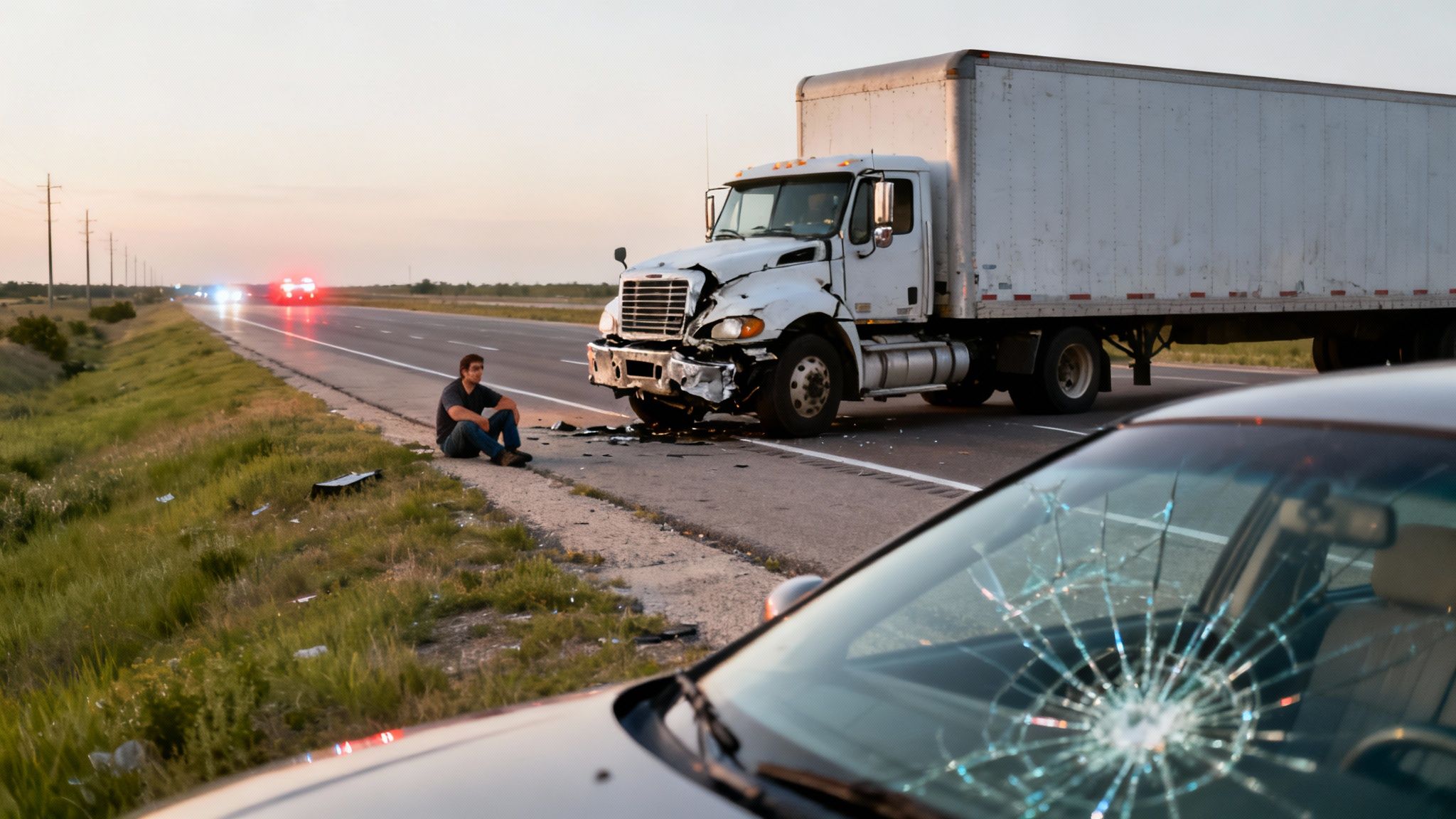
One minute you’re driving down I-45 in Houston, and the next, your world is a chaotic scene of shattered glass and twisted metal. Getting hit by a semi-truck is uniquely terrifying. We understand. The shock, the confusion, and the fear are real, but you don't have to navigate this fight by yourself.
Making your way through a truck accident claim is far more challenging than a standard car wreck. You’re not just up against a driver; you’re facing powerful trucking corporations, their aggressive insurance adjusters, and a dizzying maze of federal and state laws. This guide is here to give you straightforward, practical advice to help you protect your rights when everything feels lost.
Why Truck Wrecks Are Different
Imagine a fully loaded 18-wheeler suddenly swerving into your lane. It's a nightmare scenario that became a tragic reality for thousands of families in 2023, when 5,375 large trucks were involved in fatal crashes across the United States.
These aren't just abstract numbers. Here in Texas, we sadly lead the nation in fatal truck accidents. You can explore more of these sobering statistics from the National Safety Council.
The stakes in a truck accident are incredibly high for a few key reasons:
- Severe Injuries: The physics are brutal. The massive size and weight difference between a commercial truck and a passenger car means injuries are often catastrophic or fatal.
- Complex Liability: This isn't a simple fender-bender. Fault can lie with the driver, the trucking company (the motor carrier), the crew that loaded the cargo, or even the manufacturer of a faulty truck part.
- Aggressive Defense: Trucking companies have rapid-response teams on standby. Their job is to get to the crash scene immediately, gather evidence, and start building a case to minimize their company's financial responsibility.
Our goal is to level the playing field. We want to empower you with the knowledge you need to protect your rights and secure your future. Having an experienced and empathetic legal ally in your corner can completely change the outcome of your case.
This guide will walk you through everything, from the critical first steps at the crash scene to understanding what your claim is truly worth. We’ll break down confusing legal terms like liability (who is legally at fault for the accident) and damages (the financial compensation you can recover for your losses) into plain English.
Your job is to focus on healing. Let a dedicated legal team handle the fight for justice.
Critical First Steps After A Texas Truck Crash

In the disorienting moments after a collision with a large truck, chaos can easily take over. Your immediate actions, however, can profoundly influence both your physical recovery and the strength of your future truck accident claim. Knowing what to do can help you regain a sense of control and protect your legal rights.
Your first priority is always safety. If you are able, move your vehicle out of active traffic lanes to a safer location like the shoulder. If your car cannot be moved, turn on your hazard lights to warn other drivers. Then, call 911 immediately to report the crash and request medical assistance.
Seek Immediate Medical Attention
Even if you feel fine, it's crucial to be evaluated by a medical professional. The adrenaline from a crash can mask serious injuries like internal bleeding or concussions, which may not show symptoms for hours or even days.
Seeking prompt medical care does two critical things:
- It prioritizes your health. A doctor can identify and begin treating hidden injuries before they worsen.
- It creates an official record. Your medical records will directly link your injuries to the accident, which is vital evidence for your claim. Insurance companies often argue that delayed treatment means the injuries weren't caused by the crash.
Gather Essential Information At The Scene
While waiting for help to arrive, and only if you are safely able to do so, start documenting everything. A strong claim is built on strong evidence, and the crash scene is where the most valuable information is found. Use your phone to your advantage.
You will need to gather several specific pieces of information from the truck driver. Don't rely on memory—write it down or take pictures.
Key Information to Collect:
- Driver's Details: Get their full name, driver's license number, and contact information.
- Trucking Company: Note the name of the company displayed on the truck's cab and trailer. This is the motor carrier.
- Insurance Information: Take a clear photo of their commercial insurance policy card.
- Vehicle Numbers: Look for the USDOT number (U.S. Department of Transportation) and any state-specific numbers (like a TXDOT number) on the side of the truck. Also, get the truck's license plate number.
By documenting the USDOT number, you are identifying the federally registered entity responsible for the truck's operation. This is a crucial piece of information that helps your attorney investigate the company's safety history and compliance record.
Document The Scene Meticulously
Your smartphone is your most powerful tool for evidence collection in these initial moments. Take more photos and videos than you think you need, capturing the scene from multiple angles.
What to Photograph:
- Vehicle Damage: Take wide shots showing the positions of all vehicles and close-ups of the damage to both your car and the truck.
- The Entire Scene: Capture skid marks on the road, traffic signs, weather conditions, and any debris from the collision.
- Your Injuries: Document any visible cuts, bruises, or other injuries you sustained.
- Witness Information: If there are witnesses, ask for their names and phone numbers. Their testimony can be incredibly valuable.
Finally, be very careful what you say. Do not apologize or admit any fault to the truck driver, police, or anyone else. Stick strictly to the facts of what happened. Most importantly, do not speak with any representatives from the trucking company or their insurance provider until you have consulted with a Houston car accident lawyer. Their goal is to get you to say something that minimizes their liability.
Your focus should be on your safety and well-being. By taking these methodical steps, you are not only caring for yourself but also laying the groundwork for a successful truck accident claim.
Who Is Liable in a Texas Truck Accident?
After a devastating wreck with an 18-wheeler, it’s easy to point the finger at the person behind the wheel. While the truck driver’s mistake is often what triggers the crash, a truck accident claim is almost never that simple.
The reality is the driver is usually just one link in a much longer chain of responsibility. To get the full compensation you deserve, your legal team must uncover every single party whose negligence contributed to your injuries.
Under Texas law, liability is the legal term for responsibility. In the world of commercial trucking, that responsibility often extends far beyond the driver to powerful corporations that may have prioritized profits over people. An experienced attorney will follow the evidence, connect the dots, and hold every single one of them accountable.
It Starts With The Driver, But It Doesn't End There
The truck driver's actions are the most obvious place to start. Were they speeding to make a deadline? Were they texting? Did they violate federal hours-of-service rules and fall asleep at the wheel? These are all common, and tragic, causes of truck wrecks.
But the trucking company—the motor carrier—that hired the driver almost always shares the blame. This is because of a legal principle called vicarious liability, which holds an employer responsible for the actions of their employees while they are on the job.
For example, if a Houston trucking company pushes its drivers to meet impossible delivery schedules on I-10, forcing them to speed or skip mandatory rest breaks, the company itself is being negligent. It's not just the driver's fault.
Other ways a trucking company can be held liable include:
- Negligent Hiring: They hired a driver with a known history of DUIs, a string of traffic violations, or a known drug problem.
- Inadequate Training: They put a driver behind the wheel without teaching them proper safety protocols or how to handle the specific rig they were driving.
- Poor Maintenance: The company cut corners on inspections and repairs, leading to catastrophic mechanical failures like worn-out brakes or a tire blowout.
Uncovering The Other Players
The chain of liability doesn't stop with the driver and their employer. A thorough investigation often peels back layers of negligence, revealing other companies whose carelessness played a role in the crash.
For example, imagine a big rig's tire blows out on I-10 just outside San Antonio, causing the driver to lose control and slam into your car. The driver might be partly at fault for not doing a proper pre-trip inspection, but what if an investigation reveals the tire itself had a manufacturing defect? Now, the tire manufacturer is also liable for the crash.
This is exactly why you must look beyond the obvious. Here's a quick look at the different parties that can be held responsible in a Texas truck wreck.
Who Can Be Held Responsible In A Texas Truck Wreck
| Liable Party | Common Reasons for Liability |
|---|---|
| The Truck Driver | Speeding, distracted driving, fatigue, DUI, violating traffic laws, falsifying logbooks. |
| The Trucking Company | Negligent hiring/training, poor maintenance, pressuring drivers to violate safety rules, vicarious liability. |
| The Cargo Loader/Shipper | Improperly loading or securing cargo, causing it to shift and leading to a loss of control. |
| Maintenance & Repair Shops | Performing shoddy brake jobs, using incorrect parts, or failing to properly service the truck. |
| Parts Manufacturers | Designing or selling defective components like tires, brakes, steering columns, or coupling systems. |
As you can see, a single crash can have multiple causes, and therefore, multiple responsible parties.
A successful truck accident claim requires a deep dive into corporate structures, maintenance logs, and operational practices. It’s about connecting the dots to show how a series of failures—not just one person's mistake—led to your injuries. We leave no stone unturned.
The Risks Are Only Getting Worse On Texas Roads
Identifying all these parties is more critical than ever, as our roads are becoming more dangerous. Fleet accidents are on the rise again, reversing years of safety progress. Experts point to a perfect storm of factors: more miles being driven, a shortage of experienced drivers, and distraction behind the wheel becoming an epidemic. You can learn more about these trucking statistics and see just how serious this is.
This dangerous environment makes it far more likely that a crash will be caused by multiple points of failure—from an inexperienced driver to a poorly maintained truck and an overloaded trailer. Unraveling this web of liability takes a skilled Texas injury attorney who knows exactly what evidence to look for and which federal and state regulations were violated.
Gathering The Evidence Needed For A Strong Claim
Winning a truck accident claim isn’t about who tells the most convincing story. It's about who has the facts. These cases are won or lost based on the quality of the evidence, and a commercial truck wreck demands a much deeper investigation than your average car crash.
The moment a crash happens, you can be sure the trucking company and its insurance carrier are already moving. They have rapid-response teams whose only job is to get to the scene, control the evidence, and shape the narrative to protect their bottom line. To have any chance at a fair outcome, you must be just as aggressive in preserving the truth.
The Power Of A Spoliation Letter
One of the first and most critical actions your attorney will take is sending a spoliation letter to the trucking company. This isn't just a polite request—it's a formal legal demand ordering them to preserve every shred of evidence related to the crash.
Why is this so important? Because federal regulations only require trucking companies to keep certain records for a limited time. After that, they can legally destroy them. A spoliation letter stops that clock and puts them on notice: destroy anything, and you'll face serious penalties in court. Time is absolutely of the essence.
Key Evidence In A Trucking Claim
We start with the basics, like the police report and your medical records, but that's just scratching the surface. The real story of a truck wreck is often hidden in industry-specific documents and data that trucking companies would rather you never see.
While you can learn how to get an accident report in Houston, TX, that report is only the first piece of the puzzle. Our investigation goes much, much deeper.
Here are the crucial pieces of evidence we go after immediately:
- The Truck’s "Black Box" Data: This is the treasure trove. Known officially as an Electronic Logging Device (ELD) or Event Data Recorder (EDR), it captures everything—the truck's speed, when the brakes were applied (or not applied), steering angles, and other critical data from the moments right before impact.
- Hours-of-Service (HOS) Logs: Driver fatigue is a killer on our highways. These logs are supposed to prove the driver was complying with federal laws that limit driving time, but they often reveal a driver who was pushed well past the legal limit and was too tired to be behind the wheel.
- Maintenance and Inspection Records: Was the truck a ticking time bomb? These records expose a history of shoddy repairs, overdue service, or ignored safety warnings that could point to a catastrophic failure like bad brakes or a tire blowout.
- Driver’s Employment File: We look into the driver’s entire history—training, qualifications, previous driving violations, and drug test results. This helps us determine if the trucking company was negligent for putting an unsafe driver on the road in the first place.
A spoliation letter is your shield against disappearing evidence. It legally obligates the trucking company to preserve the very data that can prove their negligence—from the driver's logbooks showing fatigue to the black box data revealing excessive speed.
Connecting The Evidence To Build Your Case
Each piece of evidence is a dot, and our job is to connect them to paint a clear picture of what happened and who is responsible.
Let's say a tractor-trailer slams into the back of your car on I-10. The truck driver swears you braked for no reason. But the evidence doesn't lie.
This infographic shows how complex liability can be in these cases.
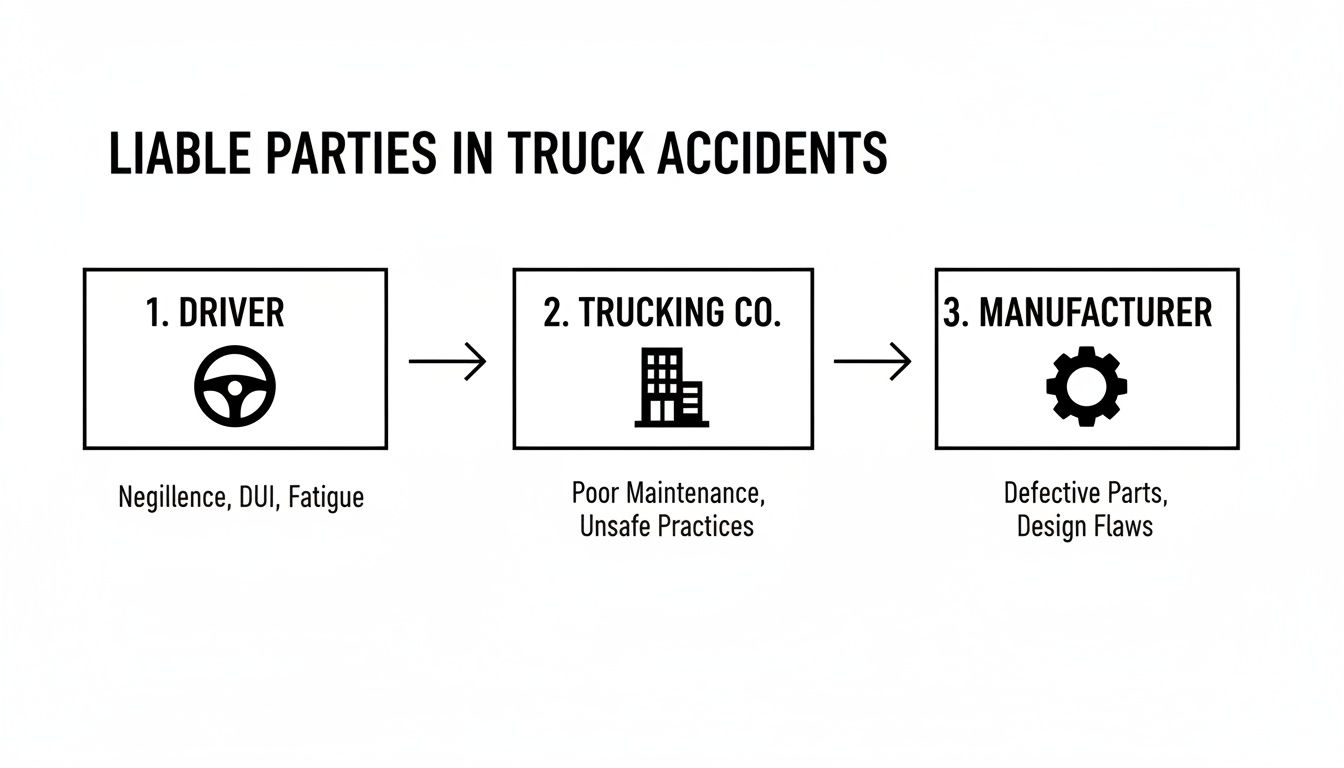
As you can see, the blame often goes far beyond just the driver. The truck's black box might show the driver never even touched the brakes, pointing to distraction. His HOS logs could reveal he was 13 hours into a shift, a clear violation of federal safety rules.
Then, we pull the maintenance records and find the truck’s brakes hadn't been properly serviced for more than a year. Just like that, we’ve built a powerful case showing negligence on the part of both the driver and the trucking company. This is how a strong truck accident claim is constructed: piece by painstaking piece.
What Compensation Can You Recover in a Truck Accident Claim?
After a devastating truck wreck, knowing your rights is the first step toward getting the compensation you and your family deserve. When you file a truck accident claim in Texas, you’re seeking damages—the legal term for the money awarded to cover your losses. The goal is to make you financially "whole" again after an accident caused by someone else's negligence.
Texas law sorts these damages into two main categories. It's critical to understand both so you can grasp the true value of your claim and not get pushed into a lowball settlement that leaves you paying for someone else's mistake down the road.
Economic Damages: The Tangible Financial Losses
First up are economic damages. These are the straightforward, calculable costs—the ones that come with receipts, invoices, and pay stubs. They represent the direct financial impact your family has taken because of this crash.
This includes money for:
- All Medical Bills: Everything from the ambulance ride and ER visit to surgeries, ongoing physical therapy, prescriptions, and any future medical care you’ll need.
- Lost Wages: Compensation for the income you lost while you were out of work recovering.
- Loss of Earning Capacity: If your injuries are permanent and stop you from returning to your old job or earning what you used to, you can be compensated for that future lost income. This is especially important in cases of wrongful death, where a family seeks wrongful death compensation for a lifetime of lost income.
- Property Damage: The cost to get your vehicle repaired or replaced, plus any personal belongings that were destroyed in the crash.
These numbers add up terrifyingly fast. A single serious injury can easily spiral into hundreds of thousands of dollars in medical debt and lost income over a lifetime.
Non-Economic Damages: The Human Cost
The second category, which is often the largest part of a settlement or verdict, is non-economic damages. These losses don’t have a price tag, but they are just as real and devastating. This is compensation for the profound human suffering the accident forced upon you.
Non-economic damages cover things like:
- Pain and Suffering: The physical agony from your injuries.
- Mental Anguish: The emotional trauma, anxiety, depression, and PTSD that almost always follow a violent collision.
- Physical Impairment: Compensation for losing the ability to do the daily activities you once took for granted, like playing with your kids, gardening, or even just going for a walk.
- Disfigurement: For permanent scarring or other changes to your appearance that serve as a constant reminder of the crash.
In Texas, there is no cap on non-economic damages in a truck accident case. A compassionate jury understands that the emotional and physical toll of a crash is often far greater than the sum of the medical bills. This is governed by the Texas Civil Practice and Remedies Code, Chapter 41.
Important Texas Laws That Affect Your Claim
Two key Texas laws will directly shape your ability to recover compensation. The first is the statute of limitations, which is your non-negotiable deadline for filing a lawsuit. In Texas, you generally have just two years from the date of the accident to file your personal injury claim. If you miss that window, you almost certainly lose your right to pursue compensation forever.
The second is Texas’s rule on shared fault, officially called proportionate responsibility (or comparative fault). This law, found in Chapter 33 of the Texas Civil Practice & Remedies Code, says you can still recover damages even if you were partially to blame, but only as long as your share of the fault is 50% or less.
Here’s a real-world example: A jury finds you were 10% at fault for a collision on a Houston freeway and decides your total damages are $100,000. Under this rule, your final award would be reduced by your percentage of fault, so you’d receive $90,000. But if that jury decided you were 51% responsible, you would get absolutely nothing. Insurance companies know this rule inside and out and will do everything they can to shift as much blame as possible onto you. Understanding the complexities of insurance policy limits in Texas is another crucial piece of your auto insurance claim.
Why You Need an Experienced Truck Accident Lawyer on Your Side
Trying to take on a commercial trucking company and its massive insurance carrier by yourself is more than just an uphill battle—it's an unfair fight from the start. The moment a crash happens, they deploy rapid-response teams of investigators and attorneys. Their one and only job is to protect the company's bottom line by finding ways to devalue or deny your truck accident claim.
Make no mistake, they are not on your side. Their goal is to pay you as little as they possibly can, and they have nearly unlimited resources to make that happen. An experienced truck accident attorney is the great equalizer, stepping in to level that dramatically uneven playing field and protect your rights from day one.
How We Fight for You
When you hire our firm, we move fast. We immediately launch our own independent, in-depth investigation, often bringing in accident reconstruction experts to analyze the scene and prove exactly what happened. One of our first moves is to send a legally critical spoliation letter. This demands that the trucking company preserve crucial evidence—like black box data, driver logs, and maintenance records—before it can be legally destroyed.
Our team then gets to work meticulously calculating the true, full value of your claim. We leave no stone unturned and account for every single loss you've suffered:
- Current and future medical bills, ensuring you’re never left paying out-of-pocket for the care you need because of someone else's negligence.
- Lost wages and diminished earning capacity if your injuries have permanently affected your ability to work and provide for your family.
- The immense pain and suffering and the deep emotional trauma that always follows such a devastating and violent event.
You only get one shot to secure the compensation you need to put your life back together. We take over the aggressive negotiations, fighting for a settlement that truly reflects the severity of your injuries so you can focus on what matters most: your recovery.
Given the complex web of state and federal regulations involved, having a lawyer who lives and breathes personal injury law is absolutely critical. We manage the entire legal process from start to finish, freeing you to concentrate on healing.
Best of all, you don't have to worry about how you'll afford expert legal help. We work on a contingency fee basis. That’s our promise to you: you pay us absolutely nothing unless we win your case. Your recovery is our only priority.
Common Questions About Texas Truck Accident Claims
When you’re trying to put your life back together after a serious truck wreck, it’s only natural to have a lot of questions. We understand. Below, we’ve answered some of the most common concerns we hear from clients who are trying to navigate a truck accident claim here in Texas. Our goal is to give you the clear, honest information you need.
What Is My Truck Accident Claim Worth?
This is, without a doubt, the first question on everyone's mind. But the truth is, anyone giving you a quick number is doing you a disservice. Those online "settlement calculators" are deeply misleading because they can't possibly grasp the unique, personal facts of your case.
The real value of your claim is built on a foundation of very specific factors:
- The severity of your injuries and the total cost of your medical care—not just the bills you have now, but what you’ll need down the road.
- The income you lost while you were out of work, and more importantly, whether this crash has permanently impacted your ability to earn a living.
- The very real physical pain and emotional trauma you've been forced to endure.
There's just no simple formula. A dedicated lawyer will painstakingly analyze every single loss to build a comprehensive and fair valuation of your claim.
Should I Give A Recorded Statement To The Insurer?
Our advice is a firm and simple "no." At least, not before you've spoken with an attorney.
Insurance adjusters are trained professionals, and their job is to protect their company's bottom line. They are skilled at asking leading questions designed to get you to say something—anything—that can be used against you later. They can twist your words to imply you were partly at fault or that your injuries aren't as bad as you say.
Your best move is to politely decline and tell them your lawyer will be in touch.
How Long Does A Truck Accident Claim Take?
Patience is key in these cases, because they rarely wrap up quickly. A more straightforward claim might settle in a few months, but don't be surprised if a complex case—one involving severe injuries or a dispute over who's at fault—takes more than a year to resolve.
It is absolutely crucial not to rush the process. A premature settlement might feel good in the short term, but it could leave you without the resources you need for long-term care. Your legal team will keep you in the loop every step of the way and manage all the critical deadlines, including the statutes of limitations in Texas.
What happens if the driver was an independent contractor? This is a common tactic trucking companies use to dodge responsibility. They'll claim they aren't liable for the driver's negligence. A thorough investigation is essential to cut through that argument and prove the company still had control over the driver's actions and should be held accountable.
The aftermath of a truck accident is overwhelming, but you don’t have to face it alone. The legal team at The Law Office of Bryan Fagan, PLLC is ready to answer your questions and fight for the justice you deserve. We are here to inform, reassure, and empower you. Contact us today for a free, no-obligation consultation to understand your rights and recovery options. https://houstonaccidentlawyers.net