A car crash can change your life in seconds — but you don’t have to face recovery alone. Receiving a denial letter for your auto insurance claim can feel like hitting a brick wall. After everything you've already been through, it’s a devastating final blow. But here’s the simple truth: insurance companies are for-profit businesses, and they often deny claims to protect their bottom line. They may use complex policy language and procedural hoops to avoid paying what you are rightfully owed.
This isn't just bad luck; it's a common tactic. We want you to know that a denial is not the final word.
Understanding the real reasons behind their decision is your first and most powerful step toward fighting for your rights. This guide is here to arm you with that knowledge and show you how to stand up for the compensation you need to recover.
Why You Cannot Take a Denial at Face Value
Insurance carriers operate on a for-profit model. It’s a simple equation: every dollar paid out on a claim is a dollar less in profit. This creates a powerful incentive for them to find reasons—any reason at all—to minimize or flat-out reject your claim.
This isn't just a hunch; the numbers tell the story. In 2023, HealthCare.gov insurers denied nearly 1 in 5 in-network claims for covered services. While these stats are for health insurance, they expose a systemic pattern of denials across the industry that impacts accident victims like you.
This means you should approach that denial letter with healthy skepticism and be ready to push back. Understanding the policy is key. While not for car insurance, resources like this complete guide to a homeowners insurance policy can break down foundational principles that apply to most insurance types.
At The Law Office of Bryan Fagan, PLLC, we stand with accident victims across Texas. We are ready to help you navigate this fight and secure the recovery you deserve.
Common Reasons Insurers Deny Car Accident Claims
After a serious car wreck, you count on the insurance company to step up and do the right thing. It’s a shock when a denial letter arrives instead of a check. Understanding why insurance companies deny claims is your first step toward fighting back. They have a standard playbook of reasons designed to protect their bottom line, not you.
These aren't random decisions—they are calculated moves. Let's pull back the curtain on the most common excuses insurers give and what they really mean for your case.

Policy and Coverage Issues
One of the easiest ways for an insurer to shut down your claim is to argue it isn't covered by the policy. This can happen for a few reasons, and you can be sure the adjuster has scoured every line of that contract looking for an out.
Common policy-related denials often include:
- A Lapsed Policy: If the other driver missed a premium payment, the insurance company will argue the policy wasn't active when the crash happened.
- Excluded Driver: The person behind the wheel might not have been listed on the policy, giving the insurer a reason to walk away.
- Policy Exclusions: Buried in the fine print are often specific exclusions. For example, most personal auto policies won't cover an accident if the driver was using their vehicle for business, like delivering food or driving for a rideshare service.
These denials all come down to the contract's specific wording. But even if you get a denial based on a policy technicality, don't assume it's the final word. To get a better handle on this, check out our guide on understanding insurance policy limits after a car accident in Texas.
Disputes Over Liability and Fault
Here in Texas, proving who caused the accident is everything. Insurance companies know this and will do everything they can to shift the blame onto your shoulders. Why? Because of a powerful Texas law called comparative fault.
Under the Texas Civil Practice & Remedies Code § 33.001, you are barred from recovering any money if you are found to be 51% or more at fault for the crash. If your fault is 50% or less, your compensation is reduced by that percentage.
So, if you have $100,000 in damages but are found 20% responsible, you can only collect $80,000. The insurer might deny your claim completely by inventing a story where you, not their driver, were the main cause. They'll twist your words from a recorded statement or misinterpret the police report to build their case against you.
Issues with Injuries and Medical Treatment
Another favorite tactic is to question your injuries. The adjuster isn't a doctor, but that won't stop them from digging through your medical records to find an excuse to avoid paying for your treatment.
They often make arguments like these:
- "Gap in Treatment": If you didn't go to the ER right after the crash, they'll argue your injuries couldn't have been that serious. Or worse, they’ll claim something else must have hurt you in the days that followed.
- Pre-Existing Conditions: They will seize on any mention of a past injury in your medical history and claim your current pain is from that old issue, not the car wreck.
- Insufficient Medical Evidence: The insurer might say your doctor's notes aren't detailed enough to justify your claim. They might even pay their own doctor to perform a so-called "independent" medical exam, which almost always produces a report that contradicts your treating physician.
These are just a few of the roadblocks insurers throw up. A denial is meant to make you give up, but you should see it as the start of the fight, not the end of it.
Common Denial Reasons and What They Really Mean
Insurance companies use specific language in their denial letters that can be confusing. Here’s a quick breakdown of what they say versus what they often mean.
| Denial Reason Given by Insurer | What It Often Means for Your Case | How a Houston Car Accident Lawyer Can Respond |
|---|---|---|
| "Your policy does not cover this loss." | They've found a loophole or exclusion in the fine print they believe lets them off the hook. | Scrutinize the policy language for ambiguities and challenge wrongful interpretations of the contract. |
| "You were at fault for the accident." | They are trying to shift blame to reduce or eliminate their payout under Texas's comparative fault rules. | Gather evidence like witness statements, photos, and accident reconstruction reports to prove their driver was liable. |
| "Your injuries are from a pre-existing condition." | They've combed your medical history and are using a past injury as an excuse to deny your current medical bills. | Use expert medical testimony to show how the accident aggravated an old condition or caused a new injury. |
| "You failed to report the claim in a timely manner." | This is a procedural denial. They're saying you waited too long, hoping you'll just accept it and go away. | Argue that the reporting was within a "reasonable" timeframe and did not prejudice the insurer's investigation. |
| "There is insufficient evidence to support your claim." | They are challenging the proof of your damages (medical bills, lost wages) or the link between the crash and your injuries. | Compile and present a comprehensive demand package with detailed medical records, bills, and proof of all losses. |
This table shows just how strategic these denials can be. They are rarely about the facts and almost always about the insurance company's financial interests. Having someone on your side who speaks their language and knows how to push back is essential.
Understanding Texas Personal Injury Law
To successfully fight a denied claim, you have to know the rules of the game. Insurance companies have teams of lawyers who know Texas law like the back of their hand, and they use it to their advantage. Let's break down the key legal ideas that control your car accident claim in plain English so you can see exactly how an insurer might try to twist the law against you.
Knowing your rights is the first and most important step toward protecting them.
Who Is Liable in a Texas Car Accident?
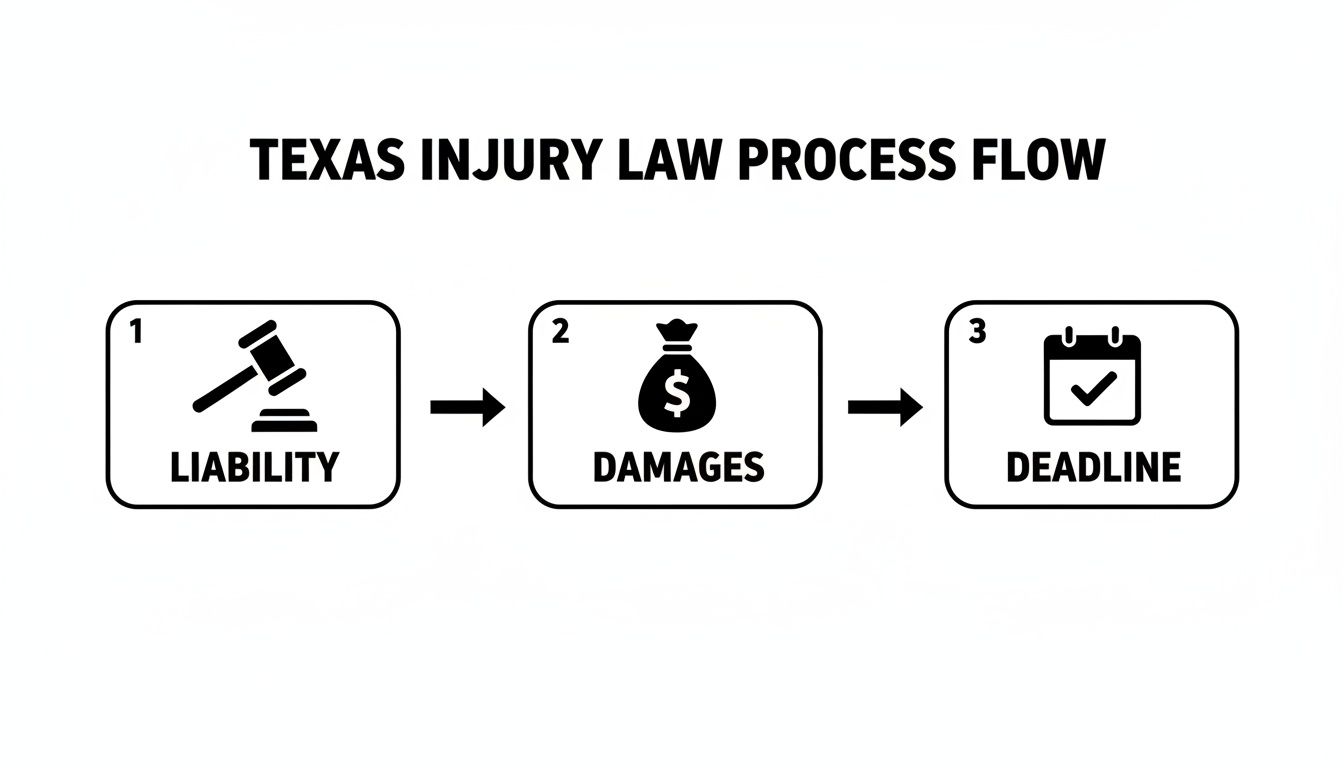
The entire personal injury system is built on one core idea: liability. In plain English, liability simply means legal responsibility. To get your claim paid, you have to prove that the other driver was negligent and that their negligence is what caused the accident and your injuries.
For example, a Houston driver texting on their phone is rear-ended on I-45 by another distracted driver. That’s a clear case of negligence. The at-fault driver had a duty to drive safely, they failed that duty by being distracted, and that failure directly caused harm. Proving this chain of events is the foundation of your entire insurance claim.
How Blame Is Divided Under Comparative Fault
Pay close attention here, because this is one of the most important rules in Texas personal injury law and a favorite tool of insurance adjusters. Texas uses a system called comparative fault, which is also known as proportionate responsibility.
Under the Texas Civil Practice & Remedies Code, Chapter 33, a judge or jury assigns a percentage of fault to everyone involved in the crash. Here’s how that works for you:
- If you are found to be 50% or less at fault, you can still recover money for your injuries. However, your total compensation will be reduced by your percentage of fault.
- But if you are found to be 51% or more at fault, you are completely barred from recovering anything.
This rule is precisely why insurance companies fight so hard to shift even a tiny bit of blame onto you. If they can convince a jury (or you) that you were mostly responsible, they get to walk away without paying a dime.
What Compensation Can You Claim? Understanding Damages
In a personal injury case, the money you can recover is called damages. This isn’t just about covering your medical bills; it’s meant to compensate you for all the ways the accident has upended your life.
In Texas, damages are usually split into two main categories:
- Economic Damages: These are the straightforward financial losses with a clear dollar amount. This includes medical bills, lost wages from being out of work, the cost of future medical care, and the repair or replacement cost for your vehicle.
- Non-Economic Damages: These compensate you for the real but intangible losses that don’t come with a receipt. This includes physical pain, emotional distress, mental anguish, and the loss of your ability to enjoy life's activities.
Insurance companies love to downplay non-economic damages, but they are a very real and often significant part of your rightful recovery. A skilled Texas injury attorney can help you fight for both economic and non-economic damages, and in some cases, pursue punitive damages under Texas Civil Practice & Remedies Code, Chapter 41 if the other driver’s conduct was grossly negligent.
The Clock Is Ticking: The Statute of Limitations
Finally, you must know about the statute of limitations. This is a hard-and-fast legal deadline for filing a lawsuit. In Texas, you generally have just two years from the date of the car accident to file a personal injury lawsuit.
If you miss that two-year window, you lose your right to seek compensation in court forever. It doesn't matter how strong your case is or how badly you were hurt.
Insurance adjusters are aware of this deadline. It’s not uncommon for them to intentionally drag out negotiations, giving you false hope while the clock runs out. This is a critical reason why you should speak with a Texas injury attorney as soon as possible after a crash.
Steps to Take After an Insurance Claim Is Denied
Getting that denial letter feels like a punch to the gut. It's often written to sound final and intimidating, making you feel like you have no other choice but to give up. But what you do next is absolutely critical.
Your next moves can either build a rock-solid case for an appeal or, unfortunately, hand the insurance company more reasons to stand by their denial. It’s time to be calm, strategic, and deliberate.
1. Stay Calm and Do Not Give a Recorded Statement
First things first: take a breath. It’s normal to feel angry or panicked, but reacting emotionally is exactly what the adjuster might be hoping for. They may call you right after sending the denial, trying to catch you off guard and coax you into a recorded statement.
Do not agree to this. Adjusters are trained to ask tricky, leading questions designed to get you to say something that undermines your own claim. Just politely decline and inform them that all future communication should be in writing.
2. Demand a Written Explanation
You have a right to know exactly why your claim was denied. A vague explanation over the phone isn't good enough. Send a formal request in writing (email or certified mail is best) demanding a detailed breakdown of the denial.
This letter forces them to go on the record and point to the specific policy language they're using to justify their decision. This document is a powerful piece of evidence. For a more detailed look at your immediate actions, this is a great guide on what to do when an insurance claim is denied.
3. Gather All Your Evidence
Now it’s time to get organized. Think of yourself as building the case file for your own claim. Find a folder or create a digital one and start collecting every piece of paper and digital file related to your accident.
This evidence file is your foundation. It should include:
- The official police report from the crash.
- Photos and videos of the vehicles and the accident scene.
- All medical bills, treatment records, and notes from your doctors.
- Receipts for any out-of-pocket expenses, like prescriptions or a rental car.
- A copy of the denial letter and all correspondence from the insurer.
- Contact information for any witnesses.
Every document helps paint a clearer picture of what really happened and supports your right to fair compensation.
4. Consult a Houston Car Accident Attorney Before You Appeal
This is a critical moment. Before you send an appeal letter to the insurance company, get a legal opinion. Trying to appeal on your own is risky. It’s easy to accidentally admit partial fault, misinterpret the policy, or fail to challenge the legal basis for their denial.
A skilled Texas injury attorney can dissect the denial letter, review your evidence, and help you write a powerful, strategic appeal that dismantles the insurer’s arguments. They’ve seen these tactics before and know how to frame your response for the best chance at getting the denial overturned.
By taking these measured steps, you shift from being a victim of a denial to a prepared advocate fighting for your rights. You can learn more by checking out our guide on what to do when insurance denies your claim. Remember, a denial isn’t the end of the road—it’s just the start of the real fight.
Recognizing When a Denial Is Insurance Bad Faith
Sometimes, a denied claim isn't just a disagreement over the facts—it’s a sign of something much worse. While insurance companies have the right to investigate and deny claims for legitimate reasons, they are legally bound to treat you fairly and honestly.
When they cross the line into unreasonable or deceptive behavior just to avoid paying what they owe, it’s known as acting in bad faith. This isn’t just bad customer service; it's an illegal act that violates the Texas Insurance Code and gives you powerful legal tools to fight back.
What Does Bad Faith Look Like in Practice?
Bad faith isn't always a dramatic act. More often, it’s a frustrating pattern of behavior designed to wear you down and make you give up on your rightful claim.
Imagine a Houston driver gets rear-ended on I-45. The facts are clear, but the other driver’s insurance company won't return their calls for weeks. When an adjuster finally gets in touch, they offer a ridiculously low amount and threaten to close the file if it isn't accepted on the spot. That’s not a negotiation—it’s an intimidation tactic and a classic sign of bad faith.
Common Warning Signs of Bad Faith Conduct
It’s crucial to recognize the red flags that suggest an insurer is acting dishonestly. A combination of these behaviors should be a serious warning to seek legal advice right away.
Key warning signs include:
- Failing to Investigate: The insurer doesn’t bother to gather evidence, talk to witnesses, or review the police report before denying your claim.
- Unreasonable Delays: They drag the process out for months without any valid reason, sometimes hoping you'll miss the statute of limitations.
- Misrepresenting the Policy: The adjuster twists the words of your policy or lies about what’s covered to justify their denial.
- Making Threats: The insurance company uses intimidation to pressure you into dropping your claim or accepting a lowball offer.
- Altering Records: In extreme cases, a company might change documents or evidence to avoid paying what they owe.
Under Texas law, proving an insurer acted in bad faith can allow you to sue for additional damages beyond your original claim. This can include compensation for the stress and financial harm their actions caused, as well as potential punitive damages meant to punish the company.
You can learn more about insurance bad faith and your rights to better understand this complex topic. If you suspect an insurer is dealing with you dishonestly after a Texas car wreck, document everything. This paper trail is vital for building a case to prove they acted in bad faith.
How Our Firm Can Take on the Insurance Company for You
After a claim denial, it’s easy to feel overwhelmed. How can one person stand up to a massive insurance corporation? The good news is, you don’t have to. This is precisely where The Law Office of Bryan Fagan steps in to take that weight off your shoulders and fight for the justice you deserve.
Taking on an insurance giant feels like a David-versus-Goliath battle. They have teams of lawyers, deep pockets, and a playbook designed to wear you down. Our job is to level that playing field. We bring our own deep knowledge of Texas insurance law, our resources, and an unwavering commitment to protecting your rights.
We Launch a Full and Independent Investigation
The insurance company’s investigation is not designed to help you; it's designed to find any reason to deny your claim. That’s why the first thing we do is launch our own thorough, independent investigation. We don't just accept the adjuster’s version of events.
Our team works immediately to establish clear proof of liability—who was legally responsible—and the full extent of your damages. This often means:
- Visiting the accident scene to find evidence the police may have overlooked.
- Interviewing eyewitnesses to lock in testimony that supports your side of the story.
- Partnering with accident reconstruction experts who can use science to prove exactly how the crash happened and who was at fault.
This proactive approach allows us to build a case based on solid facts, not the insurance company’s self-serving narrative.
We Handle All Communication and Shield You from Adjusters
The moment you hire us, the harassing phone calls from adjusters stop. Period. We take over all communications, acting as a protective barrier between you and the insurance company. You no longer have to worry about saying the wrong thing in a recorded statement or getting pressured into a lowball settlement offer.
Your only job is to focus on your physical and emotional recovery. Our job is to handle the legal fight, keeping you informed every step of the way without adding to your stress.
This frees you from the constant anxiety of dealing with an adversarial company, letting you put your energy where it matters most: getting your life back on track. A skilled Houston car accident lawyer manages these critical details so you can heal.
We Build a Trial-Ready Case to Maximize Your Leverage
Insurance companies manage risk. They know which law firms are looking for a quick, cheap settlement and which ones are prepared to go to court. At The Law Office of Bryan Fagan, we prepare every case as if it’s going to trial.
This trial-ready approach is our greatest point of leverage. We bring in medical experts to document the true, long-term cost of your injuries. We work with financial experts to calculate your total lost wages and diminished earning capacity. By building an airtight case, we send a clear message to the insurer: we are not afraid to go before a judge and jury.
This is often the very thing that convinces them to come to the table with a fair settlement for your auto insurance claim. They realize that fighting us in court is a risk they don't want to take.
A denial letter is just the beginning of the fight, not the end of your story. Contact The Law Office of Bryan Fagan today for a free, no-obligation consultation to learn how we can help you fight back.
Common Questions We Hear About Denied Texas Insurance Claims
Navigating the aftermath of a car accident is confusing enough. When the insurance company denies your claim, it just piles on more stress and uncertainty. Here are some clear, straightforward answers to the questions we hear most often from accident victims across Texas.
How Long Do I Have to File a Lawsuit After the Insurance Company Denies My Claim?
This is a critical deadline. In Texas, you generally have two years from the date of the accident to file a personal injury lawsuit. This is known as the statute of limitations.
Even while you're fighting with the insurance company through their appeals process, that two-year clock is still ticking. If you miss that deadline, you lose your right to take them to court forever, no matter how strong your case is. That's why it's so important to talk to a Texas injury attorney early on—it keeps your legal options open.
The Insurer Says I Was at Fault. Can I Still Get Compensation?
Yes, absolutely. It is still possible to recover money even if the insurance adjuster is trying to pin the blame on you. Texas uses a legal rule called comparative fault. This means you can still recover damages as long as a jury doesn't find you 51% or more responsible for what happened.
Shifting blame is a classic move by insurance companies. If they can make it look like you were partially at fault, they can reduce how much they have to pay you—or deny the claim completely. A skilled Houston car accident lawyer knows how to push back with evidence that proves the other driver’s liability.
What Happens if the Other Driver's Insurance Denies My Claim?
If the at-fault driver's insurance company denies your claim, you may have other ways to get compensation through your own auto policy.
- Collision Coverage: This part of your policy can pay to get your vehicle fixed, no matter who was to blame for the crash.
- Uninsured/Underinsured Motorist (UM/UIM) Coverage: This is one of the most important coverages you can have. It steps in to pay for your medical bills, lost wages, and other damages when the other driver has no insurance or not enough to cover all your losses, including potential wrongful death compensation if a loved one was lost in the crash.
But be warned: even your own insurance company can act as an adversary. Having a legal advocate in your corner is the best way to make sure you’re treated fairly.
A denied claim feels like a dead end, but it doesn't have to be. At The Law Office of Bryan Fagan, PLLC, we’re here to help you understand your rights and fight back against unfair insurance tactics. If your claim was denied, contact us today for a free, no-obligation consultation to find out how we can help you get the recovery you deserve.