Skip to content
A car crash can change your life in seconds — but you don’t have to face recovery alone. While you’re focused on healing, it's natural to wonder about the financial side of things—specifically, what an average settlement for a car accident looks like in Texas. The honest answer? There isn’t one. The truth is that every single case is unique, and its value is tied directly to your personal losses.
Why a Single "Average" Settlement Figure Is Misleading
After a serious wreck, one of the first questions on your mind is likely, "What is my case actually worth?" It’s a practical and urgent concern. You have medical bills piling up, you’re missing time from work, and you’re trying to figure out how to get back on your feet. It’s tempting to search online for an "average car accident settlement" and find articles tossing out numbers.
But here’s the problem: relying on a single, generic average can set you up for disappointment. A multi-car pileup on a major Houston freeway like I-45 will never have the same value as a minor fender-bender in a quiet residential neighborhood. Your settlement isn’t based on some national statistic; it's a direct reflection of your injuries, your expenses, and the specific details of your crash.
Think of your settlement less like an off-the-rack t-shirt and more like a custom-tailored suit—it has to be built to fit the exact dimensions of your damages.
Factors That Determine Your Unique Settlement Value
Focusing on a single "average" figure ignores the critical details that give a case its true value. Here are the key factors that actually matter.
| Influencing Factor | Why It Matters for Your Settlement | Example |
|---|---|---|
| Injury Severity | This is the biggest driver of value. A lifelong injury requires far more compensation than a temporary one. | A traumatic brain injury case could be worth millions, while a case involving minor whiplash might settle for a few thousand. |
| Medical Treatment | Your settlement must cover all related medical costs—past, present, and future. | Costs can range from a single emergency room visit to multiple surgeries, ongoing physical therapy, and prescription medications. |
| Lost Income | It’s not just about the work you've missed, but also the work you might miss in the future. | If an injury forces you into a lower-paying job or early retirement, your claim must account for that long-term loss of earning capacity. |
| Property Damage | The cost to repair or replace your vehicle is a straightforward but important part of the calculation. | A totaled brand-new truck will add significantly more to a settlement than minor bumper damage on an older car. |
As you can see, blending all these different scenarios into one "average" just doesn't give you a useful number.
While some industry reports suggest average payouts can range from $30,000 to over $52,900, these figures are just statistical noise. They lump catastrophic injury claims together with minor bump-and-bruise cases, making the final "average" totally irrelevant to your specific situation. You can find more insights about these personal injury statistics and what they really mean.
The key takeaway is this: your energy is better spent documenting your specific damages, not chasing a generic number. Understanding what goes into building a strong claim is the first real step toward securing the fair compensation you and your family deserve.
The Building Blocks of Your Texas Settlement Value
A car accident settlement isn't some random number pulled from a hat. Think of it like building a house—every single loss you’ve suffered is a foundational brick. To get a real sense of your claim's potential value, we have to identify and account for every one of those bricks. The final number is a direct reflection of what you lost, not what some "average" person went through.
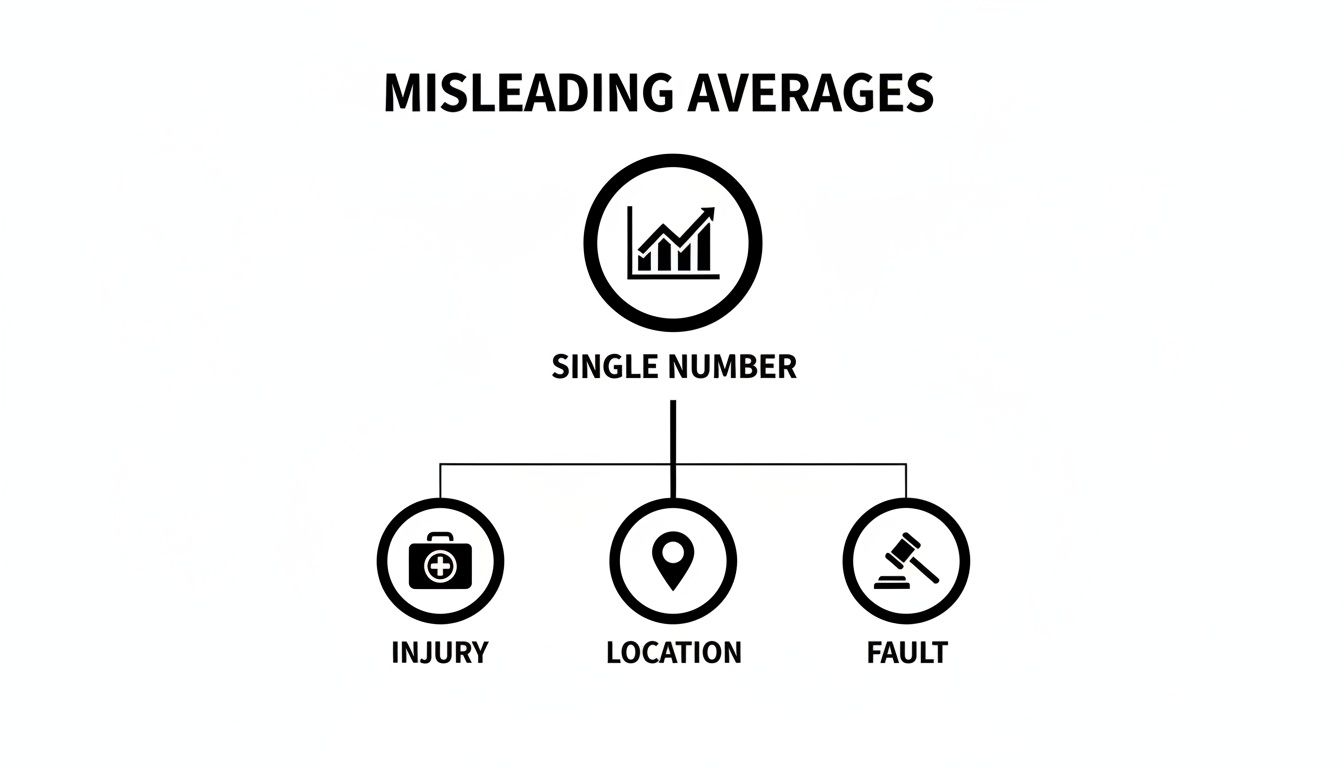
As the diagram shows, factors like how badly you were hurt, where the wreck happened, and who was at fault are what really matter. The losses you suffer are known in legal terms as "damages."
Quantifying Your Economic Damages
The most straightforward part of any claim is adding up the real, out-of-pocket costs you've paid because of the accident. We call these economic damages, and they form the solid base of your settlement calculation. Keeping detailed records here is absolutely critical.
Your economic damages include:
- Medical Bills (Past and Future): This covers everything—from the ambulance ride and ER visit to surgery, hospital stays, physical therapy, prescriptions, and any treatment you'll need down the road.
- Lost Wages: If you couldn't work because of your injuries, you are entitled to compensation for every dollar of income you missed. This isn’t just salary; it includes lost overtime, bonuses, or commissions.
- Loss of Earning Capacity: If a severe injury permanently impacts your ability to do your job or forces you into a lower-paying field, you can claim damages for this long-term financial hit.
- Property Damage: This is the cost to fix your vehicle or, if it was totaled, its fair market value right before the crash.
Let's look at a real-world example. A Houston driver rear-ended on I-45 suffers a back injury. Their immediate economic damages might look like a $15,000 emergency room bill, $8,000 in lost wages from being out of work for a month, and $12,000 to replace their car. Just like that, their baseline compensation is $35,000—and that's before we even start talking about future medical needs or the human cost of the crash.
Valuing Your Non-Economic Damages
While it's easy to add up bills and receipts, the most devastating losses from a car accident are often the ones you can't see. Texas law recognizes this and allows you to seek compensation for the human impact of the crash. These are known as non-economic damages.
While they don't come with a price tag, these losses are very real and form a critical part of your claim. An experienced Houston car accident lawyer knows how to build a compelling case to demonstrate their value to an insurance company or jury.
Common non-economic damages include:
- Pain and Suffering: This is compensation for the physical pain, discomfort, and general misery your injuries have caused.
- Mental Anguish: This addresses the emotional and psychological trauma—the anxiety, depression, fear, or even PTSD that follows a serious crash.
- Physical Impairment: If the wreck left you unable to walk, lift, or perform daily activities like you used to, you can be compensated for that loss of function.
- Disfigurement: This is compensation for scarring or other permanent changes to your appearance.
Figuring out what these damages are worth is complex. It’s more of an art than a science, but there are established methods for it. You can learn more by checking out our guide on how to calculate pain and suffering damages in a Texas claim.
The severity of your injuries is the single biggest factor here. Minor soft-tissue cases, like whiplash, often settle in the $3,000–$25,000 range. Moderate injuries, such as a broken bone, can push settlements from $50,000 into the hundreds of thousands. Tragically, cases involving catastrophic injuries or wrongful death compensation can, and should, exceed $1 million.
Each of these building blocks—from your first medical bill to your ongoing pain—has to be carefully documented and argued. It's the only way to ensure you receive the full and fair compensation you truly deserve.
Who Is Liable in a Texas Car Accident?
Knowing what your damages are is just the starting point. To get a fair settlement in Texas, you also have to understand the legal rules that decide who pays and how much you can actually receive.
You’ll hear lawyers and adjusters use legal terms like "liability" and "negligence." In plain English:
- Negligence is a careless or reckless action (or failure to act) that causes harm. A driver texting, speeding, or running a red light is being negligent.
- Liability is the legal and financial responsibility for the harm caused by negligence.
To win your case, you must prove the other driver was negligent and, therefore, liable for your damages. But what happens when the insurance company turns the tables and says you were partly to blame? This is a common tactic, and it’s where a specific Texas law can make or break your case.
Understanding Texas's Comparative Fault Rule
Texas uses a system called modified comparative fault, also known as proportionate responsibility. The official rule is found in Chapter 33 of the Texas Civil Practice & Remedies Code.
Here’s a look at the actual statute that controls how fault is divided up in Texas injury claims:
This dry legal text has a massive impact on your case. It essentially says that your right to recover money is reduced by your percentage of fault. For insurance companies, this is the most powerful tool they have to slash your settlement or deny it completely.
The 51% Bar Rule: In Texas, you can only recover damages if your share of the blame is 50% or less. If a jury decides you were 51% or more responsible for the accident, you are legally barred from getting a single dollar.
This rule is precisely why fighting back against unfair blame is so critical. Every percentage point they pin on you chips away at your compensation.
How Shared Fault Reduces Your Settlement
Imagine your total settlement is a whole pie. For every percentage of fault assigned to you, the law requires a matching slice of that pie to be taken away.
Let's use a straightforward example. Say you were in a wreck on I-45 in Houston, and your total damages—medical bills, lost income, pain and suffering—come out to $100,000.
- Scenario 1: The other driver is 100% at fault. You are entitled to the full $100,000.
- Scenario 2: You are found 10% at fault. The adjuster claims you changed lanes without signaling right before you were hit. Your $100,000 award is reduced by your 10% share of fault ($10,000), so you would receive $90,000.
- Scenario 3: You are found 51% at fault. This is the worst-case scenario. Because your fault crosses that 51% threshold, you get $0. Your entire claim is gone.
This all-or-nothing cutoff shows why you need a skilled Texas injury attorney fighting for you. We know how to gather the evidence—from traffic camera footage and witness statements to accident reconstruction reports—that protects you from these blame-shifting tactics and preserves the full value of your claim. Legal standards like these are constantly being debated and can change, as seen with the recent Florida Tort Reform, which shows just how fragile these rules can be.
The stakes are incredibly high. To dive deeper, you can read our detailed article on how comparative negligence in Texas works. This knowledge will empower you to see what’s really happening in your case and why we fight so hard over every single percentage point of fault.
How Insurance Companies Calculate a Settlement Offer
When you file an auto insurance claim, it’s critical to remember one thing: the insurance adjuster is not your friend. They work for a for-profit company, and their primary job is to protect their employer’s bottom line. That means paying you as little as legally possible.
Their first offer isn't a fair assessment of your losses; it's a business tactic. To protect your rights, you need to understand how they come up with that initial lowball number. They aren’t just guessing—they’re using specific formulas designed to minimize your claim’s value from the very start.

Economic vs. Non-Economic Damages
First, the adjuster will split your losses into two buckets. This is the foundation of their entire valuation process. Understanding these categories is the first step toward understanding your claim's true worth.
| Economic vs. Non-Economic Damages Explained |
| :— | :— | :— |
| Type of Damage | What It Covers | Common Examples |
| Economic | All the tangible, out-of-pocket financial losses with a clear paper trail. | Medical bills, lost wages from missed work, property damage (vehicle repairs), future medical care. |
| Non-Economic | The intangible, human cost of the crash and how it has impacted your quality of life. | Pain and suffering, mental anguish, permanent disfigurement or scarring, physical impairment. |
Economic damages are the straightforward, black-and-white numbers. Think of medical bills, repair estimates, and lost pay stubs—anything with a receipt. Because these are easy to prove, there's less room for argument.
Non-economic damages, on the other hand, are where the real fight happens. This covers the human toll of the accident—your physical pain, emotional trauma, and the disruption to your daily life. Since these losses don’t have a price tag, this is where adjusters have the most power to dramatically undervalue your claim.
The Multiplier Method: How Adjusters Put a Price on Suffering
To assign a dollar value to your non-economic damages, many insurance companies use a formula called the multiplier method. The concept is simple: they take the total of your medical bills and multiply it by a number, usually between 1.5 and 5.
The specific multiplier they choose is supposed to reflect how severe your injuries are, how long your recovery will take, and the overall impact on your life.
A low multiplier, like 1.5 or 2, is used for minor injuries with a quick recovery. A high multiplier of 4 or 5 is supposed to be reserved for severe, permanent, or life-altering injuries.
The adjuster’s entire goal is to justify using the lowest multiplier possible. They will downplay your pain, question your doctor's treatment plan, and argue that your injuries aren't as bad as you say—all to keep that number, and your final settlement, as low as possible.
A Real-World Example of an Undervalued Claim
Let's see how this plays out. Imagine you get rear-ended on I-10 in Houston. The crash leaves you with a herniated disc in your neck, requiring months of painful physical therapy and missed work.
Here’s the breakdown of your concrete losses:
- Total Medical Bills: $20,000
- Total Lost Wages: $5,000
- Total Economic Damages: $25,000
The insurance adjuster, focused on saving their company money, decides your injury isn't "that serious" and assigns a low multiplier of 1.5 to your medical costs to calculate your pain and suffering.
- Pain and Suffering Calculation: $20,000 (medical bills) x 1.5 (multiplier) = $30,000
Then, they add this number to your economic damages to come up with their first offer:
- Initial Settlement Offer: $25,000 (economic damages) + $30,000 (pain and suffering) = $55,000
For someone in pain and struggling with bills, $55,000 might sound like a lot of money. But an experienced Houston car accident attorney knows a herniated disc is a serious injury with potential long-term consequences. A more appropriate multiplier would be a 3 or even a 4.
Using a fair multiplier would value the pain and suffering between $60,000 and $80,000, pushing the true settlement value much, much higher. This is the difference between accepting a quick, lowball offer and fighting for the full and fair compensation you actually deserve.
Steps to File an Insurance Claim
The path from the crash to receiving your settlement check can feel long and confusing. Knowing the key steps can help reduce anxiety and empower you to make smart decisions. An experienced Texas injury attorney handles this entire process for you, letting you focus on the most important job: your recovery.

While every accident is different, the road to resolving a claim generally follows the same map. Here is some practical, step-by-step advice.
Step 1: File the Claim and Be Aware of the Deadline
Everything starts when you formally notify the at-fault driver's insurance company that you are seeking compensation. This officially opens your case file and gets an adjuster assigned to it.
But this is also where a critical legal deadline, the "statute of limitations," starts ticking.
In Texas, the statute of limitations for personal injury claims is just two years from the date of the accident. You have that two-year window to either settle your claim or file a lawsuit. If you miss it, you lose your right to recover anything—forever.
Step 2: Investigation and Building Your Case
Once the claim is filed, the real work begins. Your attorney will launch a thorough investigation to gather every piece of evidence needed to prove the other driver was at fault and document exactly what this accident has cost you.
This phase is all about building a strong foundation and involves:
- Collecting Evidence: This includes police reports, photos and videos from the scene, statements from witnesses, and even traffic camera footage if available.
- Documenting Damages: We meticulously gather all your medical records and bills, get proof of lost wages from your employer, and collect vehicle repair estimates.
- Consulting Experts: For complex cases, we may bring in accident reconstruction specialists to prove how the crash happened or medical experts to explain your need for future care.
All this evidence becomes the backbone of the powerful demand letter we eventually send to the insurer.
Step 3: The Negotiation Phase
After we have a complete picture of your losses, your attorney drafts and sends a formal settlement demand to the insurance adjuster. This letter lays out the facts, explains why their driver is responsible, details your damages, and demands a specific amount of compensation.
The adjuster will respond with a counteroffer, which is almost always far too low. This is where the real back-and-forth begins.
This negotiation is a critical stage where having a skilled negotiator in your corner is essential. They know every trick adjusters use to downplay claims and are ready to counter them with facts, evidence, and legal arguments. You can get a better sense of this process by reading our guide on how to negotiate an insurance settlement.
How long does this take? It depends. A straightforward case might resolve in a few months, but more complicated ones will take longer. Most personal injury cases resolve within a 12 to 36-month window. It's also important to know that around 95% of cases settle before ever going to trial. Our goal is always to get you a fair settlement as efficiently as possible, but we will never rush the process at the expense of your recovery.
Frequently Asked Questions About Car Accident Claims
When you're reeling from a serious car accident, a million questions can race through your mind. The uncertainty is overwhelming, but getting clear, straightforward answers is the first step toward taking back control. We’ve answered some of the most common questions we hear from accident victims across Texas.
Why Should I Never Accept the First Settlement Offer?
Simple: it’s almost always a lowball offer. Think of it as the insurance adjuster’s opening bid, designed to see if you’ll accept a quick, cheap payout and close the case. They want to settle quickly, often before you even know the full extent of your injuries or what future medical care you might need.
Once you sign that release, it’s over. You can’t go back and ask for more money, even if your doctor discovers a new injury a month later. It's absolutely critical to have an experienced Houston car accident lawyer review any offer. We can calculate what your claim is really worth and make sure you don't leave money on the table.
How Long Do I Have to File a Car Accident Claim in Texas?
Texas law puts a strict clock on your right to seek justice. This deadline is called the statute of limitations, and for most personal injury cases, it is two years from the date of the crash.
If you miss that two-year window to either settle your claim or file a lawsuit, you lose your right to recover a single dime. The court will simply refuse to hear your case. This deadline is unforgiving, which is why it’s so important to speak with an attorney long before time runs out.
Will I Have to Pay Taxes on My Car Accident Settlement?
For the most part, no. The IRS is clear that money you receive to compensate you for physical injuries, medical bills, and property damage is not considered taxable income. It’s meant to make you whole again, not to be a windfall.
There are a few exceptions. Any portion of the settlement specifically for lost wages or for emotional distress that isn’t directly tied to a physical injury could be taxed. A skilled Texas injury attorney knows how to structure a settlement to help minimize any potential tax impact.
What if the At-Fault Driver Has No Insurance?
This is a nightmare scenario, but it happens far too often on Texas roads. If the driver who hit you is uninsured—or doesn't have enough insurance to cover all your losses—you still have options. You can turn to your own insurance policy for help.
This is exactly why Uninsured/Underinsured Motorist (UM/UIM) coverage exists. It allows you to file a claim with your own insurance company to cover your medical bills, lost income, and other damages. We can help you navigate the process of filing a UM/UIM claim and ensure your own insurer treats you fairly. While you're at it, external resources that provide general information on car accidents can offer a broader perspective on your situation.
The aftermath of a car wreck is tough, but you don't have to go through it alone. At The Law Office of Bryan Fagan, PLLC, our team of dedicated Houston car accident lawyers is here to fight for your rights and help you get the recovery you deserve. We handle the legal battle so you can focus on healing.
For a free, no-obligation consultation to discuss your case and learn your options, contact us today for immediate help. We are here to listen and provide the guidance you need to move forward with confidence. Call us or visit https://houstonaccidentlawyers.net to schedule your free consultation.