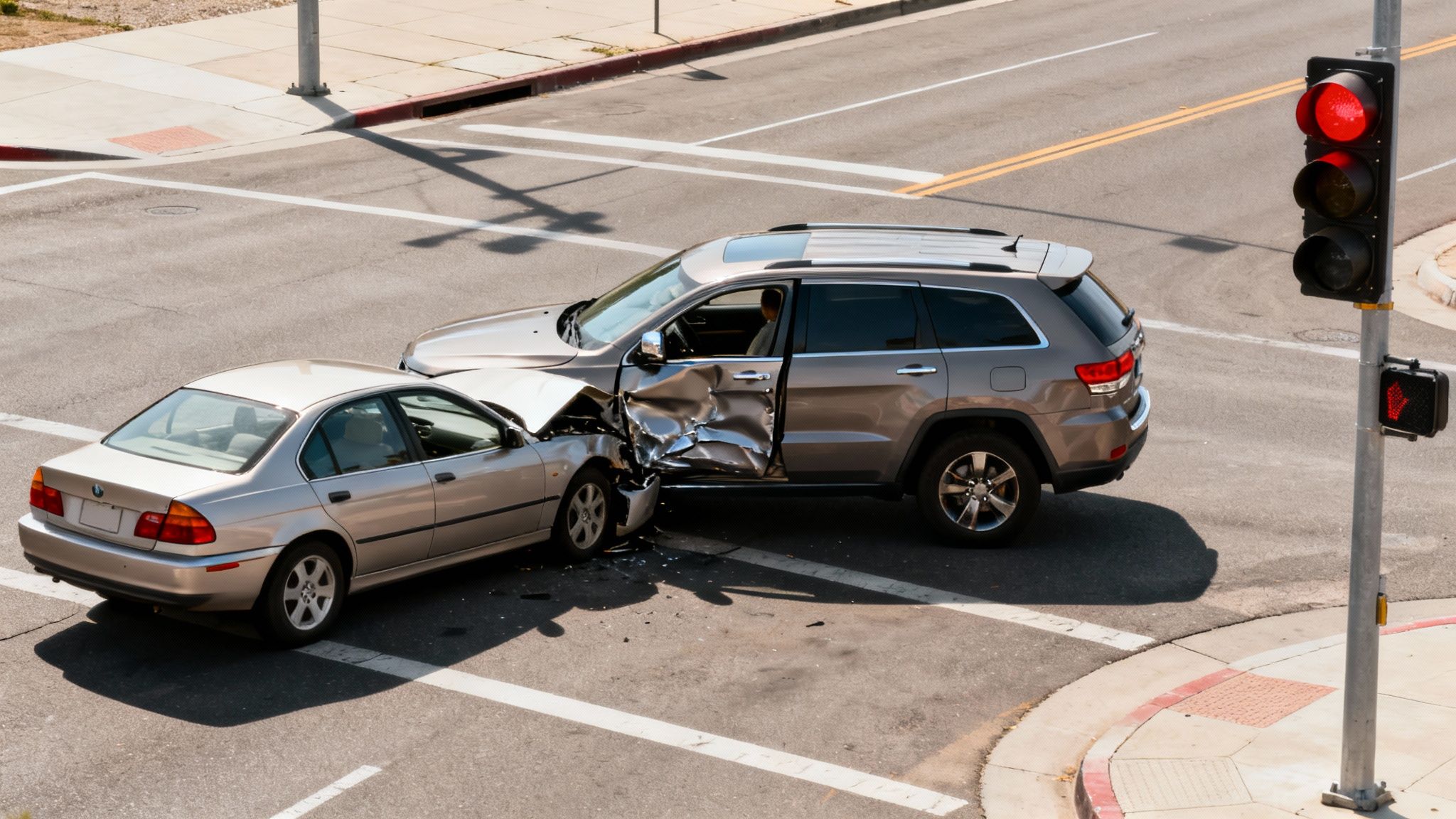
A car crash can change your life in seconds — but you don’t have to face recovery alone. When you hear the term T-bone accident, it’s not just a casual description—it’s a name for one of the most violent types of collisions on the road. Also known as a side-impact or broadside crash, it happens when the front of one car smashes directly into the side of another, forming a "T" shape at the point of impact.
These crashes are most common at intersections, often when a driver ignores a red light or stop sign, or simply fails to yield the right-of-way. Understanding your rights after such a devastating event is the first step toward getting the support you need to heal.
Understanding T-Bone Accidents and Their Dangers
A car crash can flip your world upside down in a heartbeat—but you don’t have to navigate the aftermath alone. The first step toward protecting your rights is understanding exactly what happened. A T-bone accident is uniquely dangerous because it strikes a vehicle at its most vulnerable point.
Why Side Impacts Are So Severe
Think about a car's design. The front and rear are built with "crumple zones"—areas engineered to absorb the shock of a collision and shield the people inside. They act like a built-in safety cushion.
The sides of a vehicle have nothing like that. There’s just a thin door and a window between you and the full force of another car. There’s no buffer. No real protection.
This structural weakness is what makes T-bone collisions so devastating. The force of the striking car transfers almost directly to the occupants, often causing catastrophic injuries. Imagine you’re driving lawfully through a green light at a busy Houston intersection when another driver barrels through their red light and hits your driver-side door. You have no time to react, and the consequences can be life-altering.
A car's side offers minimal protection in a T-bone crash, like a house with paper-thin walls trying to withstand a storm. This vulnerability is why side-impact collisions are among the most lethal types of accidents on Texas roads.
The Statistics Tell a Sobering Story
This isn't just theory; the data is alarming. T-bone accidents are a leading cause of severe injuries and death across the United States.
According to the Insurance Institute for Highway Safety (IIHS), side-impact collisions account for more than 23% of all passenger vehicle deaths in the country. The danger is directly tied to that lack of protection on the sides of most vehicles compared to the front or back. You can discover more insights about these T-bone collision statistics and see just how serious these crashes are.
Common Causes of Side Impact Collisions in Texas
T-bone accidents almost never “just happen.” They are almost always the result of one driver's negligence—a legal term that simply means they failed to act with reasonable care, which in turn caused someone else to get hurt.
When you start to understand the common reasons these crashes occur, you can more clearly see the careless behavior that likely led to your injuries and turned your world upside down. These collisions are most common at intersections, which are natural hotspots where the paths of multiple vehicles cross. All it takes is a single moment of inattention from one driver to cause a devastating side-impact crash.
Dangerous Driver Behaviors
Certain reckless actions are notorious for causing T-bone accidents on Texas roads. Picture a Houston driver rear-ended on I-45 because the person behind them was looking down at their phone instead of the road. In that split second, a life can change forever. A similar moment of inattention at an intersection can cause a driver to blow through a red light and smash right into a family’s car that was legally crossing.
Common examples of driver negligence include:
- Running Red Lights and Stop Signs: This is one of the most blatant and dangerous causes, where a driver completely ignores the traffic signals designed to keep everyone safe.
- Failure to Yield the Right-of-Way: This often happens when a driver making an unprotected left turn either misjudges the speed of oncoming cars or simply doesn't look carefully before hitting the gas.
- Distracted Driving: Texting, messing with the radio, or anything else that takes a driver's eyes off the road is a recipe for disaster. You can learn more about the tragic outcomes when drivers aren’t paying attention by reading about the lifelong consequences of distracted driving.
- Driving Under the Influence (DUI): Alcohol and drugs demolish a driver’s judgment, slow their reaction time, and make it nearly impossible to obey traffic laws. An impaired driver at an intersection is a massive threat.
The Tragic and Painful Consequences
The actions listed above directly lead to some of the most severe injuries imaginable. Think about it: there’s very little protecting you on the side of a vehicle—just a door and a window. The force of the impact is transferred directly to the people inside. This often results in life-altering medical conditions like traumatic brain injuries (TBIs), spinal cord damage, shattered bones, and severe internal organ damage.
The data confirms just how dangerous T-bone accidents are. Studies consistently show they are disproportionately fatal. For instance, in Texas alone, intersection-related crashes—where T-bones are incredibly common—accounted for a shocking 32% of all fatal crashes over a recent five-year period. If you lost a loved one in such a crash, you may be entitled to wrongful death compensation. The connection between a driver's negligent act and a victim's profound suffering is tragically clear.
Who Is Liable in a Texas Car Accident?
After a traumatic T-bone crash, one of the first questions running through your mind is probably, "Who is going to pay for this?" In Texas, figuring out who is at fault comes down to a legal concept called liability. Liability simply means legal responsibility. To establish liability, we must prove the other driver was negligent.
Negligence is a legal term for carelessness. It means a driver failed to act with the reasonable care that any other sensible person would use behind the wheel. When someone blows through a red light and causes a T-bone crash, they’ve acted negligently. Our job as your Houston car accident lawyer is to prove that negligence using hard evidence.
Proving Negligence After a Side Impact Crash
To hold the other driver accountable, we have to show they breached their duty to drive safely and that this failure directly caused your injuries and other damages. This isn’t just a "he said, she said" argument; it's about building a solid case backed by undeniable facts.
Some of the most powerful evidence we use to establish fault includes:
- The Police Report: This is the official starting point. It often contains the officer’s initial take on what happened and may even cite one driver for a traffic violation.
- Witness Statements: An independent witness who saw the other driver run a stop sign provides powerful, unbiased testimony that can completely change a case.
- Traffic Camera Footage: These days, many intersections in Houston and other Texas cities have cameras. This footage can provide indisputable proof of who had the green light.
- Accident Reconstruction: For complex cases, we bring in experts. They can analyze vehicle damage, skid marks, and other physical data to scientifically recreate the crash and prove exactly how it unfolded.
Understanding Texas's Comparative Fault Rule
What happens if the other driver’s insurance company tries to shift the blame? They might claim you were speeding slightly, even though their client is the one who ran the red light. Texas law has a fair system for this exact scenario, known as comparative fault or proportionate responsibility.
Under the Texas Civil Practice and Remedies Code, Chapter 33, you can still recover compensation as long as you are not found to be 51% or more at fault for the accident.
This is a critical protection for accident victims. It means that even if a jury decides you were, say, 10% responsible for the crash, you don't lose everything. Your final compensation award is simply reduced by that 10%. This rule ensures that the driver who was primarily at fault is held responsible for the harm they caused.
This rule can get complicated, but you can learn more about how it works in our guide to comparative negligence in Texas. An experienced Texas injury attorney will be your best defense against unfair blame and will fight to make sure you get the maximum recovery you deserve.
Steps to File an Insurance Claim
The moments after a T-bone crash are a blur of adrenaline and confusion. Your mind is racing, and it's easy to feel overwhelmed. But what you do in these critical minutes and hours can make all the difference for your health and your ability to get fair compensation later on. Even if you think you can just walk away, the violent jolt of a side-impact collision is notorious for causing injuries that don't show up right away.
Here is some practical, step-by-step advice on what to do after a crash and how to deal with insurance companies.
Practical Steps for Accident Victims
- Prioritize Safety and Call 911: First things first, check on yourself and anyone else in the car. If it's safe to do so, move your vehicle out of the flow of traffic. Call 911 right away to get police and paramedics on their way. An official police report is a crucial piece of evidence.
- Seek Immediate Medical Attention: Adrenaline is a powerful painkiller. You might feel fine at the scene, but that doesn't mean you aren't hurt. Getting checked out by a medical professional is non-negotiable—it protects your health and creates an official record connecting your injuries to the crash.
- Document Everything: If you're able, pull out your phone and start taking photos and videos. Get shots of the damage to both cars from every angle, any skid marks on the pavement, the traffic signals, and any visible injuries you have. You can't have too much evidence.
- Gather Information: Swap contact and insurance details with the other driver. This is important: do not admit fault or even say "I'm sorry." It can be used against you. Also, if there were any witnesses, get their names and phone numbers. Their perspective can be incredibly valuable.
- Notify Your Insurance Company: Give your own insurance provider a call to report the accident, but just stick to the basic facts. Avoid the temptation to give a recorded statement to the other driver's insurance company until you've spoken with a lawyer.
This visual guide breaks down how Texas fault laws apply after a crash, from establishing negligence to determining compensation.
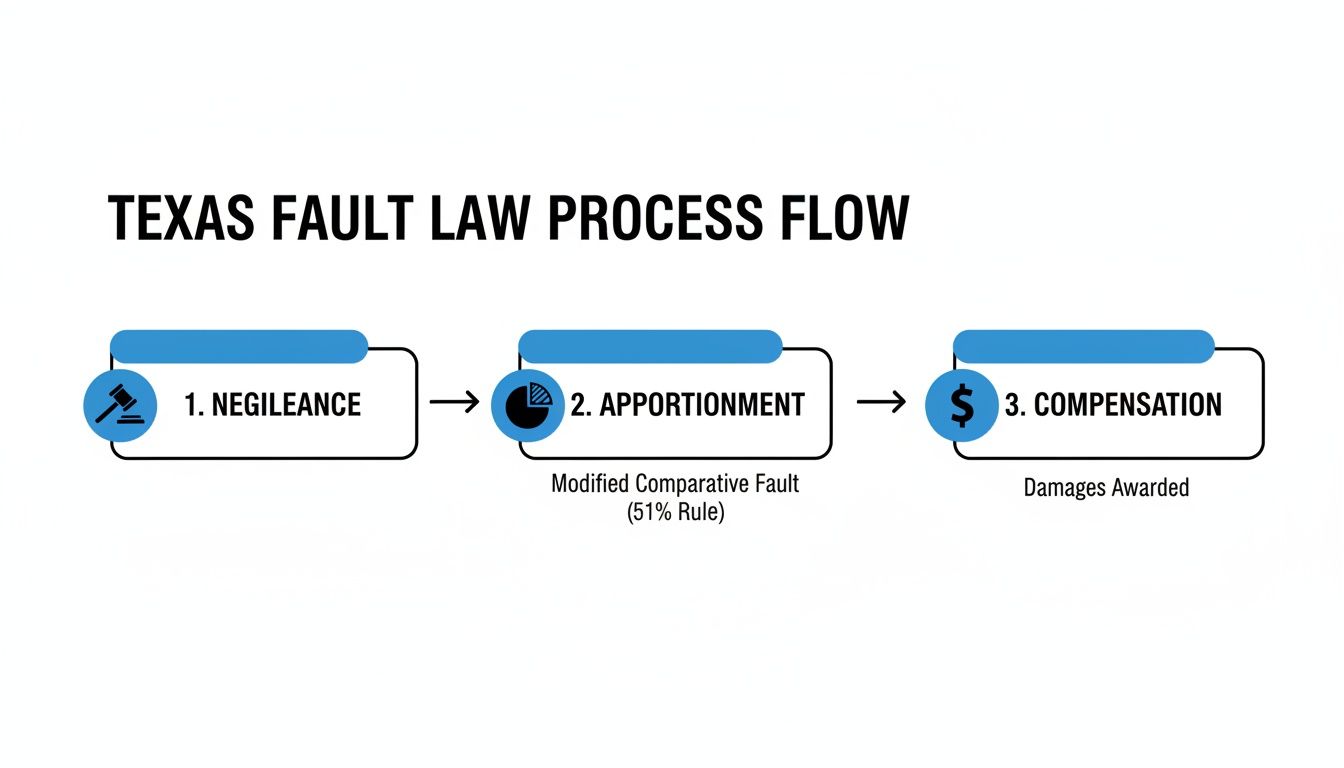
As you can see, the process moves from proving the other driver was negligent to fairly assigning responsibility before you can recover damages. If you think you may have suffered a spinal injury, understanding different disc care protocols can be vital for your long-term recovery.
For a more detailed breakdown of what to do, check out our complete guide on what to do after a car accident.
Understanding the Compensation You Can Recover
When a T-bone accident leaves you injured and out of work, the last thing you should have to worry about is how you're going to pay your bills. Fortunately, Texas law gives you the right to seek compensation from the driver who caused the crash.
This financial recovery, known legally as damages, is meant to cover every single loss you've suffered—not just the obvious ones. In plain English, damages are the money you can recover for your losses. These damages are broken down into two main categories, and understanding both is the key to fighting for a settlement that truly covers the impact this crash has had on your life.
Economic Damages: Tangible Financial Losses
The first and most straightforward category is economic damages. Just think of these as any loss that comes with a clear price tag. They are the tangible, out-of-pocket costs that start piling up from the moment the collision happens.
Your Houston car accident lawyer will help you gather every receipt, bill, and pay stub to calculate the full extent of these financial burdens.
Common economic damages include:
- Medical Expenses: This covers it all—from the ambulance ride and ER visit to surgeries, physical therapy, prescription drugs, and any future medical care you'll need down the road.
- Lost Wages: If your injuries keep you from working, you can recover the income you've already lost. This also includes your loss of future earning capacity if the accident leaves you with a long-term disability that impacts your career.
- Property Damage: This is simply the cost to repair or replace your vehicle and any other personal items, like a laptop or phone, that were destroyed in the wreck.
Non-Economic Damages: Intangible Personal Suffering
The second category, non-economic damages, is just as critical but much harder to put a number on. These damages are designed to compensate you for the immense personal, non-financial suffering that a serious T-bone accident causes. While you can’t get a receipt for this kind of pain, Texas law recognizes how real it is and that you deserve to be compensated for it.
These intangible losses often leave the deepest and most lasting scars. A truly fair settlement must account for the physical pain and emotional trauma you've been forced to endure because someone else was negligent.
This type of compensation is meant to cover losses such as:
- Pain and Suffering
- Mental Anguish
- Physical Impairment or Disfigurement
- Loss of Enjoyment of Life
To make this clearer, let's break down the types of compensation you can pursue in a Texas T-bone accident case.
Types of Damages You Can Claim in a Texas T-Bone Accident Case
| Type of Damage | What It Covers | Example |
|---|---|---|
| Economic | All medical treatment, past and future. | ER visits, surgery, physical therapy, medications, and necessary future care. |
| Economic | Income lost while recovering. | Missed paychecks from being unable to work during your recovery period. |
| Economic | Reduced ability to earn in the future. | A permanent injury prevents you from returning to your previous, higher-paying job. |
| Economic | Costs to fix or replace your vehicle. | The full amount needed to repair your car or its total market value if it's a loss. |
| Non-Economic | Physical pain from your injuries. | Chronic back pain, migraines, or nerve damage resulting from the collision. |
| Non-Economic | Emotional and psychological trauma. | Anxiety, depression, PTSD, or fear of driving after the crash. |
| Non-Economic | Permanent scarring or physical limitations. | Visible scars from surgery or the inability to walk without a cane. |
| Non-Economic | Inability to participate in hobbies. | An injury prevents you from playing sports, gardening, or enjoying life as you once did. |
Understanding both economic and non-economic damages ensures that you are pursuing a claim that addresses every aspect of your recovery—financial, physical, and emotional. A skilled attorney can help you build a strong case to prove the full value of these losses.
How a Houston Car Accident Lawyer Strengthens Your Claim
After the trauma of a T-bone accident, the last thing you should have to do is fight a massive insurance company on your own. But that's exactly the position many victims find themselves in. Remember, the insurance company isn't on your side—their primary goal is to protect their profits by paying out as little as possible. Having an experienced Houston car accident lawyer in your corner completely levels the playing field and ensures your rights are fiercely protected.

From the moment you hire our firm, we lift that burden from your shoulders. Our team immediately launches a deep dive into the crash, working tirelessly to gather every piece of critical evidence needed to build an ironclad case on your behalf.
Building a Case for Maximum Compensation
A strong auto insurance claim is built on a foundation of solid, undeniable proof. We know exactly what to look for and how to get it, leaving no stone unturned in our mission to prove the other driver’s negligence caused your injuries.
Our legal team gets to work right away, taking several key actions:
- Securing Crucial Evidence: We move fast to get our hands on police reports, witness statements, and any available traffic or security camera footage that captured the collision before it disappears.
- Consulting with Experts: T-bone crashes can get complicated. We often bring in accident reconstruction specialists who can scientifically break down the crash scene and vehicle damage to prove exactly how the wreck happened and who was at fault.
- Calculating Your True Damages: We meticulously document all of your losses—both economic and non-economic. This goes far beyond just your current medical bills and lost wages; we calculate the cost of future care, your physical pain, and the emotional suffering you've endured.
Insurance adjusters are notorious for offering a quick, lowball settlement before you even grasp the full extent of your injuries. A dedicated Texas injury attorney calculates the true, long-term value of your claim, making sure you don’t settle for a penny less than you deserve.
Handling Negotiations and Taking Your Case to Court
Once we've built a powerful case, we take over all communications and handle the aggressive negotiations with the insurance company. We present them with a detailed demand package that lays out their client’s liability and the full scope of your damages, fighting for a fair settlement that covers every single aspect of your recovery.
If the insurer refuses to make a fair offer, we are always prepared to take your fight to the courtroom. Our trial-tested attorneys aren't afraid to stand up for you in front of a judge and jury. By entrusting your case to The Law Office of Bryan Fagan, PLLC, you can finally focus on your health and recovery while we focus on securing the justice and financial stability you need to move forward.
Common Questions After a Texas T-Bone Accident
When you're dealing with the fallout of a serious T-bone crash, it's natural to have a lot of questions. Here are some of the most common ones we hear from our clients, with straightforward answers to help you understand what comes next.
What if the Other Driver Says I Was Speeding?
Don't be surprised if this happens. It's a classic defense tactic insurance companies use to shift blame and pay you less. But in Texas, this doesn't automatically kill your claim.
Our state follows a rule called comparative fault. This just means you can still get compensation as long as you weren't 51% or more at fault for the wreck. For example, if a jury decides you were 10% to blame for going slightly over the speed limit when another driver blew through a red light and hit you, your final compensation would simply be reduced by that 10%. A good lawyer will gather the evidence needed to shut down these baseless accusations and prove the other driver was overwhelmingly responsible.
How Much Time Do I Have to File a Lawsuit in Texas?
The clock starts ticking the moment the crash happens. In Texas, the statute of limitations for most personal injury claims gives you two years from the date of the accident to file a lawsuit. In plain English, this is the legal deadline for filing your case.
This isn't a soft deadline—it's a hard stop. If you miss it, you almost certainly lose your right to seek any compensation through the courts forever.
Waiting is one of the biggest mistakes you can make. Acting fast allows your attorney to preserve critical evidence, like traffic camera footage or witness statements, before it gets lost or erased. This strengthens your case from day one and protects your legal rights.
Should I Just Take the First Settlement Offer the Insurance Company Gives Me?
Almost never. Accepting the first offer is usually a huge mistake. Insurance adjusters are trained professionals whose job is to protect their company's bottom line by settling claims for as little money as possible.
Their initial offers are intentionally low and rarely account for the true, long-term costs of your injuries. They often ignore future medical treatments, the income you'll lose if you can't work, and the very real pain and suffering you've endured. An experienced Texas injury attorney can calculate what your claim is actually worth and negotiate for a settlement that truly covers everything you’ve lost.
The aftermath of a T-bone accident is difficult, but you don't have to face it alone. At The Law Office of Bryan Fagan, PLLC, our compassionate and dedicated team is ready to fight for the justice and compensation you deserve. We understand what you are going through, and we are here to help you rebuild your life. Contact us today for a free, no-obligation consultation to discuss your case and learn how we can help. Learn more at https://houstonaccidentlawyers.net.