A car crash can change your life in seconds—but you don’t have to face recovery alone. When you’re in a collision with a commercial truck, the single most important detail might not be the speed, the weather, or even the make of the vehicles involved. The crucial question is this: was the truck operating interstate or intrastate?
The answer to that question changes everything. It dictates which set of safety rules apply, how much insurance coverage is available, and ultimately, how we build your case. One type of commerce involves crossing state lines; the other begins and ends right here in Texas. This guide will provide clear, practical information to help you understand your rights and the steps you can take to seek justice.
The Critical Detail That Defines Your Truck Accident Claim
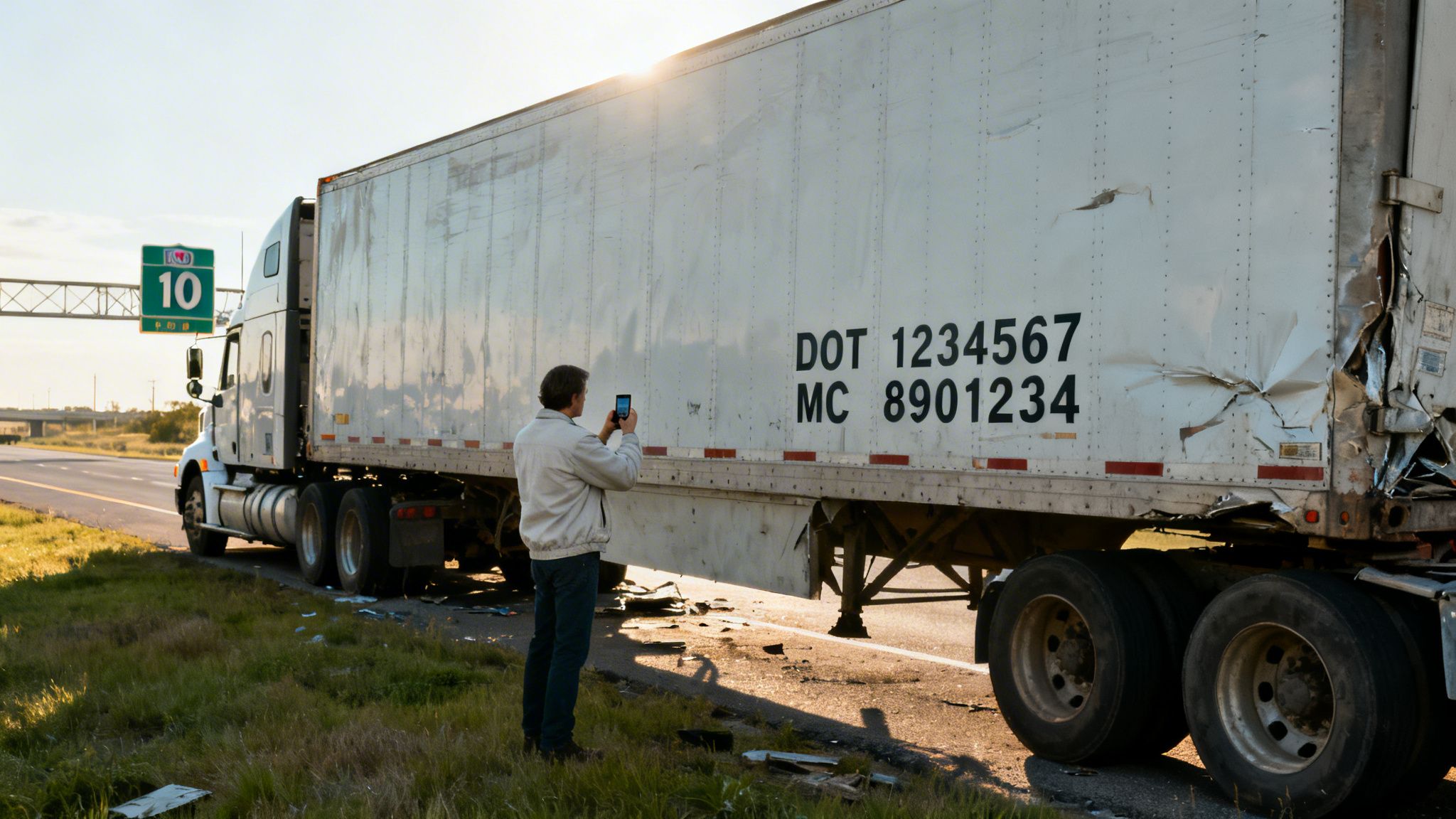
Getting into an accident with a massive commercial truck on a Texas highway like I-10 or I-45 is a life-altering event. In the chaos that follows, you're left dealing with physical pain, mounting medical bills, and a deep sense of uncertainty. You don't have to figure it out alone.
One of the first things a skilled Houston truck accident lawyer will investigate is whether the truck was an interstate or intrastate carrier. This isn't just a technicality—it's the foundation of your claim.
This single factor determines which government agency's safety regulations the driver and trucking company were required to follow. For a Houston driver rear-ended on I-45, knowing this difference is the first step toward holding the right parties accountable. You can find out more about the process in our guide to filing a semi-truck accident claim.
Key Differences at a Glance
It might seem simple, but understanding whether a truck’s cargo was crossing state lines or staying within Texas is essential. This detail affects everything from the driver's legal working hours to the minimum amount of insurance coverage available to compensate you for your injuries and losses.
Here’s a straightforward breakdown of what it means for your case.
| Factor | Interstate Commerce | Intrastate Commerce |
|---|---|---|
| Definition | Hauls goods across state or national borders. | Hauls goods that stay entirely within Texas. |
| Governing Body | Federal Motor Carrier Safety Admin. (FMCSA). | Texas Department of Transportation (TxDOT). |
| Typical Route | A truck moving freight from Dallas to Oklahoma City. | A truck moving supplies from Houston to Austin. |
| Legal Impact | Federal laws and higher insurance minimums apply. | Texas state laws and insurance minimums apply. |
This distinction is the starting point for building a successful claim for your medical bills, lost income, and suffering. Our goal is to provide the clarity you need to understand the interstate vs. intrastate difference, so you can take the first step toward securing the justice and compensation you deserve after a serious crash.
Understanding Interstate vs. Intrastate Trucking
After a collision with a commercial truck, one of the very first questions we’ll ask is whether its journey was interstate or intrastate. This isn't just legal minutia—it’s a pivotal detail that determines which safety rules, regulations, and insurance minimums will govern your case. Getting this right is the foundation of building a strong legal strategy.
Put simply, intrastate commerce refers to any transportation that starts and finishes entirely within Texas. A perfect example is a grocery distributor carrying goods from a warehouse in Houston to a supermarket in Austin. Because that cargo never crosses Texas state lines, the truck and its operator are governed primarily by Texas Department of Transportation (TxDOT) regulations.
The Reach of Federal Law in Texas Accidents
Interstate commerce, on the other hand, involves transportation that crosses state lines at any point in its journey. This is true even if the accident itself happens deep in the heart of Texas. Imagine a semi-truck hauling electronics from a factory in California to a distribution center in Dallas. Even if that truck crashes on I-35 near Waco, it is part of an interstate trip, which means much stricter federal laws kick in.
For accident victims, this is critical. Federal regulations almost always demand higher standards for safety and require significantly more insurance coverage, which can make all the difference when you're facing catastrophic injuries and mounting medical bills.
This is also where a legal principle called "shipper's intent" comes into play. If the cargo was always intended to end up in another state, federal law applies from the moment the truck is loaded. The Federal Motor Carrier Safety Administration (FMCSA) defines interstate transport as any trade between states or where the shipper intends for the cargo to cross state lines. This detail has serious legal weight, and trucking companies have been hit with major fines for trying to misclassify a load that actually began its journey out-of-state.
Following the Paper Trail
An experienced Houston truck accident lawyer knows that figuring out a truck's true status requires an immediate and thorough investigation of its paperwork. To establish whether a trucking operation is interstate or intrastate, documents like detailed truck dispatch tickets are absolutely essential for proving which set of rules applies.
These records, along with bills of lading and driver logs, paint a clear picture of the cargo’s origin, its final destination, and the route it was supposed to take. This evidence is the key to proving which regulations the trucking company was required to follow. By digging into these details, your attorney can pinpoint specific safety violations—like a driver who was on the road too long or a truck with faulty brakes—that prove negligence and hold the at-fault parties accountable for the harm they’ve caused. This investigative work is the first step toward building the powerful personal injury claim you deserve.
How Regulations And Insurance Requirements Compare
That single detail—whether a truck crossed state lines or not—changes everything. It dictates the rules the driver and their company must follow and, more importantly, how much money might be available to cover your injuries and losses.
For anyone hurt in a truck accident, these aren't just legal technicalities. They are critical factors that can make or break a personal injury claim. Understanding which rules apply is the very first step our attorneys take when building a powerful case for a client.
This visual guide breaks down the core differences between trucking operations that cross state lines and those that operate only within Texas.
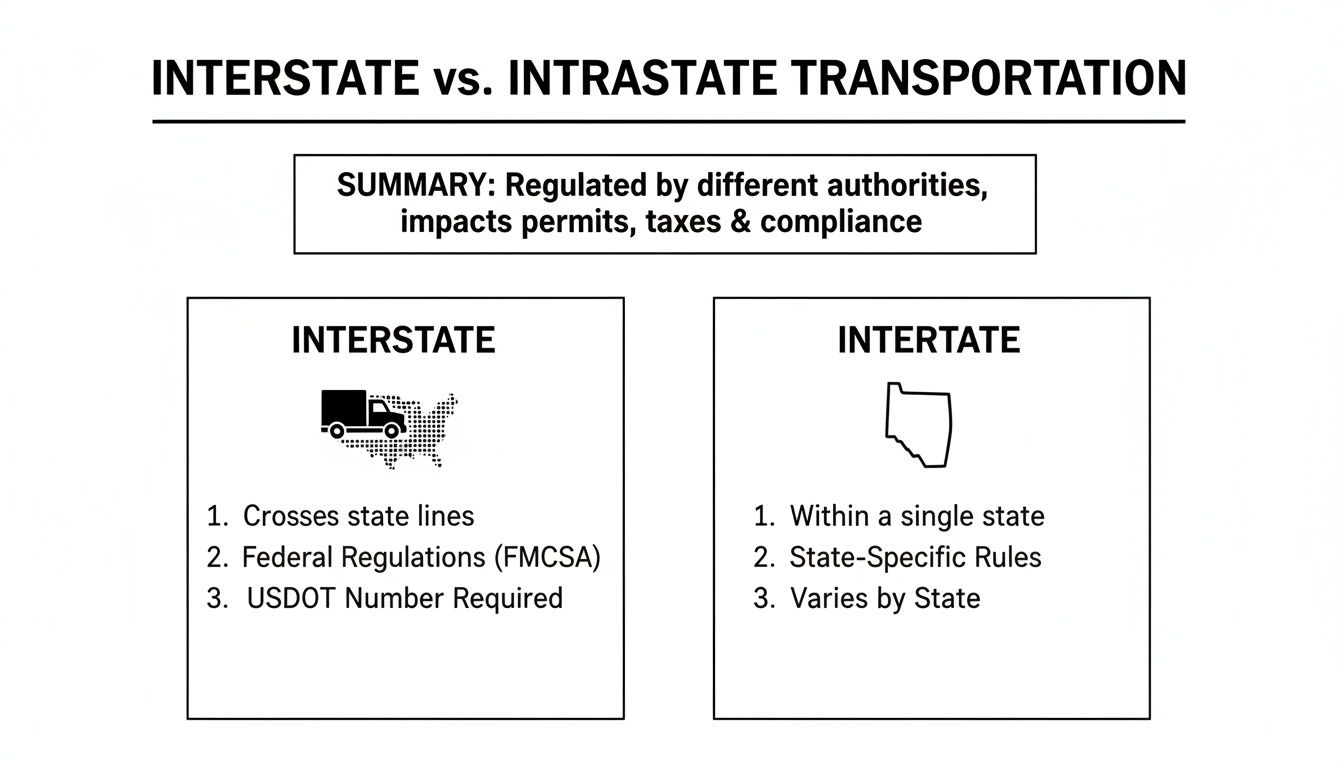
As you can see, the key contrasts come down to who makes the rules, the minimum insurance required, and the standards for drivers—all of which have a direct impact on your claim.
Federal vs State Regulatory Oversight
The biggest difference between interstate and intrastate trucking is who's in charge. Interstate trucking falls under federal law and is regulated by the Federal Motor Carrier Safety Administration (FMCSA). The FMCSA enforces a strict, uniform set of safety standards that apply to commercial trucks nationwide.
On the other hand, intrastate trucking, where a commercial truck’s entire trip takes place within Texas, is mainly governed by the Texas Department of Transportation (TxDOT). While Texas rules often adopt or mirror the federal standards, there can be subtle but crucial differences that a skilled attorney needs to pinpoint.
For instance, a truck driver hauling goods from a warehouse at the Port of Houston to a distribution center in San Antonio is an intrastate carrier following TxDOT rules. But if that same truck is hauling cargo that originated in Mexico and is just passing through Houston on its way to Oklahoma, it immediately becomes subject to the stricter FMCSA regulations.
Comparing Interstate vs Intrastate Trucking Regulations
To make this clear, we've broken down the key differences and explained exactly why they matter for your accident claim. This table highlights what our legal team looks for when investigating a truck crash.
| Regulatory Factor | Interstate Trucking (Crosses State Lines) | Intrastate Trucking (Stays Within Texas) | Why It Matters For Your Claim |
|---|---|---|---|
| Governing Body | Federal Motor Carrier Safety Administration (FMCSA) | Texas Department of Transportation (TxDOT) | Determines which specific safety laws were broken, forming the basis of your negligence claim. |
| Insurance Minimums | $750,000 to $5 million+ depending on cargo. | Can be as low as $300,000 for general freight. | Higher limits mean more potential compensation for severe injuries, medical bills, and lost wages. |
| Hours-of-Service | Strict federal rules on driving and rest periods. | Texas rules generally align with federal standards but can have exceptions. | Proving a driver violated HOS rules is powerful evidence of fatigue and negligence. |
| Driver Qualifications | Drivers must be at least 21 years old. | Drivers can be as young as 18 for certain operations. | The driver's age and experience can be a factor in determining liability. |
| Inspections & Maintenance | Subject to rigorous federal inspection protocols. | Must follow Texas-specific vehicle inspection and maintenance laws. | Maintenance logs can reveal a pattern of neglect, strengthening your claim against the company. |
This comparison isn't just academic; it's the roadmap we use to hold negligent trucking companies accountable. Identifying the truck’s status is one of the first and most important actions we take.
The Critical Role of Insurance Minimums
For an accident victim, perhaps the most impactful difference is the required insurance coverage. Federal law demands significantly higher insurance policies for interstate carriers, which can create a much larger pool of funds to compensate you for your injuries.
- Interstate Trucks: Federal regulations mandate a minimum of $750,000 in liability coverage for trucks over 10,001 pounds carrying non-hazardous freight. That minimum jumps to $1 million to $5 million for carriers hauling certain hazardous materials.
- Intrastate Trucks: In contrast, Texas law can have lower minimums. Depending on the vehicle and what it's carrying, the minimum coverage might be as low as $300,000 for general freight.
This difference is life-changing. If you suffer catastrophic injuries in a crash on US-290, the higher insurance limits of an interstate truck may be the only way to cover a lifetime of medical care, lost income, and other damages. To fully grasp how these policies work, you can learn more about understanding insurance policy limits after a car accident in Texas in our detailed guide.
Hours-of-Service and Driver Fatigue Rules
Driver fatigue is a leading cause of devastating truck accidents. To combat this, both federal and state governments impose Hours-of-Service (HOS) rules that strictly limit how long a driver can be on duty and behind the wheel before taking a mandatory rest break.
Violating these rules isn't just a mistake; it's clear evidence of negligence. The FMCSA’s HOS regulations for interstate drivers are notoriously complex, and an experienced lawyer knows how to analyze a driver's electronic logging device (ELD) data, dispatch records, and fuel receipts to find proof of violations. This evidence can become the cornerstone of a successful liability claim.
It's also essential to look at a company's overall safety culture. This includes scrutinizing whether they followed all federal and state pre-trip inspection requirements, which are designed to catch mechanical problems before a truck even hits the road.
A knowledgeable Texas injury attorney will immediately get to work determining the truck's status by examining its USDOT number, bill of lading, and driver logs. This initial investigation allows us to apply the correct set of regulations and hold the trucking company accountable for every safety failure that contributed to your crash.
Who Is Liable in a Texas Truck Accident?
After a catastrophic truck accident, getting the compensation you're owed hinges on one thing: proving someone else was legally at fault for your injuries. In Texas, we call this proving negligence. It means showing the truck driver or their company had a duty to be safe, failed in that duty, and that their failure directly caused the crash that hurt you.
This is where the difference between interstate and intrastate trucking becomes absolutely critical. The safety rules that were broken—and the evidence we need to prove it—are completely different depending on whether the truck was under federal or state jurisdiction. For an experienced attorney, this is square one.
Connecting a Rule Violation to Your Injuries
It's not enough to just point out that a rule was broken. We have to draw a direct line from that specific violation to the accident that changed your life. The evidence we hunt for is different for interstate versus intrastate trucks.
For an Interstate Truck: Imagine a driver hauling cargo from Laredo to a distribution center in Oklahoma. That driver must follow strict rules from the Federal Motor Carrier Safety Administration (FMCSA). A classic example of negligence is violating Hours-of-Service regulations. If we dig into the driver's logs and dispatch records and find they drove past their legal limit, we can make a powerful argument that fatigue caused the crash.
For an Intrastate Truck: Now, think of a driver moving construction equipment from Dallas to Fort Worth. They fall under the Texas Transportation Code. Here, negligence might look like a violation of state-mandated maintenance schedules. If we uncover records showing the company skipped a required brake inspection, we can connect that failure directly to the brake malfunction that led to your accident.
This is precisely why figuring out the truck’s status is our first move. It gives us the legal playbook we need to hold the driver and their company accountable.
An experienced Texas injury attorney knows exactly where to look. We immediately file to preserve driver logs, maintenance records, dispatch instructions, and bills of lading. This evidence trail is how we establish the truck's status and build an undeniable, evidence-backed case to prove liability.
Understanding Texas's Comparative Fault Law
What if you think you might have been partly to blame for the accident? You may still be able to recover money for your losses. Texas operates under a rule called modified comparative fault (also known as proportionate responsibility), which is laid out in the Texas Civil Practice & Remedies Code, Chapter 33.
This law means you can still be awarded damages—the legal term for money meant to compensate you for your losses—as long as you are found to be 50% or less at fault for the crash. Your final payout will simply be reduced by whatever percentage of fault is assigned to you. For example, if you're awarded $100,000 but found to be 10% responsible, you would walk away with $90,000.
But here’s the catch: if a jury finds you 51% or more at fault, you get nothing. The trucking company's insurance adjuster knows this inside and out. They will do everything they can to push blame onto you, hoping to reduce their payout or eliminate it completely. They might twist your words from a recorded statement or misrepresent the evidence. Our job is to shield you from these tactics and present a clear, factual case proving the truck driver was the primary cause of the accident. To seek wrongful death compensation, the same principles of proving fault apply. You can learn more about how to navigate a truck accident claim in our detailed guide.
Handling Complex Cases and Mixed Truckloads
Today's supply chains have completely blurred the lines between interstate and intrastate commerce, creating a legal minefield after a truck accident. Unraveling this complexity requires deep expertise, especially when a single truck is carrying a "mixed load"—goods for both local and out-of-state destinations.
Think about a delivery truck pulling out of a Houston distribution center. On that truck, you might find packages headed for Austin sitting right next to freight that started its journey in another country and is on its way to a final stop in Dallas. This is exactly why you need a skilled Houston truck accident lawyer to dig into the details of your case.
When One Package Changes Everything
In these mixed-load crashes, there’s a critical rule that changes everything: federal regulations almost always take over and govern the entire truck and driver. If even one small piece of that truck's cargo qualifies as interstate commerce, the trucking company has to follow the much stricter federal safety standards and carry higher insurance minimums.
This is often a huge advantage for you as the victim. It means we can hold the trucking company to the highest possible safety standards, which can be the key to proving they were negligent.
For instance, a truck driver might believe they're only bound by Texas rules because their route that day is entirely within state lines. But if we discover their cargo originated out of state, they are legally required to follow federal Hours-of-Service laws. Proving they violated those federal rules can be the detail that wins your case by showing driver fatigue was the cause.
The Gig Economy and Interstate Commerce
The rise of the gig economy with services like Amazon Flex and other local freight delivery companies has added yet another layer of confusion. On the surface, these drivers seem like purely local operators, picking up packages from a nearby warehouse and delivering them to homes in the same city.
However, the legal doctrine of "shipper's intent" is what really matters here. If the package you ordered online came from a warehouse in another state, that local driver is just completing the final leg of a much longer interstate journey. This means both the driver and the company they work for may be subject to federal rules, not the more lenient state ones.
Investigating these gray areas is where we excel. The Department of Transportation distinguishes between in-state business and commerce that crosses borders, and the scale of this issue is enormous. Nationwide, intrastate commerce accounted for 1.2 trillion ton-miles in 2021, a figure that rivals interstate volume and helps power the Texas economy. When a truck juggles both rule sets on a mixed load, it makes even a simple delivery legally complicated. You can find more insights into this complex regulatory world and what it means for carriers on Hazmat School's blog.
Our experienced attorneys know exactly where to look—in the shipping manifests, the bills of lading, and the corporate paperwork—to determine the true nature of that truck's trip. By identifying every single regulation that applies, we can successfully manage even the most complicated Houston truck accident cases. We leave no stone unturned to secure the compensation you deserve for your medical bills, lost wages, and pain and suffering.
Steps to File an Insurance Claim

The moments after a crash with an 18-wheeler are a blur of confusion and adrenaline. Your first thought is rightfully on your family and your own safety. But what you do in the minutes and hours that follow can have a massive impact on your health and your ability to secure the financial compensation you’ll need to put your life back together.
It can feel like you're completely on your own, but you're not. Here’s a practical, step-by-step guide on what to do right after a crash to protect your rights.
Prioritize Safety and Get Medical Help
Nothing is more important than your well-being. If you can, get your vehicle and yourself to a safe spot away from moving traffic to avoid a second collision.
Call 911 Immediately: This is not optional. A police report provides an official, third-party record of the scene, and officers can document their initial observations. More importantly, paramedics can deliver immediate medical care and evaluate injuries that adrenaline might be masking.
Seek a Full Medical Evaluation: Even if you just feel sore or shaken up, you need to see a doctor right away. Serious injuries, like internal bleeding or brain trauma, often have delayed symptoms. Getting a prompt medical evaluation creates a clear record linking your injuries to the crash—critical evidence for any personal injury claim.
Document Everything at the Scene
If you're physically able, gathering your own evidence can be a game-changer. A truck accident scene is cleared away fast, and once it's gone, crucial details are lost for good.
Use your smartphone to take as many photos and videos as you can. Be thorough. Capture:
- The final resting positions of all vehicles.
- Damage to your vehicle from every possible angle.
- Damage to the truck, paying close attention to its tires, front end, and sides.
- Any skid marks, gouges in the road, or crash debris.
- The truck's identifying numbers, specifically the USDOT number and MC number, usually found on the cab doors. These numbers are vital for figuring out if the truck is an interstate or intrastate carrier.
- The truck’s license plate and any company branding or logos.
Protect Your Legal and Financial Interests
Once the initial shock begins to fade, you can expect a call from the trucking company’s insurance adjuster. How you navigate this conversation is incredibly important.
Never give a recorded statement to the trucking company’s insurance adjuster. Their job is to protect their employer’s profits, and they are trained to ask leading questions designed to get you to weaken your own claim.
It's just as crucial that you do not sign any documents or accept a quick settlement offer. These initial offers are almost always a lowball figure that won't come close to covering your actual medical bills, lost income, and pain and suffering.
You should let your own insurance company know that an accident happened, but keep it to the basic facts. Don't guess about who was at fault or try to downplay your injuries.
Be Aware of Texas’s Statute of Limitations
In Texas, the clock starts ticking immediately. You have a limited window of time to file a personal injury lawsuit, a deadline known as the statute of limitations. For most personal injury claims, including those from a truck accident, you have just two years from the date of the crash to file a lawsuit.
If you miss that two-year deadline, you will almost certainly lose your right to seek compensation forever. This is exactly why you can't afford to wait. Contacting a Houston car accident lawyer right away ensures that all evidence is preserved, every deadline is met, and your rights are defended from the very beginning.
When you’re dealing with the fallout of a serious truck wreck, the questions can feel endless and overwhelming. Here are some straightforward answers to the questions we hear most often from victims and their families. Our goal is to give you the clarity you need to make the right decisions for your future.
How Much Does It Cost to Hire a Texas Truck Accident Lawyer?
The last thing you should worry about after a crash is how to afford a lawyer. That’s why we handle all truck accident cases on a contingency fee basis.
What does that mean? It’s simple: you pay us nothing upfront. We don’t get paid unless and until we win your case. Our fee is a percentage of the compensation we successfully recover for you. If we don’t secure a recovery, you owe us nothing. This structure allows you to get expert legal help without any financial risk.
What Compensation Can I Recover in a Truck Accident Claim?
If someone else's negligence caused your injuries, Texas law gives you the right to demand financial recovery for all of your losses, legally known as "damages."
You may be entitled to compensation for:
- Economic Damages: This covers the concrete financial hits you’ve taken. Think current and future medical bills, lost income from being out of work, and even a loss of future earning ability if the injuries prevent you from returning to your old job.
- Non-Economic Damages: This addresses the immense personal toll of the accident. It includes physical pain, mental anguish, permanent disfigurement, and physical impairment or disability.
In some cases where a trucking company’s conduct was especially reckless or malicious, punitive damages may be awarded under Chapter 41 of the Texas Civil Practice and Remedies Code. These are not meant to compensate you for a loss but to punish the at-fault party and send a strong message to deter that behavior in the future.
Should I Give a Statement to the Trucking Company’s Insurer?
Our advice is unequivocal: do not give a recorded statement to the trucking company’s insurance adjuster without speaking to an attorney first. The adjuster works for the trucking company, and their job is to protect their employer’s bottom line by paying you as little as possible.
Insurance adjusters are trained professionals who know how to ask leading questions. They can trick you into downplaying your injuries or even making it sound like the crash was partly your fault. Anything you say will be scrutinized and can be used to deny or slash the value of your auto insurance claim.
After a crash, your only job is to focus on getting better. Let a qualified attorney handle all communications with the insurance company. We know their tactics and will protect your rights. Understanding the difference between interstate vs intrastate regulations is just one piece of the puzzle; a lawyer uses that knowledge to build your case and fight for you.
A serious truck accident leaves you with more than just physical injuries—it leaves you with overwhelming questions and a legal battle you shouldn't have to fight alone. At The Law Office of Bryan Fagan, PLLC, our experienced Texas injury attorneys are ready to help you understand your rights and demand the full compensation you are owed.
We will inform, reassure, and empower you at every step, emphasizing that skilled legal help is available. Contact us today for a free, no-obligation consultation to discuss your case. Your recovery is our priority.