A car crash can change your life in seconds—but you don’t have to face recovery alone. When you're hurt by another driver's negligence, the most obvious costs are the ones with a clear paper trail: stacks of medical bills, car repair estimates, and proof of lost wages. But what about the injuries you can't see?
Non-economic damages are the invisible injuries—the profound, personal losses that don’t come with an itemized bill but can change your life just as deeply, if not more so. These damages are designed to compensate you for the human cost of an accident.
The True Cost of an Accident Beyond the Bills
A car crash can shatter your sense of normalcy in seconds. While getting your finances back in order is crucial, Texas personal injury law understands that your well-being is about more than just paying bills. It recognizes the very real human cost of a collision, from the physical pain you live with to the emotional distress that follows you long after.

Think of it this way: damages are the legal term for the losses you've suffered. Economic damages cover the cost to fix your car, but non-economic damages are meant to address the loss of peace of mind you now feel every time you get behind the wheel. These are the real-life consequences that linger long after the wreckage is cleared away.
What Counts as a Non-Economic Loss?
In a Texas auto insurance claim or lawsuit, these intangible losses are a critical piece of your potential compensation. They are designed to account for all the ways an accident has diminished your quality of life. Some of the most common examples include:
- Pain and Suffering: This covers the physical pain you endured in the crash and any chronic pain that becomes a part of your daily life during recovery.
- Mental Anguish: This refers to the emotional trauma—the anxiety, depression, fear, or even post-traumatic stress disorder (PTSD) that so often develops after a terrifying accident.
- Loss of Enjoyment of Life: If your injuries stop you from playing with your kids, enjoying your favorite hobbies, or participating in family events you once loved, this accounts for that devastating loss.
- Disfigurement: This is compensation for scarring, amputations, or other permanent changes to your physical appearance that serve as a constant reminder of the crash.
At The Law Office of Bryan Fagan, PLLC, we believe your story is more than just a pile of receipts. We fight to make sure your full experience—the pain, the sleepless nights, and the stolen joy—is seen, heard, and valued. A dedicated Houston car accident lawyer can help you prove these losses and demand the fair compensation you truly deserve.
Understanding Tangible Versus Intangible Losses
When you’re dealing with the aftermath of a serious accident, the financial strain can feel immediate and overwhelming. In any Texas personal injury claim, we break down your losses into two key categories: economic and non-economic damages. Getting a handle on this difference is the first step toward understanding what your case is truly worth.

Think of economic damages as the straightforward, tangible losses. These are the costs you can track with receipts, invoices, and pay stubs—the direct financial hits you took because of someone else's negligence.
On the other hand, non-economic damages represent the intangible, human cost of the collision. They are the deeply personal losses that shatter your quality of life but don't come with a neat price tag.
The Clear Costs: What You Can Tally Up
Economic damages are the easiest part of a claim to calculate because they’re tied to actual financial losses. These are the concrete, out-of-pocket expenses and lost earnings that resulted directly from the crash.
Common examples include:
- Medical Bills: Ambulance rides, ER visits, hospital stays, surgeries, prescriptions, and physical therapy.
- Lost Wages: The income you couldn’t earn while you were out of work recovering.
- Future Lost Earning Capacity: If your injuries mean you can no longer do your old job or earn the same living, this compensates for that long-term financial loss.
- Property Damage: The cost to fix or replace your car and anything else that was damaged.
These are the black-and-white numbers an insurance adjuster can easily verify with documentation. You can learn more about how these specific costs are categorized by checking out our guide on what special damages cover.
The Hidden, Human Costs: What a Receipt Can't Show
Non-economic damages are designed to compensate you for the suffering that doesn’t show up on a bill. Imagine a Houston driver gets rear-ended on I-45. They’ll have medical bills and a damaged car (economic losses), but what about the new, crippling fear of driving that makes their daily commute a nightmare? That’s a non-economic loss.
In Texas, the law recognizes that your recovery is about more than just your finances. It acknowledges that your physical pain, emotional trauma, and loss of life's simple joys are real, compensable losses.
These are the damages that truly tell the story of how an accident has turned your life upside down. They require a skilled Texas injury attorney to articulate and prove their value, ensuring your full story is heard and respected.
Comparing Your Losses Side-by-Side
To make this crystal clear, let’s put these two types of compensation in a head-to-head comparison. The table below breaks down the key differences between the tangible and intangible losses in a personal injury claim.
Economic vs. Non-Economic Damages at a Glance
This table provides a clear side-by-side comparison of the two main types of compensation available in a Texas personal injury claim, helping you understand what your settlement may cover.
| Category | Economic Damages (Tangible Losses) | Non-Economic Damages (Intangible Losses) |
|---|---|---|
| What It Covers | Measurable financial expenses like medical bills, lost income, and repair costs. | Subjective, non-financial losses like pain, suffering, and emotional distress. |
| How It's Proven | Through objective evidence like receipts, pay stubs, and financial statements. | Through personal testimony, medical expert opinions, and accounts from friends and family. |
| Primary Goal | To reimburse you for every dollar you have lost or spent due to the accident. | To acknowledge and compensate for the physical and emotional impact on your life. |
Understanding both sides of this equation is crucial. While economic damages cover the bills, non-economic damages acknowledge the very real human suffering that follows a serious injury.
Types of Non-Economic Damages You Can Claim in Texas
When a serious car accident turns your world upside down, the bills are only half the story. Texas personal injury law gets that. It recognizes that the deepest wounds often have nothing to do with money. These are the human losses—the kind that fundamentally change how you live your life. They’re called non-economic damages.
By understanding what these losses mean in the eyes of the law, you can start to see how your full experience—the pain, the fear, the stolen moments—has real value. Let's break down the most common types of non-economic damages in a Texas auto accident claim with real-world examples that show what they’re truly about.
Pain and Suffering
This is the one most people have heard of. Pain and suffering is legal-speak for the physical agony, discomfort, and general misery you’re forced to endure because of your injuries. It covers everything from the sharp, immediate pain of the crash to the chronic ache that might stick around for months, years, or even the rest of your life.
For example, a Houston driver rear-ended on I-45 suffers a serious back injury. Their "pain and suffering" claim isn't just an abstract idea; it's rooted in very real experiences:
- The searing pain they felt trapped in their truck.
- The misery of their hospital stay and invasive surgeries.
- The daily, grinding ache that now makes it impossible to sit, stand, or get a decent night's sleep.
- The pain they have to push through during every physical therapy session.
This isn’t just about discomfort. It’s about acknowledging that your life is now full of physical hurdles that simply weren’t there before a negligent driver changed everything.
Mental Anguish
Just as real as any broken bone is the emotional trauma that follows a violent crash. Mental anguish is the legal term for the psychological fallout—the fear, anxiety, depression, grief, and even post-traumatic stress disorder (PTSD). It’s the invisible injury that can be just as debilitating as any physical one.
Imagine a young mom who was T-boned at a busy intersection. Long after her broken arm has healed, she might be dealing with:
- Panic attacks triggered by the sound of screeching tires or the sight of flashing lights.
- A persistent, gripping fear of driving that turns a simple trip to the grocery store into a nightmare.
- Sleepless nights haunted by nightmares of the collision.
- Depression that sets in as she grapples with how her life has been so drastically altered.
These aren't just "feelings." They are genuine, life-altering conditions that deserve to be recognized as a key part of your damages.
Loss of Enjoyment of Life
This one hits hard. It’s about a devastating reality: when an injury robs you of the ability to do the things that once brought you joy. Loss of enjoyment of life is about the hobbies, passions, and simple pleasures you can no longer experience.
An avid gardener who suffers a severe shoulder injury in a wreck might never be able to tend to her beloved rose bushes again. A father who sustains a permanent leg injury might lose the simple joy of kneeling on the floor to play with his toddlers.
These are profound losses because they strip away a piece of who you are. The law allows you to seek compensation for this theft of joy, recognizing that your quality of life has been permanently damaged.
Disfigurement and Physical Impairment
Some accidents leave permanent, visible reminders of the trauma. Disfigurement compensates victims for scars, burns, amputations, or any other lasting change to their physical appearance. It addresses the emotional distress, humiliation, and self-consciousness that come with these changes.
In the same vein, physical impairment refers to the loss of use of a body part or a bodily function. If a crash victim loses their hearing, sight in one eye, or the full use of a limb, this damage category provides compensation for that devastating functional loss.
Loss of Consortium
This claim is different because it’s actually filed by the uninjured spouse of the victim. Loss of consortium is compensation for the damage done to the marital relationship itself. A serious injury can completely change the dynamic of a partnership, and this claim acknowledges the spouse's loss of:
- Companionship, affection, and emotional support.
- Intimacy and a normal marital life.
- Help with household duties and raising children.
This legal concept recognizes a fundamental truth: when one spouse is severely injured, the other suffers a real and tangible loss, too—one that can shake the very foundation of their life together. The legal system is slowly but surely evolving to recognize the immense value of these non-financial losses. For instance, recent legislative reforms in California for medical malpractice cases show a growing understanding that rigid caps on non-economic damages often fail to account for the true human cost of catastrophic injuries. You can discover more insights about these legislative changes and their broader impact on personal injury law.
Calculating the Value of Your Pain and Suffering
How do you put a dollar amount on something as personal as suffering? It’s one of the most complex yet common questions accident victims have. While there’s no magic calculator for pain, insurance companies and Texas courts rely on established methods to assign a monetary value to these profound, human losses.
Understanding these approaches is key to fighting for the compensation you deserve. But remember, these aren't rigid, set-in-stone formulas. They are starting points for negotiation, and the final value ultimately hinges on the strength of your evidence and the skill of your Houston car accident lawyer.
This chart helps break down the core components of personal suffering that get evaluated in a claim.
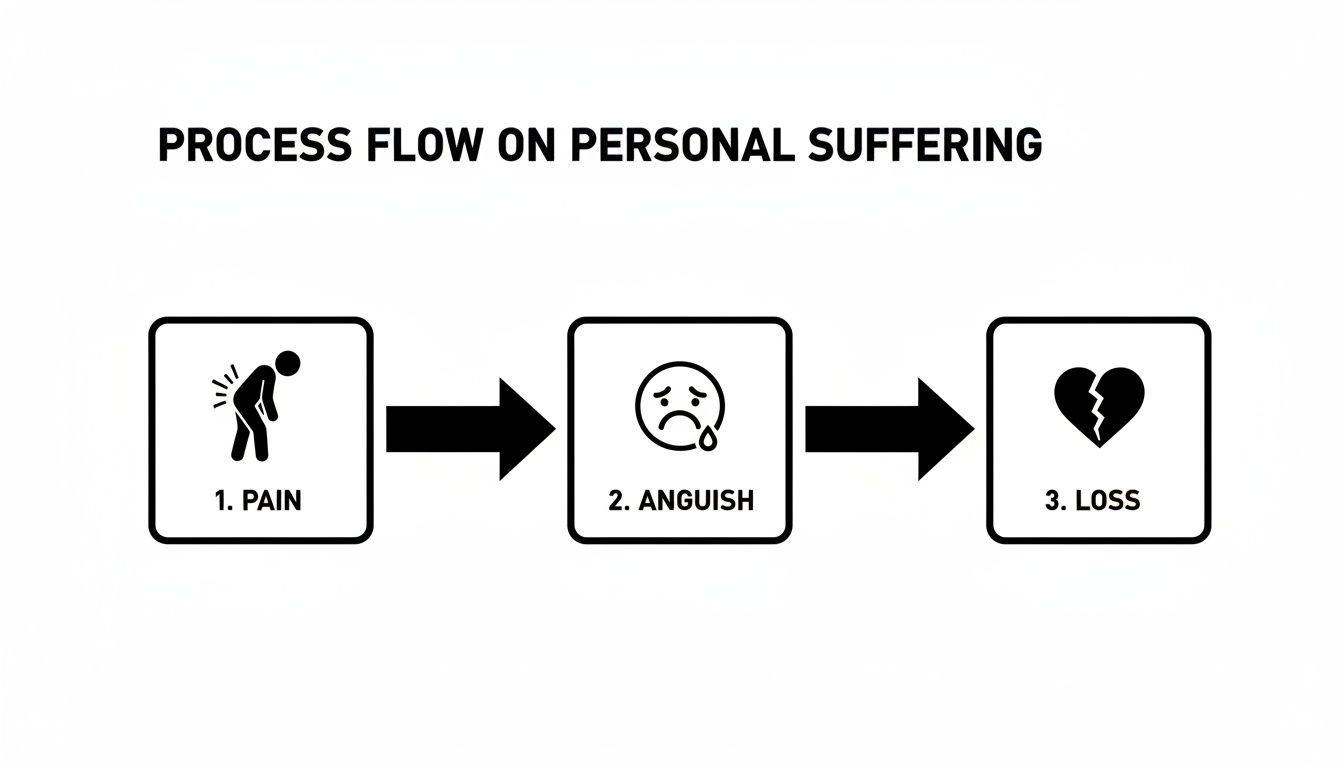
As you can see, a physical injury often creates a ripple effect, leading to deeper emotional anguish and, eventually, a significant loss of life's joys and relationships.
The Multiplier Method
The most common approach you’ll see in Texas personal injury claims is the Multiplier Method. The concept is pretty straightforward: your total economic damages (medical bills, lost wages, etc.) are multiplied by a number, typically between 1.5 and 5, to figure out a value for your non-economic damages.
That multiplier isn't just picked out of a hat. It’s directly tied to how severe and permanent your injuries are.
- Minor Injuries (Multiplier of 1.5-2): Think of a whiplash injury that heals up in a few months with some physical therapy.
- Moderate Injuries (Multiplier of 2-3): This could be a broken arm that needs surgery but is expected to heal completely.
- Serious Injuries (Multiplier of 3-4): A back injury that requires fusion surgery and leaves you with chronic pain and some permanent limitations would fall here.
- Catastrophic Injuries (Multiplier of 5+): A traumatic brain injury or spinal cord injury leading to permanent disability would command the highest multipliers.
Legal frameworks across the country recognize that injury severity is the driving factor. For instance, a broken leg with a six-month recovery might use a multiplier of 2, while a traumatic brain injury could easily justify a 4. The most devastating injuries, like amputation or paralysis, typically hit the top of the scale at a multiplier of 5 to reflect the immense suffering involved. You can learn more about how these damage calculations work in injury cases for a broader perspective.
The Per Diem Method
Another, though less common, strategy is the Per Diem Method. "Per diem" is just Latin for "per day." This method assigns a daily dollar amount to your suffering. That daily rate is then multiplied by the number of days you were in pain, starting from the accident date until you reach what doctors call "maximum medical improvement."
For example, if a reasonable daily rate is set at $200 (often based on what you earn in a day) and your recovery takes 150 days, the math looks like this:
$200/day x 150 days = $30,000 in non-economic damages
This method tends to work best for shorter-term injuries where there's a clear and predictable recovery timeline. It becomes less practical for injuries that result in permanent or lifelong suffering.
Why an Attorney Is Essential for a Fair Valuation
Here’s the hard truth: insurance adjusters are trained to minimize payouts. They will always push for the lowest possible multiplier or a rock-bottom per diem rate. They might try to argue your injuries aren't as bad as you claim or that your emotional distress is overblown.
This is where The Law Office of Bryan Fagan, PLLC, makes a critical difference. A skilled Texas injury attorney doesn't just accept the insurance company’s lowball math. We fight back by building a compelling case to justify a much higher valuation.
We do this by:
- Gathering powerful evidence of your pain, from detailed medical records and expert testimony to personal journals that document your daily struggles.
- Telling your story in a way that truly demonstrates how the accident has impacted every single aspect of your life.
- Negotiating aggressively with the adjuster, armed with the facts and the readiness to take your case to trial if they refuse to be fair.
Your pain is real, and it has value. Don’t let an insurance company be the one to decide its worth.
How to Prove Your Non-Economic Losses in Texas
How do you prove something you can’t put a price tag on? How do you show an insurance adjuster—or a jury—what your pain is truly worth? It takes more than just saying you’re hurting. It requires a powerful, evidence-backed story that shows exactly how this accident has torn through the fabric of your life.
Unlike economic damages, which you can prove with stacks of receipts and bills, non-economic damages are proven by painting a clear picture of how your world has fundamentally changed.

You can start gathering this proof from day one. An experienced Houston car accident lawyer helps you pull all these threads together, weaving them into a compelling narrative that leaves no doubt about the true scope of your suffering.
Documenting Your Daily Reality
Often, the most convincing evidence comes straight from you. Keeping a daily journal is one of the single most effective things you can do to track how the accident impacts you.
This isn’t just a diary; it’s a detailed log of your new reality. It should detail things like:
- Your Pain Levels: On a scale of 1 to 10, how bad was the pain today? When did it flare up?
- Your Emotional State: Note your feelings of anxiety, frustration, sadness, or fear. Did you have a panic attack driving past the crash site?
- Daily Challenges: Write down the specific things you couldn't do or struggled with. Maybe it was something as simple as tying your shoes, sleeping through the night, or picking up your child.
- Missed Moments: Did you have to skip your kid’s soccer game? Miss a family dinner? Cancel a vacation? Record every single one.
This personal record becomes an incredibly powerful tool. It transforms abstract legal terms like "pain and suffering" into a concrete, day-by-day account of your experience, making it much harder for an insurance company to minimize what you've been through.
Gathering Official and Expert Evidence
While your personal account is crucial, it needs to be backed up by official documentation. Your medical records are the foundation, providing an objective timeline of your injuries, treatments, and prognosis. It is absolutely critical that you tell your doctors about all your symptoms—both physical and emotional—at every single visit so they get recorded.
But we don't stop there. To build the strongest case, we often bring in other experts to validate your claims.
- Psychological Evaluations: A formal report from a psychologist or therapist can officially diagnose conditions like PTSD, depression, or severe anxiety, giving credible weight to your mental anguish.
- Expert Testimony: A vocational expert can testify about how your injuries have impacted your ability to work and even enjoy your hobbies, adding another layer of professional validation.
The Power of What Others See
Sometimes, the most impactful testimony comes from the people who know you best. We often ask friends, family members, and even coworkers to share what they've witnessed since the accident. Their perspective can be incredibly persuasive.
They can speak to:
- Changes in your personality—were you once outgoing and now withdrawn?
- The hobbies and passions you've been forced to abandon.
- The visible pain or emotional distress they see in you day-to-day.
- How your relationships with them and others have been strained.
By weaving together your personal journal, detailed medical reports, expert analysis, and heartfelt testimony from loved ones, we paint a complete and undeniable picture of your suffering. This comprehensive approach is essential for building a demand that the insurance company can't ignore, as we detail in our guide on creating a sample demand letter for an auto accident. It’s how we ensure that when we ask for compensation, we’re backing it up with powerful, multi-faceted proof.
Who Is Liable for My Damages After a Texas Car Accident?
To recover any damages—economic or non-economic—you first have to establish liability, which is the legal term for who is at fault for the crash. In Texas, this is determined by the principle of negligence. Simply put, you must prove that the other driver acted carelessly and that their carelessness directly caused your injuries.
Texas follows a "modified comparative fault" rule, also known as proportionate responsibility, outlined in the Texas Civil Practice & Remedies Code, Chapter 33. This means:
- If you are found to be 50% or less at fault for the accident, you can still recover damages. However, your total compensation will be reduced by your percentage of fault.
- If you are found to be 51% or more at fault, you are barred from recovering any compensation at all.
For example, if you are awarded $100,000 but found to be 10% at fault for the crash, your award would be reduced by 10% to $90,000. Insurance companies often try to shift blame to reduce their payout, which is why having a Texas injury attorney to defend your rights is so important.
How Our Lawyers Maximize Your Injury Compensation
Trying to go it alone against an auto insurance company is like stepping into the ring with a professional fighter. The adjusters you’re up against are trained negotiators, and their job is simple: protect their company’s profits by paying you as little as possible, especially for your pain and suffering.
This is exactly where the team at The Law Office of Bryan Fagan, PLLC, steps in. We take the fight off your hands so you can pour all your energy into what truly matters—healing.
Our process is built on a few core actions:
- Thorough Investigation: We start at the beginning, investigating every detail of the crash to prove the other driver was at fault under Texas negligence laws. This is the bedrock of your claim.
- Gathering Compelling Evidence: We collect it all—medical records, police reports, photos from the scene, and even personal journals documenting your daily struggles. We also talk to your friends and family to understand how this has changed your life.
- Consulting with Experts: To paint the clearest picture of your future, we often bring in medical and psychological experts. Their professional testimony on the long-term impact of your injuries is incredibly powerful in proving the true value of your suffering.
This aggressive, detailed approach means we negotiate from a position of strength. We don't just ask for a settlement; we present the insurer with a demand package that vividly details every way the crash has upended your life.
We handle every phone call, every negotiation, and every aggressive tactic from the insurance company. We are your shield, allowing you to focus on getting better.
Our promise to you is straightforward: we will fight to make sure your final compensation covers the total cost of the accident, both the bills you can see and the suffering you feel. We prepare every single case as if it's headed for trial. That readiness sends a clear message to the insurance companies that we mean business, often leading to a much more substantial auto accident settlement without you ever having to set foot in a courtroom.
Common Questions About Texas Car Accident Claims
When you're trying to recover from a car accident, the last thing you need is more confusion. It’s completely normal to have questions about what comes next and what you're entitled to. Here are some straightforward answers to help you see the path forward.
Are There Caps on Non-Economic Damages in Texas Car Wrecks?
This is a huge question for anyone facing significant injuries. The good news is that for most car accident claims against a negligent driver, Texas generally does not cap non-economic damages (as per Texas Civil Practice & Remedies Code, Chapter 41). This means there isn't a predetermined legal limit on what you can recover for your pain, suffering, mental anguish, or the loss of enjoyment in your life.
However, there are specific exceptions, such as in cases against government bodies or in certain medical malpractice claims. Because every situation is different, the only way to be certain is to have a Texas injury lawyer look at the specific facts of your case.
Do I Have to Go to Court to Get Money for Pain and Suffering?
Probably not. Most personal injury cases are settled through negotiations with the at-fault driver's insurance company. A settlement is simply a formal agreement that resolves the claim without the time, stress, and expense of a trial.
That said, our readiness to go to trial is our single most effective tool. Insurance adjusters know which law firms will fight and which ones will just take the first lowball offer. We prepare every single case as if it’s heading for a jury, which gives us serious leverage at the negotiating table. It forces the insurance company to come back with a fair offer that actually reflects everything you’ve lost.
How Long Do I Have to File an Injury Claim in Texas?
Texas law is very strict about this. There's a firm deadline, called the statute of limitations, for filing a personal injury lawsuit. For most accidents, you have just two years from the date of the crash to file your claim.
Two years might seem like a long time, but it disappears fast when you’re juggling doctor's appointments and trying to get your life back on track. It is absolutely critical to act quickly. If you wait, key evidence starts to vanish, and you could lose your right to seek compensation forever. Contacting a Houston car accident lawyer right away is the best way to make sure vital proof is preserved and your rights are protected.
Your story deserves to be heard, and your pain deserves to be properly valued. You don't have to navigate this complex process alone. The dedicated attorneys at The Law Office of Bryan Fagan, PLLC are here to listen, explain your rights, and walk you through every step.
Contact us today for a free, no-pressure consultation to learn how we can fight for the justice and recovery you deserve. Visit us at https://houstonaccidentlawyers.net.