A car crash can change your life in seconds — but you don’t have to face recovery alone. While you're focused on healing, dealing with insurance companies, and figuring out how to pay mounting medical bills, a critical legal deadline is already ticking away.
This deadline is known as the statute of limitations. In Texas, for most personal injury, wrongful death, and property damage claims, it's generally two years from the date of the incident. Missing this deadline isn't a minor mistake—it can permanently block you from recovering a single dollar for your losses.
Your Right to Compensation Has an Expiration Date
After a Texas car accident, your life can feel turned upside down. While you navigate physical recovery and emotional stress, it's easy to overlook the legal countdown that begins the moment the crash happens.

This is the statute of limitations, a Texas law that acts like an expiration date on your right to file a lawsuit and demand justice. Understanding this deadline is one of the most important things you can do to protect your financial future and your family's well-being.
What Is a Statute of Limitations?
In plain English, the statute of limitations is a law that sets the maximum time you have to start legal proceedings after you've been harmed. For a car accident victim, it’s the window of opportunity you have to sue the at-fault driver. If you miss that window, you lose your right to sue forever.
Texas puts these time limits in place for a few practical reasons:
- To preserve evidence: Over time, physical evidence like skid marks disappears, and witnesses' memories fade. Deadlines ensure cases move forward while the facts are still fresh and reliable.
- To provide legal finality: These laws prevent people from living under the indefinite threat of a lawsuit, allowing for closure.
- To ensure fairness: It encourages you to take action promptly, preventing claims from surfacing years later when mounting a defense would be unfairly difficult for the other party.
The Two-Year Deadline for Texas Accident Victims
For anyone injured in a wreck, the most crucial deadline is found in the Texas Civil Practice and Remedies Code § 16.003. This law is clear: you generally have two years from the date of the incident to file a lawsuit for personal injuries. The exact same two-year window applies to claims for property damage to your vehicle.
For a Houston driver injured on the Katy Freeway, missing that two-year deadline can permanently bar compensation, no matter how severe the injuries or how clear the other driver's fault. This is why acting quickly is so vital for protecting your rights.
If you are a family member who has tragically lost a loved one, you also have two years to file a wrongful death claim. But be aware: the clock starts on the date of your loved one’s passing, not necessarily the date of the accident. These timelines are incredibly strict, and Texas courts rarely make exceptions. You can explore more about these legal deadlines and how they are applied by reviewing insights on Texas law.
To keep it simple, here's a quick look at the most common deadlines you'll face after an accident.
Key Lawsuit Deadlines for Texas Accident Victims
This table summarizes the most common statutes of limitations for claims that arise from a car accident in Texas.
| Type of Claim | Standard Deadline | Governing Texas Law |
|---|---|---|
| Personal Injury | Two years from the date of the accident | Texas Civil Practice and Remedies Code § 16.003(a) |
| Property Damage | Two years from the date of the accident | Texas Civil Practice and Remedies Code § 16.003(a) |
| Wrongful Death | Two years from the date of the person's death | Texas Civil Practice and Remedies Code § 16.003(b) |
While these three deadlines cover the majority of cases, it's critical to remember that every situation is unique. As we'll discuss next, there are several exceptions and special rules that can change this two-year countdown.
Why This Legal Countdown Clock Matters for Your Claim
Think of the statute of limitations as a legal hourglass. Once that last grain of sand falls, your opportunity to seek financial justice through the court system is gone forever. It doesn't matter how clear-cut your case is or how badly you were injured.
This isn't just an arbitrary rule. Texas laws create these deadlines for practical reasons, encouraging claims to be brought forward while critical evidence—like dashcam footage or witness memories—is still fresh and reliable. For an accident victim like you, this ticking clock is everything.
The Consequences of a Missed Deadline
If you try to file a personal injury lawsuit even one day late, the at-fault party’s attorney will immediately file a motion to dismiss your case. The court will almost certainly grant it.
The result is devastating. Once your right to sue is gone, you lose all legal leverage to demand fair compensation. The insurance company for the driver who hit you is suddenly off the hook. They are no longer legally obligated to pay for your losses.
This means you could be left responsible for all your medical bills, lost wages, and future care costs. The insurance company knows this. They often use delay tactics, hoping you’ll run out of time before taking legal action.
Understanding this harsh reality is the first, most critical step toward protecting your rights after a car accident.
Real-World Example: A Houston Driver on I-45
Imagine this scenario: A Houston driver is rear-ended on I-45 during rush hour. The crash causes severe whiplash and a herniated disc, leading to months of physical therapy, missed work, and a mountain of medical debt.
For the next 20 months, you negotiate in good faith with the other driver’s auto insurance claim adjuster. The adjuster seems helpful, always asking for one more document and promising a fair settlement is right around the corner.
Trusting the process, you never call a Houston car accident lawyer. Then, two years and one day after the crash, the adjuster calls with a final, insultingly low offer. They know the legal deadline just passed. At this point, you have zero legal recourse. The courthouse doors are closed to you for good.
This is exactly why you cannot afford to wait. That two-year window isn’t a suggestion; it's a hard deadline that insurance companies count on you not understanding. To get a better sense of how these cases unfold, you can check out our guide on how long a personal injury case can take.
How to Protect Your Right to Compensation
The most powerful tool you have against this unforgiving clock is proactive legal counsel. Filing a lawsuit doesn't mean your case is destined for a dramatic trial—in fact, over 95% of personal injury cases settle out of court.
Filing simply protects your legal rights and forces the insurance company to take your claim seriously. An experienced Texas injury attorney will ensure all the paperwork is filed correctly and on time, preserving your ability to pursue the compensation you deserve while you focus on what really matters: your recovery.
Breaking Down the Deadlines for Different Accident Claims
The two-year rule is a great starting point, but it's not the whole story. A single car wreck can lead to several different types of legal claims, and each one can have its own countdown clock. Knowing the difference is vital to protecting your right to full compensation.
One crash can leave you with physical injuries, a wrecked car, and in the most heartbreaking cases, the loss of a family member. The law sees these as separate losses, which means you could have more than one legal deadline running at the same time. Let’s unpack the main categories you need to be aware of.
Personal Injury Claims
This is the claim most people think of after a crash. A personal injury claim is your legal path to getting compensation for your damages—a term that includes medical bills, lost wages, and the physical pain and emotional suffering the accident caused.
For these claims, the statutes of limitations in Texas are straightforward. The two-year clock starts ticking on the exact date of the accident. So, if a distracted driver hits you on I-10 in Houston on May 1st, 2024, you have until May 1st, 2026, to file a lawsuit.
Property Damage Claims
Your personal injury claim doesn't cover the damage to your car. For that, you need a separate property damage claim to recover money for repairs or the replacement value if your vehicle was totaled.
Luckily, Texas keeps this part simple. The deadline for filing a lawsuit for property damage is also two years from the date of the accident. Most people bundle their injury and property damage claims together, but it's crucial to understand they are technically two distinct legal actions.
Wrongful Death Claims
This is where the timeline gets a little different, and it's perhaps the most critical distinction for grieving families to understand. When a loved one tragically dies from injuries sustained in a car accident, the family has the right to file a wrongful death claim. This type of lawsuit is meant to cover funeral costs, the loss of financial support, and the immense emotional void left by a family member's passing. It seeks wrongful death compensation for the harm your family has suffered.
The two-year statute of limitations for a wrongful death claim does not start on the date of the accident. Instead, the clock begins on the date of the person's death.
This is a profoundly important detail. For example, say a crash happens on June 10th, but your loved one fights for their life in the hospital before passing away from their injuries on June 25th. The two-year deadline to file a lawsuit starts on June 25th, not June 10th. This subtle but significant difference gives families the time they need to grieve before facing legal deadlines. If you're navigating this difficult path, you can learn more about how to file a wrongful death lawsuit in Texas.
Trying to keep these different timelines straight is overwhelming, especially when you're also trying to heal. An experienced Texas injury lawyer can take on this burden, making sure every path to compensation is protected while you focus on what matters most—your family's recovery.
When the Countdown Clock Can Be Paused or Extended
While the two-year deadline is a firm rule in Texas, the law recognizes that life isn't always so simple. Some situations make it fundamentally unfair—or impossible—for an accident victim to file a lawsuit on time. In these specific cases, Texas law allows the countdown clock to be paused. This legal concept is known as tolling.
Tolling essentially freezes the deadline until the condition preventing you from filing is resolved. It’s the legal system's way of acknowledging that a child shouldn't be responsible for navigating a lawsuit or that someone with a severe brain injury might not be capable of managing their own legal affairs. This protection is a critical lifeline, showing that your rights may not be lost even if significant time has passed.
When Minors Are Injured in an Accident
One of the most important exceptions involves children. When someone under the age of 18 is hurt in a car crash, their two-year clock doesn't start ticking right away. Texas law understands that a minor can't be expected to pursue a legal claim on their own.
Instead, the statute of limitations is tolled until their 18th birthday. This means a child injured in a Dallas wreck at age 12 would generally have until their 20th birthday—two years after they legally become an adult—to file a lawsuit. It gives them the opportunity to make their own decisions about their legal rights once they're old enough.
Incapacity and Other Special Circumstances
The law extends similar compassion to people who are mentally incapacitated because of their injuries. If a traumatic brain injury from a crash leaves someone of "unsound mind," the two-year deadline can be paused until they regain their mental capacity.
Texas law also has provisions for other unique situations. For instance, if the at-fault driver flees the state after the accident to avoid a lawsuit, the time they spend outside of Texas doesn't count toward the two-year limit. This prevents them from simply running out the clock from another state.
According to Texas Civil Practice & Remedies Code § 16.001, the limitations period for a minor does not begin until they turn 18. Similarly, the clock is paused for individuals deemed to be of 'unsound mind' until they regain capacity. Under § 16.063, the statute is also tolled for any period the defendant is absent from the state. For certain medical malpractice claims, sending a formal notice can toll the statute for up to 75 days. You can learn more about these legal exceptions in Texas.
The Discovery Rule
Sometimes, the most serious injuries aren't obvious right after a crash. You might walk away feeling sore but fine, only to develop debilitating back pain months later that a doctor traces back to a herniated disc from the accident. In these limited cases, the discovery rule may apply.
The discovery rule says that the statute of limitations clock doesn't start until the date you knew, or reasonably should have known, about your injury. This is a complex legal standard, and proving it often requires the skill of an experienced Texas injury attorney.
This decision tree shows the different paths a claim can take after an accident.
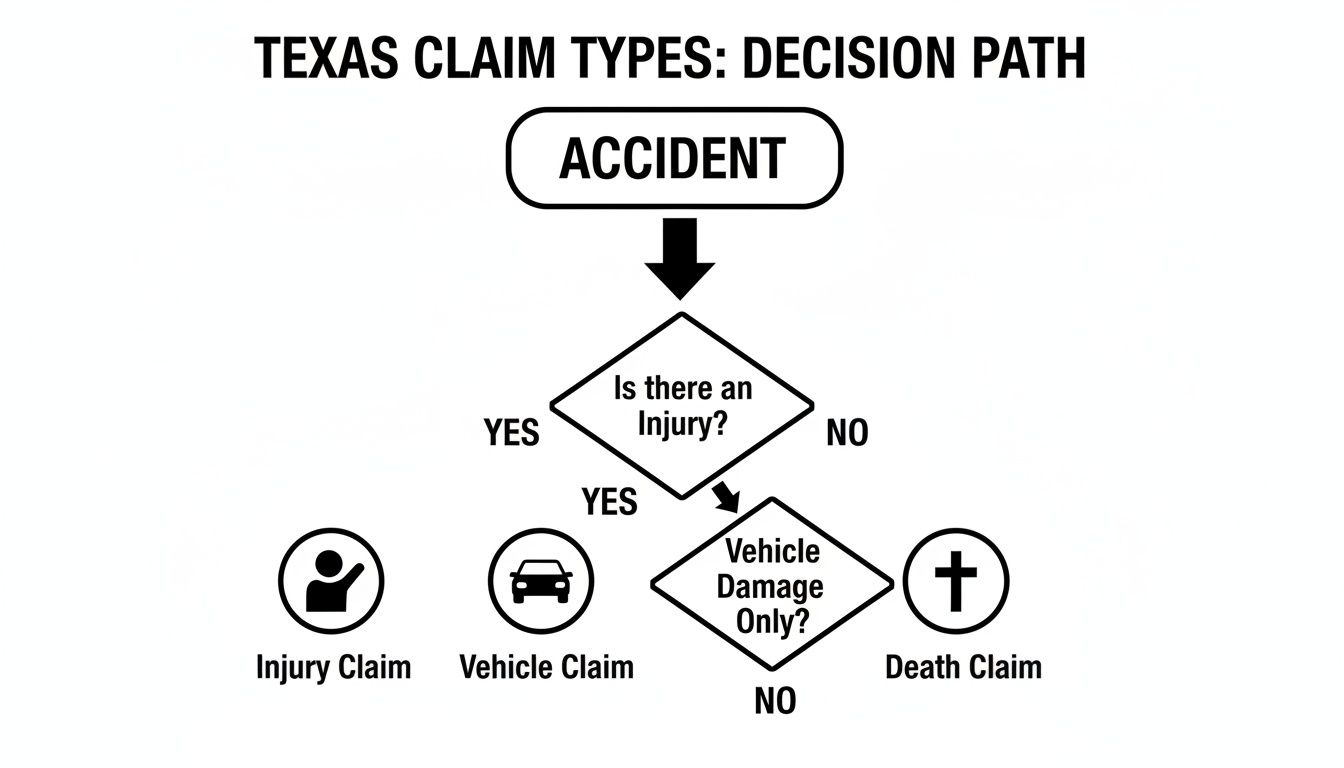
As the visual highlights, a single accident can result in claims for personal injury, vehicle damage, or wrongful death, each with its own potential timeline. Navigating these exceptions is tricky, and figuring out whether your deadline can be extended requires a careful legal analysis of your specific situation.
Navigating Claims Against Government Entities in Texas
What happens if your accident involves a city bus, a state-owned truck, or a poorly maintained public road? Suing the government isn’t like suing a regular person or a private company. A legal shield called sovereign immunity protects government bodies from most lawsuits.
But that shield isn't absolute. The Texas Tort Claims Act creates limited situations where you can hold the government accountable for injuries. The most common one is when a government employee’s negligence while driving a motor vehicle causes a crash. The catch? You have to move incredibly fast.
The Critical Notice of Claim Deadline
Forget the standard two-year statute of limitations for a moment. When a government entity is involved, a much shorter, far more dangerous deadline comes first: the notice of claim. This is a formal, written notification you must send to the correct government agency, alerting them to your injury and your intent to seek compensation.
How short is this deadline? It depends on the agency, but it’s never long. Many cities and state departments require this notice within 90 to 180 days of the accident. Some local governments have even tighter windows, demanding notice in as little as 45 or 60 days.
If you miss this notice deadline, your case is almost certainly over before it begins. It doesn’t matter how clear the government’s fault is or that you’re still within the two-year window to file a lawsuit. The court will dismiss your case, and your right to recover anything is permanently lost.
This rule is a procedural trap that’s shockingly easy for an injured victim to fall into while trying to heal.
A Real-World Example in San Antonio
Imagine you’re driving through San Antonio when a city maintenance truck runs a red light and T-bones your car. You’re seriously hurt and spend the next five months focused on doctor’s appointments, thinking you have plenty of time to deal with the legal side of things.
But when you finally call a lawyer, you get devastating news. The City of San Antonio’s charter requires a formal notice of claim to be filed within just 90 days of the incident. Because you missed that deadline, your claim is likely barred. The city is now immune from your lawsuit, no matter how negligent their driver was.
This is a heartbreaking scenario we see all too often. The rules are unforgiving, and Texas courts enforce them strictly.
Why You Must Act Immediately
Claims against government entities are among the most complex and time-sensitive injury cases. The notice requirements are confusing, and just figuring out who to notify is a challenge. You don't have time to sort these details out on your own. If you’ve been in any accident involving a government vehicle—from a police car to a school bus—your first steps are critical:
- Get Medical Help: Your health always comes first.
- Document Everything: Take clear photos of all vehicles, paying close attention to any government seals, logos, or markings.
- Call an Attorney: Immediately consult a Texas injury lawyer with experience handling cases under the Texas Tort Claims Act.
An experienced attorney can cut through the red tape, identify the responsible government body, find the exact notice deadline, and make sure every procedural step is handled perfectly. This is not a situation to handle on your own—protecting your rights starts the moment the accident happens.
Steps to Protect Your Rights After a Texas Accident
Knowing about the statutes of limitations in Texas is one thing, but taking decisive action is what actually protects your future. Think of that two-year clock not as time to wait, but as the time you have to build a strong case. While you’re focused on healing, it's critical to safeguard your legal rights with a clear, proactive plan.

The moments, days, and weeks after a crash are a whirlwind of pain and confusion. But the steps you take during this period can make or break your ability to recover the compensation you deserve.
Your Immediate Post-Accident Checklist
Your well-being is always the top priority. Once you’re safe, a few key actions can preserve critical evidence and protect your claim from the very beginning.
-
Seek Immediate Medical Attention: Go to a doctor or an emergency room right away, even if you feel fine. Serious injuries like concussions or internal damage don't always show symptoms immediately. This visit creates an official medical record that links your injuries directly to the crash.
-
Preserve All Evidence: Keep everything related to the accident. This includes photos from the scene, your medical bills, the police report, and any letters you get from insurance companies. Every document helps tell your story.
-
Avoid Speaking with the Other Driver's Insurer: The at-fault driver's insurance adjuster is not on your side. Their job is to minimize your claim or get you to accept a quick, lowball settlement. It's always best to politely decline to give a recorded statement until you've spoken with an attorney.
For a more detailed walkthrough, check out our guide on what to do after a car accident to make sure you cover all your bases.
Why Consulting an Attorney Is Not a Last Resort
Many people think they only need a lawyer if their case goes to court. This is a dangerous myth. The most critical time to speak with a Houston car accident lawyer is as soon as possible after the wreck, because that two-year deadline approaches much faster than you think.
Waiting too long to get legal advice is one of the biggest mistakes you can make. Evidence vanishes, witness memories fade, and insurance companies will use that ticking clock against you. An attorney levels the playing field from day one.
An experienced lawyer immediately takes over the burdens you shouldn't have to carry. They will:
- Manage All Communications: Your attorney will handle all calls and paperwork from insurance adjusters, shielding you from their tactics.
- Investigate the Crash: They can gather police reports, interview witnesses, and bring in experts when needed. After a Texas accident, securing expert forensic assistance for legal teams in Texas can be a critical step in building a strong legal case.
- Calculate Your True Damages: They will assess all of your losses—medical bills, future treatment costs, lost income, and pain and suffering—to determine what your claim is truly worth.
- Ensure Deadlines Are Met: Most importantly, they will make sure every legal document is filed correctly and long before any statute of limitations runs out.
You've been through enough. You shouldn’t have to face the legal system alone or live in fear of missing a critical deadline. The compassionate team at The Law Office of Bryan Fagan, PLLC is here to help you understand your rights and fight for the recovery you deserve. Contact us today for a free, no-obligation consultation to discuss your case.
Common Questions About Texas Injury Deadlines
After a car wreck, you're dealing with enough confusion. It's completely normal to have questions about your rights and the legal timelines you're up against. Here are some of the most common questions our clients ask about the statutes of limitations in Texas, answered in plain English to help you feel more in control.
What Happens If I Miss the Deadline to File My Lawsuit?
If you let the two-year window close, your right to get compensation through the courts is almost certainly gone for good. The other driver's lawyer will immediately ask the judge to dismiss your case based on the expired deadline, and the judge will have no choice but to agree.
It doesn't matter how strong your case is or how clear the other person's fault was. Once that deadline passes, you are legally barred from recovering a single penny for your medical bills, lost wages, or pain and suffering. This is why the statute of limitations is so unforgiving—it's an absolute final cutoff.
Does Talking to the Insurance Company Pause the Clock?
No, and this is one of the most dangerous misunderstandings. Negotiating a settlement with an auto insurance claim adjuster does absolutely nothing to stop or "toll" the two-year countdown.
Insurance companies know this deadline well. Some adjusters will deliberately drag out negotiations, making you feel like a fair settlement is just around the corner, all while hoping you'll let the clock run out. You must file a lawsuit before the deadline passes, even if you’re in the middle of what seem like productive talks with the insurer.
It's a classic tactic: an adjuster seems friendly for months, only to make a ridiculously low offer—or deny your claim entirely—right before your two years are up. At that point, all your leverage has vanished.
How Soon After My Accident Should I Contact an Attorney?
As soon as you can. Contacting a Texas injury attorney right after your accident is one of the smartest moves you can make, long before the deadline is on the horizon. That two-year window isn't time to sit back and wait; it's the time your lawyer needs to build a powerful case on your behalf.
Acting quickly gives your legal team the chance to:
- Preserve crucial evidence like security camera footage before it disappears.
- Investigate the crash while memories are still fresh for witnesses.
- Handle all communication with insurance adjusters, shielding you from their delay tactics.
- Build leverage to negotiate a fair settlement without the pressure of a looming deadline.
Waiting until the last minute puts your entire claim at a serious disadvantage. The sooner you get an expert in your corner, the better your chances of a successful outcome.
Can I Still File a Claim If I Did not Realize I Was Injured Right Away?
In some very specific situations, you might be able to. Texas law includes the "discovery rule," which says the statute of limitations clock doesn't start ticking until the date you discovered your injury, or reasonably should have discovered it.
For instance, if a specialist diagnoses you with a traumatic brain injury 18 months after a crash and can medically prove it was caused by the accident, the discovery rule could potentially apply. But this is a very high legal bar to clear and is never a guarantee. You absolutely need to speak with a skilled Houston car accident lawyer to determine if this narrow exception could apply to your case.
The legal system is complicated, but you don’t have to face it alone. At The Law Office of Bryan Fagan, PLLC, our experienced team is ready to answer your questions, manage every deadline, and fight for the full compensation you deserve. Contact us today for a free, no-obligation consultation to learn how we can protect your rights and your future. Visit us at https://houstonaccidentlawyers.net to get started.