A car crash can change your life in seconds—but you don’t have to face recovery alone.
A T-bone accident, also known as a side-impact collision, happens when the front of one vehicle crashes directly into the side of another, forming a "T" shape. These crashes are especially dangerous because the sides of a vehicle offer very little protection compared to the front or back, often leading to serious injuries for those inside.
The Shocking Reality of a T-Bone Accident
It happens in an instant, often at an intersection, and your life is turned upside down without warning. One moment you're driving through a green light in Houston, and the next you're reeling from the terrifying force of a vehicle crashing into your driver's side door.

This guide is here to help you understand what just happened. We will explain why these accidents are so severe, how Texas law determines who is responsible, and the practical steps you can take to protect your health and your legal rights.
Understanding the Basics of a Side-Impact Crash
Think about the front and back of your car. They have crumple zones—the engine block and the trunk—designed to absorb a massive amount of force in a head-on or rear-end collision. But what's on the side? Usually, just a thin door and a window.
This lack of protection means the force of the impact is transferred directly to you and your passengers. It’s the reason T-bone collisions so often lead to catastrophic injuries. Your well-being and legal rights are what matter most right now, and knowing what to do next is the first step toward recovery.
You are not alone in this. The immediate aftermath of a crash is confusing and frightening, but understanding your situation is the first step toward regaining control. A knowledgeable Texas injury attorney can provide the clarity and support you need.
To get started, here's a quick look at the key elements of these dangerous collisions.
T-Bone Accident at a Glance
This table breaks down the fundamental aspects of a T-bone accident to give you a clear, immediate understanding of the situation.
| Aspect | Description |
|---|---|
| Collision Type | A perpendicular crash where one car's front hits another's side. |
| Common Location | Intersections, especially when a driver runs a red light or stop sign. |
| Primary Danger | Minimal protection on the sides of vehicles leads to severe injuries. |
| Legal Focus | Often involves proving another driver's negligence, like failing to yield. |
Having these basics in mind helps frame the challenges ahead as you navigate the aftermath.
Why Side-Impact Collisions Are So Dangerous
T-bone accidents are among the most brutal types of crashes you can experience. Unlike the front or rear of your car, which has an engine block and a trunk to act as "crumple zones" to absorb impact, the sides of your vehicle have almost nothing to protect you. It's just a door and a window.
This minimal protection leaves you and your passengers incredibly vulnerable to the full force of a collision.
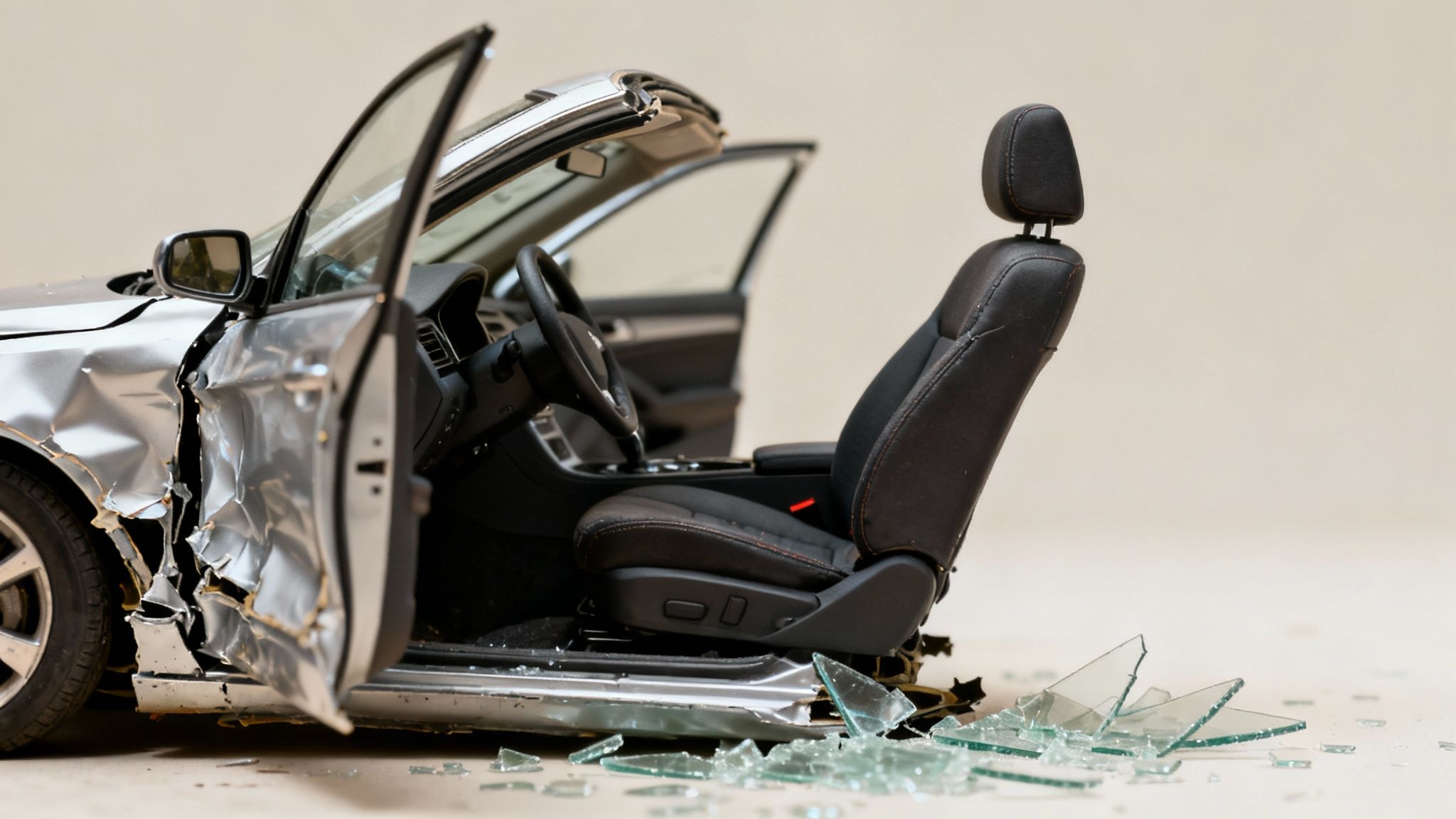
The direct force of the impact is transferred almost entirely to the people inside. This raw, blunt force is why a T-bone accident so often leads to catastrophic harm.
The Physics of a Side Impact
During a side-impact crash, there’s very little structure to slow down the striking vehicle before it intrudes into the passenger cabin. The energy from that collision has nowhere else to go but straight into the side of your car and, tragically, into its occupants.
This violent transfer of energy can throw your body sideways, causing devastating contact with the car's interior or even the other vehicle itself. The consequences are often life-altering, highlighting the urgent need for both immediate medical care and experienced legal support.
Common Injuries in T-Bone Accidents
The injuries from T-bone accidents are typically severe and, all too often, fatal. Medical research consistently shows that blunt force trauma, particularly to the chest and head, is a common outcome. In fact, one study on side-impact collisions found that head injuries were incredibly frequent, with brain trauma leading to more fatalities than injuries to any other organ. You can learn more about these injury findings here.
Because of this, victims often suffer from:
- Traumatic Brain Injuries (TBIs) from the head slamming into a window or being violently jolted.
- Spinal Cord and Neck Injuries, which can include herniated discs, fractures, or even paralysis.
- Broken Bones, especially pelvic, hip, and rib fractures due to the direct side impact.
- Severe Internal Organ Damage and internal bleeding from the sheer force of the crash.
The moments after a T-bone crash are critical. Even if you feel fine, adrenaline can mask serious internal injuries. Seeking immediate medical attention is essential for your health and for documenting the harm you've suffered for a potential auto insurance claim.
Because the potential for serious harm is so high, it's vital to understand what causes these wrecks. Recognizing the negligence that leads to a T-bone collision is the first step toward holding the responsible driver accountable. If you or a loved one has suffered, a compassionate Houston car accident lawyer can help you navigate the difficult road ahead.
Common Causes of T-Bone Accidents in Texas
Side-impact collisions rarely happen by chance. They are almost always the result of a driver’s preventable mistake—a moment of carelessness that ends in devastation. On Texas’s crowded roads, these errors are tragically common.
A T-bone accident is alarmingly frequent, making up a staggering 44.9% of all two-vehicle accidents. Even worse, these crashes are disproportionately deadly, causing nearly a quarter of all deaths in passenger vehicles. You can discover more insights about crash data here. Understanding what causes them is the first step toward protecting your rights.
Intersection-Related Negligence
Intersections are ground zero for T-bone wrecks. The entire system of lights and signs depends on every driver following the rules. When one person breaks that trust, other people pay the price.
The most common negligent actions include:
- Running Red Lights or Stop Signs: This is the most clear-cut cause. A driver ignores a traffic signal and barrels straight into the path of cars that have the right of way.
- Failure to Yield on a Left Turn: A driver turning left must wait for oncoming traffic to clear. Impatience or misjudging another car's speed can lead to a violent collision.
- Speeding Through an Intersection: Trying to "beat the yellow light" is a recipe for disaster. Excessive speed reduces a driver's reaction time and dramatically increases the force of impact.
Imagine a driver speeding down I-45 in Houston, trying to make it through an intersection before the light changes. They misjudge it, enter the intersection on red, and plow into a family that just got the green light. It happens in an instant and changes lives forever.
Driver Inattention and Impairment
Beyond blatant rule-breaking, a driver's state of mind and focus are huge factors in these crashes. In today's world, distractions are everywhere.
"A distracted driver is a dangerous driver. A few seconds looking at a phone is all it takes to miss a stop sign and forever change someone's life."
Key contributing factors include:
- Distracted Driving: Texting, taking a call, or even fiddling with the GPS takes a driver’s eyes and mind off the road at the most critical moments.
- Driving Under the Influence (DUI): Alcohol and drugs impair a person's judgment, coordination, and reaction time, making it nearly impossible to navigate an intersection safely.
- Driver Fatigue: A drowsy driver can be just as dangerous as a drunk one. Their reflexes are slow, and their decision-making is dangerously impaired.
Recognizing these common forms of negligence is crucial. It’s the foundation for building a strong case with a Texas injury attorney and holding the responsible driver accountable for the harm they’ve caused.
Who Is Liable in a Texas Car Accident?
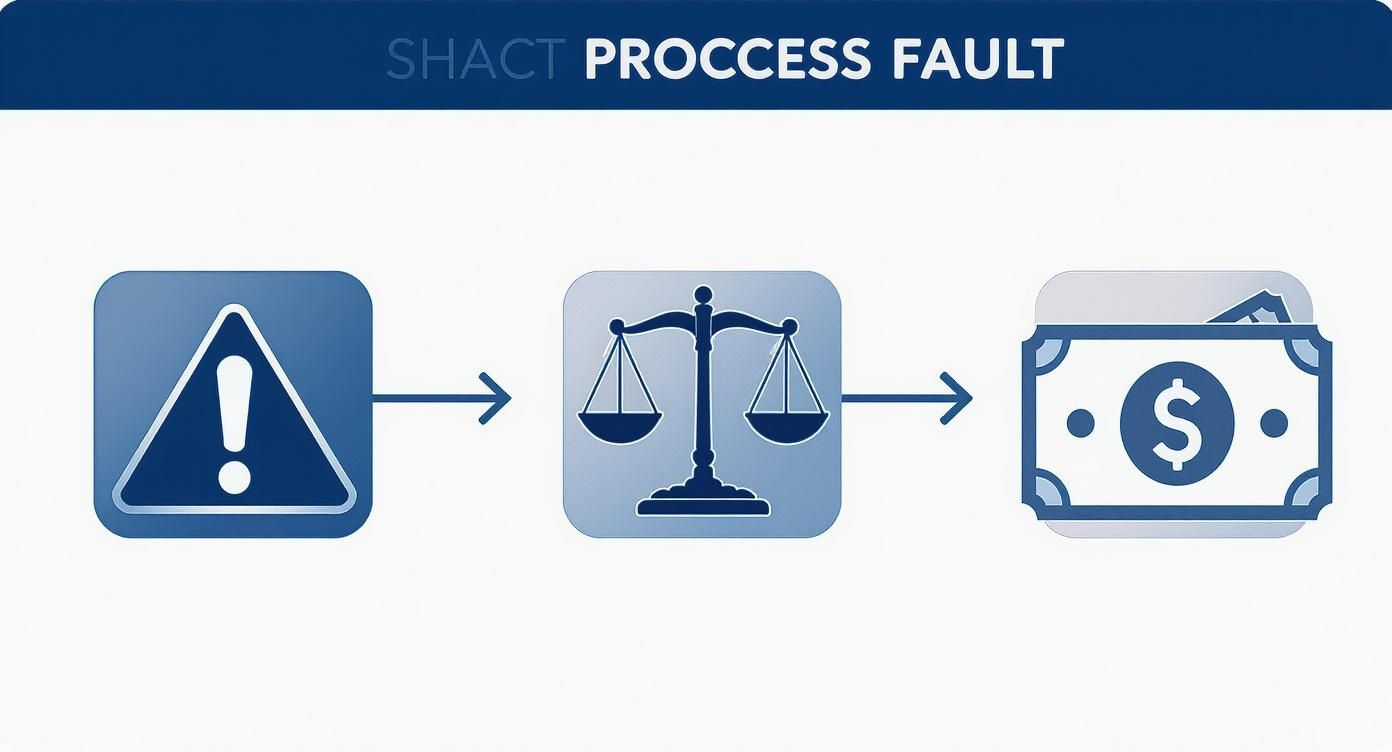
After the shock of a T-bone crash, one of the first questions you'll have is, "Who is going to pay for this?" In Texas, the answer hinges on a legal concept called negligence. In plain English, negligence means someone else failed to drive with reasonable care, and that failure directly caused your injuries.
To receive compensation for your medical bills, lost income, and suffering, you must prove the other driver was negligent. For instance, if a driver ran a stop sign on a busy Houston street and slammed into your side, their decision to ignore traffic laws is clear evidence of negligence.
How Texas Law Handles Shared Fault: Comparative Fault
Sometimes, more than one person shares the blame for a collision. This is where Texas’s modified comparative fault rule, also known as the 51% Bar Rule, comes into play (Texas Civil Practice & Remedies Code, Chapter 33).
Here’s what it means for you:
- You can still recover money for your injuries even if you were partially at fault.
- Your final compensation award will be reduced by your percentage of fault.
- The critical part: Your share of the fault cannot be 51% or more. If a jury finds you were 51% or more responsible, you are legally barred from recovering any money.
For example, if you were found 10% at fault for a T-bone crash, and your total damages were $100,000, your final award would be reduced by 10% ($10,000), leaving you with $90,000. However, if you were found 51% at fault, you would receive nothing.
Key Takeaway: The 51% rule makes it essential to build a strong case that minimizes your share of fault. Insurance adjusters are experts at shifting blame to reduce their payout or deny your claim entirely. This is why having a skilled Texas injury lawyer on your side is so important.
Proving Negligence and Determining Liability
Proving the other driver was negligent is the foundation of your personal injury claim. Liability—the legal and financial responsibility for the crash—is assigned based on who was negligent. In most T-bone wrecks, liability falls on the driver who ignored the right-of-way.
To establish this, your attorney will gather crucial evidence, including:
- The official police report.
- Photos and videos of the vehicle damage, intersection, and traffic signals.
- Statements from witnesses.
- Dash cam or nearby traffic camera footage.
This evidence helps create a clear picture of the accident, showing exactly who failed to follow the rules of the road. Determining liability can get tricky, especially if you're navigating a third-party insurance claim. A good lawyer will investigate every angle to make sure the right people are held accountable.
Steps to Take After a T-Bone Crash
The moments after a T-bone crash are confusing and chaotic. It’s natural to feel overwhelmed. However, the choices you make in this critical window can shape both your physical recovery and the success of your insurance claim.
Here are the practical, step-by-step actions you should take.
1. Prioritize Safety and Call 911
Your first priority is safety. Check yourself and your passengers for injuries. If you can, check on the occupants of the other vehicle. Call 911 immediately to report the crash and request medical assistance. Even if you feel fine, adrenaline can mask serious injuries like concussions or internal bleeding.
2. Secure The Scene And Gather Evidence
While waiting for help, document everything you can. Stick to the facts—never apologize or admit fault, as this can be used against you later.
Use your phone to:
- Photograph the damage to all vehicles from multiple angles.
- Record where the cars came to rest after the impact.
- Capture the entire intersection, including traffic lights, stop signs, and any skid marks.
- Document any visible injuries.
If there are witnesses, politely ask for their names and contact information. Their statements can be vital. Remember, A dash cam can provide invaluable evidence to show exactly what happened.
3. Seek Medical Attention and Report the Accident
See a doctor as soon as possible, even if you don't feel hurt. A medical evaluation creates an official record that links your injuries directly to the crash—a crucial piece of evidence for your claim.
Once you are safe, notify your own insurance company about the accident. However, do not give a recorded statement to the other driver’s insurer until you have spoken with a Texas personal injury attorney. For a complete checklist, see our guide on what to do after a car accident in Texas.
How to File an Insurance Claim and Recover Damages
After a T-bone accident, you are left to pick up the pieces—physically, emotionally, and financially. Texas law gives you the right to seek compensation for these losses, which are legally known as damages. Understanding what you can claim is the first step toward getting the justice you deserve.
The process begins by filing an auto insurance claim, but it's important to know that the other driver’s insurance company is not on your side. Their goal is to protect their profits by paying you as little as possible.
Understanding the Compensation You Can Recover
In Texas personal injury cases (Texas Civil Practice & Remedies Code, Chapter 41), damages are split into two main categories:
- Economic Damages: These are the tangible, calculable costs resulting from the crash. They include all medical bills (past and future), lost wages from being unable to work, and the cost to repair or replace your vehicle.
- Non-Economic Damages: These compensate you for the immense personal suffering that doesn’t have a clear price tag. This includes your physical pain, emotional distress, mental anguish, and loss of enjoyment of life.
A skilled Houston car accident lawyer can help you calculate the full scope of your damages to ensure nothing is overlooked. When sharing your medical records, it is also important to use secure, HIPAA-compliant methods for transmitting healthcare documents.
Deadlines and Dealing with Insurance Adjusters
You must act quickly. In Texas, the statute of limitations gives you a strict two-year deadline to file a personal injury lawsuit. If you miss this window, you lose your right to seek compensation in court forever.
Soon after the crash, you will likely get a call from an insurance adjuster. They may sound friendly, but their job is to minimize their company’s payout. For more on their tactics, learn how to deal with insurance adjusters. They will often push for a quick, lowball settlement or try to get you to say something that can be used to blame you for the accident.
Never give a recorded statement or sign any documents from an insurance company without talking to an attorney first. They are experts at twisting your words to weaken your claim.
An experienced Texas injury attorney can take over all communications with the insurance company for you. We handle the aggressive negotiations and build a powerful, evidence-backed case to fight for the full compensation you are owed. Your job is to focus on healing, not haggling with adjusters.
How a Houston Car Accident Lawyer Can Help You
Trying to handle the aftermath of a T-bone accident alone is overwhelming. You’re hurt, stressed, and now facing insurance adjusters and stacks of paperwork. But you don’t have to go through this by yourself. A dedicated Texas injury attorney is your advocate, taking charge of the legal details so you can focus all your energy on healing.
The moment you hire us, we launch an independent investigation. We work quickly to secure critical evidence—like traffic camera footage, police reports, and witness statements—before it disappears. We also consult with medical and financial experts to calculate the true, long-term cost of your injuries, ensuring that everything from future surgeries to lost earning potential is accounted for.
Then, we take the fight to the insurance companies. Their goal is to pay as little as possible, but our goal is to secure the fair settlement you need to rebuild your life. We are skilled negotiators, but if the insurance company refuses to offer a fair settlement, our trial-tested attorneys are always prepared to take your case to court.
Your only job is to get better. Our job is to handle the rest. We are here to lift the legal burden from your shoulders.
Don't try to face this challenge by yourself. A compassionate Houston car accident lawyer can protect your rights and help you secure the financial support you need for your recovery.
A car crash can change your life in an instant, but you don't have to face the recovery process alone. Contact The Law Office of Bryan Fagan, PLLC today for a free, no-obligation consultation. We'll listen to your story, explain your rights, and show you how we can help you get the justice and financial support you deserve. Visit us at https://houstonaccidentlawyers.net to get started.