Skip to content
A car crash can change your life in seconds—but you don’t have to face recovery alone. In the moments after a collision, your priorities are simple: make sure everyone is safe, call 911, and avoid discussing who was at fault. Taking these steps protects your well-being and builds the foundation for the financial recovery you deserve.
Your Immediate Actions at the Accident Scene
The moments after a car accident are a blur of confusion and shock. Your adrenaline is pumping, which makes it incredibly hard to think straight. But what you do right after a crash—whether it's on a packed Houston freeway like I-45 or a quiet neighborhood street—can make all the difference for your physical recovery and your ability to get fair compensation.

Prioritize Safety First
Before you do anything else, check on yourself and your passengers. If anyone is hurt, their well-being comes first. If your vehicle is still drivable and it's safe to do so, move it over to the shoulder. This helps prevent another collision and protects you from oncoming traffic. Flip on your hazard lights immediately to warn other drivers.
Always Call 911
This is non-negotiable, even if the accident seems minor. There are two critical reasons why you should always make this call:
- You Need a Medical Assessment: Paramedics can check for injuries right there. Serious issues like whiplash or internal bleeding might not show symptoms right away because of the shock and adrenaline. A medical evaluation at the scene is the first step in documenting your injuries.
- You Need an Official Police Report: A responding officer will create an official accident report. This document is a vital piece of evidence. It offers an objective account of the scene, notes witness information, and sometimes includes the officer's initial assessment of fault. This report becomes the backbone of your auto insurance claim.
Getting medical help right away is crucial. Prompt medical attention after a crash can dramatically improve the outcome for serious injuries. Waiting can lead to complications and is a major cause of preventable harm after accidents, a fact that traffic safety experts constantly emphasize.
What to Say and What to Avoid
Stay calm and cooperate with the police when they arrive. However, be very careful what you say to the other driver. Never apologize or say anything that could sound like you're admitting fault, like, "I didn't see you." Insurance adjusters can and will use statements like that against you later.
Key Takeaway: Stick to the facts when you talk to anyone at the scene. Your job is to focus on safety and gathering information, not figuring out who was at fault.
Beyond the immediate scene, managing any physical discomfort is important; understanding when to apply ice or heat for injuries can be a big help in the early stages of recovery. Also, if children were involved, you need to make sure their car seats are still safe to use. You can find more specific guidelines in our article on https://houstonaccidentlawyers.net/2025/11/10/texas-regulations-on-car-seats/.
How to Document Evidence After a Crash
Once you've made sure everyone is safe and you've called 911, your next job is to gather information. The evidence you collect right then and there can be the single most important factor in proving your auto insurance claim and protecting your rights.
Your smartphone is your best friend in this situation. It’s the tool that will help you build a clear, undeniable record of what happened.
Your Smartphone is Your Most Powerful Tool
Start taking photos and videos of everything. Don't just snap a few quick pictures of the dent in your door. You need to paint a complete picture of the scene for anyone who wasn't there.
- Vehicle Damage: Get up close. Photograph every scratch, dent, and broken part on all vehicles involved. Then, step back and take wider shots to show the full context of the damage.
- The Big Picture: Capture the final resting positions of the cars. Photograph any skid marks on the road, shattered glass, or other debris scattered from the impact.
- The Surroundings: Look around. Are there traffic lights? Stop signs? Was a sign hidden by a tree branch? Were there construction barrels narrowing the lane? Document the road conditions, weather, and anything else that might have played a role.
- Visible Injuries: If you have any cuts, scrapes, or bruises, take pictures of them immediately. Injuries can change or fade over time, so capturing them right away is crucial.
Get the Facts: Information is Your Ammunition
As you're documenting the scene, you also need to swap information with the other driver. Stay calm and stick to the facts. This isn't the time for arguments or accusations.
Politely ask for—and take a picture of—the other driver's:
- Full Name and Phone Number
- Driver's License
- Insurance Card (get the company name and policy number)
- License Plate Number
Now is also the time to look for witnesses. People often stop to help, but they won't stick around forever. If you see someone who saw the crash, ask them for their name and number. A simple, "Excuse me, did you see what happened? Would you mind if I got your contact information?" can be incredibly helpful. An independent witness can completely validate your side of the story.
The information you gather does more than just help your claim. According to the World Health Organization, accurate accident reporting provides critical data that helps authorities identify dangerous intersections and improve road safety for everyone.
The Most Important Thing to Not Say
Adrenaline will be pumping, and it’s human nature to want to be polite, even apologetic. You have to fight that urge.
Crucial Advice: Never, ever apologize or admit fault after an accident. Saying something as simple as "I'm so sorry" or "I didn't see you there" can be used against you later by an insurance adjuster to argue that you accepted liability.
Don't discuss fault at all. Your only job is to collect facts. Let the police report and your lawyer determine who was responsible.
Essential Information to Collect at the Scene
| Information Type | What to Get | Why It's Important |
|---|---|---|
| Other Driver Info | Name, address, phone number, driver's license number | To identify the at-fault party for your insurance claim. |
| Insurance Details | Insurance company name, policy number, phone number | This is how you'll initiate the claims process. |
| Vehicle Details | Make, model, year, license plate number, color | Helps accurately identify the vehicle in all reports. |
| Witness Info | Name, phone number, email address | Provides an unbiased account of the accident. |
| Police Info | Officer's name, badge number, report number | The official police report is a key piece of evidence. |
| Scene Details | Date, time, location (street names, mile markers) | Establishes the official record of when and where it happened. |
Having this list handy—maybe saved as a note on your phone—ensures you don't miss anything critical in the heat of the moment.
Finally, start a dedicated folder for everything related to the accident. This is where you'll keep the police report, photos, medical bills, and all your repair records. Be sure to get detailed mechanic repair receipts that itemize all the work done. Staying organized from day one will make the entire claims process much smoother.
Who Is Liable in a Texas Car Accident?
After a wreck, the biggest question is always the same: who pays for everything? From your medical bills to your car repairs, the financial stress can be overwhelming. Texas is an "at-fault" state, which means the person who caused the crash is legally responsible for the harm they caused. We call this liability.
To get the compensation you need, your Houston car accident lawyer must prove the other driver was negligent. Negligence is a legal term for failing to act with reasonable care. For example, a driver is negligent when they are texting, speeding, or running a red light. We must show that their careless actions directly caused your injuries and financial losses, which the law calls damages.
Understanding Comparative Fault in Texas
But what happens if both drivers share some of the blame? Imagine a Houston driver rear-ended you on I-45, but one of your brake lights was out. This is where Texas law gets tricky.
Our state uses a rule called modified comparative fault, also known as the 51% bar rule (found in Texas Civil Practice & Remedies Code, Chapter 33). This law is a huge factor in determining whether you can get paid, and how much.
Here's how it breaks down:
- If you are 50% or less at fault, you can still recover money for your damages. However, your total payout will be reduced by your percentage of fault.
- If you are 51% or more at fault, you get nothing. You are completely barred from recovering any compensation.
This is exactly why insurance adjusters work so hard to pin even a little bit of the blame on you. Every percentage point they can shift in your direction saves them money and pushes you closer to that 51% cutoff.
How Fault Impacts Your Compensation
Let's put this into a real-world context. Say your total damages—medical bills, lost income, and vehicle repairs—add up to $50,000. If a jury decides you were 20% responsible for the crash, your final award is cut by that amount ($10,000). You'd walk away with $40,000.
Key Takeaway: With the 51% bar rule hanging over every claim, evidence is everything. The photos you take at the scene, the witnesses you find, and the details in the police report are all critical pieces of the puzzle. They work together to build a strong case for the other driver's liability and protect your right to full and fair compensation.
The infographic below highlights the first critical actions you need to take to start gathering that proof.
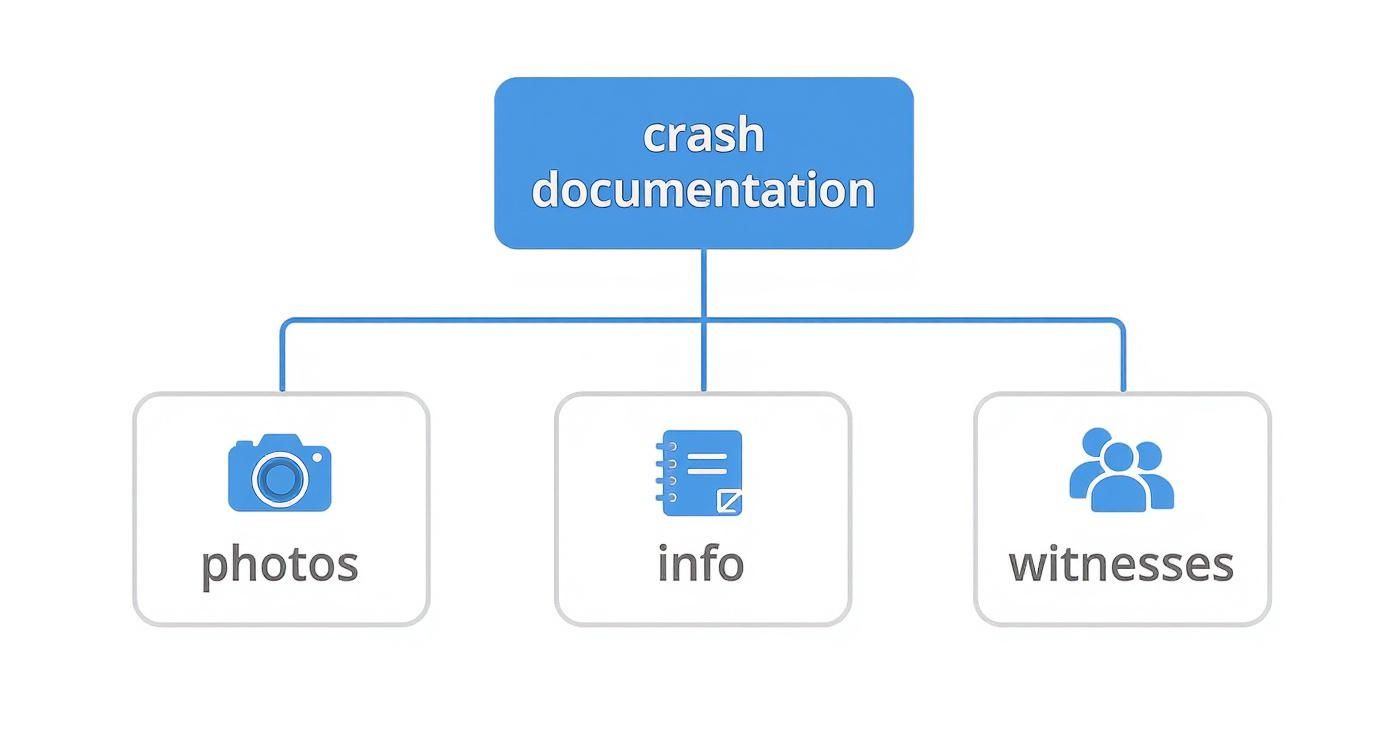
Think of this as your starting point. Documenting the scene properly lays the foundation for proving fault and successfully navigating the complexities of Texas's fault laws. It all starts in those first few moments after the impact.
Steps to File an Insurance Claim
Dealing with insurance companies after a crash can feel like a high-stakes game where you don't know the rules. The constant calls, the pointed questions, and the pressure to settle can be incredibly overwhelming, especially when you're just trying to heal. Learning how to handle your auto insurance claim is one of the most critical parts of the post-accident process, as it directly impacts your financial recovery.

First things first: you need to report the accident to your own insurer, and you should do it promptly. This holds true even if the other driver was clearly at fault. Give them a simple, factual account of what happened. Stick to the basics and avoid guessing, speculating, or admitting any fault. This gets the ball rolling and fulfills your obligations under your policy.
But when the other driver’s insurance adjuster calls, you need to switch gears and be much more cautious. Their job isn't to help you; it's to protect their company's bottom line by paying out as little as possible.
What to Say to an Insurance Adjuster
Keep your conversations with the at-fault driver's insurer brief and factual. You are under no obligation to give them a recorded statement, and it's almost always in your best interest to politely decline until you've spoken with a lawyer.
Here’s a quick guide on how to handle that call:
- Provide basic facts only: You can confirm your name, the date, and the location of the crash. That's it.
- Decline recorded statements: A simple, firm, "I'm not comfortable providing a recorded statement at this time" is all you need to say.
- Never discuss your injuries in detail: Just tell them you are receiving medical treatment. Many injuries take days or even weeks to fully surface, and any early statement you make can be used to downplay your pain later on.
Key Takeaway: An adjuster's goal is to find reasons to minimize or deny your claim. They often use friendly, casual conversation to get you to say something that implies you were partly at fault or that your injuries aren't that serious. Stick to the facts and protect your rights.
Understanding the Damages You Can Claim
In Texas, the compensation you can pursue after a crash is legally referred to as damages. These aren't just about your car repair bills; they cover the full spectrum of your losses. They fall into two main categories, and both are equally important for making you whole again.
Economic Damages: These are the tangible, verifiable financial losses you've suffered. They have a clear dollar amount attached and include things like:
- All medical bills (past, present, and future)
- Lost wages from time you had to take off work
- Diminished earning capacity if your injuries impact your career long-term
- Vehicle repair or replacement costs
Non-Economic Damages: These losses are more subjective but are just as real. They are meant to compensate you for the human cost of the crash. They cover:
- Pain and suffering
- Emotional distress and mental anguish
- Physical impairment or disfigurement
- Loss of enjoyment of life
Calculating the full value of these damages is complex. An experienced Texas injury attorney can help ensure nothing is overlooked, from the cost of future physical therapy to the deep, personal impact the crash has had on your quality of life. In cases involving extreme negligence, like a drunk driving accident, you may also be entitled to exemplary damages (also called punitive damages under Chapter 41 of the Texas Civil Practice & Remedies Code) which are intended to punish the wrongdoer.
Resist the temptation of a quick, lowball settlement offer. It might look like easy money, but it almost never covers the true long-term costs of a serious accident. Once you accept that check, you lose the right to seek any more compensation, no matter what happens with your health down the road.
When It's Time to Call a Car Accident Attorney
Navigating the chaos after a car accident is incredibly overwhelming. Between doctor’s appointments, dealing with your damaged vehicle, and trying to heal, the last thing you want is a fight with an insurance company. But you don't have to go through the complex legal and insurance maze by yourself.
Deciding when to bring in a Houston car accident lawyer is one of the most important moves you can make. A good attorney does far more than just fill out forms; they become your advocate, fighting for your best interests every step of the way.

From day one, a skilled Texas injury attorney will launch a full-scale investigation into the crash. We gather the evidence needed to prove who was at fault and calculate the true, long-term value of your claim. This goes way beyond just your current medical bills—we factor in future treatments, lost wages from missed work, and the real-world impact of your pain and suffering.
Once we're on your side, we take over all communications and negotiations with the insurance companies, shielding you from the high-pressure tactics adjusters are known for.
Don’t Miss Texas’s Strict Legal Deadlines
One of the biggest reasons to act quickly is something called the statute of limitations. In Texas, this is a hard-and-fast legal deadline for filing a personal injury lawsuit.
For most cases, you have just two years from the date of the accident to file.
If you miss that deadline, you lose your right to seek compensation in court forever, no matter how clear-cut your case is. That two-year window can fly by, especially when you're focused on healing. An attorney makes sure every deadline is met, protecting your legal rights while you focus on recovery.
Key Takeaway: The statute of limitations is an unforgiving deadline. Consulting an attorney early ensures your case is protected and filed on time, preserving your right to pursue the compensation you deserve.
How Can You Afford a Lawyer?
Many people hesitate to call a lawyer because they're worried about the cost. We get it. That's why most personal injury firms, including The Law Office of Bryan Fagan, make expert legal help accessible to everyone, regardless of their financial situation.
It all starts with a free consultation. You can sit down with us, tell us what happened, and we'll review your case and lay out your options with zero obligation.
Even better, we work on a contingency fee basis. What does that mean for you? Simple: you pay absolutely nothing unless we win your case. Our fee is just a percentage of the settlement or verdict we secure for you, so there are no upfront costs to get started. This approach lets you get top-tier legal representation without adding another bill to your pile.
If you're weighing your options, our detailed guide on when to hire a car accident lawyer can provide even more clarity.
The difference between managing a claim on your own and having a legal team in your corner can be night and day. Here’s a quick look at what that difference means in practice.
Handling Your Claim Alone vs With an Attorney
| Task | Handling It Alone | With The Law Office of Bryan Fagan |
|---|---|---|
| Evidence Gathering | You are responsible for collecting police reports, photos, and witness statements. You might miss crucial evidence. | Our team conducts a thorough, independent investigation, preserving evidence and hiring experts if needed. |
| Calculating Damages | You might only focus on current medical bills and car repairs, underestimating long-term costs. | We calculate the full value of your claim, including future medical needs, lost earning capacity, and pain and suffering. |
| Insurance Negotiations | You're up against trained adjusters who aim to minimize payouts. They might use recorded statements against you. | We handle all communications, protecting you from pressure tactics and fighting for a fair settlement based on evidence. |
| Meeting Deadlines | It's easy to miss the two-year statute of limitations or other critical deadlines, potentially losing your rights. | We manage all legal timelines and procedural requirements, ensuring your case is filed correctly and on time. |
| Going to Court | Representing yourself in court is incredibly complex and risky, with a low chance of success against experienced defense attorneys. | You have a seasoned trial attorney ready to take your case to court and advocate for you before a judge and jury if needed. |
Ultimately, having an experienced attorney manage your claim allows you to focus on what matters most—your health and recovery.
Common Questions We Hear After a Texas Car Accident
When you’ve just been in a car crash, your head is spinning with a million questions and even more worries. It's a completely overwhelming experience, but getting clear answers is the first real step toward getting things back on track.
Here are a few of the most common questions we get from folks just like you, right after they've been in an accident here in Texas.
Do I Really Need to See a Doctor if I Feel Fine?
Yes. Without a doubt. The adrenaline that floods your system during a crash is nature’s way of coping, but it’s incredibly effective at hiding pain. Serious injuries—like whiplash, internal bleeding, or even a concussion—often don't show up for hours or sometimes days.
Getting checked out by a medical professional is non-negotiable for two huge reasons. First, and most importantly, it’s for your own health. But second, it creates an official medical record that connects your injuries directly to the accident. That piece of paper becomes powerful proof when you file your auto insurance claim, and it’s absolutely essential for getting the compensation you deserve for your medical bills.
What if the Other Driver Doesn’t Have Insurance?
It’s a scary thought, but it happens all the time on Texas roads. If you’re hit by someone who is uninsured or doesn't have enough insurance to cover your damages, you’re not necessarily out of luck.
This is exactly what Uninsured/Underinsured Motorist (UM/UIM) coverage is designed for. If you have this on your policy, you can file a claim with your own insurance company to cover your medical bills, lost wages, and other losses. A Texas injury attorney can be a lifesaver here, making sure your own insurance company treats you fairly and gives you the benefits you've been paying for.
Keep This in Mind: Even though it's your own insurance company, their goal is to pay out as little as they can. Having an experienced attorney fighting for you is critical in a UM/UIM claim.
How Long Do I Have to File a Lawsuit in Texas?
Texas has a strict legal deadline for filing a personal injury lawsuit, known as the statute of limitations. For almost all car accident cases, you have exactly two years from the date of the crash to file your lawsuit.
If you miss that two-year window, the court will almost certainly throw out your case. You will lose your right to seek compensation forever. It's a harsh deadline, which is why it's so important to talk with a Houston car accident lawyer as soon as you can. They'll protect your rights and get the ball rolling on your case long before time runs out. In cases where a loved one is lost, this same deadline applies to filing for wrongful death compensation.
The minutes, hours, and days after a car accident are chaotic and stressful. You don't have to navigate the insurance claims and legal hurdles by yourself. The experienced, compassionate attorneys at The Law Office of Bryan Fagan, PLLC are here to provide clear answers, protect your rights, and fight for every penny you deserve. We are here to inform, reassure, and empower you on the road to recovery.
Contact us today for a free, no-pressure consultation to talk about your case. Visit us online at https://houstonaccidentlawyers.net to get started.